
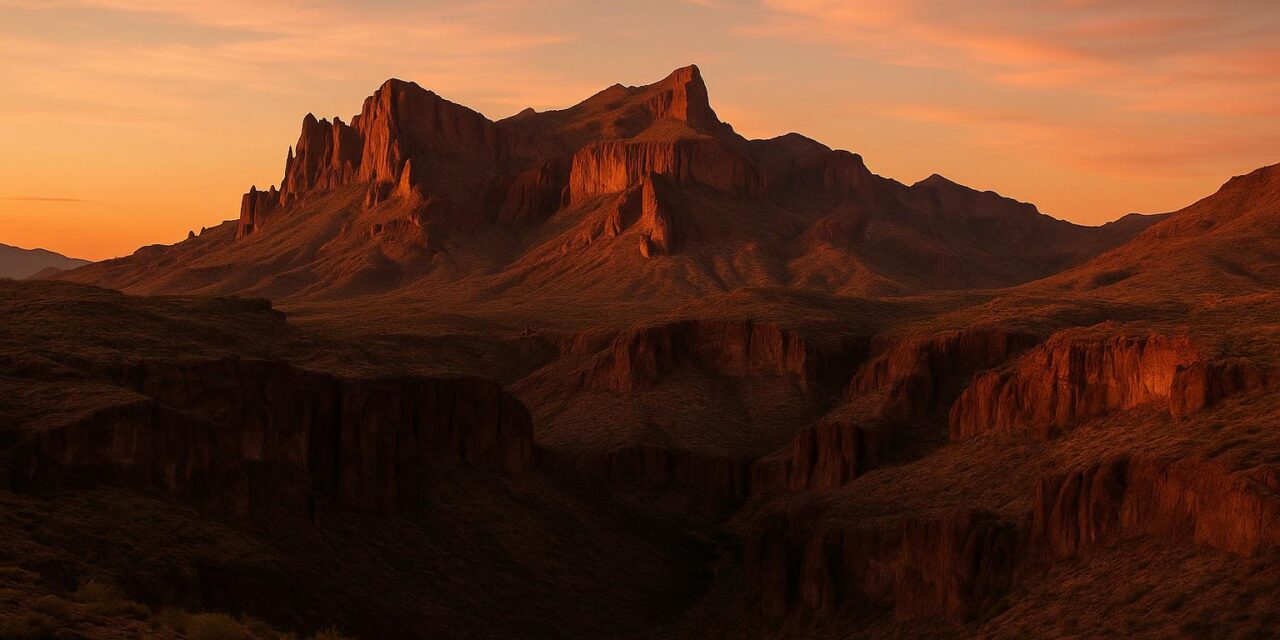
The mountains change color as the sun drops, sliding from tan to rust to a deep, bruised purple that swallows the ridgelines whole. It is easy, standing at the edge of this wilderness, to understand why men have walked into it convinced that somewhere among those folds of rock sits a vein of gold rich enough to change their lives, and why more than thirty of them, by one accounting, have walked in and never walked back out. The desert does not announce which canyon is which. It simply waits, the same way it has waited since long before anyone ever whispered the name Waltz.
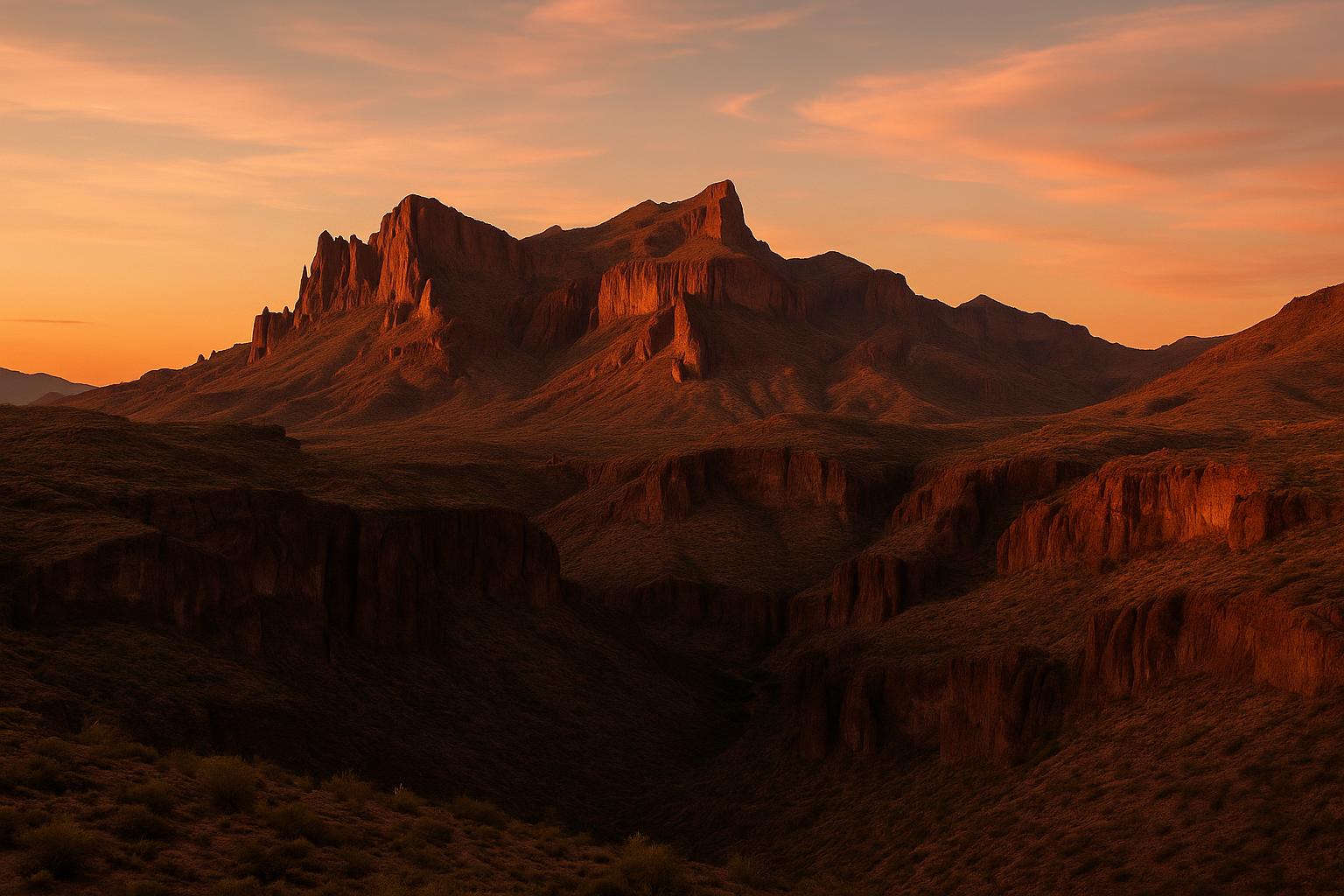
Superstition Mountains: The Lost Dutchman’s Gold Mine
The legend belongs to a stretch of rugged desert wilderness east of Phoenix, near Apache Junction, Arizona, an area now protected as the Superstition Wilderness within Tonto National Forest. The story attached to it centers on Jacob Waltz, a prospector whose name has become permanently fused with the promise of a hidden gold mine somewhere in these mountains. Since 1891, the tale of Waltz’s supposed mine has drawn a steady stream of searchers into the Superstitions, each one convinced that careful reading of old clues, or sheer persistence, would succeed where everyone before them had failed. More than a century later, the name Waltz still carries enough weight that mentioning the Superstition Mountains to anyone familiar with American treasure lore prompts an immediate, almost reflexive association with his lost mine.
What separates the Lost Dutchman legend from a simple treasure story is the mountains themselves. The Superstition Wilderness is not a gentle landscape. It is a jagged, dry, disorienting stretch of desert terrain, cut through with box canyons and false trails, the kind of place where a landmark that looks distinctive from one angle disappears entirely from another. That terrain has done as much to keep the legend alive as any cipher or map ever could, because it has made verification, or refutation, functionally impossible. No one has ever produced Waltz’s mine. No one has ever conclusively proven it never existed, either. Ridgelines that appear to line up perfectly from a highway pull-off dissolve into a maze of identical canyons once a searcher is actually standing among them, and the desert offers few forgiving cues to correct a wrong turn.
For the prospecting and treasure-hunting community, the Lost Dutchman occupies an almost mythic tier of its own, distinct from documented shipwrecks or dated historical finds. It is a story built as much on the mountains’ capacity to swallow searchers as it is on gold. That reputation is not exaggeration or marketing. It is the plain, documented cost of the search, and it is central to understanding why this particular legend is treated differently than most.
Much of what circulates about the Lost Dutchman today has been passed down informally, generation to generation of searchers trading partial clues and half-remembered landmarks, rather than preserved in a single authoritative account. That informal transmission has its own effect on the legend: details shift, landmarks get reinterpreted, and each new wave of searchers arrives convinced they have access to an insight the last wave lacked. The mine itself, if it exists, has never had to hold up under that scrutiny, because no one has ever actually located it to compare against the stories.

A Search That Has Claimed Lives
The human toll attached to the Lost Dutchman legend is the part of the story that separates it most sharply from other treasure tales in this genre. Since 1891, the hunt for Waltz’s mine has been connected to more than thirty deaths, a number that reflects not a single dramatic incident but a long, grinding accumulation of searchers who underestimated the Superstition Wilderness and did not walk back out of it. Some were lost to the terrain itself, disoriented in a landscape that offers few reliable landmarks and plenty of ways to become stranded. Others were undone by the desert’s more basic hazards: extreme heat, sudden cold, and long stretches without water or shelter. The Superstition Wilderness can swing from scorching daytime heat to sharp overnight cold within the same 24 hours, a combination that has proven fatal for searchers who prepared for one extreme and were caught by the other.
That toll has shaped how the legend is discussed today. It is not told, responsibly, as a straightforward adventure story with a happy ending waiting at the far side of persistence. It is a cautionary tale as much as a treasure story, one where the central lesson is not about a mine but about a wilderness that has proven, over more than a century, that it does not forgive carelessness. The thirty-plus lives lost searching for Waltz’s gold are not a footnote to the Lost Dutchman legend. They are arguably the most important fact anyone needs to understand about it.
The searchers who have gone missing or died pursuing this story span the full length of its history, from the earliest years after 1891 through more recent decades, evidence that the danger has never been isolated to a less-informed era. Improved gear, better maps, and modern navigation tools have not eliminated the risk, because the risk was never really about a lack of information. It has always been about a landscape that punishes overconfidence regardless of how well-equipped the person carrying it happens to be.
Whatever became of Jacob Waltz’s mine, if it ever existed as described, the search for it has left a documented trail of tragedy across the Superstition Wilderness that outweighs, by any reasonable measure, whatever gold might theoretically still be sitting in the rock.
Superstition Wilderness: A Protected Site
The Superstition Wilderness Area, part of Tonto National Forest, is not open ground for prospecting today. Under the Wilderness Act of 1964, the area was closed to new mineral entry effective January 12, 1984, a designation that overrides any general expectation of needing only landowner or permit-based permission. Inside the wilderness boundary, new prospecting and claim-staking are prohibited outright under United States Forest Service policy. This is a protected landscape, managed specifically to preserve its wild character, and that protection sits above and beyond whatever legend continues to draw attention to it.
This story is presented here as history, not as an invitation. The Superstition Wilderness carries real, well-documented physical dangers, from disorienting terrain to extreme heat and cold, that have already cost more than thirty lives in the pursuit of a mine that has never been verified to exist. Its legal status as protected wilderness closed to new mineral entry stands entirely apart from, and unaffected by, the enduring popularity of the Lost Dutchman legend. Visitors to the Superstition Wilderness today go for hiking and scenery within a protected national forest landscape, not for prospecting, and that distinction matters: enjoying the wilderness as wilderness is different from treating it as an open search area for a legendary mine.
The Legacy of the Lost Dutchman
The Lost Dutchman’s Gold Mine endures as one of the most recognized legends in American treasure-hunting lore, not because anyone has found the gold, but because the search for it has become a story in its own right, one written in more than thirty lost lives and a landscape that has earned its forbidding reputation the hard way. For anyone drawn to this hobby, the Superstition Wilderness is worth knowing as a cautionary chapter as much as a romantic one: a reminder that the terrain a legend is built on can matter more than the treasure it promises, and that some places are protected precisely because the risk they carry is real. The mine may or may not be out there. The mountains, and everything they have already taken, are not in question at all.
Story Source: www.truewestmagazine.com
Location: Superstition Wilderness Area, near Apache Junction, AZ
Site Status: Restricted or illegal to collect — informational/historical only
Legal Conditions: The Superstition Wilderness Area (Tonto National Forest) was closed to new mineral entry under the Wilderness Act of 1964, effective January 12, 1984, overriding the Tier 1 default of “permission required” with an outright prohibition on new prospecting or claim-staking inside the wilderness boundary (Verified confidence, per USDA Forest Service policy). This is a new Tier 3 finding added to the legal repository this session.
Hazards: Difficult terrain/remote access (disorienting box canyons and false trails in the Superstition Wilderness — landmarks visible from a distance can become unrecognizable once inside the canyon system); Extreme heat/cold/exposure (can swing from scorching daytime heat to sharp overnight cold within the same 24 hours). This combination has been linked to more than 30 searcher deaths since 1891, per the story’s own account.
Google Map
Firsthand Accounts
Julia Thomas, the woman who nursed a dying Jacob Waltz in 1891 and received his deathbed directions, sold her belongings to fund an 1892 expedition into the Superstitions with brothers Hermann and Rhinehart Petrasch.
Hermann Petrasch spent decades searching the range after the 1892 Thomas expedition, becoming, per local historical accounts, one of the mine’s most persistent lifelong seekers.
Historian Tom Kollenborn, co-author of “Superstition Mountain: A Ride Through Time” (1981) and writer of the long-running “Kollenborn Chronicles,” documented the legend and its searchers for decades until his death in 2018.
Adolph Ruth disappeared in the Superstitions in June 1931; his bullet-holed skull was recovered roughly six months later, and the case, still disputed by his family, drove national attention to the legend.
Prospector James A. Cravey flew into the Superstition canyons by helicopter in June 1947 searching for the mine; his camp was found but he was not, and his headless skeleton turned up the following February.


