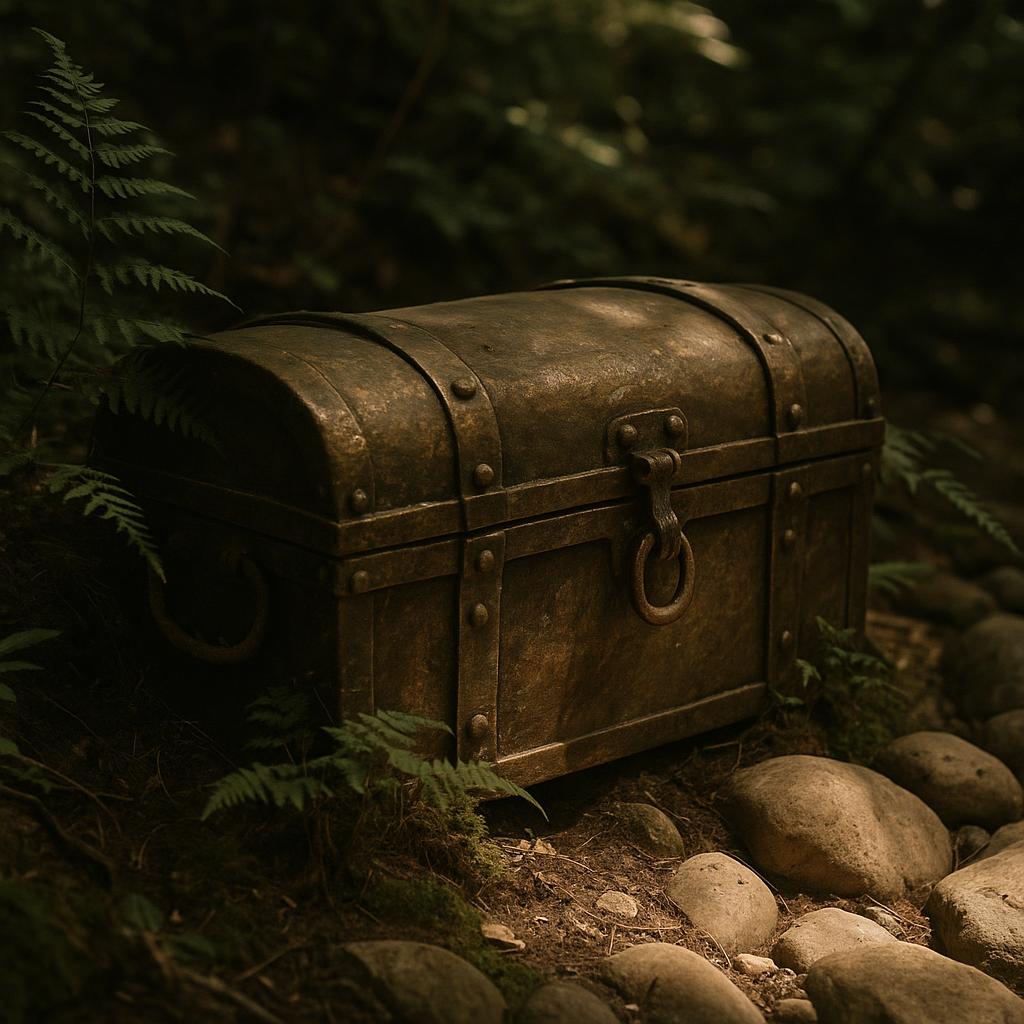
Ten years is a long time to keep a secret buried in the woods, and an even longer time to keep believing you might be the one to dig it up. For a decade, a bronze chest sat somewhere within the boundaries of America’s first national park, its exact location known only to the man who put it there, while thousands of searchers combed river bottoms, forest floors, and mountain passes trying to guess where. Some gave up after a season. Some never gave up at all.
Yellowstone: Forrest Fenn’s Hidden Treasure
The story begins with Forrest Fenn, who in 2010 hid a bronze chest somewhere within Yellowstone National Park, Wyoming, reportedly worth around two million dollars. Rather than simply announcing a location, Fenn built the search around clues meant to be worked out by anyone determined enough to try, turning an act of hiding into a decade-long public puzzle that drew searchers from across the country into Yellowstone’s backcountry. The exact site was chosen and concealed with enough care that a full decade of dedicated searching, across one of the most thoroughly mapped and heavily visited parks in the country, still wasn’t enough to locate it until 2020. Fenn himself never revealed the precise spot, and to this day it remains known only to the person who eventually found it.
What made the Fenn treasure unusual within the broader world of American treasure legends is how public and current it was. This was not a two-hundred-year-old rumor or a Gold Rush-era mine story handed down through generations. It was a live, ongoing hunt, playing out in real time across one of the most visited and most rugged landscapes in the country, with a known creator, a known approximate prize value, and an unknown but confirmed endpoint. Fenn himself remained a public figure throughout the hunt rather than a distant historical name, available to comment on the search as it unfolded, which gave the story an interactive quality that no nineteenth-century legend could ever replicate. Searchers were not just interpreting old, static evidence; they were participating in something that was still actively being shaped. That combination gave it an intensity that older legends rarely carry, because searchers were not chasing a maybe. They knew, with certainty, that the chest was really out there, sitting in real Yellowstone terrain, until someone actually found it.
That certainty changed the character of the search itself. Where older treasure legends invite skepticism as much as effort, since no one can be entirely sure the prize was ever real, the Fenn hunt operated on a foundation of confirmed fact: a known individual had stated, publicly, that he had hidden a real chest of real value inside the park. Searchers could disagree about where, and about how to interpret his published clues, but not about whether the object of the search actually existed.
A Decade-Long Hunt and Its Cost
The search for Fenn’s treasure ran from 2010 until 2020, a full decade during which searchers pored over Fenn’s clues and fanned out across Yellowstone and its surrounding wilderness trying to translate riddle into coordinates. The clues themselves were published for anyone to read and interpret, meaning the hunt required no special access, no insider knowledge, and no financial investment beyond the cost of getting to Yellowstone and searching, which is part of what made it accessible to such a wide range of participants over the years. In 2020, a medical student, publicly identified as Jack Stuef, succeeded where a decade of searchers had not, locating and recovering the chest from within the park. His discovery closed out one of the longest-running treasure hunts in recent American history, ending a search that had drawn in retirees, students, and lifelong outdoorsmen alike, all working from the same published clues.
But the decade-long search did not end without real cost. Over the course of the hunt, five searchers lost their lives pursuing Fenn’s treasure, a toll that reflects the genuine danger of Yellowstone’s backcountry rather than any flaw unique to this particular puzzle. The park’s terrain is remote and difficult, its weather capable of swinging to extremes of heat and cold, and its rivers and thermal areas carry real drowning and strong-current hazards for anyone moving off established trails in pursuit of a clue. Those five deaths turned what began as a playful literary puzzle into a story that also had to be told, responsibly, as a cautionary one. Those risks were not abstract or occasional; they were the same risks any visitor to Yellowstone’s backcountry faces, magnified by searchers who were often moving off established trails, in unfamiliar terrain, chasing a riddle rather than following a marked path.
When the chest was finally located in 2020, it was not quietly kept or privately sold. It was surrendered to Yellowstone park authorities and verified by rangers, formally closing the hunt through the park’s own oversight rather than through any private salvage arrangement. That detail matters: the recovery happened within, and was validated by, the very federal system that governs what can and cannot be removed from Yellowstone in the first place.
That verification step also settled, definitively, a question that had shadowed the hunt for years: whether the treasure was real at all. Fenn had always maintained that it was, but a decade without a confirmed find had left room for doubt among some searchers and observers. The ranger-verified 2020 recovery closed that question along with the hunt itself. For a story that had run for ten years on faith as much as fact, that final, official confirmation was, in its own way, as significant as the discovery itself.
Yellowstone: A Protected Site
Yellowstone National Park is federally protected land, and under 36 CFR 2.1, digging, metal detecting, and removing objects without authorization are prohibited across the park. That framework governed the treasure hunt from the start and continues to govern the park today, regardless of the Fenn story’s fame. The same regulations apply uniformly across the park’s geysers, rivers, forests, and backcountry, regardless of whether a visitor is chasing a well-known legend or simply exploring. The confirmed 2020 find site lies within Yellowstone’s boundaries, and the chest’s recovery, surrendered to and verified by park rangers, took place under that same protective framework rather than through any collecting permit or salvage claim.
This story is told here as history, not as an invitation. The hunt itself is over, the chest has been found, and Yellowstone remains what it has always been: a national park where unauthorized digging or removal of objects is not permitted, whatever legends continue to draw visitors to its trails and backcountry. Visitors to Yellowstone today experience the park through its designated trails, overlooks, and ranger-led programs, the same way any national park visitor does, rather than through any ongoing search, since the object that once justified one no longer exists to be searched for.
The Legacy of the Fenn Treasure
The Forrest Fenn treasure hunt stands as one of the defining modern additions to American treasure-hunting lore, not because it revived an old legend, but because it created an entirely new one in real time, with a known hider, a known prize, and a documented, verified ending. For the prospecting and treasure-hunting community, it is worth remembering both for what it accomplished, a decade of public engagement with a single, solvable puzzle, and for what it cost: five lives lost in pursuit of it. That combination, wonder and consequence in equal measure, is precisely what makes the Fenn story worth understanding rather than simply romanticizing. It is also a useful modern counterpoint to older, murkier legends: proof that even a treasure hunt built on solid, verifiable fact rather than rumor still carries real risk, and that the existence of a prize is never, by itself, a reason to treat the search for it lightly.
Story Source: www.outsideonline.com
Location: Yellowstone National Park, WY (exact site kept private by finder)
Site Status: Restricted or illegal to collect — informational/historical only
Legal Conditions: Per the Tier 1 U.S. federal default, National Park Service land is essentially closed to unauthorized digging, metal detecting, or removal of objects (36 CFR 2.1), and the confirmed 2020 find site lies within Yellowstone National Park (Verified confidence). The chest was surrendered to and verified by Yellowstone rangers rather than recovered under any salvage or collecting permit, so this story is historical/informational only.
Hazards: Difficult terrain/remote access (Yellowstone backcountry, frequently searched off marked trails); Extreme heat/cold/exposure (typical Yellowstone backcountry weather swings); Drowning/strong current (rivers and thermal areas carry real risk for searchers moving off-trail). This combination was tied to five searcher deaths during the decade-long hunt, per the story’s own account.
Google Map
Firsthand Accounts
Jack Stuef, a Michigan medical student, told Outside magazine he spent 25 search days over two years before locating the chest at Yellowstone’s “Nine Mile Hole” fishing spot on June 6, 2020.
Forrest Fenn described hiding the chest and the reasoning behind his 24-line poem in his 2010 memoir “The Thrill of the Chase.”
CBS News’ “48 Hours” documented the hunt’s fatalities in “One Chest of Gold, Five Deaths,” covering searchers Randy Bilyeu, Jeff Murphy, Eric Ashby, Paris Wallace, and Mike Sexson.
New Mexico State Police Chief Pete Kassetas publicly urged Fenn to call off the hunt in 2017 after three deaths within weeks, saying “he’s putting lives at risk,” per ABC News.
MeatEater’s investigative reporting later identified the find site as Yellowstone’s Nine Mile Hole, based on park records and statements from Fenn and Stuef, though the Park Service has withheld official confirmation of exact coordinates.