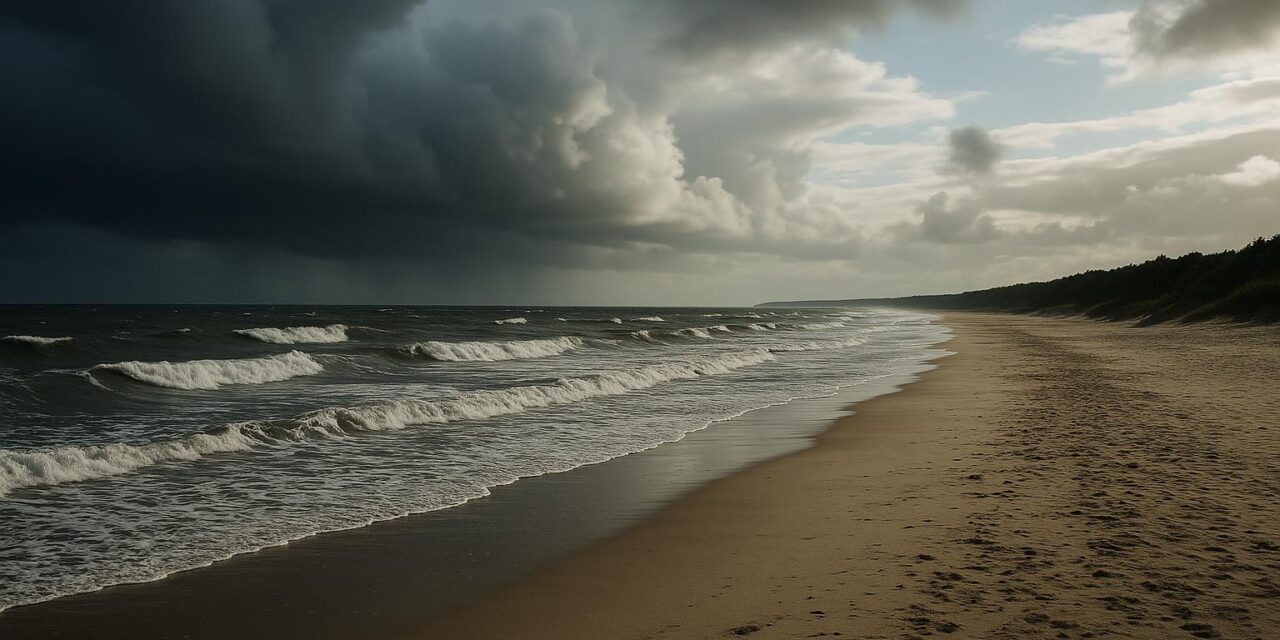
A wave pulls back across the sand and leaves behind a scattering of dark, glossy fragments that catch the low morning light differently than everything else on the beach. Most people would walk past them without a second look. Someone who knows what they’re looking for stops, crouches, and picks one up, turning it over to check whether the light passes through it the way only one material on this beach actually does.

Poland’s Baltic Coast: The Amber Shore
The beaches near Gdansk, along Poland’s stretch of the Baltic Sea, have long been known for something the sea itself delivers for free: amber, fossilized tree resin that storms regularly wash up onto the sand. This isn’t a rare, occasional occurrence limited to a handful of lucky finds. It’s a recurring, predictable pattern tied directly to the region’s geology and weather, one that has made this coastline a genuine destination for anyone interested in hunting for a real, valuable material without needing to dig, mine, or excavate anything.
What makes Baltic amber significant isn’t just its beauty but the sheer scale of deposits sitting beneath the Baltic Sea itself, close enough to shore that storms can dislodge and carry pieces onto the beach in meaningful quantities. After a serious storm churns up the seabed, hunters know to head for the coast, because the same wave action that makes the sea rough enough to be worth watching from a distance is also the mechanism that delivers amber onto the sand for anyone willing to look. That relationship between storm activity and amber availability is central to how this hobby actually works here, and it’s part of what separates Baltic amber hunting from other forms of treasure hunting that depend on luck alone. It also means the hobby has a rhythm to it that’s genuinely different from most forms of prospecting. A gold panner or a metal detectorist has to search steadily, working a stretch of ground or streambed on the assumption that whatever is there has been there all along, waiting to be found through patience and technique. Amber hunting on the Baltic coast works differently: the material isn’t waiting in a fixed location so much as being actively redistributed by the sea itself, meaning the best days to search aren’t random, they’re the days right after the weather has done the work of bringing material within reach. Understanding that rhythm, checking conditions and timing a visit for the days following a storm rather than showing up on an arbitrary afternoon, is arguably the single most important piece of practical knowledge for anyone serious about this particular hunt.

Hunting the Shoreline After a Storm
The method itself is refreshingly simple compared to most treasure-hunting pursuits. Hunters comb the beaches by hand, scanning the wet sand and the debris line left behind by receding waves, sometimes using a UV torch to help pieces of amber stand out from ordinary stone and shell debris in low light. There’s no specialized industrial equipment involved in this version of the hobby, no pumps, no sieves, no heavy machinery, just patience, timing, and knowing what to look for after the right kind of weather.
That simplicity is also what makes the legal picture here unusually favorable compared to many other prospecting pursuits. Hand-collecting amber that has washed up on public beaches is legal for personal use in Poland, with no permit required and no specialized equipment needed. That stands in real contrast to digging into dunes, forests, or national parks nearby, which is illegal regardless of what someone believes they might find there, and to any larger-scale or commercial extraction from underground deposits, which falls under Poland’s Geological and Mining Law of 2011 and requires a formal concession. The distinction is straightforward: what the sea delivers onto public sand is fair game to pick up by hand, but going after amber still in the ground, whether in a dune or a forest, is not. That line, between what the sea has already delivered and what remains buried on land, is worth understanding clearly rather than assuming the whole coastline operates under one uniform rule. A piece of amber sitting loose on wet sand after a storm is treated entirely differently under Polish law than the same material would be if it were still embedded in a dune just a short walk further up the beach. The dune, the forest, and any protected national park land nearby all fall outside the personal, no-permit collecting rule that applies to the open beach itself, and treating them as equivalent would be a real mistake for anyone hoping to stay on the right side of the law.
Accessing Poland’s Amber Coast Today
For anyone planning to hunt amber along this coastline, the practical picture is genuinely encouraging. Walking the beaches near Gdansk after a storm and hand-collecting whatever amber has washed up requires no permit and no specialized gear, just a willingness to search carefully and, ideally, a UV torch to help spot pieces that might otherwise blend into the sand and debris. The one caveat worth taking seriously is what happens if a hunter finds something unusually large or valuable: pieces of that kind may need to be declared, since Poland’s legal framework distinguishes between ordinary personal beachcombing finds and specimens significant enough to draw regulatory attention. That declaration requirement isn’t designed to discourage casual hunters, and it shouldn’t be read that way. It exists specifically because Poland’s Geological and Mining Law draws a distinction between small personal finds, which the law treats as freely collectible, and genuinely significant specimens, which carry enough potential value or scientific interest to warrant a different level of oversight. For the overwhelming majority of hunters picking through a storm-line on a Tuesday morning, that distinction will simply never come up. It only becomes relevant for the rare hunter who turns up something well beyond the ordinary.
Hunters should also be realistic about the physical conditions involved. Searching a storm-affected coastline means contending with strong currents and genuinely rough water in the immediate aftermath of bad weather, along with the general exposure that comes with extended time on an exposed beach. None of that changes the fundamental appeal of the activity, but it’s worth planning around rather than ignoring. The very conditions that make amber available, a recent storm having churned up the seabed, are the same conditions that make the water itself more dangerous than usual. Strong currents and rough surf don’t disappear the moment the storm passes, and anyone tempted to wade in for a closer look at material still visible in the surf line should recognize that the safest, most productive amber hunting happens above the waterline, working the wet sand and debris the sea has already delivered rather than chasing material still in the water.
The Legacy of Baltic Amber
Baltic amber hunting stands out within the broader prospecting and treasure-hunting world precisely because of how accessible it remains. There’s no permit standing between a visitor and a legitimate, valuable find, no equipment barrier keeping the hobby out of reach, and no legal gray area clouding the basic activity of picking amber up off a public beach. For anyone serious about this hobby, Poland’s Baltic coast represents one of the rare places where the law, the geology, and the accessibility of the search all line up in the hunter’s favor, provided the hunt stays on the sand and out of the protected dunes and forests where the same freedom simply doesn’t apply. That combination of open legal access and genuine, storm-driven abundance is rare enough in this hobby that it’s worth appreciating on its own terms. Most of the sites worth knowing about in prospecting and treasure hunting involve some kind of trade-off, a permit process, a restricted zone, a hazard that limits how freely someone can search. Poland’s amber coast asks comparatively little in return for a real chance at a real find, which is exactly why it has earned its place as one of the more approachable entry points into this hobby for anyone willing to check the weather, watch the tide line, and show up ready to look closely at what the sea leaves behind.
Story Source: culture.pl
Location: Baltic Sea beaches near Gdansk, Poland
Site Status: Open to public collecting
Legal Conditions: This is a new Tier 1 finding for Poland: hand-collecting amber washed up on public beaches is legal for personal use, with no permit and no specialized equipment (pumps, industrial sieves) required (Reported confidence). Digging into dunes, forests, or national parks is illegal, and Poland’s Geological and Mining Law (2011) requires a concession for any larger-scale/commercial extraction from underground deposits; unusually large or valuable stones may need to be declared.
Hazards: Drowning/strong current; Extreme heat/cold/exposure
Google Map
Firsthand Accounts
Amber hunter Lucjan, 25, told Luxury Tribune he works mainly in the fall, rushing to the beach with a net right after storms to retrieve stones washed ashore, which he sells to regional workshops and a luxury-brand supplier.
In 1466, following the Thirteen Years’ War, Polish King Kazimierz Jagiellonczyk granted Gdansk the right to harvest amber along the Hel Peninsula and gave the city a trade monopoly, launching what historians call the region’s “Golden Age of Amber.”
The First News reported crowds of treasure hunters wading knee-deep in the surf near Gdansk after a storm, citing Polish Geological Institute estimates that roughly 5.5 tons of amber are found on beaches annually, versus only about 1 ton mined from underground deposits.
Local amber craftsman Tomasz Oldziejewski told The First News that canal-dredging work near Katy Rybackie in May 2021 dislodged loaf-of-bread-sized amber pieces, drawing treasure hunters from as far as Bielsko-Biala and Krakow with UV lights and dredging nets.