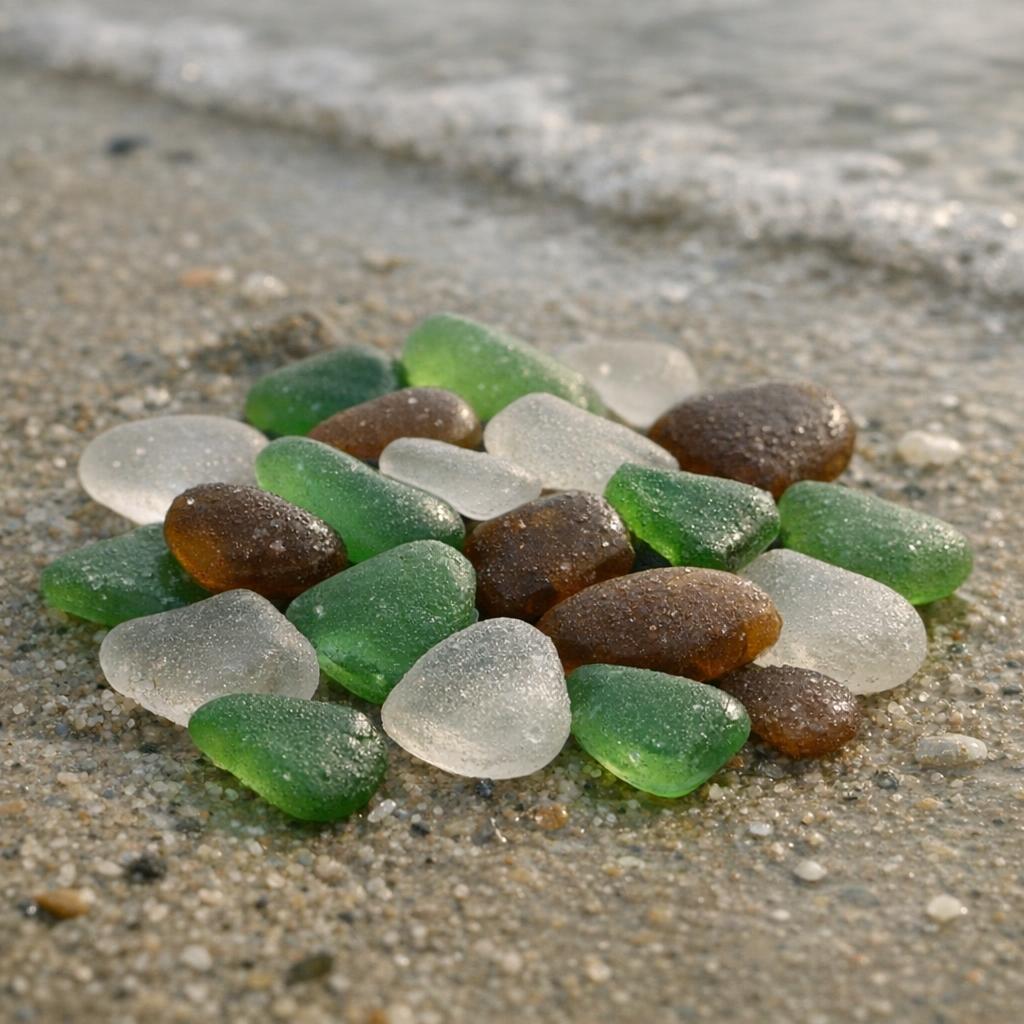
Sunlight hits the sand and something answers back, a scatter of green, brown, and white catching the light like scattered gemstones instead of what it actually is: broken glass, tumbled smooth by decades of surf until every sharp edge has disappeared. Reach down and pick up a piece, and it feels less like trash and more like a small, weathered jewel that took the ocean itself to make.
Fort Bragg’s Glass Beach: California’s Sea Glass Shore
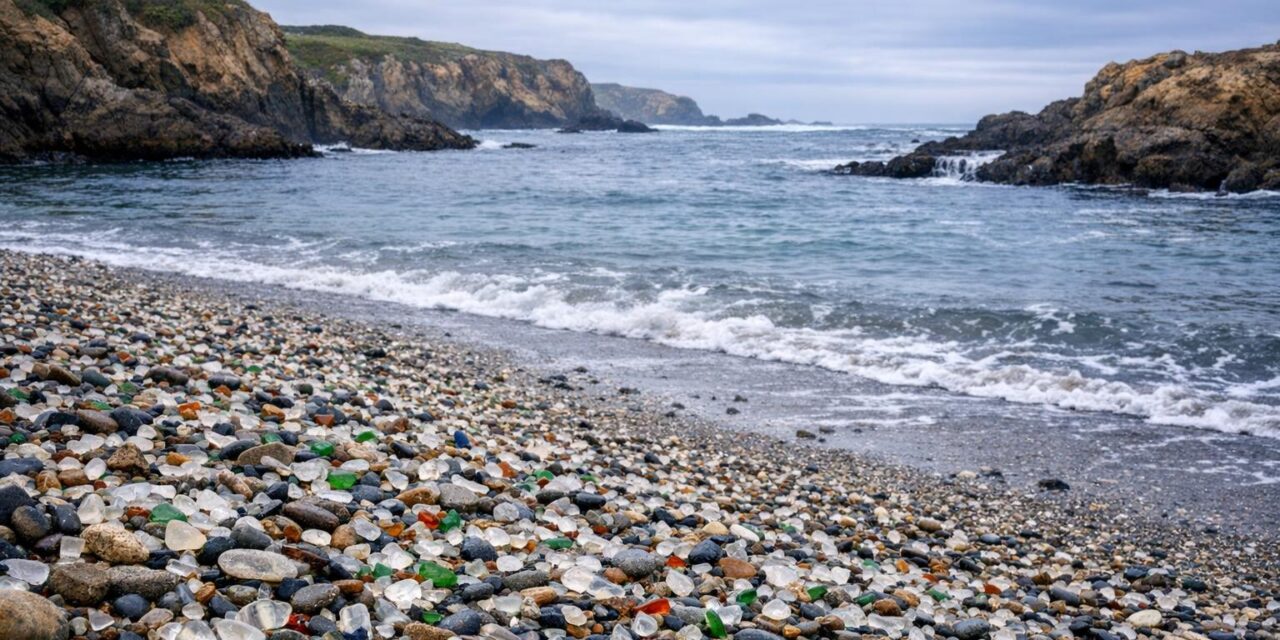
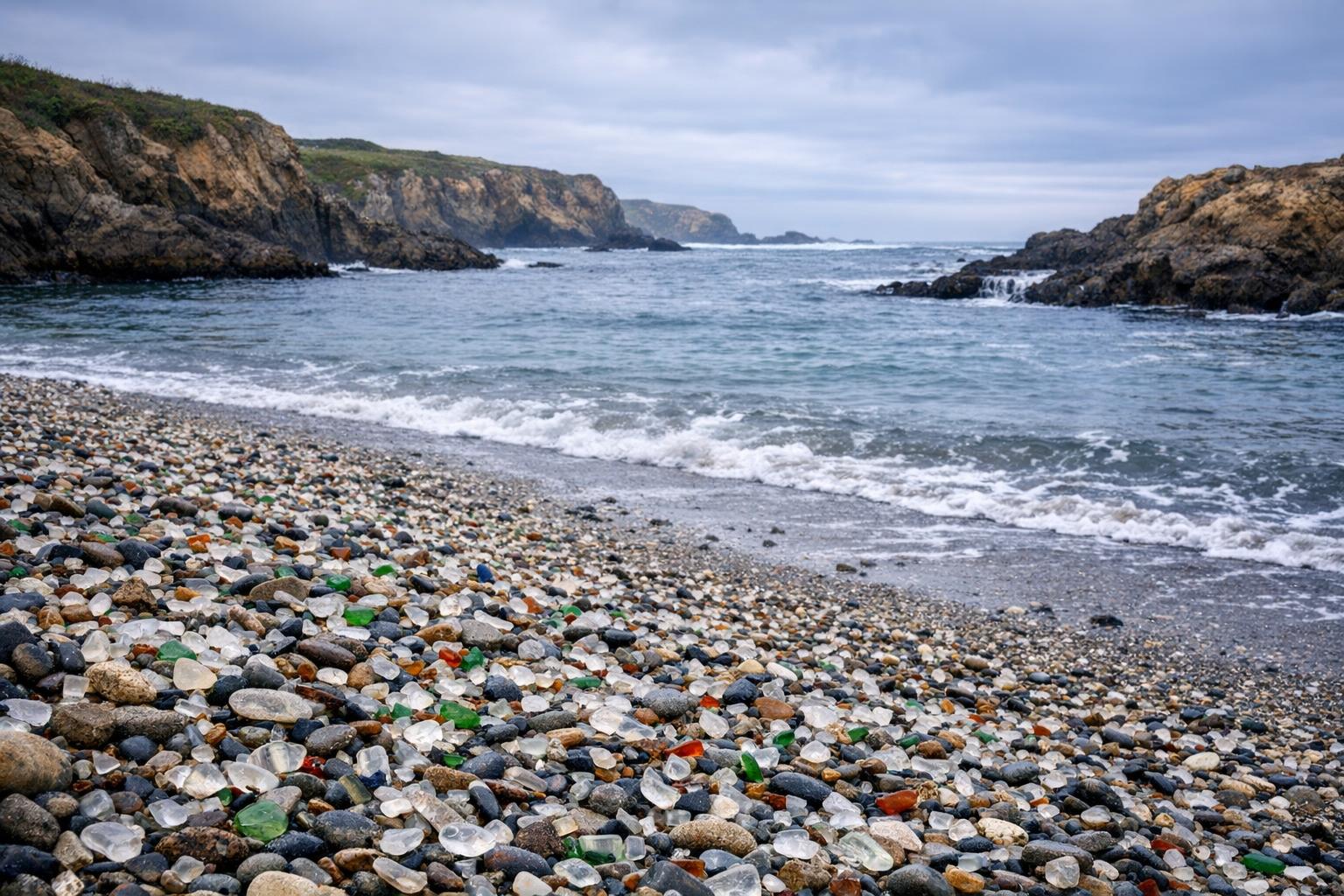
Fort Bragg’s Glass Beach sits along the Mendocino coast in Northern California, its sand studded with sea glass in a density rarely seen anywhere else in the country. What makes the beach so unusual isn’t a natural process at all, at least not at the source. Between 1906 and 1967, this stretch of coastline served as a dump site, and the glass, along with everything else discarded there over those six decades, was left to the ocean. What the sea did afterward is the real transformation: decades of relentless wave action ground down broken bottles, jars, and other glass debris into the smooth, rounded, frosted fragments that now cover the beach in place of sand.
That history, an industrial dump slowly reworked by the ocean into something that looks almost like a jeweler’s display case, is what makes Glass Beach unlike any other beachcombing destination in California. It’s a place where decades of what would otherwise be considered pollution have been transformed by nothing more than time and tide into a genuinely beautiful, if entirely artificial, natural feature. The area was formally absorbed into MacKerricher State Park in 2002, folding what had once been an informal dumping ground into the same state park system that manages protected coastline up and down California. There’s a real irony sitting at the center of Glass Beach’s appeal, one worth sitting with rather than rushing past. Almost every other beachcombing destination worth visiting owes its appeal to something the earth or the sea produced entirely on its own, a fossil, a mineral deposit, a shipwreck’s cargo scattered by a storm. Glass Beach is different. Its main attraction exists only because people spent six decades treating this stretch of coastline as a place to throw things away, and it took the ocean’s own indifferent, mechanical persistence, wave after wave for year after year, to turn that discarded material into something people now travel specifically to see. Nothing about the transformation was intentional. No one set out to create a tourist attraction here. The beauty is a byproduct of exactly the kind of environmental disregard that would be treated as an obvious problem anywhere else, which makes the eventual outcome almost accidental in a way that few other natural attractions can claim.
From Dump Site to Protected Shore
The defining shift in Glass Beach’s story isn’t a single discovery so much as its formal incorporation into MacKerricher State Park in 2002. Before that point, the beach existed in a kind of legal limbo, a former dump site that had, through decades of natural process, become an object of genuine fascination and a popular stop for beachcombers drawn to its unusual sea glass. Once it became part of the state park system, that informal status changed. The same protections that apply to any historical or archaeological material inside a California state park, protections already well established at other sites like Bodie, extended to Glass Beach’s sea glass as well.
Under California Code of Regulations Title 14, along with Penal Code provisions covering objects of archaeological and historical interest, removing material from inside the park is a misdemeanor, carrying a penalty of up to ninety days in jail and a fine of up to one thousand dollars. That legal reality sits at odds with the beach’s popular reputation as a place to collect sea glass, a reputation that predates the 2002 park designation and has proven difficult to shift in the public imagination even after the legal status changed.
That gap between reputation and enforcement is itself part of the story. A park district superintendent has acknowledged that removing sea glass from the protected beach “could” result in a citation, language that reflects real legal authority without describing routine, active enforcement. Meanwhile, the owner of the local Sea Glass Museum, situated near the beach, has disputed that any meaningful enforcement actually happens in practice. That tension, real legal protection sitting alongside inconsistent enforcement, has left many visitors genuinely uncertain about where the line actually falls, which is precisely why the site’s legal status is worth understanding clearly rather than assuming based on the beach’s collecting-friendly reputation. It’s worth being precise about what that tension does and doesn’t mean. Inconsistent enforcement is not the same thing as no law existing at all, and a visitor who takes a handful of sea glass home from the protected beach and never hears from a ranger has not thereby proven the rule doesn’t apply to them. The law’s existence doesn’t depend on how often it’s actively enforced on any given afternoon, and treating spotty enforcement as evidence of legality would be a real misreading of how state park regulations generally work. The honest picture is one of a real rule, genuinely on the books, that happens to be difficult to enforce along a long, open, popular stretch of public beach, not a rule that has quietly stopped existing because enforcement is inconsistent.
Fort Bragg’s Glass Beach: A Protected Site
Glass Beach’s status as part of MacKerricher State Park means the same rule that protects Bodie’s scattered bottles and artifacts applies here to sea glass: removing material from the beach is a misdemeanor under California law, regardless of how informal the site’s origins as a dump once were or how inconsistently that rule gets enforced in practice. The material sitting on the sand today, however strange its origins, is now treated as protected park content, not abandoned trash free for the taking.
Worth noting for context: two other beaches locally also called “Glass Beach” sit just south of the park boundary, outside MacKerricher’s protected footprint, and collecting from those unprotected sites remains legal. That distinction, protected inside the park boundary, open just beyond it, is a genuinely important piece of the area’s legal geography, one that separates this specific, famous stretch of sand from the broader stretch of Mendocino coastline carrying the same name. Visitors should also be aware of the physical realities here: the terrain along this stretch of coast is difficult and remote in places, and strong currents and the risk of drowning are real concerns along the shoreline. That boundary line, invisible on the sand itself but very real in terms of which rules apply, is exactly the kind of detail that separates a casual assumption about this stretch of coast from an accurate understanding of it. The name “Glass Beach” alone doesn’t tell a visitor which legal regime applies to any given stretch of sand; only knowing exactly where the state park boundary falls does that.
The Legacy of Glass Beach
Glass Beach endures as a strange, singular case study in how quickly the human definition of waste can invert itself, an industrial dump that the ocean spent six decades quietly transforming into one of the most photographed beaches in California. For anyone serious about beachcombing, Glass Beach is worth understanding not as a place to fill a pocket with sea glass, but as a place to appreciate what happens when an accident of history and decades of tidal patience combine to produce something genuinely beautiful out of what was once simply garbage. Its real value to this hobby lies in the story itself, proof that even a landfill, given enough time and enough ocean, can become something worth protecting rather than discarding twice over. That’s a genuinely unusual lesson for a hobby built mostly around finding things nature made deliberately valuable long before any human ever arrived to look for them. Glass Beach flips that premise entirely, and understanding why it’s protected today, rather than simply mourning that it’s no longer legal to collect there, is the more interesting way to engage with what this place actually represents.
Story Source: www.parks.ca.gov
Location: Glass Beach, near MacKerricher State Park, Fort Bragg, CA 95437
Site Status: Restricted or illegal to collect — informational/historical only
Legal Conditions: This falls under the same Tier 2 California state-park rule already documented for Bodie: California Code of Regulations Title 14 and Penal Code provisions on objects of archaeological/historical interest bar removing anything (misdemeanor, up to 90 days/$1,000 fine), and Glass Beach became part of MacKerricher State Park in 2002 (Verified confidence). Enforcement is inconsistent — a district superintendent said it “could” result in a citation while the local Sea Glass Museum’s owner disputes any real enforcement — but the two other, unprotected “Glass Beach” sites just south of the park boundary remain legal to collect from.
Hazards: Difficult terrain/remote access; Drowning/strong current
Google Map
Firsthand Accounts
Captain Cass Forrington, a retired merchant mariner who founded Fort Bragg’s International Sea Glass Museum in 2009, publicly disputes that collecting is illegal, saying “there is no ticketing going on” and calling the prohibition claims put out by the city false.
Richard LaMotte, co-founder of the North American Sea Glass Association and author of “Pure Sea Glass,” has documented Glass Beach’s rise as one of the world’s best-known sea-glass destinations.
The Sonoma-Mendocino Coast District superintendent of California State Parks told a reporter that removing sea glass “would not necessarily result in a citation, but it could,” reflecting the park system’s official but loosely enforced stance.
The City of Fort Bragg erected an on-site historical marker, “Our Past Through Our Trash,” directly pleading with visitors: “please don’t take our sea glass away,” noting the glass remaining today is a fraction of what covered the beach in the early 1980s.