
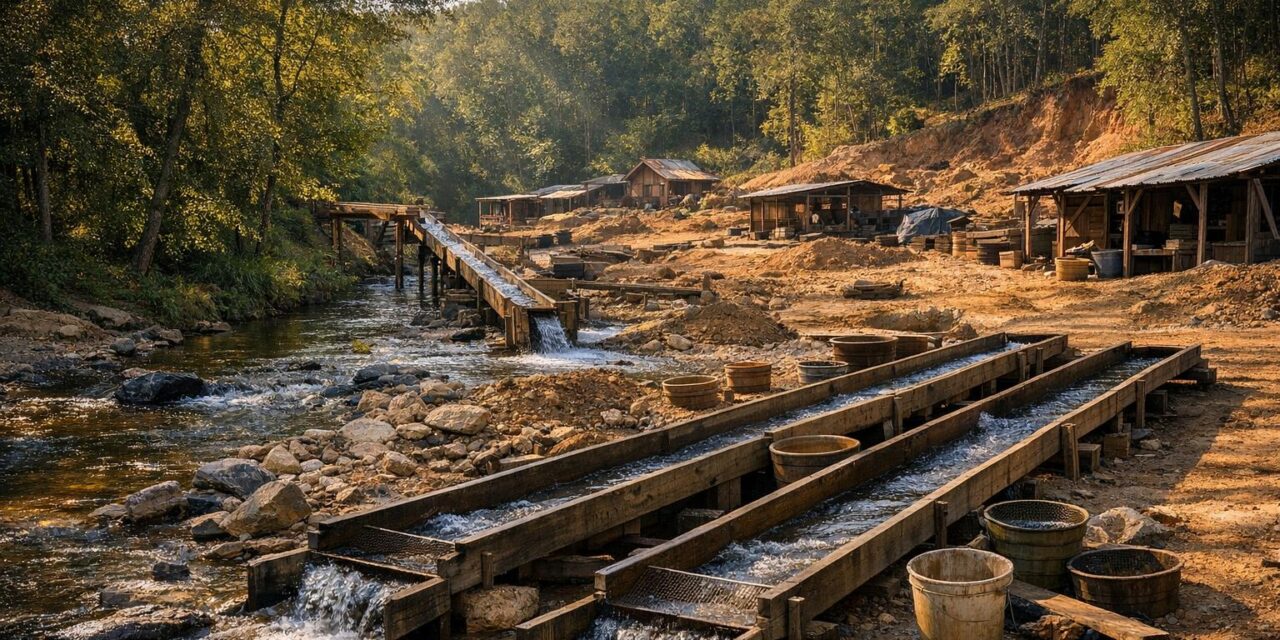
Cold creek water runs over a screen tray, and for a second nothing looks like anything but wet gravel. Then a flash of green catches the light, small, sharp-edged, unmistakably different from every gray pebble around it. A hand reaches in before the thought even finishes forming: that’s not just a rock.

Emerald Hollow Mine: Hiddenite, North Carolina’s Gem Ground
Emerald Hollow Mine sits in Hiddenite, North Carolina, on ground with a genuinely rare distinction: it’s the only publicly accessible emerald mine in North America. That alone would make it a notable stop for anyone serious about gem hunting, but the site’s significance runs deeper than access alone. This is the historic ground where hiddenite, a green variety of spodumene found almost nowhere else on earth, was first identified in 1879, and the mineral takes its name directly from the town that grew up around it. Few places in the gem-hunting world can claim to be the literal namesake location of the mineral they’re known for, and Emerald Hollow Mine sits on exactly that ground. That naming connection isn’t incidental trivia, either. It means anyone digging here today is searching the same ground, geologically speaking, that produced the type specimen defining an entire mineral variety, a link between a modern pay-to-dig outing and a genuine, documented moment in mineralogical history.
What makes the site function today isn’t a natural, uncontrolled deposit open to anyone willing to dig without oversight, but a deliberately structured commercial operation built specifically around public access. Emerald Hollow Mine operates as a pay-to-dig business on private land, charging a per-person admission fee in exchange for the right to search the property’s mineral-bearing ground and creek gravel. That commercial structure is precisely what makes consistent, legal, no-permit access possible here, in sharp contrast to sites where gem-bearing ground sits on private land with no public access at all, or on protected land where removing anything is against the law. That distinction matters more than it might first appear. Plenty of significant gem and mineral deposits across the country sit entirely out of reach of ordinary hobbyists, either locked up on private land with no public access whatsoever, or protected specifically because removing material would damage a historically or scientifically significant site. Emerald Hollow Mine sidesteps both problems by turning access itself into the product being sold. The landowner profits from admission fees rather than from selling the gems directly, which means the incentive structure lines up cleanly with letting visitors keep everything they find, since the value to the business comes from the experience of digging, not from the minerals extracted.

The Only Public Emerald Mine in North America
The core appeal of Emerald Hollow Mine is straightforward and unusual: visitors dig, and whatever they find is theirs to keep, in full, with no value cap and no landowner claim on rare or valuable specimens. That policy applies across the board, whether a visitor turns up an ordinary quartz fragment or an emerald or hiddenite crystal worth genuine money. There’s no separate negotiation, no additional fee for a significant find, and no requirement to hand over anything unusually valuable. The admission fee is the entire transaction. That no-cap policy is worth dwelling on, because it’s genuinely unusual within the broader pay-to-dig and gem-hunting world. Plenty of comparable operations elsewhere reserve the right to buy back or claim a share of an unusually valuable find, or cap what an ordinary admission ticket entitles a visitor to keep. Emerald Hollow Mine draws no such line. A visitor who happens to pull an exceptional, high-value emerald out of the creek gravel keeps it exactly the same way they’d keep an unremarkable piece of quartz, a policy that treats every visitor’s potential find with the same straightforward ownership rule regardless of luck.
The mine also offers multiple ways to search, reflecting different levels of effort and different budgets. Creek sluicing lets visitors pan through the property’s natural waterways by hand, a low-cost, low-equipment approach well suited to a family outing or a first-time visitor. Flume mining offers a more structured, water-assisted sluicing setup designed to make sorting through gravel faster and easier. For visitors willing to pay for a more intensive search, heavy-equipment dirt bucket options bring larger volumes of unsearched ground within reach, dramatically increasing the amount of material a visitor can sift through in a single visit. That range of options, from a simple creek pan to genuine heavy machinery, means Emerald Hollow Mine accommodates both a casual afternoon visitor and someone treating the trip as a serious hunting expedition. That tiered structure also means the site scales naturally to how seriously any given visitor wants to take the hunt. A family with young children can spend an easy afternoon at the creek with basic sluicing equipment and still walk away with real finds, while someone specifically chasing a significant emerald or hiddenite specimen can pay for heavy-equipment access and search through a genuinely large volume of fresh ground in a single visit. Few pay-to-dig operations offer that same range, from casual to serious, all on the same property and under the same simple keep-what-you-find rule.
The gems themselves reflect the genuine geological richness of this ground. Beyond emeralds and hiddenite, the site produces sapphire and a range of other gem material, a diversity that reflects real mineralogical variety in the underlying rock rather than a single, narrow vein of one specific stone. That variety is part of what makes the site rewarding even for visitors who don’t turn up the site’s namesake gems on a given visit, since the ground genuinely holds more than one kind of find worth keeping.
Visiting Emerald Hollow Mine Today
Emerald Hollow Mine is open to the public by design, a commercial operation built specifically around visitors coming to dig and keep what they find. No permit beyond paying the standard admission fee is required, and no special legal status complicates a visit the way it would at a protected historical site or restricted public land. A visitor simply pays, picks a digging method suited to their budget and ambition, and starts searching.
That said, visitors should come prepared for real outdoor conditions. Digging happens outside, in creek water and open flume areas, and North Carolina summers bring genuine heat that makes a long day of digging more demanding than it might first appear. Sensible preparation, water, sun protection, and reasonable expectations about the physical effort involved, goes a long way toward making a visit here enjoyable rather than simply exhausting. None of that changes the fundamental appeal of the site, but it’s a genuinely physical activity, standing in or near creek water, sifting gravel by hand or with equipment, for hours at a stretch, and treating it as a leisurely stroll rather than real outdoor work is the most common way a first-time visitor ends up disappointed by the experience rather than energized by it.
The Legacy of Emerald Hollow Mine
Emerald Hollow Mine holds a genuinely unique place in American gem hunting: the only site in the entire country where the public can legally dig for real emeralds and keep whatever they find, sitting on the exact ground where hiddenite itself was first identified and named in 1879. For anyone serious about this hobby, that combination, rare access plus rare mineralogical history, makes the site worth understanding as more than just another pay-to-dig operation. It’s one of the few places in North America where a visitor with no special expertise, no permit application, and no prior connection to the land can walk away with a genuine, valuable gemstone earned entirely through their own effort at the screen tray. That’s a rare combination in this hobby, genuine mineralogical significance paired with completely unrestricted public access, and it’s precisely what makes Emerald Hollow Mine worth the trip regardless of whether a particular visit turns up an emerald, a piece of hiddenite, or simply an afternoon spent doing something few other places in the country actually allow.
Story Source: www.emeraldhollowmine.com
Location: Emerald Hollow Mine, 484 Emerald Hollow Mine Dr, Hiddenite, NC 28636
Site Status: Open to public collecting
Legal Conditions: Matches the Tier 1 U.S. federal default for Pay-to-Dig Gem Mines: open to the public by design, since this is a commercial operation on private land selling the right to dig. Emerald Hollow Mine charges a per-person admission fee (multiple digging options, from creek sluicing to flume mining to heavy-equipment dirt buckets) and visitors keep 100% of what they find, including emeralds, hiddenite, sapphire, and other gems — no value cap or landowner claim on rare finds. No permit beyond paying admission is required. This is the only publicly accessible emerald mine in North America, sitting on the historic ground where hiddenite was first identified in 1879.
Hazards: Extreme heat/cold/exposure (outdoor creek and flume digging in summer NC heat)
Google Map
Firsthand Accounts
In 1879, mineralogist William Earl Hidden came to the Hiddenite/Stony Point area on a tip from Thomas Edison, who was hunting for platinum to use as lamp filament wire. Hidden never found platinum, but locals showed him unusual green crystals turning up in the Adams farm dirt, which he sent off to specialists for identification, setting off the chain of discovery that put the area on the gem-collecting map.
Chemist and mineralogist J. Lawrence Smith examined the green crystals Hidden had collected and determined they were a distinct new mineral species, a lithium-rich variety of spodumene now called hiddenite in Hidden’s honor. The formal identification turned a curiosity found in a farmer’s field into a named gemstone species found almost nowhere else on Earth.
Decades after the original mining claims went quiet, Mike Watkins opened the property to the public in 1986 as Emerald Hollow Mine, letting visitors pay to dig, sluice, and flume for gems on ground that once produced museum-quality specimens. The pay-to-dig model turned a played-out commercial mine into a tourist attraction still running today.
In 2009, prospector Terry Ledford unearthed a roughly 64-carat emerald crystal at Emerald Hollow Mine that he named the “Carolina Emperor,” one of the largest gem-quality emeralds ever found in North America. The find is one of several headline-grabbing emeralds pulled from the Hiddenite area that keep drawing rockhounds back to the same ground worked since the 1800s.
Just up the road at the nearby North American Emerald Mine in 2003, miner Jamie Hill pulled a 1,869-carat emerald crystal from the ground, among the largest ever recovered in North America. Though found at a separate operation rather than at Emerald Hollow itself, the find is part of the same Hiddenite-area emerald belt that gives the public mine its reputation.


