

The sky over the high desert split open just after dawn, and for a few seconds it rained rock. Witnesses described a fireball brighter than the sun, a roar that shook windows for miles, and then a hail of stones thudding into the sand and scrub around them — thousands of them, scattered across miles of open Arizona desert in a matter of moments. By the time the sound faded, the ground itself had become the story. Nobody who witnessed it that July morning would forget the sight of stone falling out of a clear desert sky.

Holbrook, Arizona: Site of a Historic Meteorite Shower
On July 19, 1912, a meteor exploded in the atmosphere above Holbrook, Arizona, and the resulting shower scattered more than 14,000 individual stones across the desert east of town, in what is now Navajo County. That number alone makes the Holbrook event one of the largest witnessed meteorite falls ever recorded, a genuinely rare occurrence — most meteorite falls are either unwitnessed or produce only a handful of recoverable fragments, and Holbrook did neither. A fireball bright enough and low enough to be seen clearly by observers on the ground, followed by a shower producing thousands of individually recoverable stones, is an extraordinarily rare combination in the historical record of meteorite falls anywhere in the world. The strewnfield runs along the route of the Santa Fe Railway east of town, across a landscape that mixes Bureau of Land Management land, state trust land, and private ranch property, a patchwork of ownership that has shaped how the site has been treated ever since. That the fall happened to scatter along a route so closely tracking an active rail line only added to how quickly word of the event, and eventually specimens themselves, spread beyond the immediate area.
The scale of the 1912 fall made Holbrook significant to the scientific community almost immediately, and it has remained a point of reference for meteorite researchers and collectors alike in the century since. A fall producing this many individual stones, scattered across such a wide area, offered an unusually large sample size for studying a single meteoroid’s fragmentation and distribution pattern, and Holbrook specimens have circulated in scientific and private collections for generations as a result. Few single events anywhere have given researchers this much material from one meteoroid to study fragmentation patterns, weathering over time, and the physical characteristics of the original body that broke apart high above the Arizona desert that morning.
A Century of Recovered Stones
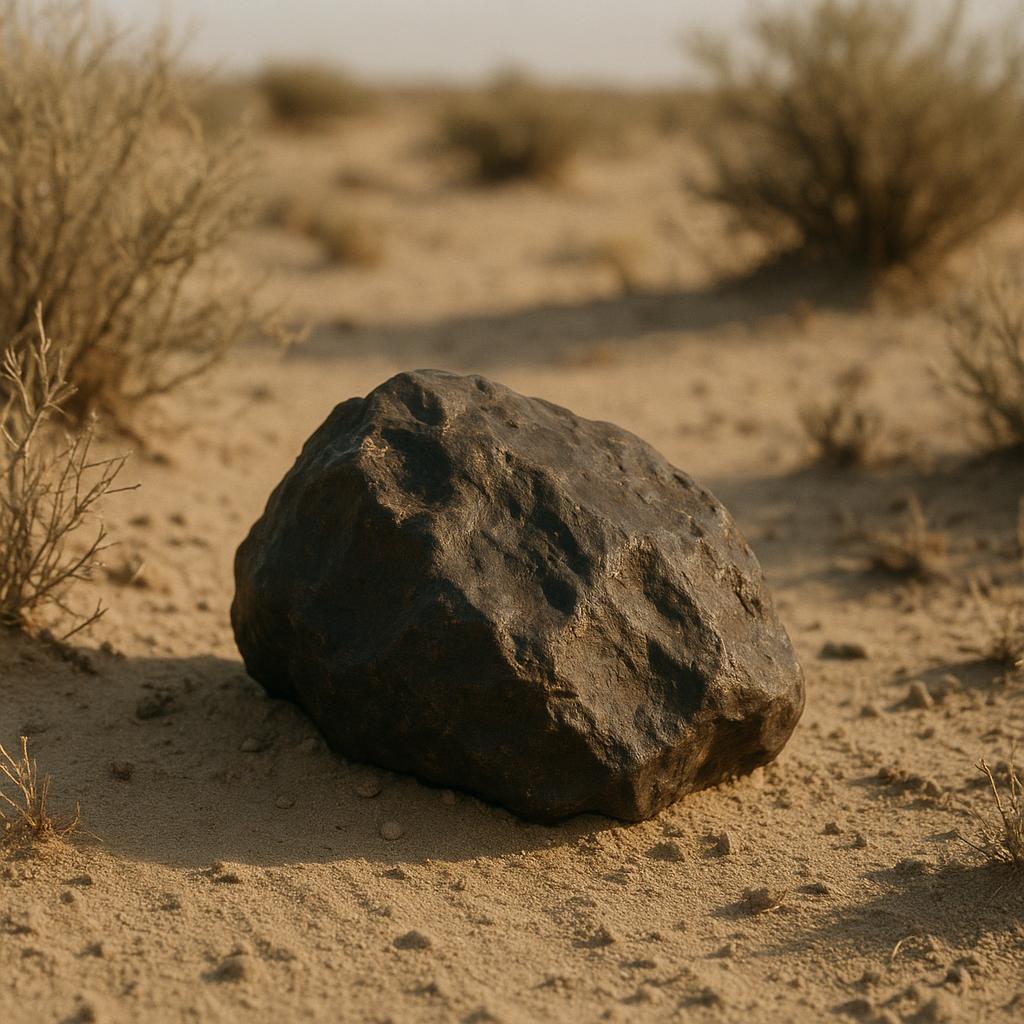
What sets Holbrook apart from most historic meteorite falls is that the strewnfield has never really stopped producing material. Fresh fragments are still being found in the desert around Holbrook more than a century after the original 1912 event, a testament both to how many stones fell that July morning and to how much of the strewnfield remains unsearched or only partially searched at any given time. That’s an unusual quality for an event this old — most historic strewnfields of comparable age have long since been thoroughly picked over, while Holbrook’s sheer size has kept it productive across generations of searchers. Wind, erosion, and shifting sand continue to expose material that had been buried or hidden since the fall itself, which means the same stretch of desert that produced thousands of stones in 1912 has kept giving up new finds to searchers ever since. A stone that sat undisturbed for decades under a few inches of blown sand can surface again after a single strong storm, which is part of why experienced hunters return to the same general area repeatedly rather than assuming it’s been exhausted.
That ongoing productivity has made Holbrook a name recognized well beyond Arizona within the meteorite-hunting community, a rare case of a century-old fall that still rewards a careful, patient search rather than being fully picked over decades ago. The strewnfield’s size works in searchers’ favor here too — a fall this widely scattered, across a mix of land types running for miles along the old rail line, means there’s simply more ground to cover than any single generation of hunters could realistically exhaust. Even after eleven decades of periodic searching, the sheer geographic footprint of the original 1912 shower means new ground is still being covered for the first time by each new hunter who visits.
The mixed land ownership across the strewnfield — Bureau of Land Management, Arizona state trust land, and private ranches all sitting within the same scattered debris field — has meant that different stretches of the same event have been treated very differently by hunters over the decades, depending entirely on which parcel a given stone happened to land on. A single meteoroid breaking apart in the atmosphere doesn’t respect property lines on the ground below, so the exact same shower produced fragments now sitting under three entirely different legal regimes, purely as an accident of trajectory and wind drift on the morning of the fall.
The Current Status of the Holbrook Strewnfield
The legal status of collecting meteorite fragments from the Holbrook strewnfield is genuinely unresolved and varies by the specific parcel of land involved. On private ranch land within the strewnfield, longstanding U.S. common law, most notably the 1892 Iowa Supreme Court decision Goddard v. Winchell, holds that a meteorite becomes part of the soil it lands on and belongs to the landowner rather than whoever finds it — meaning explicit landowner permission is legally required to search or collect on any private parcel within the strewnfield. That precedent has stood for well over a century and remains the foundational rule applied nationwide in meteorite ownership disputes, not a regional quirk specific to Arizona.
On the Bureau of Land Management land that makes up part of the same strewnfield, meteorite ownership remains a genuinely disputed question, without a settled federal rule specifically addressing it. That’s a meaningfully different situation from the clarity of the private-land rule, and it’s one that hunters researching this strewnfield should weigh carefully before assuming any given stretch of desert is straightforwardly open. What is documented is that hunters have reported keeping BLM-land finds from this strewnfield without incident, though that pattern of practice is not the same as a confirmed legal right, and the underlying question of ownership on federal land has not been definitively resolved. That gap between common practice and settled law is exactly what makes this site’s status genuinely unresolved rather than simply unenforced. Anyone considering the Holbrook strewnfield should understand that its legal status differs meaningfully depending on which specific parcel is involved, and that private land within the field carries a clear permission requirement that BLM land does not. That distinction is worth understanding on its own terms, independent of what any individual hunter has or hasn’t experienced in practice.
The Legacy of the Holbrook Meteorite Shower
The Holbrook shower matters to the meteorite-hunting and scientific communities because of its sheer scale and its remarkable persistence — a single 1912 event that scattered more than 14,000 stones across the Arizona desert, and a strewnfield that has continued yielding fresh material for over a century since. Few witnessed falls in recorded history have produced this much recoverable material or held collector and researcher attention for this long. That combination of scale, documentation, and longevity is genuinely rare in the history of meteoritics. For anyone interested in the history of American meteorite falls, Holbrook stands as one of the most significant events on record, a reminder of how dramatically the sky can announce itself, and how long the evidence of that morning has continued to surface from the desert floor. More than a hundred years on, the Arizona desert east of Holbrook is still, quietly, giving up pieces of that July morning.
Story Source: turnstone.ca
Location: Strewnfield along the rail line east of Holbrook, Navajo County, AZ
Site Status: Status unresolved
Legal Conditions: The Tier 1 U.S. federal default for Meteorite Hunting is Unconfirmed/disputed on federal land. The Holbrook strewnfield runs along the Santa Fe Railway east of town across a mix of BLM, state trust, and private ranch land in Navajo County; on private land, U.S. common law (Goddard v. Winchell, Iowa Supreme Court, 1892, the foundational precedent applied nationwide) holds that a meteorite becomes part of the soil and belongs to the landowner, so permission is legally required there. On BLM land, meteorite ownership remains genuinely disputed in practice, though most hunters report keeping BLM-land finds without incident.
Hazards: Extreme heat/cold/exposure (high desert, exposed strewnfield with little shade); Difficult terrain/altitude/remote access (sandy, dune-like terrain away from marked roads); Wildlife (rattlesnakes and other desert wildlife common to the area).
Google Map
Firsthand Accounts
Mineral dealer W.M. Foote organized the original recovery effort within weeks of the fall, hiring locals to gather fragments along the Santa Fe rail line and shipping them out by train; he published the first scientific account of the shower, including a reference to the concurrent Perseid meteor swarm. Source: W.M. Foote, “Preliminary Note on the Shower of Meteoric Stones Near Holbrook, Navajo County, Arizona, July 19th, 1912,” American Journal of Science, Vol. 34, Series IV, pp. 437-456.
Meteorite hunter and science writer James Tobin recounted a two-day 2012 hunting trip to the Holbrook strewnfield with a companion named Paul, describing how he learned to rake anthills for overlooked fragments and ultimately recovered 93 individual stones, including two halves of the same meteorite found two feet apart near the Arntz railroad crossing. Source: James Tobin, “2012 Vacation Part Two: Success at Holbrook,” Meteorite Times Magazine, January 1, 2013.
Smithsonian geologist George P. Merrill published an early scientific account of the fall just weeks after it occurred, documenting the event for the national scientific record alongside Foote’s independent report. Source: G.P. Merrill, “A Recent Meteorite Fall Near Holbrook, Navajo County, Arizona,” Smithsonian Miscellaneous Collections, Vol. 60, No. 9, Publication 2149, 1912.


