The ocean floor here sits so far down that sunlight never reaches it, and the pressure alone would crush an unprotected diver in seconds. Fifteen tons of gold have rested in that darkness since a storm tore a ship apart more than a mile above the seabed, and for over a century, no one on the surface knew exactly where. The Atlantic doesn’t advertise what it’s swallowed. It just keeps moving, indifferent, over water deep enough to hide a fortune for generations.
The Atlantic: The SS Central America’s Ship of Gold
The wreck at the center of this story lies roughly one hundred sixty miles off the coast of South Carolina, out in the open Atlantic, where the SS Central America went down in 1857 carrying an estimated fifteen tons of gold. The ship’s loss was, at the time, a national disaster and a financial shock, since that gold represented real wealth being shipped from one American coast to another. Once the ship sank, though, its exact location disappeared along with it, swallowed by open ocean far beyond where anyone could simply look down and see it. A hundred sixty miles offshore is itself a considerable distance, well beyond sight of land, in open water where finding a specific wreck site is never simply a matter of picking a promising stretch of coastline and starting to look.
What makes the SS Central America significant to the treasure-salvage world is not just the scale of the gold involved, but the depth at which it came to rest. The wreck sits roughly seven thousand two hundred feet down, a depth well beyond the reach of ordinary diving and far beyond what nineteenth or even mid-twentieth century recovery technology could have reasonably accessed. For well over a century, the fifteen tons of gold aboard the Central America were, for all practical purposes, unreachable, not because their location was a mystery to history, but because reaching them required equipment that simply did not exist yet.
That combination, a well-documented historical loss and a genuinely inaccessible location, sets the Central America apart from many other sunken treasure stories. This was never a case of searchers guessing at an unknown spot. It was a case of a known disaster sitting at a depth that made recovery a technological problem rather than merely a search problem, which is part of why its eventual recovery became such a significant moment in the history of deep-sea salvage.
The scale of the loss also mattered to how the story was remembered. Fifteen tons of gold was, and remains, an enormous quantity of wealth to lose in a single event, and the Central America’s sinking was felt as a genuine financial shock at the time, not merely a maritime tragedy. That combination of human loss, financial impact, and an enormous, well-documented quantity of gold is part of what has kept this wreck a point of fascination for well over a century.
A Deep-Sea Recovery and a Legal Fight
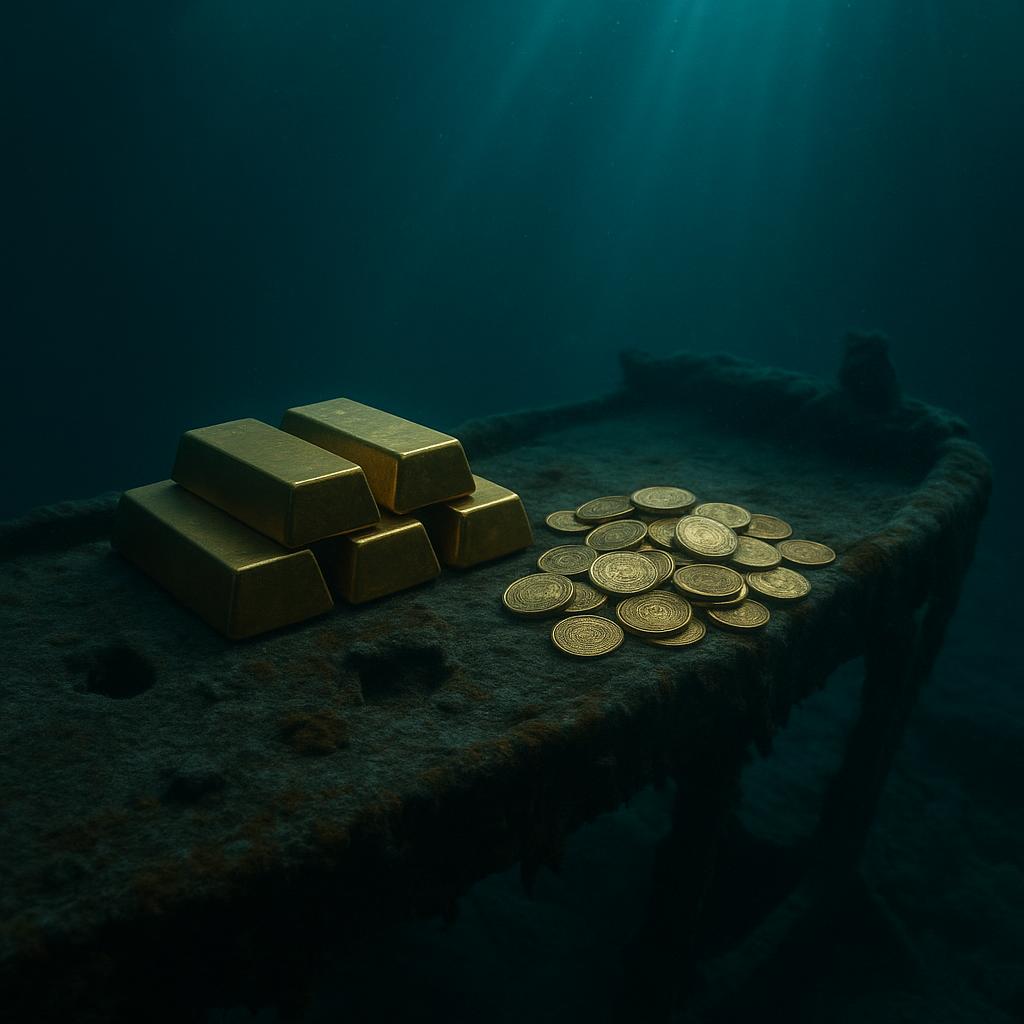
Recovering gold from seven thousand two hundred feet down required capabilities that did not exist for most of the wreck’s history, and the eventual salvage effort represented a genuine advance in deep-ocean recovery work, reaching a wreck far past the depth of any casual or amateur search. Locating and recovering material from that kind of depth is an entirely different undertaking than searching shallow coastal waters, requiring specialized vessels and equipment capable of operating under pressures that would be lethal to an unprotected person. The gap between a shallow coastal wreck and one resting at seven thousand two hundred feet is not a matter of degree; it is a difference in kind, requiring an entirely different category of technology, funding, and expertise before anyone could even confirm what was down there, let alone bring any of it to the surface.
But finding and recovering the gold did not settle who was entitled to keep it. The Central America’s cargo became the subject of a significant legal dispute, one that reached the federal appellate courts in Columbus-America Discovery Group v. Atlantic Mutual Insurance Co., decided by the Fourth Circuit in 1992. At issue was a foundational question in maritime law: whether the wreck should be treated under the law of finds, which can grant ownership to whoever recovers an abandoned object, or under the law of salvage, which instead provides a reward to the recoverer while leaving original ownership intact. That question, finds versus salvage, sits at the heart of nearly every major shipwreck dispute in American maritime law, and the Central America case became one of the clearest, most closely watched examples of how a federal appellate court works through it.
The court’s ruling turned on abandonment. The original insurers of the Central America’s cargo had paid out claims on the lost gold generations earlier, but the court held that they had not proven they had abandoned their interest in it. Because abandonment could not be established, the law of salvage applied rather than the law of finds, meaning the recovery team was entitled to a salvage reward rather than outright ownership of everything brought up from the seafloor. That distinction, reward versus ownership, is a meaningful one in maritime law, and the Columbus-America case remains a real, citable precedent on exactly how that line gets drawn when original owners or insurers have not clearly walked away from a wreck. In practice, that meant the recovery team’s years of effort and technological investment were compensated through a salvage award rather than simply awarded full title to everything they had located and lifted from the seafloor, a distinction with real financial consequences for everyone involved in the case.
Accessing the SS Central America Today
The SS Central America’s wreck site is not open to casual searching. Recovery here has always operated under the structure established by federal admiralty and salvage law rather than through any general public access, and the Fourth Circuit’s ruling in Columbus-America Discovery Group confirmed that a formal court-recognized salvage claim, not a finders-keepers approach, governs who is entitled to work the site and what they are entitled to keep. Any further recovery work at this depth would require both the legal standing to do so and the kind of deep-ocean technology capable of reaching seven thousand two hundred feet safely.
For anyone drawn to this story, the practical reality is straightforward: this is not a wreck within reach of a weekend diver or an independent searcher, regardless of legal permissions. The combination of extreme depth and established federal salvage precedent means the site is governed by maritime law and specialized recovery operations rather than open access. That is a meaningfully different situation than a shallow coastal wreck where the main barrier to access is legal permission rather than physics. Here, depth alone would stop nearly anyone long before any permitting question even became relevant.
The Legacy of the Ship of Gold
The SS Central America stands as a landmark case in both deep-sea salvage technology and maritime law, a wreck whose gold was locked away less by mystery than by sheer physical depth for more than a century. For the treasure-hunting and salvage community, it represents the outer edge of what recovery can accomplish once technology catches up to a known historical loss, and the Columbus-America ruling remains a foundational reference point for how courts weigh salvage against abandonment when a wreck’s original owners never definitively let go. It is a story about gold, but just as much a story about depth, law, and the decades it can take for both to be resolved. Few wrecks illustrate as clearly that knowing exactly where a fortune lies is sometimes only half the challenge; reaching it, and then legally keeping it, can take just as long.
Story Source: www.pcgs.com
Location: Wreck site ~160 miles off the coast of South Carolina, Atlantic Ocean
Site Status: Permission or permit required
Legal Conditions: Per Tier 1 U.S. federal default for Sunken Treasure, recovery here required a federal court salvage award rather than casual access; in Columbus-America Discovery Group v. Atlantic Mutual Insurance Co., 974 F.2d 450 (4th Cir. 1992), the court held that since original insurers had not proven they abandoned their interest, the law of salvage (a reward, not full ownership) applied rather than the law of finds (Verified confidence, real case).
Hazards: Wreck lies roughly 7,200 feet down — far beyond even professional scuba limits. This isn’t “difficult terrain” in the usual outdoor sense; the entire barrier is depth and the need for specialized deep-ocean recovery vessels. No physical location is open to the public here — recovered artifacts have circulated through auctions and traveling exhibits (I checked; the collection has been progressively sold off since 2022) rather than a fixed museum.
Google Map
Firsthand Accounts
Fireman Alexander Grant, 26, survived four days adrift on a piece of the ship’s deck and nine days without food or water after the September 1857 sinking; his account ran in the October 17, 1857 issue of Harper’s Weekly.
Bob Evans, the expedition’s chief scientist and historian since 1983, gathered 33 separate 1857 newspaper accounts of the sinking to help pinpoint the wreck before Tommy Thompson’s team located it on September 11, 1988.
The Seattle Times reported that 13 mostly Seattle-area sonar engineers and technicians who helped locate the wreck in 1988 waited 30 years and a protracted lawsuit before finally splitting roughly $678,000 in shares in the late 2010s.
Discoverer Tommy Thompson, who raised $12.5 million from 161 investors to fund the 1988 search, later went into hiding in 2012 and was a fugitive until U.S. Marshals located him in January 2015; he served a decade in prison for contempt before his March 2026 release.
Numismatist Dwight Manley formed the California Gold Marketing Group in 1999, purchasing the roughly 8,000-piece court-approved gold recovery for over $30 million and touring it as an educational exhibit seen by more than a million people.