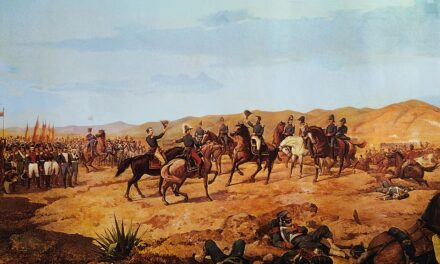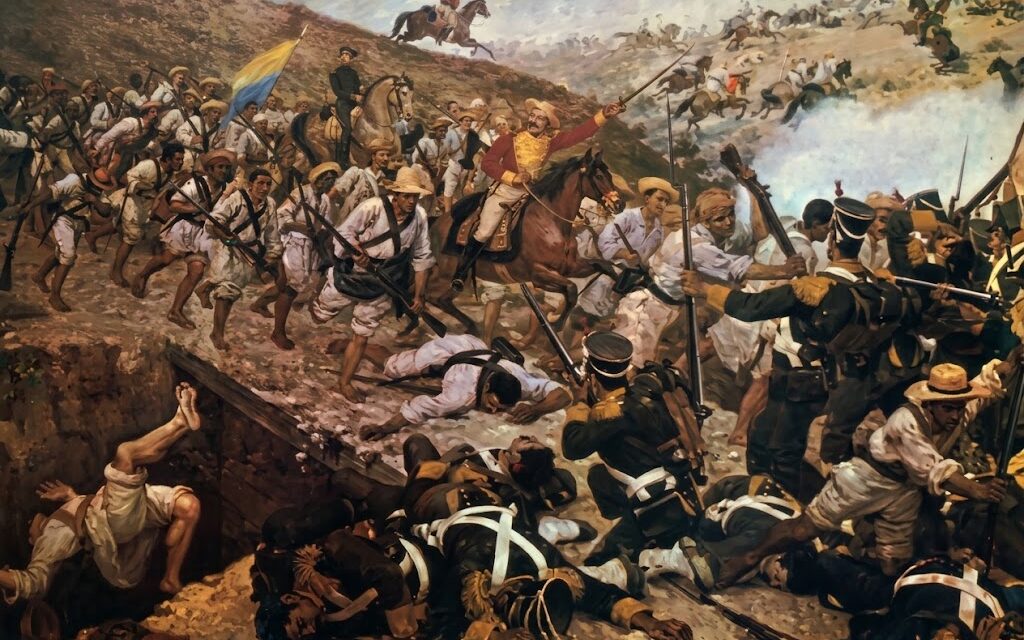
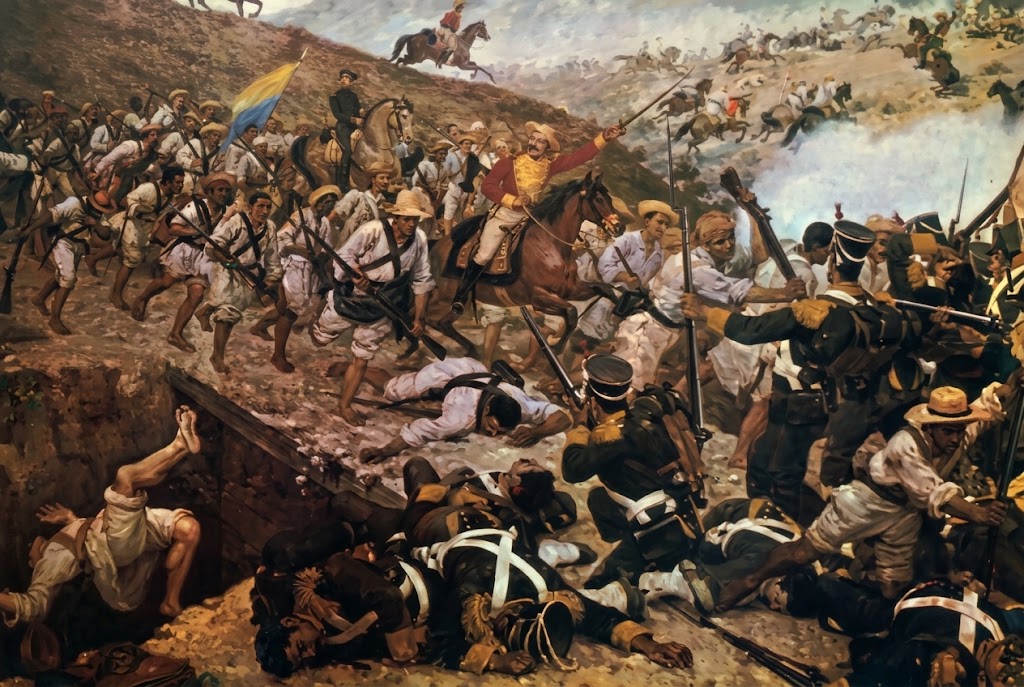
In under two hours of fighting along a narrow stone bridge in the Andean highlands, Simón Bolívar’s patriot army effectively decided the fate of an entire continent’s independence movement, shattering a Spanish royalist force and opening the road to Bogotá without the drawn-out siege or prolonged campaign that so many other decisive battles required. The Battle of Boyacá’s brevity belied its consequences: within days, Bolívar would enter the viceregal capital in triumph, and within years, Spanish rule across most of northern South America would collapse in the campaign this single afternoon set in motion. Few battles in the history of Latin American independence packed so much consequence into so short a span of fighting, a fact that still shapes how Colombia remembers the date more than two centuries later.
Boyacá: The Road to Battle
By 1819, Simón Bolívar had spent years leading patriot forces in a grueling, often desperate struggle against Spanish royalist authority across present-day Venezuela and Colombia, suffering repeated setbacks that had scattered and exhausted his armies in earlier campaigns. In one of the boldest strategic gambles of the independence wars, Bolívar led his army on a punishing march across the flooded plains of Casanare and then over the frigid, high-altitude passes of the Andes into the Colombian highlands, a crossing that cost the lives of many soldiers to exposure and altitude sickness before the army had even engaged the enemy. Having descended into the temperate valleys of Boyacá province, Bolívar’s forces won a series of preliminary engagements against royalist troops under Colonel José María Barreiro, weakening and disorganizing the Spanish force as it attempted to retreat toward the safety of Bogotá and link up with reinforcements. These preliminary clashes, fought over the days immediately preceding the main battle, steadily eroded Barreiro’s confidence and cohesion, forcing his army into an increasingly hurried withdrawal that left it strung out and vulnerable by the time it reached the Boyacá River crossing.
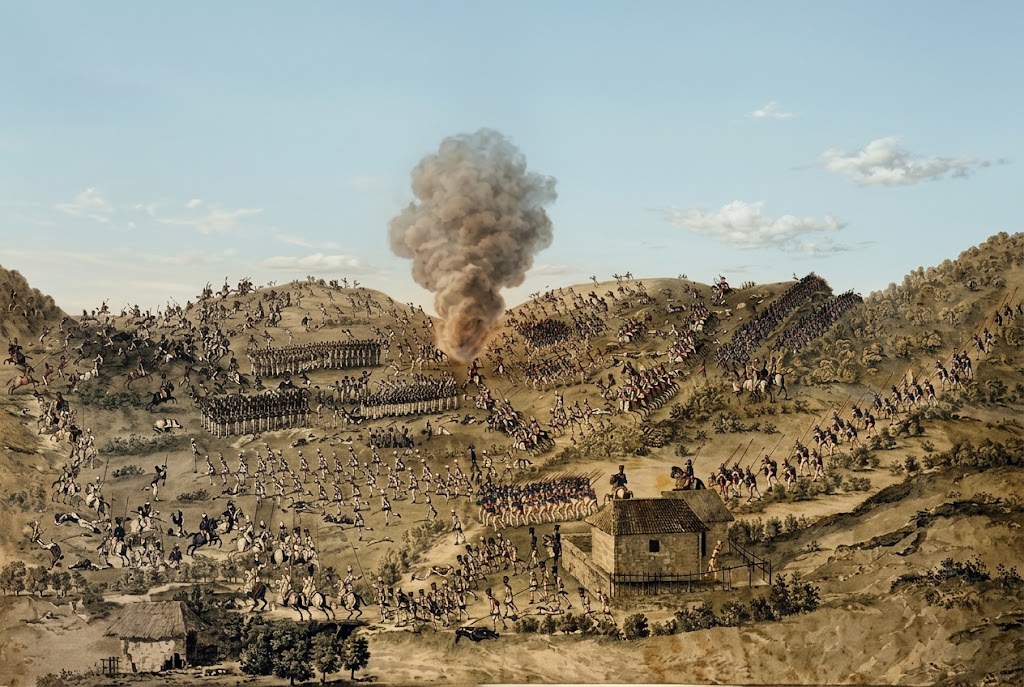
By early August 1819, Barreiro’s royalist army found itself strung out along the road near the Boyacá River, attempting to cross a narrow stone bridge with Bolívar’s patriot forces closing rapidly from multiple directions, an increasingly precarious position for a force that had hoped to avoid decisive battle altogether. Bolívar recognized the opportunity presented by the royalist army’s divided position, with a portion already across the bridge and a portion still approaching it, and moved swiftly to exploit the gap before Barreiro could reunite and reorganize his scattered command. The patriot army that made this final push was itself a diverse force, drawing together Venezuelan and New Granadan troops alongside a contingent of British and Irish legionnaires who had crossed the Atlantic to join the independence cause, a coalition forged through years of shared hardship on campaigns that had taken them across some of the most difficult terrain in South America.
The Battle of Boyacá
On August 7, 1819, Bolívar’s patriot forces struck the strung-out royalist column near the Boyacá River, with General Francisco de Paula Santander personally leading the vanguard’s assault to seize and hold the critical stone bridge that split the battlefield in two. Santander’s vanguard successfully crossed and secured the bridge, cutting the royalist army in half and preventing the portion that had already crossed from reinforcing or retreating to support the main body still on the opposite bank. With the bridge in patriot hands, Bolívar’s main force pressed the attack against Barreiro’s divided and increasingly disorganized troops, who found themselves unable to coordinate a unified defense or orderly withdrawal under the pressure of simultaneous assaults from separated patriot columns. The royalist force, caught in this untenable tactical position and unable to reunite its divided wings, collapsed with remarkable speed, and Colonel Barreiro himself was captured along with the bulk of his officer corps and roughly 1,600 royalist soldiers, an overwhelming haul that effectively destroyed Spanish military capacity in the region in a single afternoon.
Patriot casualties were comparatively light, a testament to how thoroughly Santander’s bridge maneuver had unbalanced the royalist defense before the main engagement could develop into a prolonged, costly struggle, with most patriot losses occurring among the vanguard units that bore the brunt of the initial fighting for control of the crossing itself. The speed and completeness of the victory stunned observers on both sides, transforming what might have been a grinding campaign of attrition through the highlands into a single decisive engagement that shattered royalist authority across the entire viceroyalty within the span of a single day. Barreiro’s officers, many of them experienced veterans of earlier campaigns against the patriots, reportedly found themselves unable to issue coherent orders once the bridge fell and their line of retreat toward Bogotá was severed, a command breakdown that turned an already difficult tactical position into an outright rout within minutes of the crossing being lost.
With Barreiro’s army destroyed and no meaningful royalist force remaining to block the road, Bolívar’s patriot army marched on Bogotá almost unopposed, entering the city in triumph just three days later as Spanish colonial officials fled the capital rather than face a battle they now had no means to win. The scale of the collapse, an entire royalist field army eliminated or captured in a matter of hours, gave the patriot cause a level of momentum and legitimacy that years of smaller, indecisive engagements had failed to produce. News of the disaster reached Spanish colonial authorities in Bogotá well before Bolívar’s own advance guard did, and the psychological effect of losing an entire field army in a single afternoon proved as damaging to royalist morale across the viceroyalty as the material losses themselves, hastening the collapse of Spanish authority in towns and provinces far from the battlefield itself.
The Legacy of Boyacá
The Battle of Boyacá is widely regarded as the single most decisive engagement of the South American wars of independence, securing the liberation of what is now Colombia in a single afternoon and providing the military and political foundation for Bolívar’s subsequent creation of Gran Colombia, the short-lived republic uniting present-day Colombia, Venezuela, Ecuador, and Panama. The victory transformed Bolívar from a resilient but frequently defeated revolutionary leader into the continent’s preeminent military and political figure, a stature he would leverage to extend the independence movement into Venezuela, Ecuador, and eventually Peru and Bolivia over the following years. Colombia commemorates the battle each August 7 as a national holiday, and Francisco de Paula Santander’s decisive role at the bridge established him as Bolívar’s leading lieutenant and, eventually, as an independent nation’s founding statesman in his own right, later serving as Colombia’s first vice president and then president in the decades following independence. The battle’s outsized historical weight relative to its brief duration has made it a recurring point of comparison for historians studying how single tactical decisions, rather than prolonged campaigns of attrition, can sometimes determine the fate of entire independence movements.
Visiting Boyacá Today
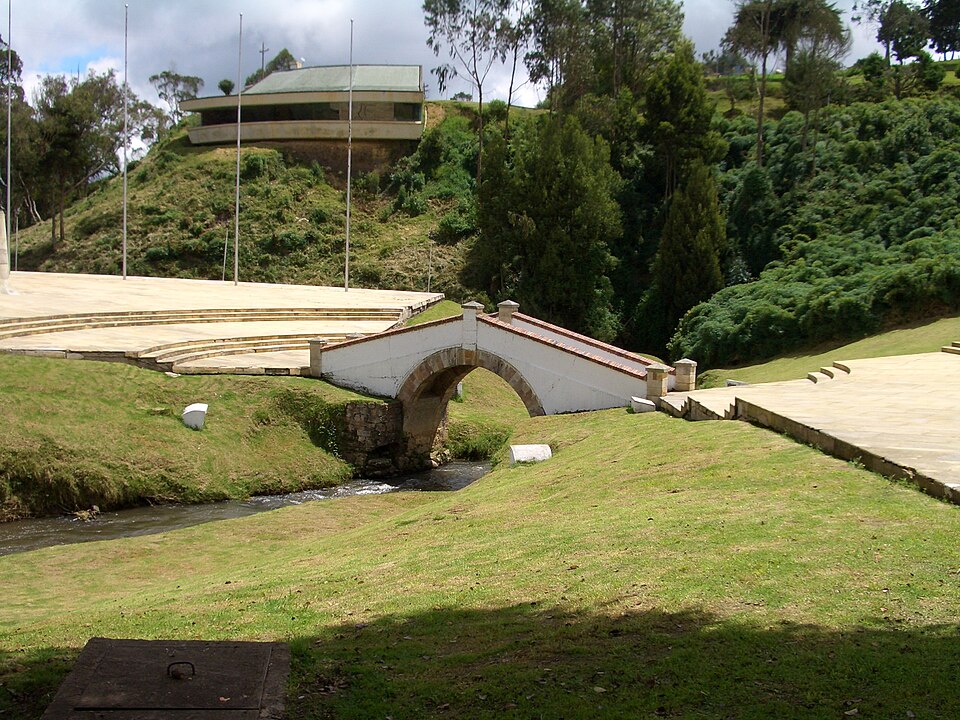
The Parque Nacional Monumento Puente de Boyacá preserves the battle site as an actively maintained national monument park centered on the reconstructed stone bridge where Santander’s vanguard turned the tide of the engagement. The grounds include a monument to Simón Bolívar, a statue honoring Francisco de Paula Santander, the Plaza de las Banderas flag display representing the nations Bolívar helped liberate, an eternal flame, a triumphal arch, and a chapel, all arranged across an open-air site with no formal indoor museum. Entry involves a modest admission fee, and while the grounds are open daily, exact hours and pricing can vary, so visitors should check locally before planning a trip.
Every August 7, the site hosts Colombia’s official Battle of Boyacá holiday commemorations, drawing annual military and civic ceremonies that transform the usually quiet monument park into the center of national celebration. The nearest full-service town is Tunja, the Boyacá departmental capital roughly 14 kilometers away, making it a convenient base for visitors, and a typical visit to the monument grounds runs 30 to 60 minutes, enough time to walk the plaza, view the bridge, and take in the flag displays and monuments without needing to budget for a longer stop. The grounds are generally well maintained and quiet outside the major commemorative dates, giving visitors an unhurried setting in which to take in the monuments and the historic bridge itself, though travelers visiting during the December holiday season or around the August 7 anniversary should anticipate heavier crowds and traffic than the site sees on an ordinary day. The monument park’s open-air layout means the visit is best paired with other stops in the region, such as Tunja’s colonial architecture, rather than treated as a full day’s destination on its own.
Remembrance of Boyacá
Simón Bolívar himself issued an official war dispatch in the immediate aftermath of the battle, a firsthand account preserved in Vicente Lecuna’s compiled edition of the Liberator’s correspondence that remains the standard reference collection for Bolívar’s own writings. Francisco de Paula Santander, who personally led the vanguard’s assault to seize and split the royalist army at the bridge, documented the tactical execution of that decisive maneuver from the patriot vanguard’s perspective in his own later writings, preserved in the multi-volume Archivo Santander. Daniel Florencio O’Leary, an Irish-born aide-de-camp who served on Bolívar’s staff throughout the Boyacá campaign, left what historians consider the most extensive eyewitness memoir of the entire independence wars, later published in English as Bolívar and the War of Independence. Taken together, these three accounts, the victorious commander’s own contemporary battle report, the tactical architect’s firsthand record of the maneuver that decided the day, and a devoted aide’s sweeping memoir of the wider campaign, preserve Boyacá through the eyes of the men who planned and executed one of the most consequential single afternoons in the history of South American independence, a record that continues to shape how the battle is taught and commemorated across the nations Bolívar helped bring into being.
Further Exploration: Book titled “Bolívar and the War of Independence: Memorias del General Daniel Florencio O’Leary, Narración” by Daniel Florencio O’Leary, translated by Robert F. McNerney Jr. (University of Texas Press, 1970)
Location: Parque Nacional Monumento Puente de Boyacá, Vereda Puente de Boyacá, Ventaquemada, Boyacá Department, Colombia
Site Status: National Park/Managed Historic Site
Visitation Notes: The Parque Nacional Monumento Puente de Boyacá is an actively maintained national monument park centered on the reconstructed stone bridge, with a monument to Simón Bolívar, a statue of Francisco de Paula Santander, the Plaza de las Banderas flag display, an eternal flame, a triumphal arch, and a chapel. It’s an open-air site with no formal indoor museum. Entry involves a modest admission fee and the grounds are open daily; exact hours and pricing can vary, so check locally before visiting. August 7 is Colombia’s official Battle of Boyacá holiday, marked by annual military and civic ceremonies at the site. The nearest full-service town is Tunja, the Boyacá departmental capital, about 14 km away; a typical visit runs 30–60 minutes.
Google Map
Visitor Comments
Neil P., visiting from Houston, described a striking holiday-season light display at the monument, though he noted heavy traffic congestion during peak visiting hours.
— from TripAdvisor
R.K.V. from Bogotá called it a nice, pretty place with a special atmosphere, though felt there wasn’t much to do for a longer visit beyond the monument itself.
— from TripAdvisor
Miguel P., from Bogotá, praised the on-site craft vendors, the historical significance, and the peaceful, clean grounds, calling it a great stop on a road trip.
— from TripAdvisor
Karen Natalia M. criticized the entrance fee as too high for a government-run site, calling the pricing exploitative.
— from TripAdvisor