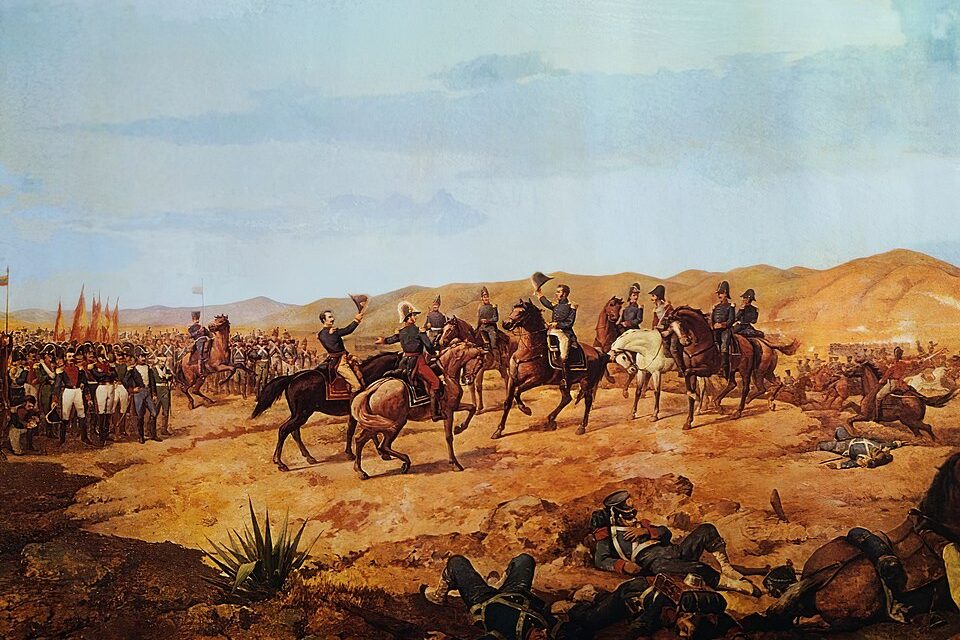
The high ground was the one advantage the royalist army actually held, and General Jose de Canterac gave it up anyway. Just after dawn on December 9, 1824, thousands of Spanish infantry began filing down the slopes of Condorcunca hill onto the open plain below, trading a defensible ridge for room to maneuver against a smaller patriot force arrayed on the pampa. It was a gamble made under pressure: Viceroy Jose de la Serna had spent weeks trying to force a decisive engagement before patriot reinforcements could arrive, and for a few hours that morning the descent looked like the opening move of a battle Spain could still win. By early afternoon, the plain below the hill would be littered with the wreckage of nearly three centuries of Spanish rule in South America.
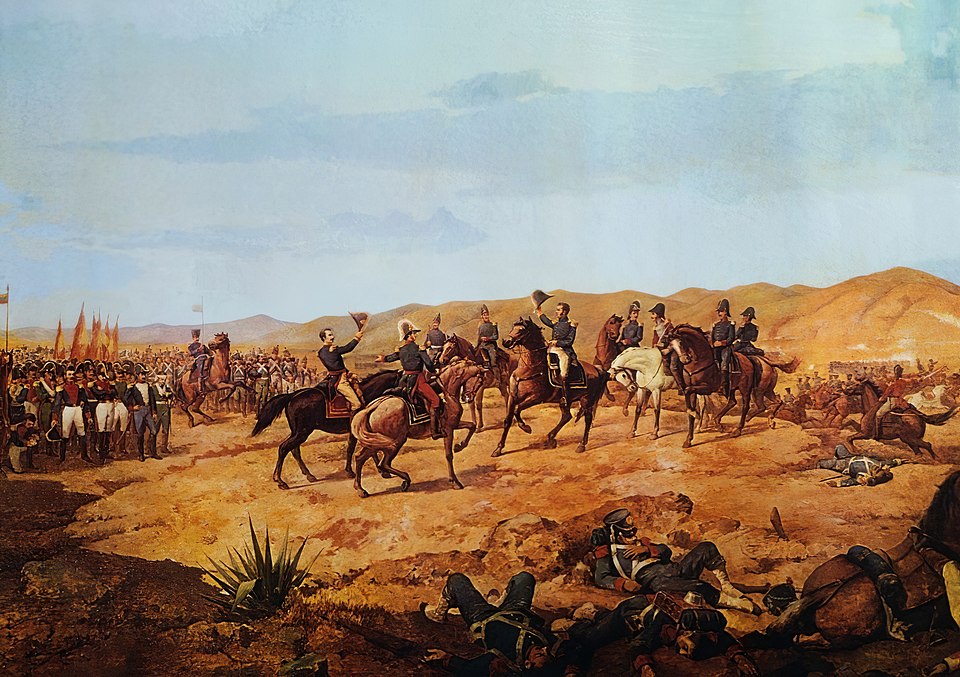
Battle of Ayacucho: The Road to Battle
By 1824, Spain’s grip on its South American empire had been slipping for more than a decade. What began around 1810 as scattered juntas and uprisings across the continent had hardened, by the early 1820s, into open wars of independence that stripped Spain of Mexico, Gran Colombia, and the southern provinces of Rio de la Plata and Chile one region at a time. Simon Bolivar, having secured the north, turned his campaign south into the Andes, where Peru — the historic seat of Spanish viceregal power on the continent and the last territory of real strategic weight still under the crown — remained stubbornly in royalist hands. Bolivar entrusted the final phase of that campaign to his most capable subordinate, Antonio Jose de Sucre, whose smaller, highly mobile patriot army spent much of 1824 maneuvering through the Peruvian highlands, trying to draw the larger royalist forces into a fight on ground of Sucre’s choosing rather than the viceroy’s.
That fight nearly happened months earlier. A patriot cavalry action at Junin that August had already routed part of the royalist force and shaken confidence in Spanish command, but it settled nothing on its own, and both armies spent the following months maneuvering rather than engaging directly, each wary of committing to open ground on the other’s terms. Viceroy La Serna used the time to consolidate what remained of his scattered garrisons from across the highlands into a single force, determined to end the campaign with one decisive confrontation before the season turned against him and before Sucre could be reinforced further. By early December, the two armies had converged on the high plain near the small town of Ayacucho, in the shadow of Condorcunca hill, each side aware that whatever happened next would likely settle the question of Spanish rule in South America for good — not just for Peru, but for a continent that had already watched every other Spanish stronghold fall in the years before it.
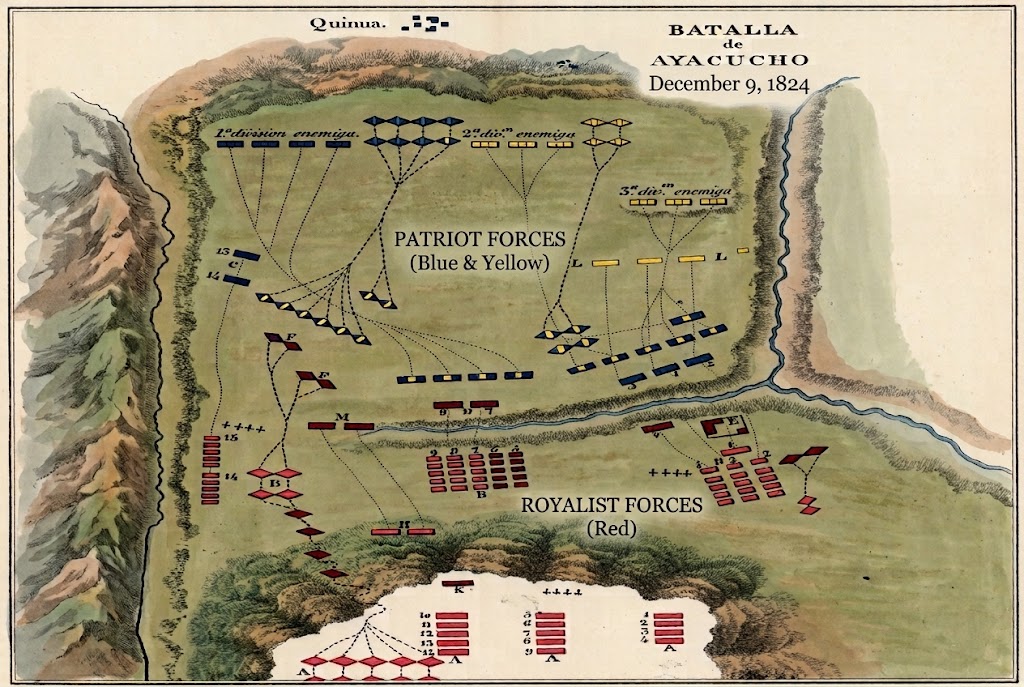
The Battle of Ayacucho
Sucre positioned his roughly 5,800 troops on the plain below Condorcunca and waited rather than advanced, forcing the larger royalist army — numbering close to 9,000 and organized into several divisions under Canterac’s overall field command — to come down off the high ground it held. In his official report to Bolivar written immediately after the engagement, Sucre described what followed less as a prolonged fight than a rapid unraveling: as the royalist divisions reached the base of the hill still reorganizing from their descent, patriot infantry and cavalry struck in a coordinated assault that broke General Monet’s division within the battle’s opening phase. The collapse spread quickly along the royalist line as neighboring units, exposed once Monet’s division gave way, found themselves fighting on ground with no natural cover and little room to regroup. Viceroy La Serna himself was wounded and captured in the fighting, an event that threw the remaining royalist command into confusion at the worst possible moment.
With the viceroy in patriot hands, General Canterac found himself commanding an army that had lost both the high ground and its senior leadership within the space of a few hours, encircled on open terrain with no realistic path to organized retreat. Royalist losses in killed, wounded, and captured ran into the thousands before the fighting stopped, while patriot losses were comparatively light — a lopsided outcome that reflected how quickly the battle turned once the royalist descent went wrong and the army lost the cohesion to fall back in order. Entire royalist units that had marched down off Condorcunca that morning as an organized fighting force found themselves, only hours later, cut off in small pockets with no line of retreat and no senior officer left to direct one. Rather than continue a fight that had already been decided, Canterac opened negotiations on the field that same afternoon, and by the day’s end the terms that would become known as the Capitulation of Ayacucho had been agreed: a full and immediate surrender that effectively ended organized Spanish military resistance on the South American mainland.
The recriminations began almost as soon as the shooting stopped. Andres Garcia Camba, a Spanish royalist officer who lived through the defeat and its aftermath, recorded in his memoir the bitter exchanges among returning Spanish officers, some of whom accused others of disloyalty or outright betrayal in explaining how so complete a defeat had been possible. Garcia Camba recalled one officer’s blunt response to the accusations: that the battle had simply been lost the way battles are lost, with no conspiracy required to explain it. It was, in its own way, as candid an assessment of Ayacucho’s outcome as any that would come from the winning side, and a reminder that the officers living through the collapse understood, even in the moment, that no single betrayal explained what a single bad morning on an open plain had done to three centuries of colonial rule. Within hours of the surrender, the terms of the Capitulation went further than a simple battlefield truce: Canterac agreed to the withdrawal of all remaining Spanish forces from Peru, effectively signing away what was left of the viceroyalty in the same document that ended the fighting on the pampa.
The Legacy of Ayacucho
Ayacucho did not end the wars of Spanish American independence outright — isolated royalist garrisons, most notably the fortress at Callao, held out for a time afterward — but it broke the back of organized Spanish power on the continent in a single afternoon. The Capitulation signed on the battlefield secured Peru’s independence and cleared the way for the creation of Bolivia, named for Bolivar himself and led first by Sucre, later that same year. What had been, for nearly three centuries, the wealthiest and most heavily defended core of Spain’s American empire passed permanently out of its hands on the plain beneath Condorcunca hill, in a battle that lasted barely a single morning. For historians of the era, Ayacucho is generally treated as the effective closing engagement of the mainland wars of independence — the moment the outcome of a fight that had run for well over a decade across two continents was no longer seriously in doubt.
Visiting Ayacucho Today
The battlefield survives today as the Pampas de Ayacucho Historic Sanctuary, a preserved stretch of high plain near the town of Quinua, roughly 30 to 45 minutes from Ayacucho city by road. The site is centered on a 44-meter obelisk monument flanked by bronze statues of the battle’s commanding generals, reached by climbing a stairway to a viewing platform; a companion museum sits in Quinua’s main plaza, housed in part in the room where the Capitulation of Ayacucho was actually signed, giving visitors a rare chance to stand in the actual space where the fighting’s outcome was formalized on paper. Both the sanctuary grounds and the town museum charge modest general-admission fees, with discounted student pricing typically available, keeping the visit accessible without requiring advance booking.
Visitors should come prepared for the altitude: the site sits high in the Peruvian highlands and is frequently windy and cold, so warm clothing and time to acclimatize are worth planning for regardless of the season. The sanctuary and the town of Quinua are close enough together to cover on foot, and the walk between them is, by most accounts, part of the appeal rather than an inconvenience — an unhurried approach to a monument that otherwise sits in fairly isolated, open countryside. Because the sanctuary, the obelisk, and the signing-room museum in town are spread across a short distance rather than concentrated in a single building, most visitors treat Ayacucho as a half-day outing rather than a brief roadside stop, pairing it where possible with the nearby Wari archaeological site and the surrounding highland scenery.
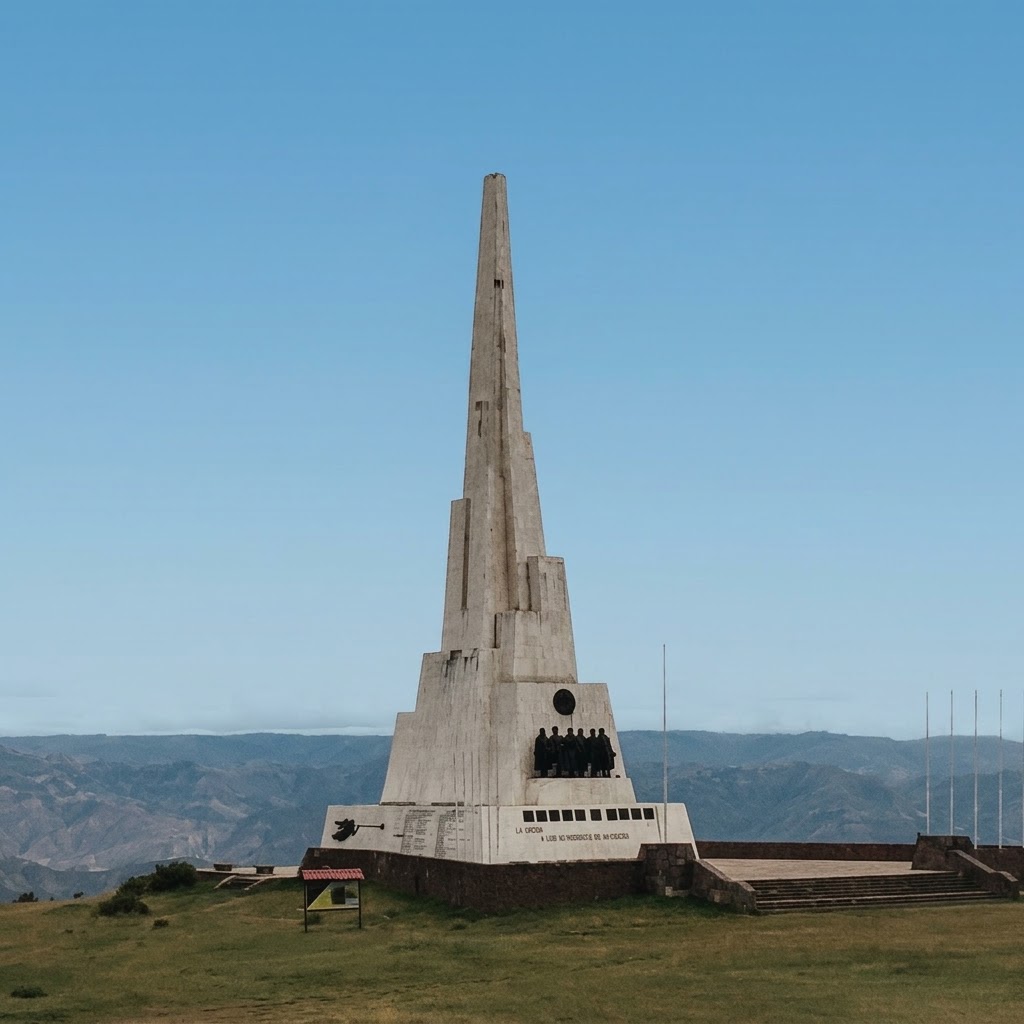
Remembrance at Ayacucho
December 9 is observed as a national holiday in Peru, marking the anniversary of the battle with ceremonies held both nationally and at the site itself, drawing visitors and dignitaries to the obelisk on the pampa where the Capitulation was negotiated two centuries ago. The date’s status as a national holiday means the commemoration is not a niche or local affair but a fixture of the Peruvian civic calendar, taught in schools and marked well beyond the Ayacucho region itself. Beyond the annual observance, the sanctuary and its museum function as a standing act of remembrance in their own right: the preserved signing room in Quinua, the statues of the opposing commanders positioned together at the monument, and the sweep of open pampa itself all keep the memory of the battle visible to anyone who makes the trip, independent of any scheduled event. For a battle so often described as the moment Spanish rule in South America ended, the site’s quiet, ordinary presence in the middle of a highland farming town is its own kind of testimony.
Visitor Info: Book titled “Memorias para la historia de las armas espanolas en el Peru” by Andres Garcia Camba (1846)
Location: Pampas de Ayacucho Historic Sanctuary, Obelisco de la Pampa de la Quinua, Quinua, Ayacucho Region, Peru
Site Status: Preserved Site, Minimal Facilities
Visitation Notes: The battlefield is preserved as the Pampas de Ayacucho Historic Sanctuary near the town of Quinua, roughly 30-45 minutes from Ayacucho city by road, centered on a 44-meter obelisk monument with bronze statues of the battle’s commanding generals and a small on-site museum in Quinua’s main plaza, including the room where the Capitulation of Ayacucho was signed. Both the sanctuary grounds and the town museum charge modest general-admission fees, with discounted student pricing typically available, and reaching the obelisk viewing platform involves climbing a stairway. The site sits at high altitude and is often windy and cold, so visitors should dress warmly and allow time to acclimatize. December 9 is a national Peruvian holiday marking the battle’s anniversary, observed with ceremonies held nationally and at the site.
Google Map
Visitor Comments
Berthaki praised the obelisk for honoring the independence fighters and offering good views from the top, though warned of the many stairs involved, and recommended bringing warm clothing for the wind and cold at the site’s high altitude.
— from TripAdvisor
Patricia Paz described the 44-meter obelisk and its accompanying monument to Marshal Sucre, roughly 35 kilometers from Ayacucho in Huamanga province, and praised the splendid view of the surrounding Andean landscape from the site.
— from Minube
A visitor who booked a guided tour, Hector Raul, praised the knowledge and kindness of their guide, with the only complaint being that the tour vehicle’s air conditioning worked only intermittently on the drive out to the site.
— from GetYourGuide
Natalia Garcia Cavero called the pampa the scenario of the war that secured Peruvian independence from Spain, framing the obelisk as a tribute to the fallen and wounded, including soldiers of other nationalities who fought alongside Peruvian forces.
— from Minube