By the summer of 1938, Republican military planners knew that even a total victory on the battlefield could no longer change the underlying trajectory of Spain’s civil war, yet they launched a massive offensive across the Ebro River anyway, gambling not on winning the war outright but on proving to the world that the Republic could still fight, in hopes of persuading Western democracies to lift their arms embargo before it was too late. The 115 days of fighting that followed became the longest and bloodiest single battle of the entire conflict, a battle fought as much for international opinion as for Spanish ground, and one that ultimately changed neither.
The Ebro: The Road to Battle
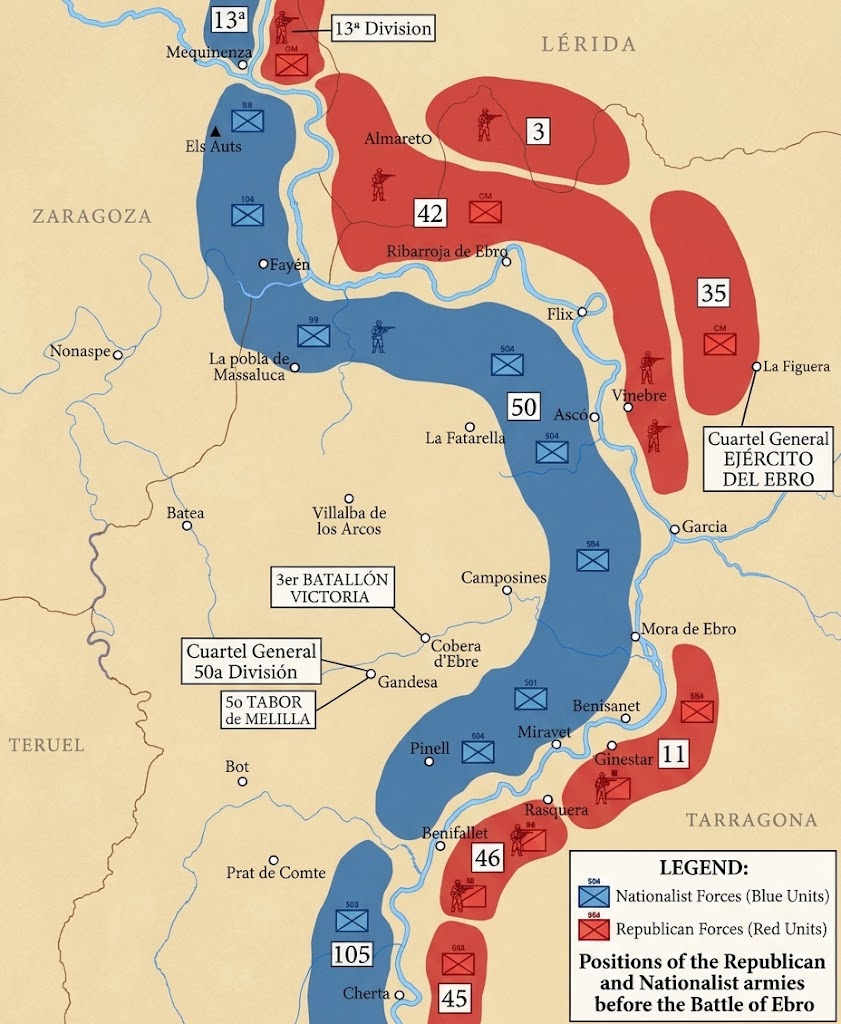
By mid-1938, Francisco Franco’s Nationalist forces had driven a wedge through Republican-held territory, splitting Catalonia from the rest of Republican Spain and pushing toward the Mediterranean coast, a strategic disaster that left the Republic’s government searching for any operation that might reverse the war’s momentum or at least buy time to secure international support. Republican commanders, led by Juan Modesto and drawing on the Spanish Republican Army’s most capable remaining formations, including International Brigade units such as the British Battalion and the American Abraham Lincoln Battalion, devised a bold plan to cross the Ebro River and strike into Nationalist-held territory around Gandesa, aiming to relieve pressure elsewhere, reconnect the two halves of Republican Spain, and demonstrate the Republic’s continued capacity to wage offensive war even after a string of demoralizing defeats.
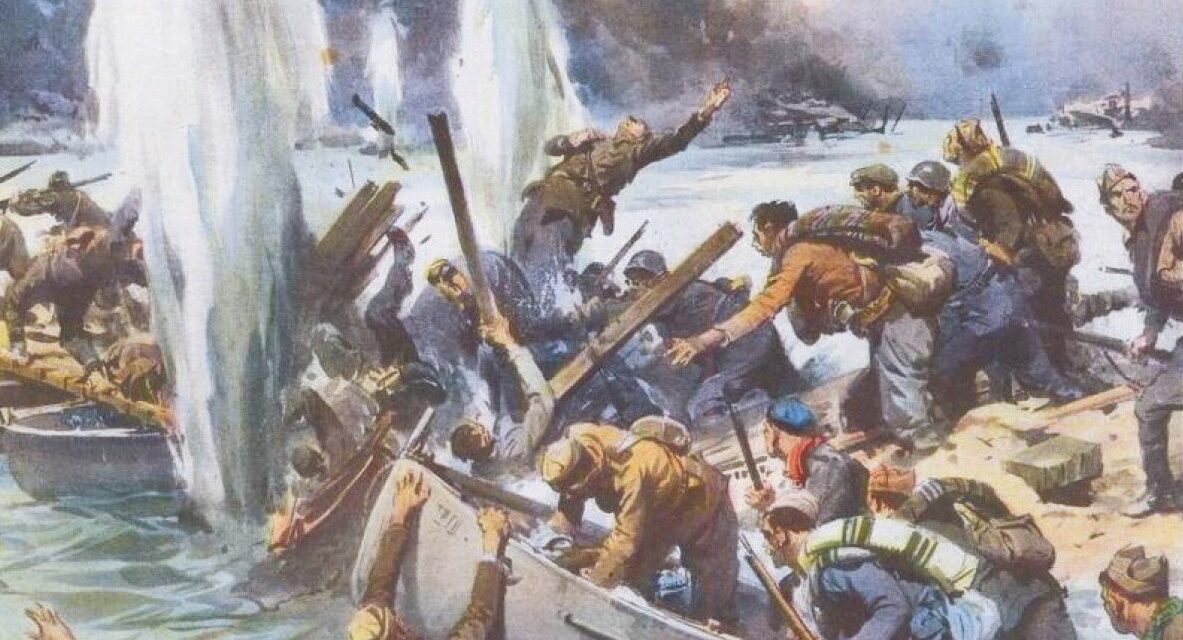
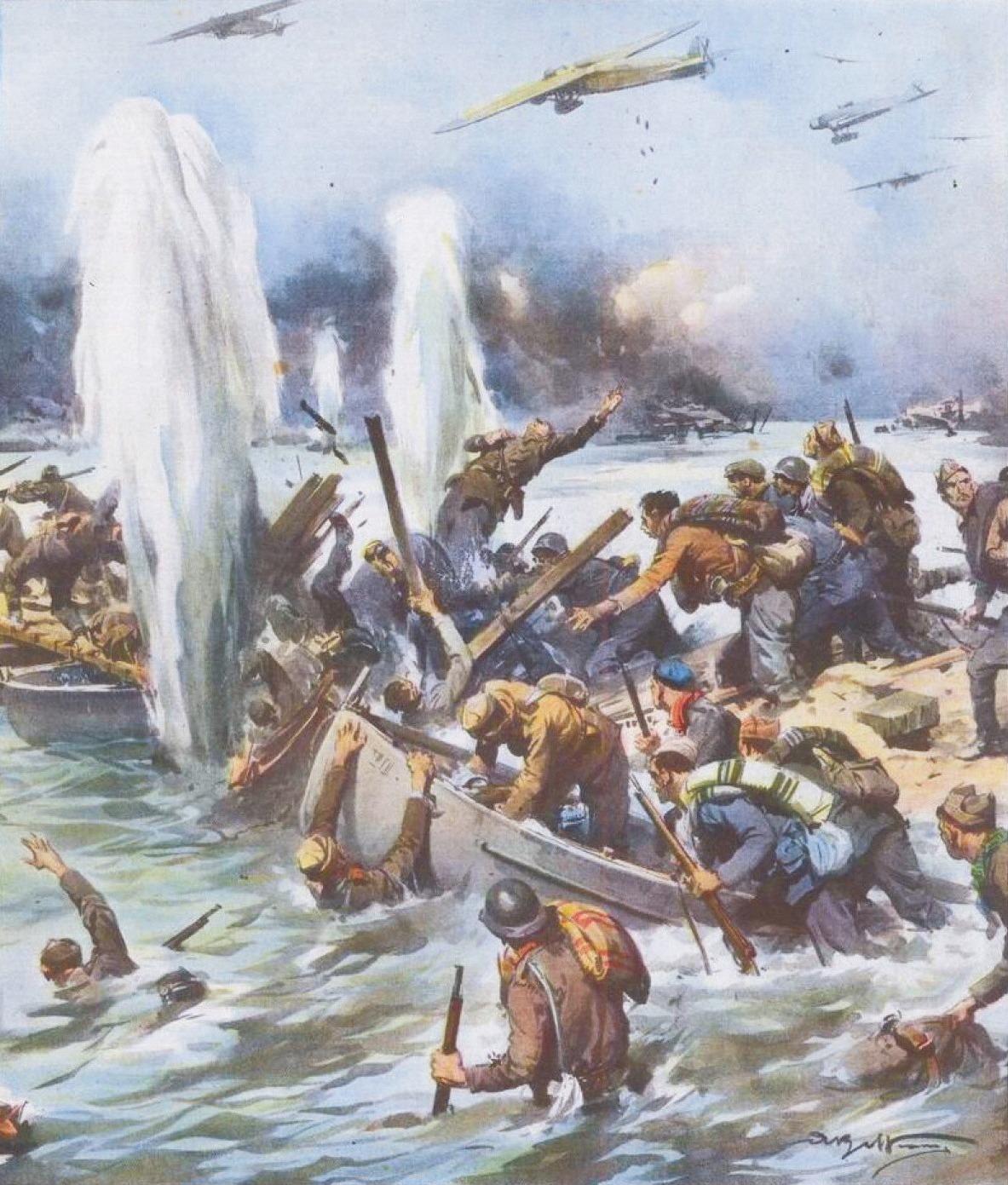
In the predawn hours of July 25, 1938, Republican troops crossed the river using rowboats, pontoon bridges, and improvised rafts along a broad front stretching many miles, catching Nationalist defenders largely by surprise and achieving rapid early gains that pushed several miles into enemy territory within the operation’s opening days, a degree of initial success that briefly raised Republican hopes the offensive might achieve far more than a mere propaganda gesture. The crossing itself was a considerable engineering and logistical achievement, conducted largely at night and under difficult river conditions with strong currents and limited equipment, with military engineers building and repeatedly repairing pontoon bridges that Nationalist aircraft targeted relentlessly once the offensive’s scale became clear, forcing repair crews to work under near-constant bombardment to keep supply lines open to the troops advancing on the far bank. Franco, recognizing the political stakes riding on the battle for both sides and unwilling to allow a Republican success that might sway international opinion at a critical moment, diverted substantial forces and airpower from other fronts to contain and then reverse the Republican advance, transforming what began as a fast-moving offensive into a grinding battle of attrition around the town of Gandesa and the surrounding hill country of the Terra Alta, terrain that offered little cover and became a killing ground for both armies as the summer wore on into a punishing Mediterranean heat that compounded the misery of soldiers dug into barren hillsides.
The Battle of the Ebro
After the initial Republican advance stalled short of Gandesa in early August, the battle settled into a brutal, months-long struggle over a series of barren, sun-scorched hills, where Nationalist artillery and the era’s most sophisticated air power, including German and Italian squadrons flying in support of Franco’s forces, pounded Republican positions with a relentlessness that soldiers on both sides described as unlike anything else in the war. Jack Jones, a British volunteer wounded at the Ebro who later became a major UK trade unionist, described a field hospital near Hill 481 as being “like an abattoir; blood everywhere,” a description that captured the extraordinary casualty rates the fighting produced on both sides throughout the late summer.
International Brigade units, including the British Battalion and the American Abraham Lincoln Battalion under commander Milton Wolff, fought through repeated Nationalist counterattacks aimed at retaking the hills the Republicans had captured in the offensive’s opening days, often holding positions for weeks under continuous bombardment with dwindling supplies and reinforcements. Peter Kerrigan, political commissar of the British Battalion, later described the battalion’s final three days of combat in September 1938 as “a tragic and heartbreaking end,” reflecting the exhaustion and mounting losses that had ground down even the war’s most committed international volunteers by the battle’s closing weeks. Nationalist forces, benefiting from superior artillery, air support, and a steady stream of reinforcements that the increasingly isolated Republic could not match, gradually pushed the Republican army back across the hills it had won in July, retaking ground meter by meter through a series of costly, methodical counteroffensives launched through August and September, often measured in the capture of a single ridge or hilltop after days of bombardment.
By mid-November 1938, after nearly four months of continuous fighting, Republican forces had been pushed back across the Ebro River to roughly their starting positions, having suffered catastrophic casualties, with estimates of combined losses on both sides running well into the tens of thousands killed, wounded, and captured, a toll historians still cite as the single bloodiest of the entire Spanish Civil War. The battle’s staggering cost, absorbing men and materiel the Republic could not replace, left its army critically weakened at precisely the moment Franco was preparing the final offensive against Catalonia that would follow within weeks, making the Ebro not the turning point Republican planners had hoped for but instead the battle that broke the back of organized Republican resistance in the war’s last full year of fighting. Both sides, and the international volunteers fighting alongside the Republic in particular, would later describe the Ebro’s 115 days as a uniquely exhausting ordeal, one fought under conditions of heat, thirst, and near-constant aerial bombardment that distinguished it even from earlier, already brutal engagements of the war.
The Legacy of the Ebro
The Battle of the Ebro proved the single costliest engagement of the Spanish Civil War, and its outcome sealed the fate of Catalonia, which fell to Nationalist forces within months of the Republican retreat back across the river. The International Brigades, having suffered enormous losses in the battle’s final stages, were formally withdrawn from Spain shortly afterward as the Republican government sought to bolster international sympathy by demonstrating good faith to a League of Nations commission, a gesture that came too late to alter the war’s outcome and left many volunteers processing the loss of comrades who had fallen in the Terra Alta hills. For the volunteers who survived it, the Ebro remained the defining memory of their service in Spain, a battle whose ferocity and human cost exceeded anything most of them had previously experienced, and one that many later recalled as the moment they understood the Republic’s cause, however just they still believed it to be, could no longer be won on the battlefield alone.
Visiting the Ebro Today
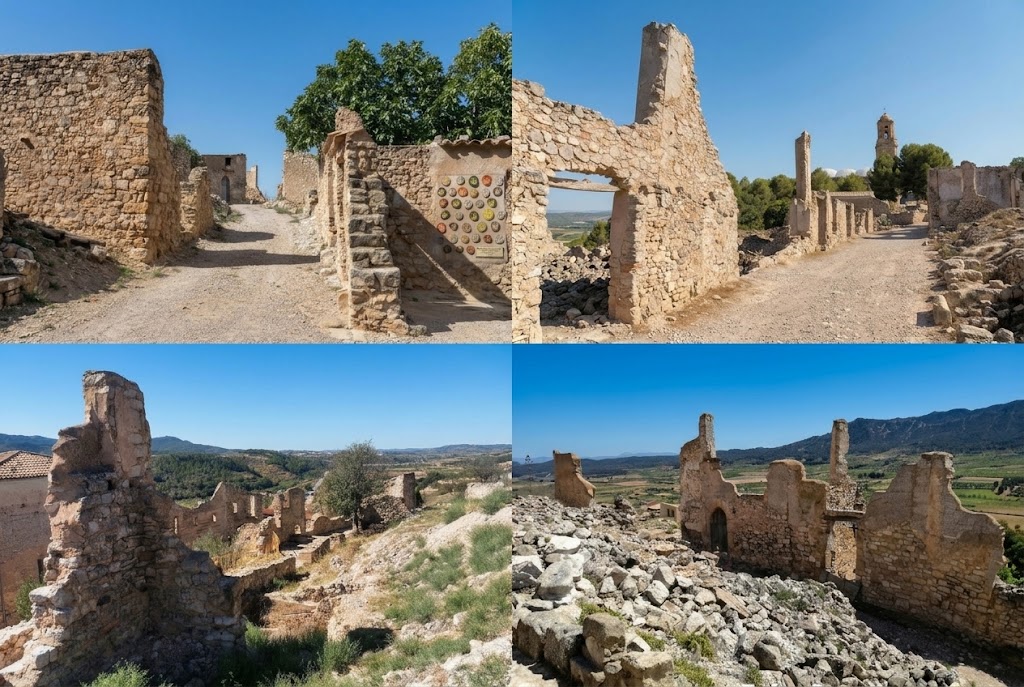
The Terra Alta region of Catalonia today maintains an active memorial network run by COMEBE, the Consorci Memorial dels Espais de la Batalla de l’Ebre, with interpretation centers and preserved sites spread across several villages including Corbera d’Ebre, Gandesa, Batea, El Pinell de Brai, La Fatarella, and Vilalba dels Arcs. The flagship site, the Poble Vell de Corbera d’Ebre, preserves the bombed ruins of the original village exactly as they were left after the fighting destroyed it, an unrestored memorial whose roofless stone houses and rubble-strewn streets stand alongside an adjoining interpretation center covering the battle’s full “115 days” of combat. The network’s sites keep seasonal, weekend-weighted hours and charge modest entry fees, though some nodes close periodically for conservation work, making it worth checking current hours at batallaebre.org before setting out.
Gandesa serves as a natural base for visitors exploring multiple sites across the region, with Tortosa and Tarragona standing as the nearest larger towns offering fuller lodging and transport options, and the surrounding wine country of the Terra Alta appellation gives visitors a reason to extend a stay in the area beyond the battlefield sites themselves. A single site visit runs roughly 45 to 90 minutes, while touring several of the network’s locations across the Terra Alta hills makes for a half-day to full-day trip through the same terraced, sun-baked terrain that Republican and Nationalist soldiers once fought over hill by hill. The Poble Vell’s roofless houses and rubble-choked lanes remain open to the elements year-round, left deliberately unrestored so that visitors encounter the village much as the fighting left it rather than as a reconstructed or sanitized version of the site.
Remembrance of the Ebro
Peter Kerrigan, political commissar of the British Battalion of the XV International Brigade, described the unit’s final three days of combat in September 1938 as a tragic and heartbreaking end, an account preserved in the International Brigade Memorial Trust’s educational materials on the offensive. Jack Jones, a British volunteer wounded during the fighting who went on to become a major United Kingdom trade unionist, recalled the horror of a field hospital near Hill 481 in his 1986 autobiography, describing conditions there in stark, unflinching terms. Milton Wolff, the last commander of the American Abraham Lincoln Battalion, fought through the battle’s grinding months on the hills above Gandesa, his experience documented alongside those of other American volunteers in later historical accounts of the International Brigades. Taken together, these three accounts, a political commissar’s elegy for his exhausted battalion, a future labor leader’s memory of a makeshift hospital’s horrors, and an American commander’s firsthand experience of the war’s longest battle, preserve the Ebro through the eyes of volunteers who came from across the world to fight in hills whose names most of them had never heard before that summer, and whose testimony has since become central to how historians and the memorial network itself now interpret the battle for visitors walking the same ground today.
Visitor Info: Ebro Battlefield Memorial (Consorci Memorial dels Espais de la Batalla de l’Ebre)
Location: Poble Vell de Corbera d’Ebre, Carrer Doctor Ferran, s/n, 43784 Corbera d’Ebre, Tarragona, Spain
Site Status: National Park/Managed Historic Site
Visitation Notes: The Terra Alta region maintains an active memorial network run by COMEBE (Consorci Memorial dels Espais de la Batalla de l’Ebre), with interpretation centers and preserved sites across several villages, including Corbera d’Ebre, Gandesa, Batea, El Pinell de Brai, La Fatarella, and Vilalba dels Arcs. The flagship site is the Poble Vell de Corbera d’Ebre, the bombed ruins of the original village left unrestored as a memorial after being destroyed during the battle, with an adjoining interpretation center covering the ‘115 days’ of fighting. Sites keep seasonal, weekend-weighted hours and charge modest entry fees; some network nodes close periodically for conservation work, so current hours should be checked at batallaebre.org before visiting. Gandesa serves as a natural base for exploring multiple sites, with Tortosa and Tarragona as the nearest larger towns. A single site visit runs about 45–90 minutes; touring several sites is a half-day to full-day trip.
Google Map
Visitor Comments
A visitor named 829apple called Poble Vell a really interesting, deserted village left standing since the Spanish Civil War.
— from TripAdvisor
Javier G described Corbera Vell as pure historical memory, calling it scars that must survive so the past isn’t forgotten.
— from TripAdvisor
AlbertSalichs found the remains of the bombed town genuinely moving, noting they were destroyed by fascist aviation during the Spanish Civil War.
— from TripAdvisor
Stella S gave a more mixed review, noting the site’s signage is mostly in Catalan only, which made it difficult for English-speaking visitors to follow.
— from TripAdvisor