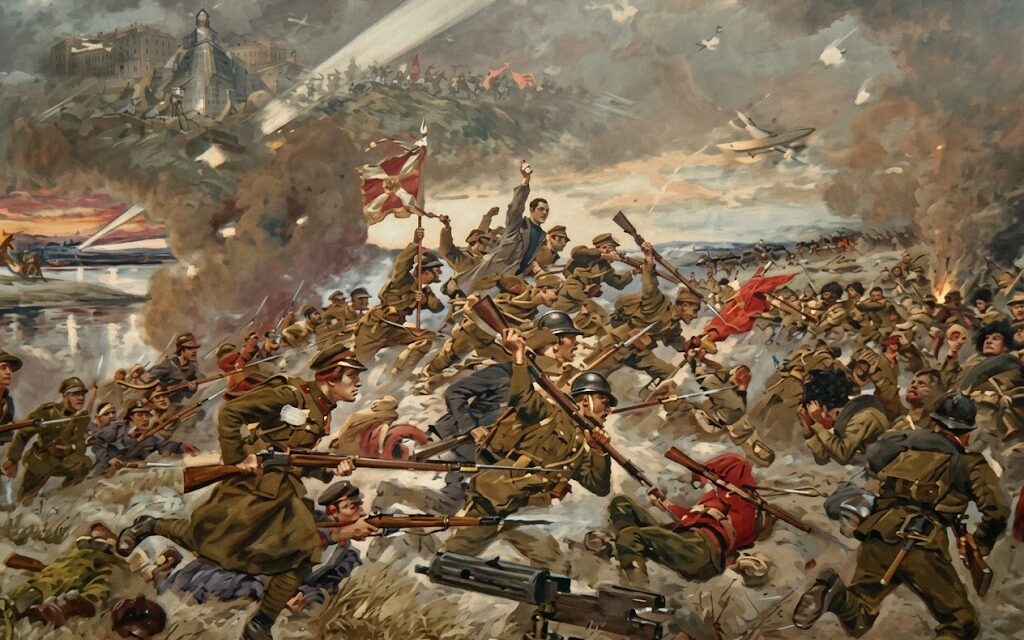
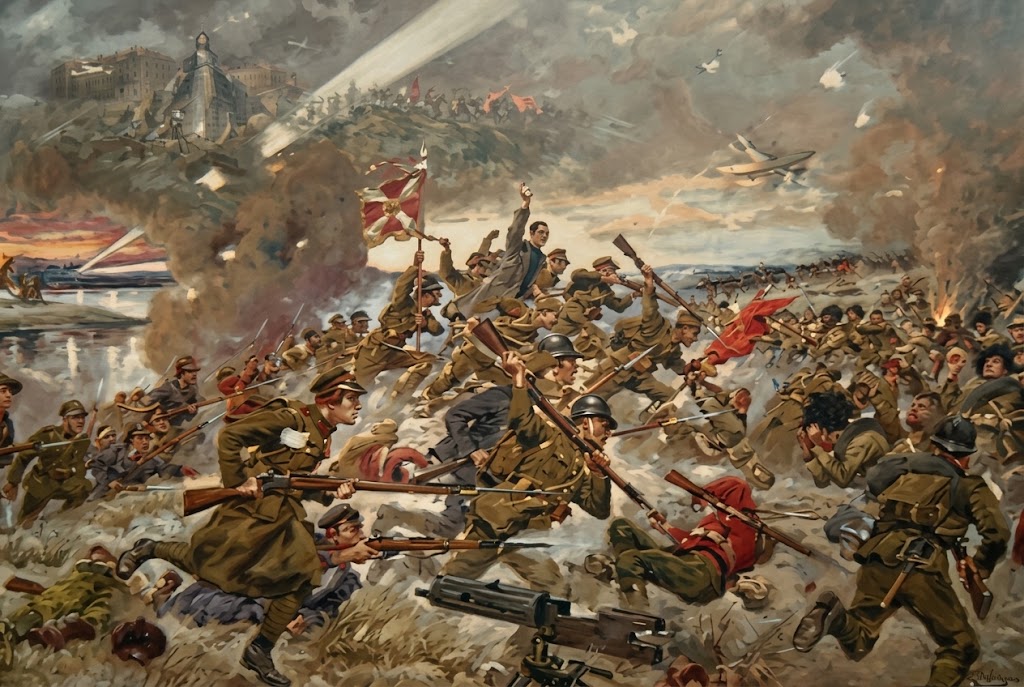
The priest ran forward without a rifle. Father Ignacy Skorupka, a chaplain attached to a regiment of teenage volunteers thrown into the line with barely any training, raised a crucifix over his head and led the counterattack himself when the young soldiers around him began to waver under fire. He was killed within moments, cut down before he had gone more than a few steps, but the men he’d rallied held the line at Ossów that morning, and Poland, against nearly every expectation two weeks earlier, held Warsaw.
Warsaw 1920: The Road to Battle
By the summer of 1920, the newly independent Second Polish Republic, reconstituted only two years earlier after more than a century of partition among neighboring empires, found itself fighting for its survival against the westward advance of Soviet Russia’s Red Army. What began as a Polish offensive into Ukraine the previous spring, part of an attempt to secure Poland’s eastern borders while Soviet Russia was still consumed by its own civil war, had turned into a headlong Soviet counteroffensive that pushed Polish forces back hundreds of miles in a matter of weeks, and by early August Soviet commanders believed Warsaw itself, and with it the collapse of the fragile new Polish state, was within reach.
Soviet leadership saw the campaign as more than a border dispute: a Polish collapse, in Lenin’s own strategic calculation, could open a direct route for revolutionary momentum to spread into a defeated, economically shattered, and politically unstable Germany, making the battle for Warsaw a contest over the future shape of Central Europe rather than a purely territorial fight between two neighboring states. Polish commander Jozef Pilsudski, along with French military advisors attached to the Polish army as part of a broader Allied mission to support the new state, devised a bold and considerably risky counteroffensive plan that depended on holding the Soviet main thrust just outside Warsaw while a separate strike force, assembled in secret and stripped from other parts of the front, hit the exposed Soviet flank from the south once the Red Army’s attention was fully fixed on the capital.
The Battle of Warsaw
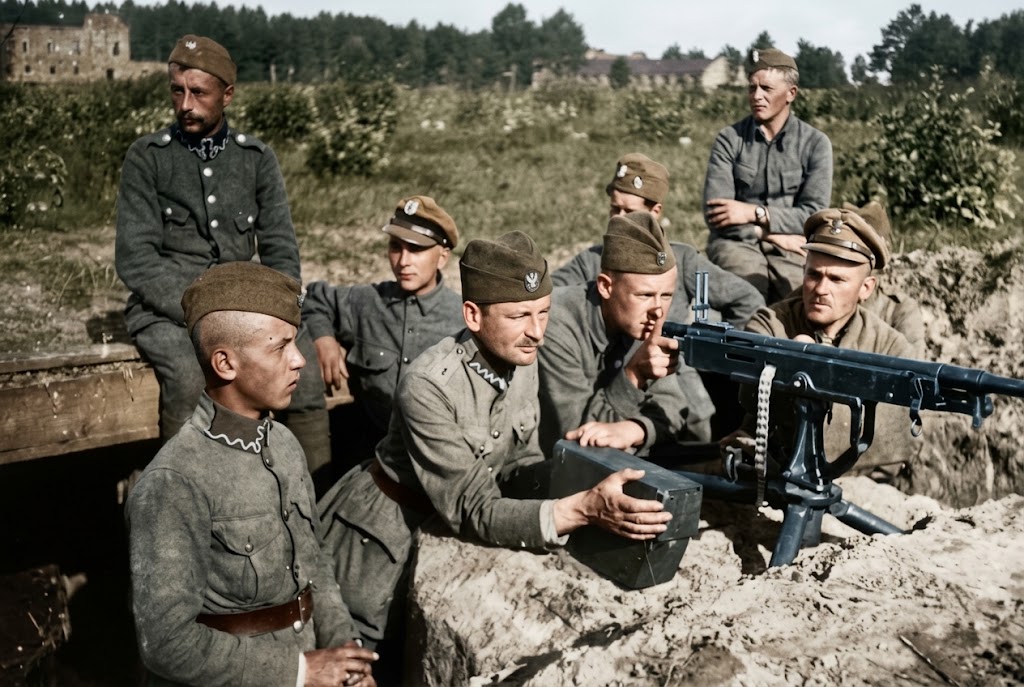
The battle’s opening and most desperate phase unfolded around the village of Ossów, northeast of Warsaw, where a hastily organized Polish volunteer force, including the 236th Infantry Regiment made up largely of civilian volunteers and students with little formal training, faced the advancing Soviet 16th Army on August 14, 1920. Father Ignacy Skorupka, the regiment’s military chaplain, was killed while ministering to troops under fire and, according to accounts corroborated by contemporary military dispatches, personally rallying wavering volunteers forward at a critical moment when the inexperienced line looked close to breaking; he was posthumously awarded Poland’s highest military honor, the Virtuti Militari, and his death at Ossów became one of the battle’s most enduring symbols, immortalized soon afterward in Polish popular memory as a moment when an untested citizen army held its ground against a hardened professional force.
Colonel Z. Podhorski’s 203rd Lancer Regiment carried out a raid near Ciechanów on August 8 that destroyed a Soviet 4th Army radio station, an episode remembered in Polish military history as the “Miracle of Ciechanów” for how thoroughly it disrupted Soviet communications at a critical juncture, cutting off Soviet commanders from timely information about Polish troop movements just as Pilsudski’s counteroffensive was taking shape. Further cavalry actions followed in the days after, including a charge documented by Colonel A. Zakrzewski at Milewo north of Warsaw, while a French technical advisor attached to Polish forces, Colonel Loir, recorded a separate raid carried out by the Polish 8th Cavalry Brigade, part of the wider eyewitness record left by the French military mission assisting Poland during the campaign. These cavalry operations, individually modest in scale, cumulatively deprived Soviet field commanders of the coordination and communication their rapid advance had depended on.
While the Ossów line held against direct assault, Pilsudski’s flanking force struck south of the city on August 16, catching Soviet forces still oriented toward the capital and rolling up their exposed rear areas before commanders on the Soviet side fully grasped what was happening. By August 25, the Red Army’s westward drive had been broken and thrown into a disorganized retreat back toward Soviet territory, a reversal so sudden and complete relative to the desperate circumstances of just two weeks earlier that Polish accounts came to call it the “Miracle on the Vistula,” a name that stuck precisely because so few observers on either side, Polish or Soviet, had expected the battle to end this way.
The Legacy of Warsaw 1920
The Polish victory preserved Poland’s newly restored independence and halted the westward spread of Soviet influence into Central Europe for two decades, an outcome some historians have argued changed the course of European history by denying the Soviet Union a direct route into a revolution-vulnerable Germany at a moment when Communist movements elsewhere in Europe were watching Moscow’s fortunes closely. The battle remains a defining moment of Polish national memory, credited with securing the survival of the interwar Polish state at a moment when its collapse seemed close to inevitable, and its unlikely, come-from-behind character has kept it a touchstone of Polish national identity through the occupations and political upheavals that followed over the rest of the twentieth century.
What Remains at Warsaw 1920
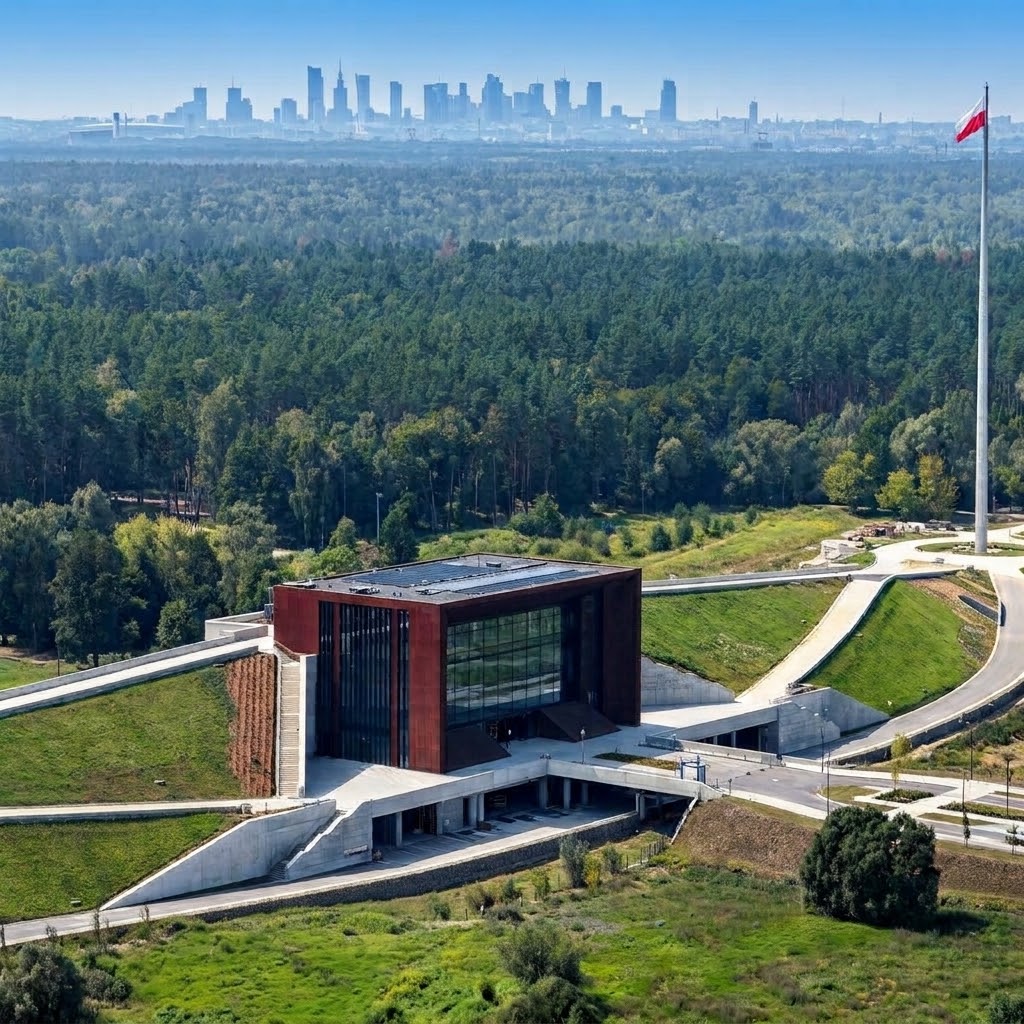
Because the battle was fought across what are now Warsaw’s built-up northeastern suburbs, most of the actual ground is no longer open countryside available to walk as a battlefield in the traditional sense, having been absorbed into the modern city’s expansion over the century since the fighting. A dedicated Museum of the Battle of Warsaw 1920 opened in 2025 at Ossów, built on the actual site where Father Skorupka was killed, alongside scattered monuments and a memorial chapel in nearby Radzymin that mark the wider battle area for visitors willing to travel slightly outside the city center. The Polish Army Museum, centrally located at Warsaw’s Citadel, also covers the 1920 campaign within its broader collection of Polish military history.
Museum admission is paid at both institutions, while the outdoor monuments around Ossów and Radzymin remain freely accessible at any time with no fee or booking required. The accounts quoted below in “What Others Have Experienced” describe visits to the Polish Army Museum’s collection rather than a walk across the historic battlefield itself, since the fighting ground around central Warsaw has since been built over and the Ossów site, while newly developed, remains a smaller and more specialized destination than the Citadel museum.
Remembrance at Warsaw 1920
The battle is formally commemorated every August 15 on Poland’s Armed Forces Day, a date chosen specifically to mark the anniversary of the Soviet retreat and the “Miracle on the Vistula,” with a military parade held in Warsaw and additional ceremonies conducted at battle sites including Ossów and Radzymin; the date’s dual significance, coinciding with the Catholic feast of the Assumption, has given the anniversary an added layer of resonance in a country where Father Skorupka’s death and the battle’s unlikely outcome have long been woven together in popular memory. The new 2025 museum at Ossów gives that annual commemoration a permanent home tied directly to the ground where Father Skorupka fell, anchoring what had previously been a more scattered set of memorials, spread across Ossów’s chapel and Radzymin’s monuments, into a single dedicated site for remembering the campaign — its opening more than a century after the battle reflects a renewed institutional effort to preserve a site whose direct physical connection to the fighting had, until recently, been marked mainly by modest local memorials rather than a purpose-built museum.
Visitor Info: Feature film titled “1920 Bitwa Warszawska” (dir. Jerzy Hoffman, 2011)
Location: Museum of the Battle of Warsaw 1920, Ossów, Wołomin County, Mazovia, Poland (opened 2025 at the site of the Battle of Ossów; also Polish Army Museum, Warsaw Citadel)
Site Status: Marker or Monument Only
Visitation Notes: The battle was fought across what are now Warsaw’s built-up northeastern suburbs, so most of the ground itself is no longer open countryside, but a dedicated Museum of the Battle of Warsaw 1920 opened in 2025 at Ossów, on the actual site where chaplain Fr. Ignacy Skorupka died, alongside scattered monuments and a memorial chapel in nearby Radzymin. The Polish Army Museum, centrally located at Warsaw’s Citadel, also covers the battle within its broader collection. Museum admission is paid at both sites, while outdoor monuments remain freely accessible at any time. The battle is formally commemorated every August 15 on Poland’s Armed Forces Day, marked with a military parade in Warsaw and ceremonies at battle sites.
Google Map
Visitor Comments
James N noted the Polish Army Museum’s move to its new home at the Warsaw Citadel, calling it a completely new space that offers visitors an excellent experience spanning centuries of Polish military history.
— from TripAdvisor
Jarid B described the museum’s layout as walking through the Polish Armed Forces’ history in chronological order, roughly 1800 through 1970, and singled out the outdoor tank, artillery, and aircraft display as a highlight, calling the armor collection unreal.
— from Google Maps via Wanderlog
Marius P noted the museum works well for a family visit with children, though was disappointed to find no gift shop on site, and mentioned the museum’s Google Maps location pin currently points to the wrong spot on the Citadel grounds.
— from Google Maps via Wanderlog
A visitor to the Charles de Gaulle monument in Warsaw, Raintree_Thailand, explained that de Gaulle served as a member of the French Military Mission sent to help strengthen Poland’s armed forces in the aftermath of the First World War.
— from TripAdvisor