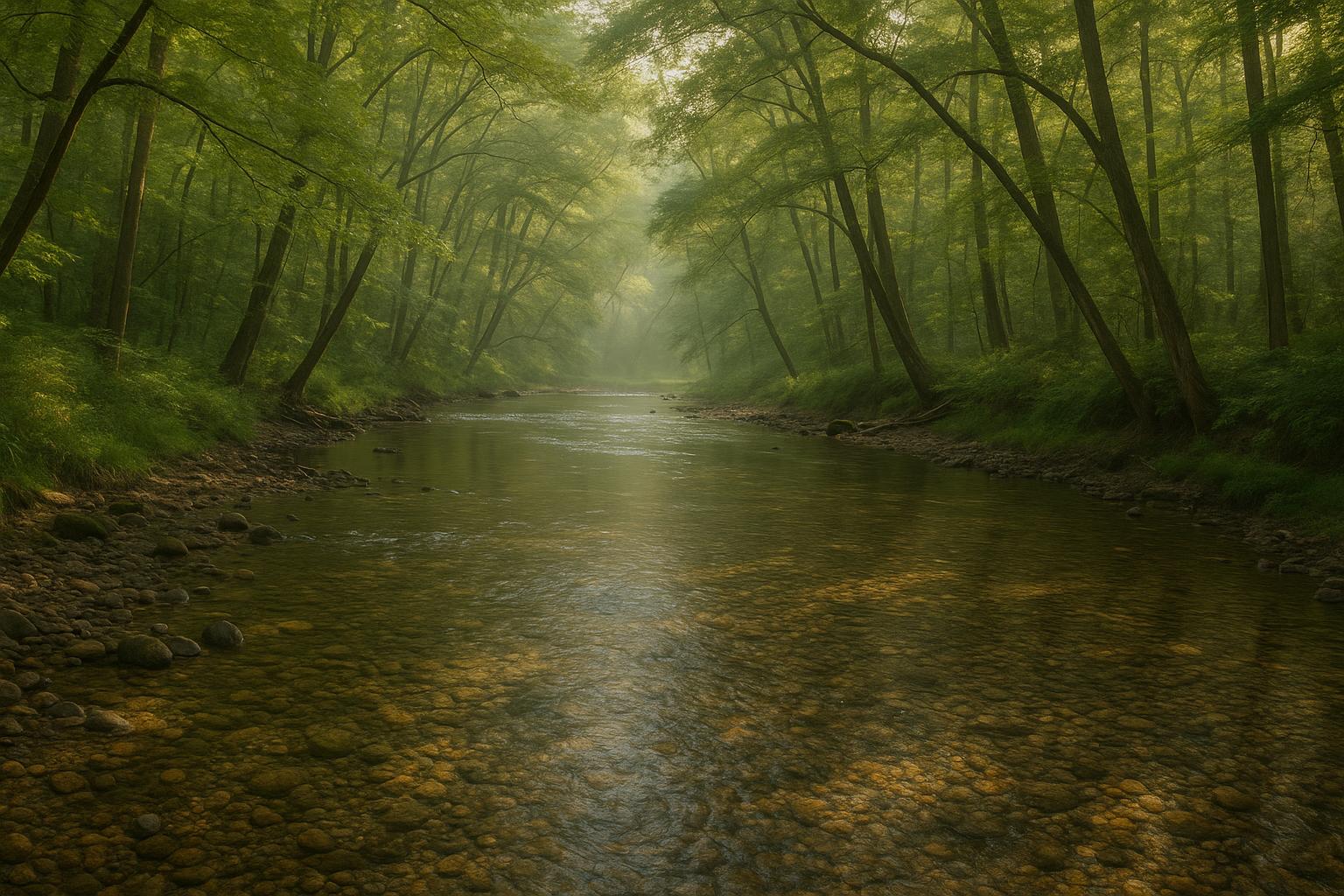
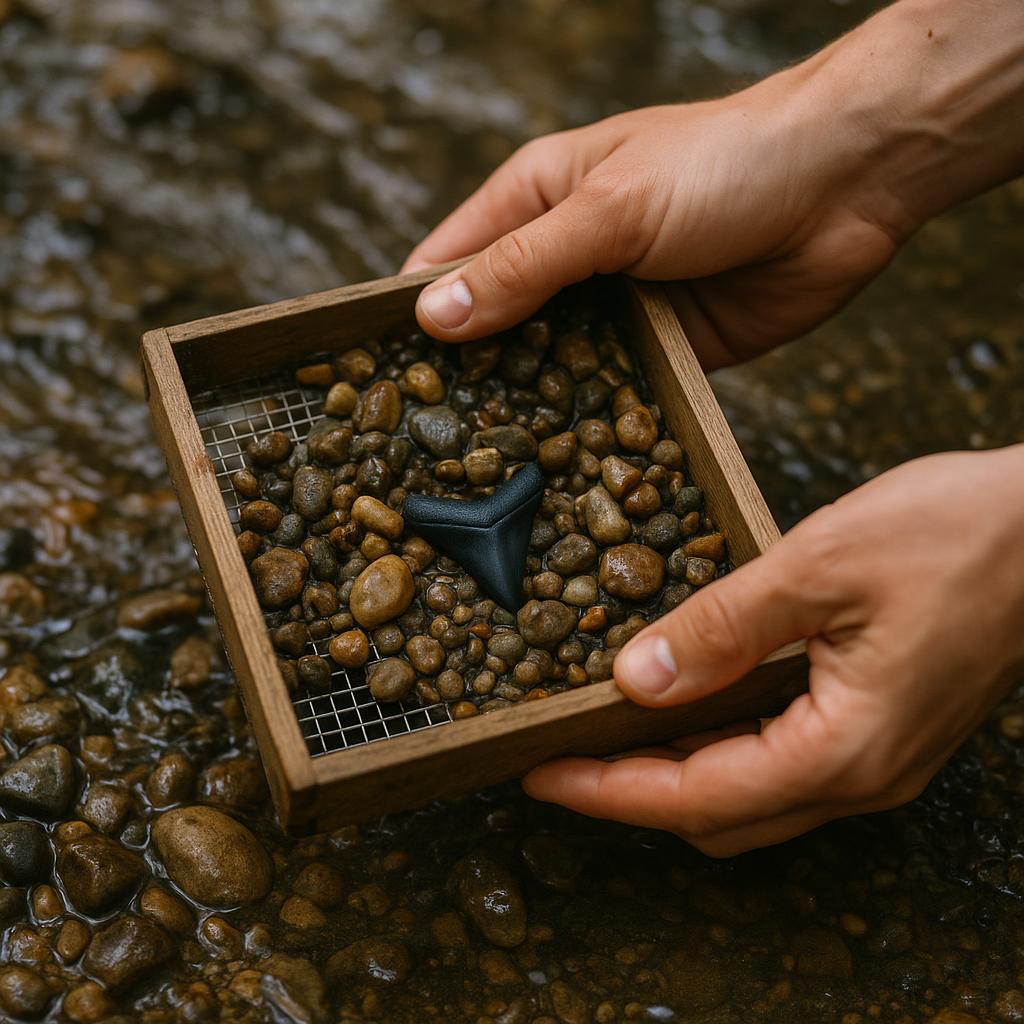
The stream is barely knee-deep in most places, clear enough to see every pebble on the bottom, and cold enough in early spring to numb bare hands within minutes. That doesn’t stop anyone. A screen dips below the surface, gets a slow shake, and the gravel left behind gets picked apart one piece at a time — until something dark and glossy turns up that’s shaped nothing like a stone. It’s a shark’s tooth, and it’s been sitting in this New Jersey streambed since a time when the water above it was a shallow sea patrolled by animals that don’t exist anywhere on Earth today.
Big Brook Preserve: New Jersey’s Cretaceous Streambed
Big Brook Preserve sits in Colts Neck, New Jersey, at 95 Hillsdale Road, a modest township and county park built around a stream that happens to cut directly through sediment dating back roughly 65 million years, to the very end of the Cretaceous period. That timing matters enormously to fossil hunters: this was the last chapter of the age of dinosaurs, and the seas that once covered this part of New Jersey were home to sharks, mosasaurs, and other marine reptiles whose remains settled into the layers the brook is still eroding today. Every time the stream rises and falls, it reworks its own bed, exposing fossils that had been buried in sediment that’s been accumulating and shifting for tens of millions of years. Unlike a static quarry face, Big Brook is a living system — the water is doing the excavation work constantly, year-round, without anyone needing to lift a shovel into the surrounding land.
What makes Big Brook significant within the fossil-hunting world is the combination of its age and its accessibility. Cretaceous-era marine fossils of this quality aren’t common finds anywhere in the country, let alone in a public park a short drive from major population centers in New Jersey. Shark teeth are the most frequent find in the streambed, but the same layers have also produced mosasaur fossils — remains of the large, formidable marine reptiles that ruled these ancient seas at the very end of the dinosaur era. Mosasaurs were apex predators of their era, and finding even a fragment associated with one connects a hunter directly to the top of a Cretaceous marine food chain that vanished entirely at the same mass extinction that ended the age of dinosaurs on land. That combination has made Big Brook a well-known destination for both casual hobbyists and serious collectors looking for genuine Cretaceous material without needing a private lease or a commercial dig operation. For many East Coast hobbyists, it’s the closest thing to a guaranteed introduction to real vertebrate paleontology: no travel to a remote quarry out west, no pay-to-dig fee, just a public stream that happens to sit on top of one of the more productive small Cretaceous exposures in the region.
Fossiling Under Township Rules
Big Brook Preserve operates under Colts Neck Township and Monmouth County Park System rules that are unusually specific for a fossil-collecting site, a reflection of just how much interest this small streambed draws from hunters year after year. Collecting is permitted only within the active streambed itself, meaning digging into the stream banks above the waterline is off-limits — a rule that protects the surrounding land from erosion while still leaving the naturally reworked gravel in the water open to anyone willing to wade in and search it. Township ordinance caps what a single hunter can take home at five fossils per person per day, a limit designed to keep the resource available for the next visitor rather than letting any one person clear out a productive stretch of gravel in a single outing. It’s a modest limit, but a deliberate one, and it reflects a broader philosophy running through all of Big Brook’s rules: the site is meant to be shared indefinitely, not maximized by any single visit.
Tool restrictions are just as specific. Collectors are limited to a trowel blade no longer than six inches and a sifting screen no larger than eighteen inches, rules that keep the activity to hand-scale searching rather than allowing larger excavation equipment that could damage the streambed or the surrounding preserve. Larger groups face an additional requirement: any group of fifteen or more visitors must obtain a permit in advance from the township before showing up to collect, a rule clearly aimed at managing the site’s popularity and preventing large, unmanaged crowds from overwhelming a fairly small stretch of stream. These rules are documented directly in the Township of Colts Neck Code, Article VII, which specifically governs Big Brook Preserve, along with supplemental fossiling rules published by the Monmouth County Park System — a level of formal, written regulation that’s rare for a site this size, and a clear sign of how seriously the township takes both public access and resource protection here. That written framework gives visitors something many informal fossil sites lack: a clear, published set of expectations, rather than a patchwork of unwritten local custom that varies depending on who happens to be at the park that day.
That regulatory structure is part of what makes Big Brook such a well-functioning example of public fossil collecting: specific enough to prevent the site from being stripped or damaged, but permissive enough that an ordinary visitor with a small trowel and a screen can still walk away with real Cretaceous shark teeth on a weekend afternoon. It’s a model that other small public fossil sites around the country could reasonably learn from — narrow enough in scope to protect a fragile, popular resource, but clear enough in its rules that a first-time visitor can read the requirements in a few minutes and know exactly what’s expected before ever stepping into the water.
Visiting Big Brook Preserve Today
Big Brook Preserve remains open to public fossil collecting today, with collecting restricted to the active streambed and capped at five fossils per person per day. Tools are limited to a six-inch trowel blade and an eighteen-inch sifting screen, digging into the stream banks above the waterline is prohibited, and groups of fifteen or more need to secure a permit from the township in advance of a visit.
The stream itself demands real caution despite its modest size. In places it reaches up to four feet deep, with slippery gravel underfoot and unexpected deep holes that can catch a visitor off guard. The streambed is uneven and slick throughout, and waders are strongly recommended over ordinary boots for anyone planning to spend real time searching the gravel. Deep holes can appear with little visible warning even in otherwise shallow-looking sections, so testing footing carefully before committing weight to a step is worth the extra few seconds it takes. None of that makes Big Brook difficult to visit responsibly — it’s a well-established, well-documented public site — but it does mean coming prepared for wet, slippery conditions rather than a dry walk in the park. Many regular visitors treat a pair of chest waders as essential gear rather than an optional extra, precisely because the depth and footing can change from one bend in the stream to the next.
The Legacy of Big Brook Preserve
Big Brook Preserve matters to fossil hunters because it proves genuine Cretaceous-era material, the kind associated with mosasaurs and the last sharks of the dinosaur age, doesn’t have to be locked away in a museum collection or a private quarry to be accessible to the public. A township park with a five-fossil daily limit and a short list of tool restrictions has managed to stay open and productive for generations of local and visiting collectors alike. For anyone serious about the hobby, that’s a rare thing worth knowing about: 65 million years of history, reachable with a small trowel and a sifting screen, in a stream that keeps giving up new material every time it rises and falls.
Story Source: www.fossilguy.com
Location: Big Brook Preserve, 95 Hillsdale Rd, Colts Neck, NJ 07722
Site Status: Open to public collecting
Legal Conditions: Big Brook Preserve is a Colts Neck Township/Monmouth County park (Tier 3 local ordinance, Verified), open to fossil collecting within the active streambed only. Township rules cap collecting at 5 fossils per person per day, restrict tools to a 6-inch trowel blade and 18-inch sifting screen, and prohibit digging into the stream banks above the waterline; groups of 15 or more must obtain a permit in advance. Source: Township of Colts Neck Code, Article VII (Big Brook Preserve); Monmouth County Park System, “Supplemental Rules for Fossiling at Big Brook Park.”
Hazards: Drowning/strong current (stream can reach up to four feet deep in spots, with slippery gravel and deep holes); Difficult terrain/altitude/remote access (uneven, slick streambed — waders are recommended over ordinary boots).
Google Map
Firsthand Accounts
Fossil collector Derek Yoost recounted his first Big Brook trip in a firsthand narrative for Lapidary Journal, describing how field-trip leader Louise Schwartz — a veteran collector who insisted on waders — guided him and his fiancee Annette Beale to the gravel bars, where they found nearly 100 shark teeth (including an extinct crow shark tooth) and narrowly missed a mosasaur tooth found by another club member just upstream. Source: Derek Yoost, Lapidary Journal, August 1995 (pp. 67-68, 117-119).
Collector Ned Gilmore, who has hunted Big Brook fossils since 1984, described the site’s abundance and variety to a reporter, noting that alongside common shark teeth from species like Squalicorax and Scapanorhynchus, the brook has also produced rare mosasaur, plesiosaur, and dinosaur remains, plus a surprising Pleistocene fauna of mammoths and giant ground sloths. Source: Derek Yoost, Lapidary Journal, August 1995 (quoting Ned Gilmore).
Monmouth County collector Paul Kovalski discovered a hadrosaur (duck-billed dinosaur) bone in Big Brook in December 2008, a find significant enough that a tributary of the brook was later named the Paul Kovalski Tributary in his honor. Source: “Sifting Through the Past: New Jersey’s Fossils,” New Jersey Monthly.