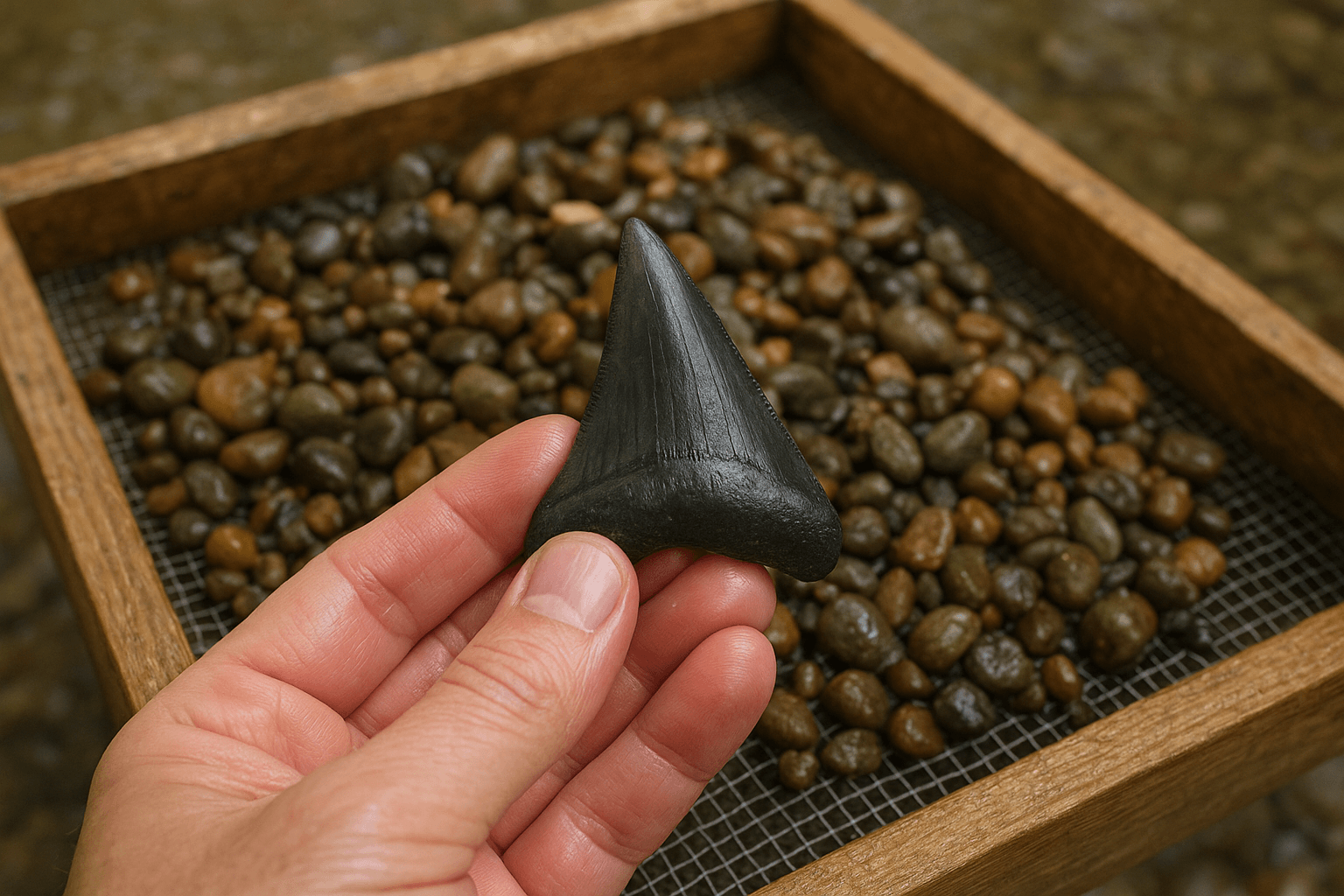
The gravel bar looks like nothing at first, just a low stretch of dark sand and pebbles exposed where the river bends. Then a shape catches the eye — a triangle of glossy black, smooth-edged, heavier than it looks when it’s finally pulled free of the mud. It’s a shark’s tooth, and it’s been waiting here since long before Florida looked anything like it does today. Somewhere upstream, the current is still working the same ancient layer loose, tooth by tooth, for whoever wades in next.

Peace River: Florida’s Fossil-Rich Waterway
The Peace River winds through Arcadia, Zolfo Springs, and the surrounding stretches of DeSoto and Hardee Counties in central Florida, cutting through layers of sediment that have been accumulating and eroding for millions of years. Much of what the river exposes dates to the Miocene epoch, a period when Florida sat under shallow, shark-rich seas, and the riverbed and gravel bars are full of the fossilized remains that period left behind. Shark teeth are the most common find, ranging from small Miocene species to the larger, denser teeth associated with ancestral relatives of the modern great white and the giant extinct megalodon, whose serrated black teeth are among the most sought-after finds on the river. The river’s slow, steady erosion means the same stretch of gravel bar can look completely different from one season to the next, as older layers are exposed and reworked by every rise and fall of the water. That constant reshuffling is also why experienced hunters return to the same bars repeatedly rather than treating any single visit as a one-time search — a bar picked over in the spring can look entirely different, and produce entirely new material, once summer rains have moved enough sediment downstream.
What makes the Peace River significant to fossil hunters isn’t just the sheer volume of material eroding out of its banks and gravel bars — it’s that Florida law treats much of what turns up here differently than fossils found almost anywhere else in the country. Under Florida Statutes 1004.57 and 1004.575, fossil plants, invertebrates, and shark or stingray teeth collected from state lands, which includes most stretches of the river outside designated state parks, can be kept for personal use without any permit at all. That’s a rare arrangement, and it’s the reason the Peace River has built a reputation among rockhounds and fossil enthusiasts as one of the most accessible fossil-hunting destinations in the eastern United States, a place where a first-time hunter with nothing more than a mesh screen and a pair of wading boots can walk away with a real, keepable piece of prehistoric Florida, no license, application, or fee required for the most common finds.
What the River Gives Up
The Peace River doesn’t require excavation in the way a dry quarry or exposed cliff face does — the river itself does the work, constantly cutting into its banks and reworking its gravel bars, and fossils simply appear among the rock and sediment for anyone willing to sift through it. Shark teeth dominate what’s found, and megalodon teeth in particular have made the Peace River something of a pilgrimage site within the fossil-hunting community, since the river is one of the more reliable places in the country for an ordinary visitor to find one without a boat, a permit, or a guided dive. Miocene-era shark species left behind teeth in a huge range of sizes and shapes, and the river’s constant erosion means that material once buried under sediment is regularly exposed and washed into new gravel bars each season, so the same stretch of river can keep producing finds year after year rather than being picked clean.
The Peace River isn’t only a shark tooth site, though — its layers also hold the remains of Ice Age mammals, and those finds sit under a different legal framework entirely. Bones from mammals like mastodons and giant ground sloths do turn up in the same gravel bars as shark teeth, but under Florida law, vertebrate fossils beyond fish and shark or stingray teeth require a separate Florida Fossil Permit, issued by the Florida Museum of Natural History for a $5 annual fee, before a hunter can legally keep them. That distinction matters and it’s worth knowing before wading in: a shark tooth found in the river bed is yours to keep on the spot, but a mammal bone found in the same handful of gravel is not, unless the $5 permit has already been secured ahead of time. Native American artifacts occupy a category of their own — they remain illegal to collect anywhere in the state under the separate Florida Historical Resources Act, regardless of what fossil permits a collector holds, and that line is enforced independently of the fossil-collecting rules entirely. It’s a distinction that surprises a lot of first-time hunters, who assume a single permit or a single set of rules governs everything that comes out of the riverbed, when in fact Florida has built three separate legal categories — permit-free fossils, permitted vertebrate fossils, and off-limits cultural artifacts — into what looks, from the water, like the exact same stretch of gravel.
That layered legal structure, resting on top of a river that genuinely produces fossils in volume, is what has made the Peace River one of the most talked-about fossil-hunting locations in the country. It rewards patience and a good eye rather than special equipment or a boat, and the sheer frequency of shark tooth finds keeps drawing hunters back to the same gravel bars season after season, generation after generation, in a state where most fossil-bearing ground is either privately held or locked up in a park.
Visiting the Peace River Today
The Peace River remains open to public collecting today, and fossil plants, invertebrates, and shark or stingray teeth can be gathered from state lands along the river, including most stretches outside designated state parks, without a permit. Anyone hoping to also keep vertebrate fossils like Ice Age mammal bones should secure the $5 annual Florida Fossil Permit from the Florida Museum of Natural History first, since that permit is required for those specific finds even though shark teeth themselves need no permit at all, and Native American artifacts remain off-limits to collect under separate state law no matter what permits are in hand.
The river carries real hazards alongside its fossil-hunting reputation, and they shouldn’t be treated lightly. American alligators and venomous snakes are present in and along the water, and the current can be strong, especially after rain, with submerged obstacles and snagged trees that can catch a hunter off guard. The riverbed itself is uneven and slippery, and some stretches are difficult enough that hunters end up carrying canoes over log jams or shallow sections rather than paddling through. Florida’s heat, sun, and biting insects are a constant as well, particularly outside the cooler months. None of that makes the river inaccessible, but it does call for real preparation, sturdy footwear, and caution rather than a casual wade in flip-flops.
The Legacy of Florida’s Peace River
The Peace River matters to fossil hunters because it’s a rare case where the law itself invites participation rather than restricting it — shark and stingray teeth here are legally collectible without a permit, in a river that has been reliably producing megalodon teeth and other Miocene fossils for generations of hunters. For anyone serious about the hobby, that combination of legal accessibility and genuine fossil abundance is hard to find anywhere else in the country, let alone in a single river system spanning multiple counties. It’s a place where the reward is directly tied to time spent looking rather than to expensive gear or insider knowledge, and where a single afternoon of sifting gravel can turn up a tooth that predates the state of Florida itself by millions of years, pulled from the same current that’s been delivering them to patient hands for as long as people have known to look.
Story Source: www.fossilguy.com
Location: Peace River, Arcadia/Zolfo Springs, DeSoto & Hardee Counties, FL
Site Status: Open to public collecting
Legal Conditions: Under Florida Statutes 1004.57/1004.575 (Tier 2 state law, Verified), fossil plants, invertebrates, and shark/stingray teeth collected from state lands (including most river stretches outside state parks) may be kept for personal use without a permit. Other vertebrate fossils — such as the Ice Age mammal bones also found in the Peace River — require a $5 annual Florida Fossil Permit issued by the Florida Museum of Natural History; collecting Native American artifacts remains illegal under the separate Florida Historical Resources Act regardless of permit status.
Hazards: Wildlife (American alligators and venomous snakes are present in and along the river); Drowning/strong current (river current and submerged obstacles, especially after rain); Extreme heat/cold/exposure (biting insects and Florida heat/sun); Difficult terrain/altitude/remote access (slippery, uneven riverbed and snagged trees can force hunters to carry canoes).
Google Map
Firsthand Accounts
Paleontology writer Jayson Kowinsky, who runs Fossilguy.com, has documented the Peace River site in detail, crediting fellow collectors Lee Cone and Chuck Ferrara of the Southwest Florida Fossil Society for photographs of their own sifting trips and finds, including Megalodon and Ice Age mammal fossils pulled from the river’s gravel bars. Source: Jayson Kowinsky, “Peace River Fossil Hunting Guide,” Fossilguy.com, published March 10, 2017.
Fred Mazza, owner of the guided tour company Paleo Discoveries, leads first-time visitors on the Peace River and is recommended specifically for his experience navigating its gravel bars and identifying shark teeth for beginners. Source: Jayson Kowinsky, “Peace River Fossil Hunting Guide,” Fossilguy.com (referencing Fred Mazza, Paleo Discoveries).
Author Mark Renz, in his book Fossiling in Florida: A Guide for Diggers and Divers, documents decades of firsthand fossil-hunting stories from Florida’s rivers, including discoveries of saber-toothed cat and mammoth remains alongside the shark teeth common to sites like the Peace River. Source: Mark Renz, Fossiling in Florida: A Guide for Diggers and Divers (University Press of Florida).