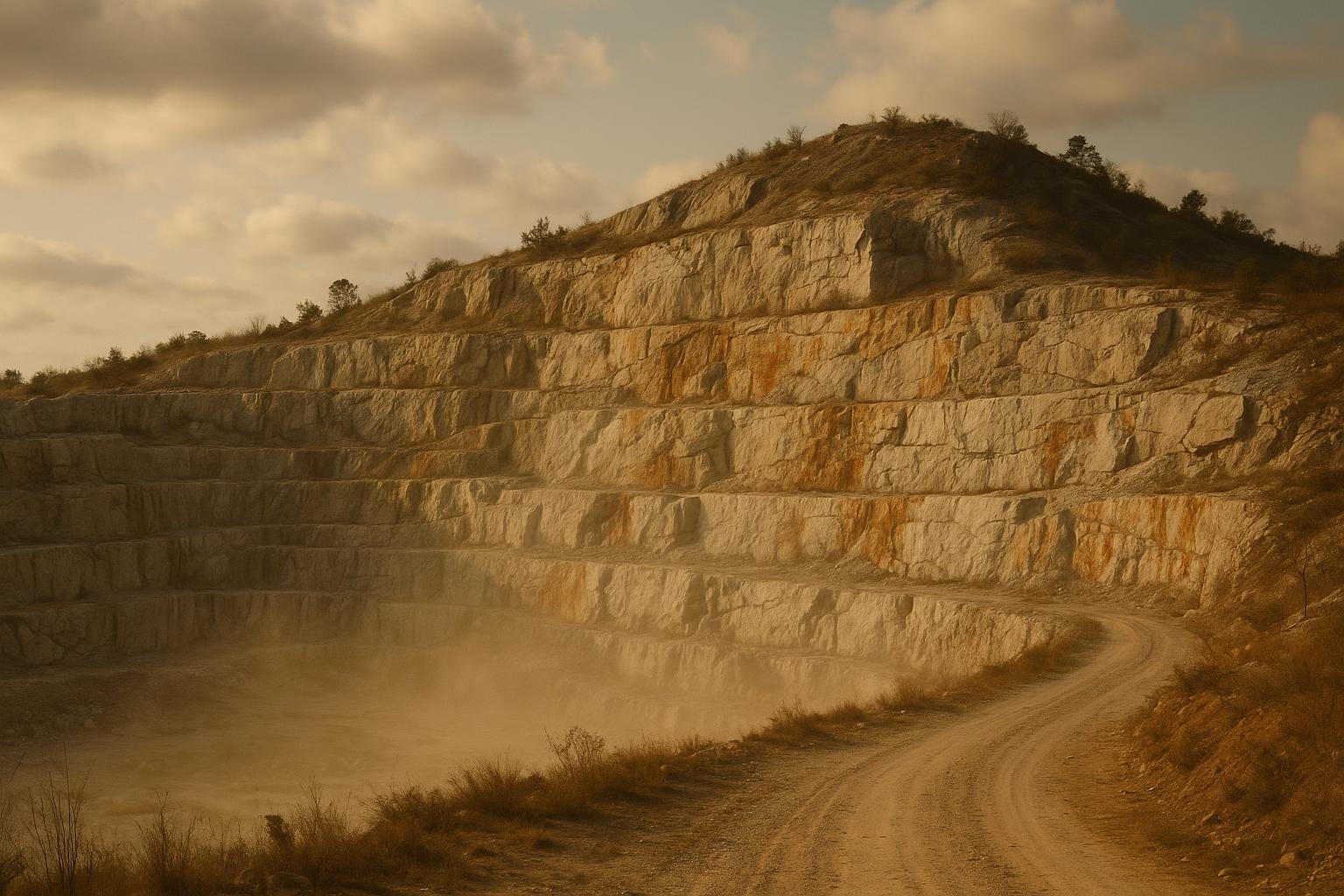
Twice a year, a gate that stays locked for months swings open, and a line of cars kicks up red Georgia dust on the road in. Beyond the gate, quarry walls rise in pale, broken tiers, streaked with mineral color that most people will never see up close in their lives. Somewhere in that broken rock is a crystal worth the drive — rutile, kyanite, lazulite, the names collectors trade like currency — and for one weekend, twice a year, this private mountain belongs to whoever showed up early enough to get through the gate.
Graves Mountain: Georgia’s Rutile Mecca
Graves Mountain sits in Lincoln County, Georgia, and among mineral collectors it has a reputation that few American sites can match. The mountain is world-famous for rutile, kyanite, and lazulite, minerals prized by collectors for their crystal form and color, and Graves Mountain’s deposits are considered among the finest examples found anywhere in the country — the kind of specimens that end up in serious mineral collections rather than tourist gift shops. That reputation isn’t recent. The site drew serious commercial attention as far back as the 1920s, when Tiffany & Co. mined the mountain directly — a level of interest from one of the most recognized names in the jewelry and gem trade that speaks to just how significant this deposit really is, and one that has shaped the mountain’s reputation for a full century since.
What makes Graves Mountain unusual today is that it remains private property, owned by ABB, the industrial conglomerate that took over the site from its earlier owner, Combustion Engineering. That ownership status means Graves Mountain isn’t public land, isn’t a park, and isn’t open to walk-in visitors the way a BLM collection area might be. It’s a working private site, still tied to industrial ownership, with a specific, narrow window during which collectors are allowed on the property at all rather than a standing invitation.
That window is what gives Graves Mountain its unusual place in the hobby. Rather than being permanently closed off the way most private mineral deposits eventually become, it opens deliberately, on a fixed schedule, specifically so the collecting community can access ground that would otherwise be entirely off-limits. For collectors chasing rutile, kyanite, or lazulite specimens with real pedigree, that combination of world-class mineral quality and rare, structured access is exactly what makes Graves Mountain a name worth knowing well before the gate ever opens.
The Tiffany & Co. Era and the Biannual Dig
Tiffany & Co.’s mining operation at Graves Mountain in the 1920s is part of what cemented the site’s reputation, establishing early on that the minerals coming out of this Georgia hillside were good enough to interest a major commercial jeweler rather than only regional collectors. That commercial-grade pedigree has followed the site ever since, even as active commercial mining gave way, over the following decades, to today’s arrangement of controlled, occasional public access under private ownership.
That access takes the form of the Rock Swap & Dig, held twice a year — the last weekend of April and the first weekend of October, running from 8 a.m. to 6 p.m. The event is organized by Clarence “Junior” Norman Jr., the on-site caretaker who manages access to the property. Individuals or groups can also arrange a visit outside those two weekends directly through Norman, but the biannual events remain the primary, best-known way collectors get onto the mountain, drawing collectors who plan their trips around the fixed spring and fall dates well in advance.
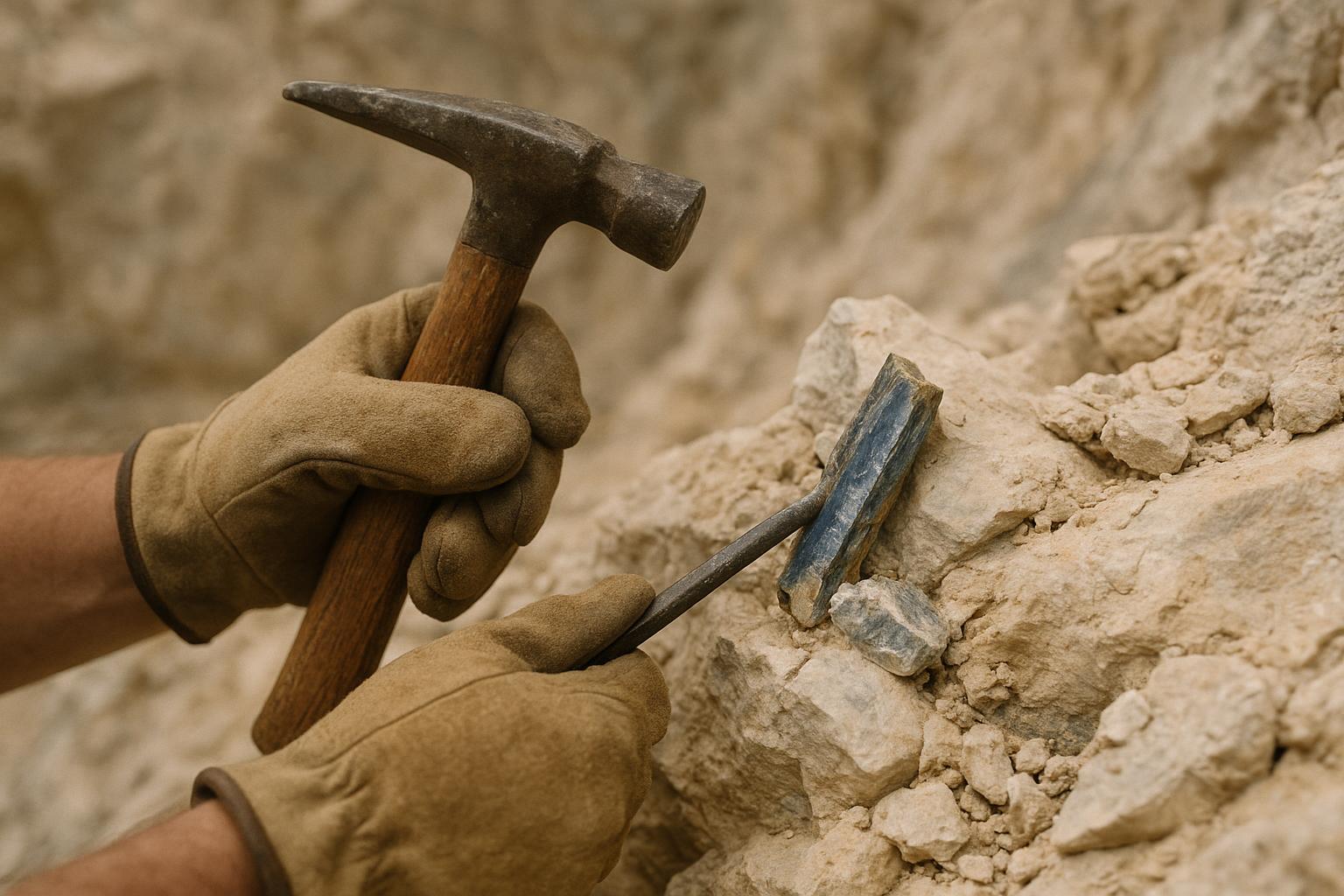
Access to a working private quarry like this one comes with real conditions attached, and they exist for good reason. Every participant must sign a liability release at the welcome tent before heading into the quarry, a reflection of the genuine physical risk involved in collecting on active, unstable quarry walls. Collecting itself is restricted to hand tools only — no power tools, no ladders, and no rappelling are permitted, rules that keep the activity within the bounds of what a private landowner is willing to allow on a site with real rockfall risk. Those rules aren’t arbitrary. They reflect a site that has produced serious specimens for a century, and a property owner managing real liability on ground that isn’t set up for unsupervised, unlimited access — a private quarry, not a groomed public park.
Accessing Graves Mountain Today
Graves Mountain remains private property, and legal access is limited strictly to the biannual Rock Swap & Dig events, held the last weekend of April and the first weekend of October, 8 a.m. to 6 p.m., or by individual or group reservation arranged directly with on-site caretaker Clarence “Junior” Norman Jr. There is no walk-in or unscheduled access to the property at any other time, and showing up outside those arranged windows isn’t an option. Every participant signs a liability release at the welcome tent, and collecting is restricted to hand tools only, with no power tools, ladders, or rappelling permitted.
The hazards here are real, specific, and documented, not theoretical. Quarry walls are high and unstable, prone to rockfall — a Georgia Mineral Society member documented witnessing a near-fatal boulder collapse in 1999. Acidic pond water sits at the bottom of the pits, a product of pyrite decomposition and acid mine drainage serious enough to have been the subject of a 1991 lawsuit brought by neighboring landowners. Extreme heat is also a factor; most local clubs restrict visits to the cooler months between September and May, since the site offers little shade and summer conditions in this part of Georgia are considered unbearable for a full day of digging.
The Legacy of Graves Mountain
Graves Mountain matters to the mineral-collecting community because it represents something increasingly rare: a world-class private deposit, once significant enough to draw Tiffany & Co. into direct operation in the 1920s, that still opens its gates to collectors twice a year rather than closing permanently once commercial mining ended. The biannual Rock Swap & Dig is the reason a site with genuine rutile, kyanite, and lazulite pedigree remains reachable at all, rather than existing only as a name in old mining records. For anyone serious about the hobby, that twice-a-year window, arranged through caretaker Clarence “Junior” Norman Jr. and bound by real safety rules — hand tools only, a signed liability release, real respect for unstable quarry walls — is a legitimate and worthwhile chance to collect specimens from ground with a genuinely storied history, on a mountain that has been worth mining since Tiffany & Co. first proved it.
Story Source: www.gamineral.org
Location: Graves Mountain, Lincoln County, GA
Site Status: Permission or permit required
Legal Conditions: Graves Mountain is private property (owned by ABB, formerly Combustion Engineering); collecting is only permitted during the biannual Rock Swap & Dig events (last weekend of April and first weekend of October, 8am-6pm) organized by on-site caretaker Clarence “Junior” Norman Jr., or by individual/group reservation arranged directly with him. All participants must sign a liability release at the welcome tent. Hand tools only — no power tools, ladders, or rappelling. Source: Georgia Mineral Society (gamineral.org). Confidence: Verified.
Hazards: Mine shaft or collapse (high, unstable quarry walls prone to rockfall — a Georgia Mineral Society member documented witnessing a near-fatal boulder collapse in 1999); Toxic exposure (acidic pond water at the pit bottoms from pyrite decomposition/acid mine drainage, subject of a 1991 lawsuit by neighboring landowners); Extreme heat/cold/exposure (most local clubs restrict visits to September-May due to unbearable summer heat with no shade).
Google Map
Firsthand Accounts
Georgia Mineral Society member Dr. Henry Barwood documented two collecting trips to Graves Mountain’s East and West pits in June and July 1999, recovering what he called “world class” variscite crystals up to 10x10x12mm, while also warning that the unstable high walls had already caused a near-fatal boulder collapse he personally witnessed. Source: Dr. Henry Barwood, “Report on some trips to Graves Mountain,” Georgia Mineral Society (sent July 21, 1999).
Field-trip leader and Rock & Gem contributor Jim Haege traced Graves Mountain’s collecting history back to an 1859 paper by C.U. Sheppard that drew German mineralogists Haidinger and Gustav Rose to study its rutile, and described how Tiffany & Co. later collected specimens there under gemologist George F. Kuntz (namesake of kunzite) before Vernon J. Hurst’s 1959 Georgia Geological Survey report led to large-scale kyanite mining. Source: Jim Haege, “The Treasures of Graves Mountain,” Rock & Gem, August 1998, Vol. 28, No. 8.
In a 2010 video documented by American Rockhounds founders Richard and Sandy Jacquot, members of the Mountain Area Gem & Mineral Association (MAGMA) spent a club dig day working Graves Mountain’s upper and lower pits, discussing their rutile, kyanite, and lazulite finds on camera. Source: Richard Jacquot (American Rockhounds), as reported by Antoinette Rahn, “Dig Day at Graves Mountain,” Rock & Gem, December 31, 2020.