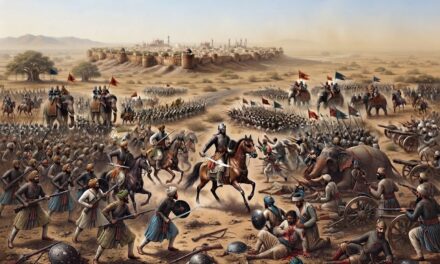
The carts came first. Seven hundred of them, lashed wheel to wheel into a single barricade across the plain, with narrow gaps left just wide enough for a matchlock to poke through. Behind that wall of wood and rope waited fewer than 15,000 men, watching a Sultan’s army that outnumbered them several times over begin its advance across the open ground of Panipat. Somewhere behind the line, gunners trained in Ottoman artillery techniques checked their cannon, weapons that had never before been used on an Indian battlefield in quite this way.
Panipat: The Road to Battle
By 1526, Zahir-ud-din Muhammad, known to history as Babur, had spent years as a Timurid prince without a secure throne, pushed out of his ancestral territory in Central Asia in his youth and forced to rebuild his fortunes around a modest kingdom based at Kabul. A direct descendant of both Timur and, through his mother, Genghis Khan, Babur had spent much of his life fighting to reclaim the kind of empire his ancestors once held, and by his mid-forties had turned his ambitions south toward the far greater wealth of Hindustan. He launched a series of probing raids into Punjab through the early 1520s, testing the strength of the Delhi Sultanate’s defenses before finally committing to a full invasion aimed at Delhi itself, then ruled by Ibrahim Lodi, the last sultan of the Lodi dynasty.
Ibrahim Lodi commanded a vastly larger force, reportedly including a substantial corps of war elephants and outnumbering Babur’s army several times over by most contemporary estimates, but his sultanate was weakened from within by rebellion among his own nobles, several of whom had grown so hostile to his rule that they went as far as inviting Babur’s invasion themselves as a way to unseat him — among them Daulat Khan Lodi, the governor of Punjab, whose invitation gave Babur both a pretext and a foothold for the campaign that followed, illustrating how much the coming battle owed to Delhi’s own fractured politics as much as to any external threat. Babur, heavily outnumbered and fighting far from any reliable base of supply, chose the flat ground near the town of Panipat to make his stand, anchoring one flank on the town itself and using a line of trees and other natural obstacles on the other flank to limit how the larger Lodi army could bring its full numbers to bear against him at once, a choice reflecting a broader pattern in his approach to the campaign: rather than seek a fair fight on open terrain where Lodi’s numbers would tell decisively, he looked for a position that could neutralize as much of that advantage as the landscape allowed.
The Battle of Panipat
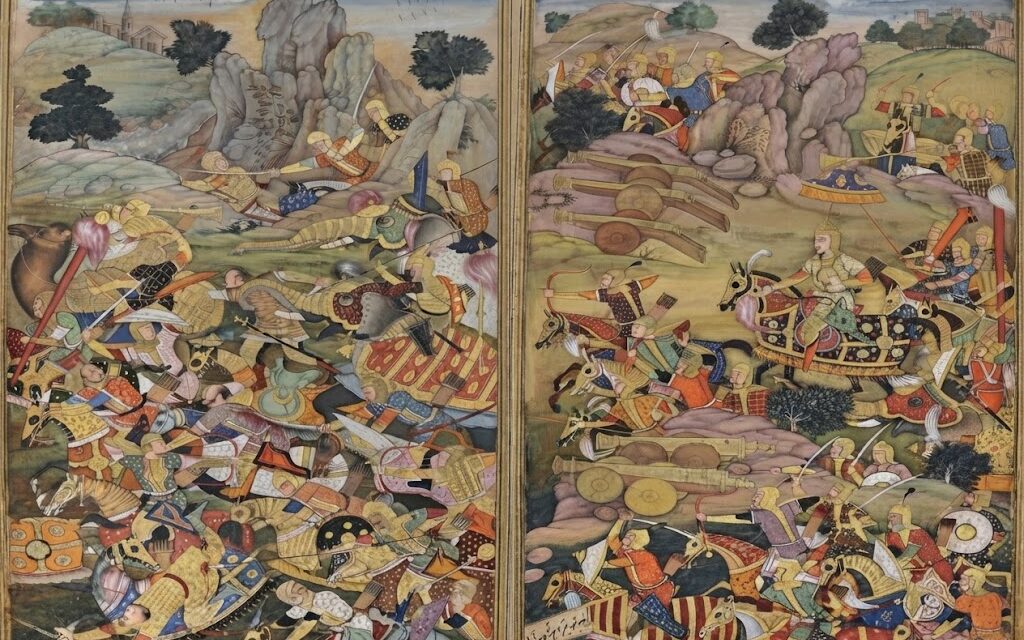
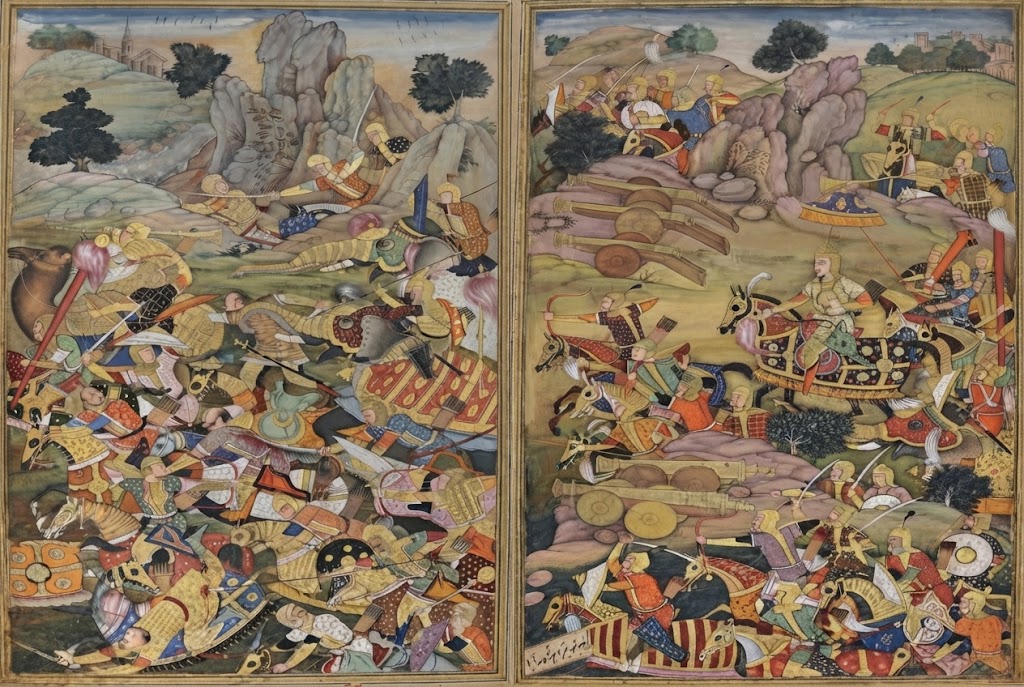
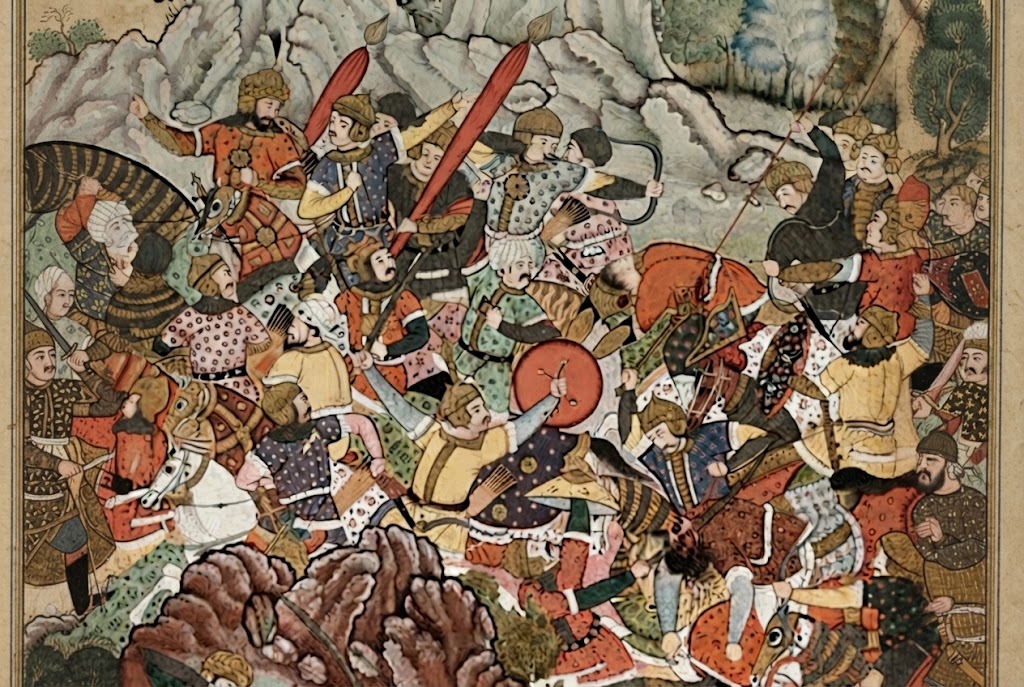
Babur’s own account of the battle, recorded in his memoir the Baburnama, describes fortifying his position with roughly 700 carts lashed together into a barricade, leaving gaps between them for matchlockmen sheltered behind breastworks, while Ottoman-trained gunners Ustad Ali Quli and Mustafa Rumi manned cannons positioned along the line, an arrangement modeled on the Ottoman tactic of the tabur cengi, or wagon-fort, that Babur had learned of through his own contacts with the wider Islamic world stretching back to his time in Central Asia. It was, by his own telling, a defensive innovation few if any commanders in Hindustan had faced before, and one that gave his heavily outnumbered force a fixed point capable of absorbing an assault that raw numbers alone should have overwhelmed.
When Ibrahim Lodi’s army advanced on the morning of April 21, 1526, it pressed directly into Babur’s fortified center and stalled there under sustained musket and artillery fire, unable to bring its numerical advantage to bear against a line it could not break through or maneuver around quickly enough. The sheer size of the Lodi force, which had been an advantage on open ground, became a liability once compressed against Babur’s line: units toward the rear could not see what was happening ahead and kept pressing forward into an increasingly congested mass of men, horses, and elephants.
Babur then committed the tactic that decided the battle: dividing his cavalry into flanking wings, called the tulughma, he sent them around both sides of the pinned Lodi force to envelop it from the flanks and rear, turning the larger army’s own crowded advance against it as men and elephants alike found themselves unable to maneuver or retreat under fire from multiple directions at once. The Lodi war elephants, intended as a decisive shock weapon, instead became a liability once panicked by gunfire and noise they had never encountered in battle before, trampling their own troops as they turned and fled back through the packed ranks behind them. Ibrahim Lodi was killed in the fighting, one of the few Delhi sultans to die on the battlefield rather than in a palace intrigue, and his army collapsed within hours, its numerical superiority never able to translate into the field advantage it should have provided against Babur’s smaller but far better-coordinated force. Contemporary estimates of the dead on the Lodi side ran into the tens of thousands, though precise figures from a battle this old are impossible to verify with confidence, and the fighting itself was reportedly over well before midday, a strikingly short span of time to have decided the fate of an empire.
The Legacy of Panipat
Babur’s victory at Panipat ended the Delhi Sultanate outright and opened the path to Delhi and Agra, which he occupied within days, laying the foundation for the Mughal Empire that his descendants would rule over much of the Indian subcontinent for more than three centuries afterward, until the empire’s final formal dissolution under British rule in 1857. The battle is remembered as much for its tactics as its outcome, since Babur’s combination of a fortified gun line with flanking cavalry demonstrated how gunpowder weapons, still a relatively new factor in South Asian warfare at the time, could offset a severe disadvantage in raw numbers when paired with disciplined maneuver and terrain awareness, a lesson that shaped Mughal military practice for generations of Babur’s successors.
Panipat Today
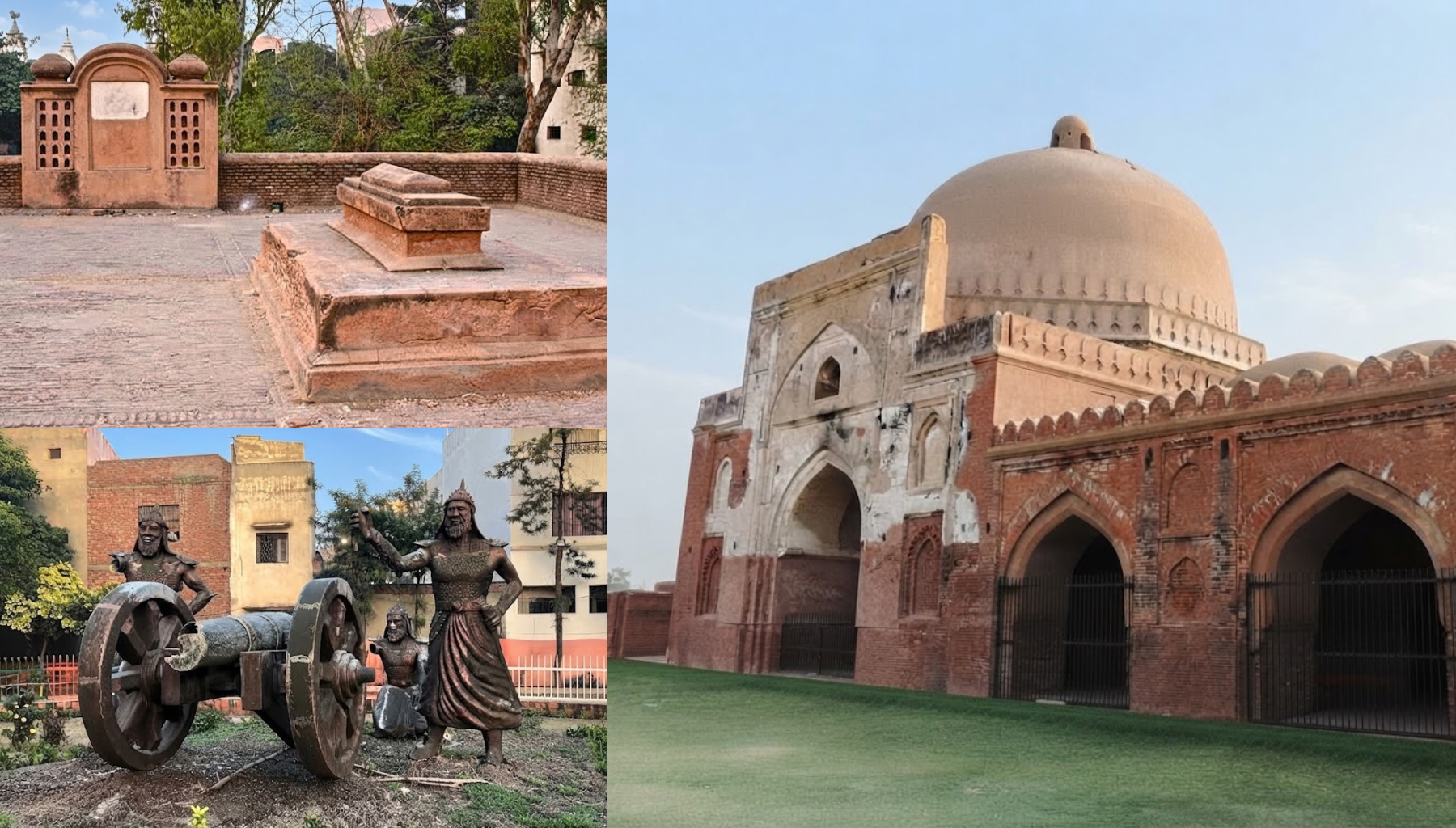
The First Battle site sits within the modern city of Panipat in Haryana, marked chiefly by the Tomb of Ibrahim Lodi near the Tehsil Office and the nearby Kabuli Bagh Mosque, which Babur himself had built in 1527 specifically to commemorate his victory. Both sites are freely accessible with no admission charge, though visitors should expect a plain, largely unmarked historical site rather than a developed battlefield park: neither location has organized visitor facilities, signage, or guided tours, and the mosque in particular shows visible signs of neglect despite its protected heritage status as a centuries-old monument to one of the subcontinent’s most consequential battles.
The best time to visit is October through March, avoiding the region’s intense summer heat, and the sites sit within an ordinary modern city rather than a dedicated historic district, since Panipat today is best known as an industrial center, particularly for textiles, rather than a heritage destination. Visitors comfortable navigating an unfamiliar city on their own, rather than expecting a curated tourist experience, will get the most out of a stop here — this is a site for those specifically seeking out the ground itself, not a polished visitor attraction. Panipat is roughly a two-hour drive or train ride from Delhi, making it a feasible day trip for travelers already based in the capital who want to see where the Mughal era actually began, rather than a standalone destination in its own right.
Remembrance at Panipat
No annual commemorative ceremony specific to the First Battle is currently held at either site, and the tomb and mosque today draw far less attention than the scale of what happened at Panipat might suggest, quietly absorbed into the fabric of a working modern city rather than set apart as a place of pilgrimage or ceremony. What remembrance exists is largely informal and historical rather than ceremonial, carried by the sites’ surviving structures themselves — a tomb, a mosque built specifically to mark a victory — and by the battle’s continuing place in the broader story of how the Mughal Empire began. Panipat’s name would go on to be attached to two later, equally decisive battles fought on nearly the same ground in 1556 and 1761, a coincidence of geography that has made the town’s name almost synonymous with turning points in Indian history, even as the physical evidence of any one of the three battles remains modest.
Visitor Info: Book titled “Gunpowder and Firearms: Warfare in Medieval India” by Iqtidar Alam Khan (Oxford University Press, 2004)
Location: Tomb of Ibrahim Lodi, near Tehsil Office, Panipat, Haryana, India (First Battle site; also nearby Kabuli Bagh Mosque, built by Babur in 1527 to commemorate his victory)
Site Status: Marker or Monument Only
Visitation Notes: The First Battle site sits within modern Panipat, marked chiefly by the Tomb of Ibrahim Lodi near the Tehsil Office and the nearby Kabuli Bagh Mosque, which Babur built in 1527 to commemorate his victory. Both sites are freely accessible with no admission charge, though neither has organized visitor facilities, signage, or guided tours, and the mosque in particular shows visible signs of neglect despite its protected heritage status. Best visited October through March to avoid the region’s intense summer heat. No annual commemorative ceremony specific to the First Battle is currently held at either site.
Google Map
Visitor Comments
sabsgupta described the Tomb of Ibrahim Lodi as a plain rectangular structure on a raised platform near the Tehsil Office, noting that it was relocated and renovated by the British in 1866, and recounted how Ibrahim Lodi was killed by Babur’s forces in the battle that followed.
— from TripAdvisor
curatorofmemories noted the tomb’s location near the Tehsil office and the Dargah of Bu Ali Shah Qalandar, describing it as a plain open grave on a high double-terraced platform that, despite its historical weight, bears little architectural significance, and mentioned it was rebuilt in 1867 under British rule.
— from TripAdvisor
Uday Baxi recounted an unplanned family trip to track down all three Panipat battlefields, describing the First Battle site as enclosed within a small park featuring Mughal cannon statues near a Durga temple, and noted it was surprisingly difficult to find as a casual visitor, with most local residents unaware of the site’s historical significance.
— from Ghumakkar.com
Hari P, a visitor to the nearby Kabuli Bagh Mosque, built by Babur to commemorate his victory, advised visiting in a group since there is no ticket booth, guide, or visitor facilities on site, though a security guard is typically present.
— from Google Reviews