An eyewitness present in the winning camp the following morning put a number on what had happened overnight: roughly forty thousand prisoners, most of them unarmed, executed in a single dawn. Kashi Raj Pandit was not exaggerating for effect; he was a minister recording events he had personally witnessed from inside the victorious Afghan-allied camp, and later historians drawing on his account have found no reason to dismiss it. On January 14, 1761, the Maratha Empire’s northern army was annihilated on the plain outside Panipat by an Afghan-led coalition under Ahmad Shah Durrani, and what followed the battle itself, a night and morning of mass killing among the shattered army’s survivors, has made this single day’s combined death toll one of the highest of any engagement fought anywhere in the eighteenth century.
Panipat: The Road to Battle
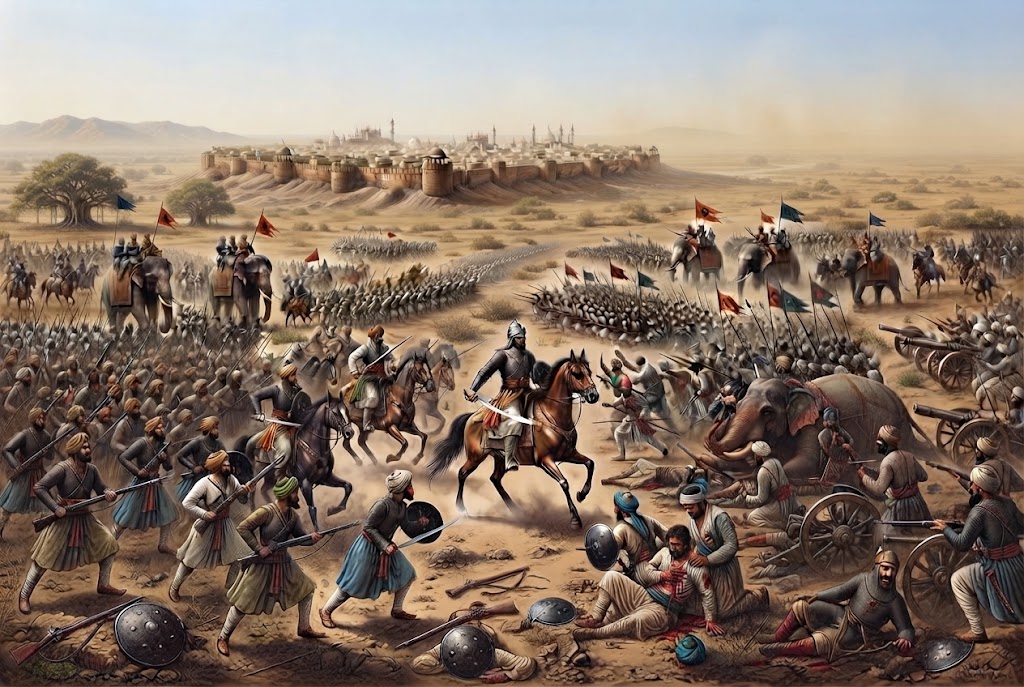
By the middle of the eighteenth century, the Maratha Empire had expanded from its Deccan heartland to dominate much of the Indian subcontinent, filling the power vacuum left by a rapidly weakening Mughal Empire and extending Maratha influence, garrisons, and tribute-collecting expeditions deep into the north, as far as Punjab and the outskirts of Delhi itself. This expansion inevitably brought the Marathas into conflict with Ahmad Shah Durrani, the founder of the Afghan Durrani Empire, who had repeatedly invaded northern India from across the Khyber Pass throughout the 1740s and 1750s and had his own ambitions for the Punjab and the Mughal capital, a rivalry sharpened further after Maratha forces briefly seized Lahore and pushed Durrani’s own governors out of the region. In 1760, the Maratha leadership in Pune dispatched a large northern army under Sadashivrao Bhau, a cousin of the Peshwa and a capable but relatively untested commander in independent command of a major campaign, to confront Durrani and reassert Maratha authority in the north, an appointment that placed an administrator with limited independent battlefield experience above several more seasoned Maratha generals who instead served under him. Bhau’s army, encumbered by a vast baggage train of civilians, pilgrims, and merchants that swelled its numbers without adding to its fighting strength, advanced to Panipat, the same plain north of Delhi where two earlier decisive battles, in 1526 and 1556, had already reshaped the fate of the Mughal Empire in the preceding two centuries. Durrani, allied with the Rohilla Afghans of the Doab and the Nawab of Awadh, Shuja-ud-Daula, maneuvered his own combined force to cut off the Maratha army’s supply lines from the south, a strategic encirclement built up gradually over weeks rather than achieved in a single decisive stroke, and by the closing weeks of 1760 the two armies had settled into an extended standoff at Panipat, with the increasingly encircled and provision-starved Maratha camp facing a steadily tightening blockade through the winter months as food, fodder, and firewood grew scarcer by the week.
The Battle of Panipat
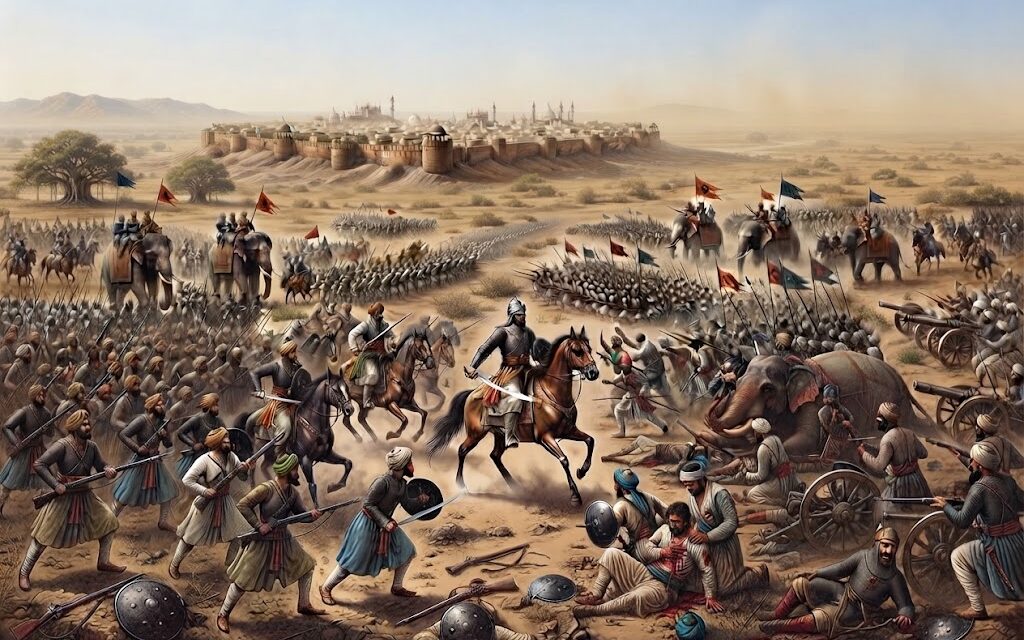
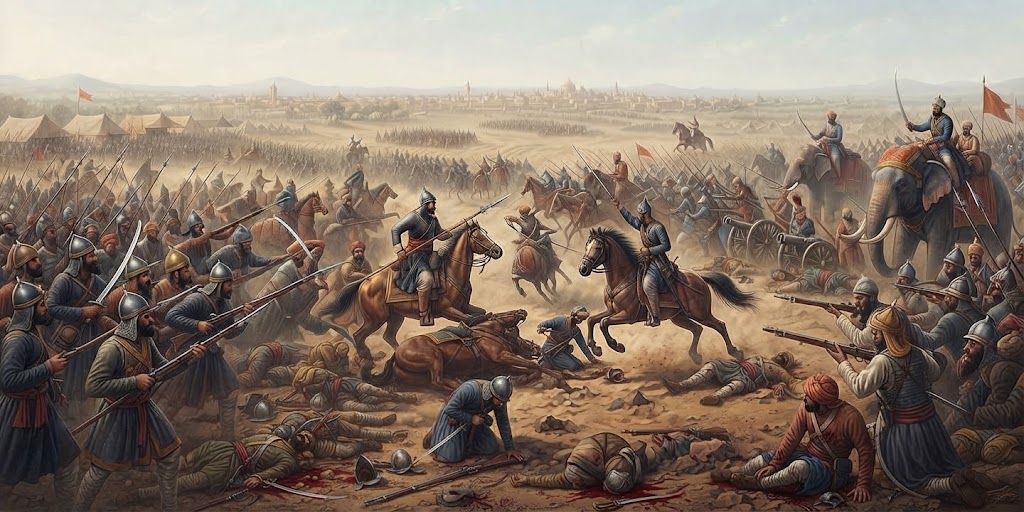
By January 1761, months of blockade had left the Maratha camp desperately short of food and fodder, with soldiers reportedly reduced to eating whatever grain and pack animals remained, and Bhau, judging that further delay would only weaken his starving army further while Durrani’s own supply lines remained comparatively secure, resolved to break out and force a decisive battle rather than continue to wither inside his own defensive lines. On the morning of January 14, the Maratha army advanced from its fortified camp in a dense, coordinated formation built around massed artillery and infantry at the center, with cavalry wings on either flank and much of the civilian baggage train held in the rear, an approach that initially achieved real success against Durrani’s own center and inflicted heavy casualties on the opposing infantry and artillery positioned there through sustained, disciplined cannon and musket fire. For much of the day the battle hung in a genuine balance, with Maratha forces under commanders including Ibrahim Khan Gardi, a Maratha artillery officer trained in European-style gunnery techniques by French instructors, pressing the Afghan-Rohilla center hard enough that a Maratha breakthrough appeared within reach for several hours of hard, grinding fighting under the winter sun. The turning point came as the exhausted Maratha center, having fought without adequate rest, food, or fresh ammunition for hours, began to falter under Durrani’s disciplined and comparatively fresh reserves, while on the flanks Maratha cavalry increasingly found themselves outmatched by the superior mobility and coordination of the Afghan and Rohilla horsemen, who gradually worked around the exposed edges of the Maratha formation. Sadashivrao Bhau himself was killed in the fighting, along with a substantial portion of the Maratha army’s senior leadership, including several other prominent Maratha commanders and members of the Peshwa’s own family who had accompanied the campaign, a catastrophic loss of command that accelerated the collapse of Maratha resistance across the field as the army’s cohesion broke down entirely by the battle’s later stages. What followed the battle’s collapse was, by many accounts, more devastating than the fighting itself: as the shattered Maratha army and its accompanying civilians attempted to flee the field in the winter dusk, Durrani’s forces pursued them for miles across the open plain and killed enormous numbers of soldiers and non-combatants alike, with the eyewitness account of Kashi Raj Pandit, present in the victorious camp, providing the widely cited estimate of roughly forty thousand Maratha prisoners massacred the following day, January 15, a scale of post-battle killing that has made Panipat’s overall death toll a subject of continued historical debate among historians, with total estimates for the day and its immediate aftermath ranging from tens of thousands into the low hundreds of thousands depending on the source, but universally understood to be immense, among the highest of any single engagement fought anywhere in the eighteenth century.
The Legacy of Panipat
The defeat at Panipat devastated the Maratha Empire’s northern leadership at a single stroke, killing an entire generation of senior commanders and administrators and setting back Maratha expansion in North India by roughly a decade before the empire recovered under new leadership, most notably Madhavrao I, who succeeded his father as Peshwa within months of the disaster and worked steadily to rebuild Maratha authority across the subcontinent. The battle is remembered in Indian historical memory as one of the era’s great catastrophes, its scale of loss so severe that the phrase itself entered common usage in some Indian languages as a byword for utter disaster, invoked long after 1761 to describe any crushing, irreversible defeat. The power vacuum the defeat created in North India also opened space for the later rise of British colonial influence across the region in the following decades, as no single Indian power remained strong enough in the immediate aftermath to fill the gap the shattered Maratha army left behind.
What Remains at Panipat
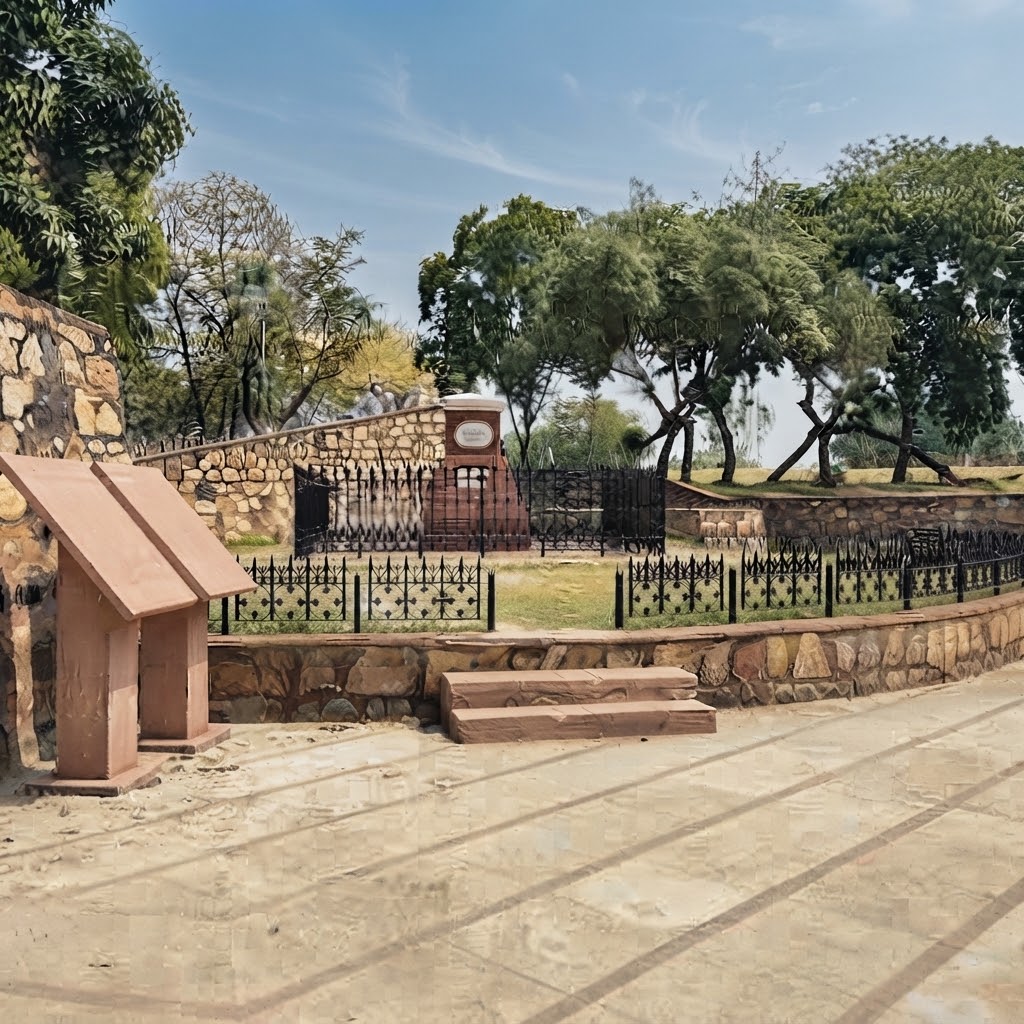
The Kala Amb memorial, roughly eight kilometers from Panipat town off National Highway 44, marks the traditional site of Sadashivrao Bhau’s command post during the battle and remains free to visit, with modest fenced grounds that are currently under ongoing restoration and development. It is a brief stop by design rather than an extensive site, and visitors typically pair it with the Panipat Museum in town, which covers all three historical Battles of Panipat fought on this same plain rather than the 1761 battle alone, offering broader context that the memorial grounds themselves do not attempt to provide. An annual commemorative program is held at the site each year around the battle’s January anniversary, drawing visitors and descendants of those connected to the battle for a more organized remembrance than the rest of the calendar year offers, with speeches and floral tributes typically held near the fenced memorial ground itself. There is no direct rail stop serving the memorial, so a personal vehicle or local taxi from Panipat town is the practical way to reach it, and amenities and food options near the site itself remain limited for now, so visitors are advised to plan accordingly and eat beforehand rather than expecting facilities on site once they arrive. The memorial grounds themselves remain modest and understated by design, a small fenced enclosure rather than a sprawling historical park, a tone that suits a site remembered chiefly for tragedy rather than triumph, and one that the ongoing restoration work has so far preserved rather than diluted with excessive new construction.
Remembrance at Panipat
The most cited contemporary account of the battle’s aftermath comes from Kashi Raj Pandit, Diwan to Shuja-ud-Daula, the Nawab of Awadh, who was present as an eyewitness in the victorious Afghan-allied camp during and after the fighting. His contemporary newsletter, drawn on directly by James Grant Duff in his nineteenth-century History of the Marathas and translated in the years since, remains the source for the widely cited estimate of Maratha prisoners massacred the day after the battle and for detailed contemporary troop-strength figures on both sides. The principal Marathi-language narrative of the campaign survives in the Bhausahebanchi Bakhar, the “Chronicle of Bhausaheb,” traditionally attributed to Krishnaji Shamrao, believed to have served in the camp of the Maratha commander Mahadji Shinde, though this attribution remains disputed among historians and should be treated as uncertain rather than settled fact. Despite that uncertainty, the Bakhar remains the principal Marathi-side account of Sadashivrao Bhau’s campaign and death, cited extensively by later historians, including T.S. Shejwalkar in his influential 1946 study Panipat 1761, and it offers a perspective from the losing side that stands in stark contrast to Kashi Raj Pandit’s contemporary account from within the victorious camp. Together, the two accounts preserve the battle’s aftermath from opposite ends of the same catastrophic day, a rare pairing of perspectives for an eighteenth-century engagement fought so far from the archives of any single European power.
Visitor Info: Book titled “Solstice at Panipat: 14 January 1761” by Uday S. Kulkarni (Mula Mutha Publishers, 2011)
Location: Kala Amb Memorial, near Panipat, Haryana, India (approx. 8 km from Panipat town center, off NH-44)
Site Status: Marker or Monument Only
Visitation Notes: The Kala Amb memorial, roughly 8 km from Panipat town off NH-44, marks Sadashivrao Bhau’s traditional command post and is free to visit, with modest fenced grounds under ongoing restoration. It’s a brief stop, best combined with a visit to the Panipat Museum in town, which covers all three historical Battles of Panipat rather than 1761 alone. An annual commemorative program is held each year around the battle’s January anniversary. A personal vehicle or local taxi is the practical way to reach the site, as there is no direct rail stop.
Google Map
Visitor Comments
According to baleshwarprasad, Kala Amb takes its name — literally “black mango” — from a local tradition holding that the ground beneath the historic mango tree here was so soaked with blood after the 1761 battle that the fruit and soil darkened permanently. Visiting the marker today feels less like a typical tourist stop and more like standing at the edge of that history.
— from TripAdvisor
The site carries a quiet, reflective atmosphere that visitors describe as having an almost palpable weight given what happened here, and it is currently undergoing further development to better honor the site. Amenities and food options nearby are limited, so it is worth planning ahead.
— from Holidify