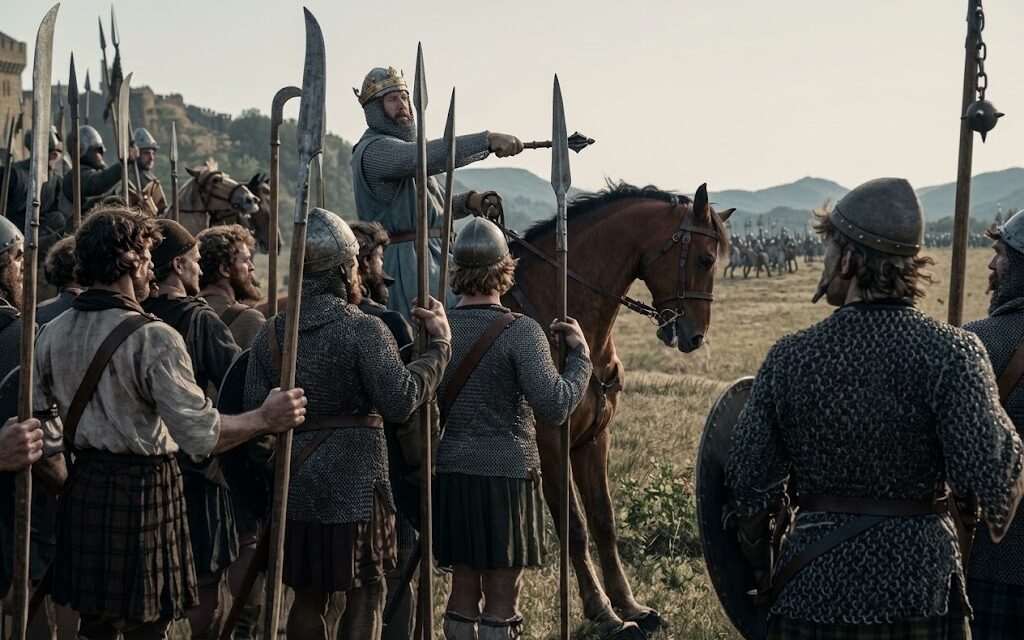
On the first morning of the battle, an English knight named Henry de Bohun spotted a lone rider on a small horse, armed with nothing more than a battle-axe, and saw an opportunity to end the coming fight before it began. He put his lance down and charged. The rider was Robert the Bruce, King of Scots, and rather than retreat he stood his ground, sidestepped the lance at the last instant, rose in his stirrups, and split de Bohun’s skull with a single blow of his axe, snapping the axe’s handle in the process. It was reckless, and Bruce’s own commanders reportedly told him so afterward. It was also exactly the kind of moment a heavily outnumbered army needed to believe it could win.
Bannockburn: The Road to Battle
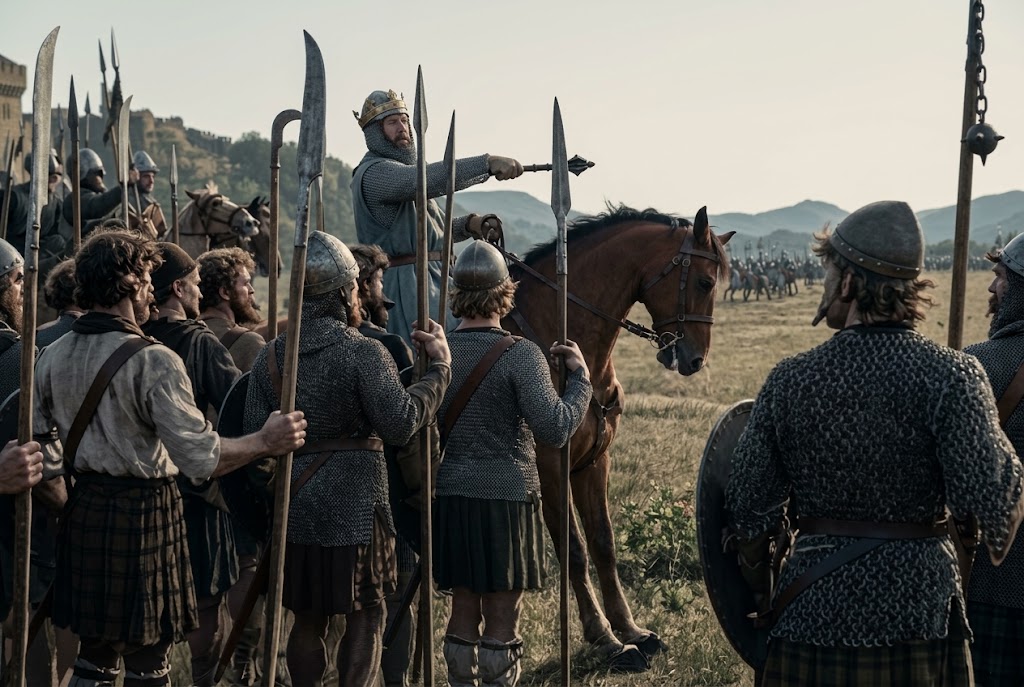
By 1314, Robert the Bruce had spent eight years fighting to make good his claim to the Scottish throne, a claim he had seized under violent circumstances in 1306 when he killed a rival claimant, John Comyn, an act that earned him excommunication and forced years of guerrilla warfare before his position was secure. In the years since, Bruce had waged a grinding campaign of sieges and raids that steadily stripped England of its garrisons across Scotland, often demolishing captured castles rather than holding them, denying Edward II any secure base from which to reassert control. Only a handful of strongholds remained in English hands by 1314, and none mattered more than Stirling Castle, the gateway between the Scottish Highlands and Lowlands. Its English commander, Philip de Mowbray, had struck a deal with Bruce’s brother Edward the previous year: if no English relief force reached the castle by midsummer’s day, June 24, 1314, he would surrender it without a fight. That agreement forced King Edward II’s hand, since losing Stirling without a battle would be a humiliating admission that England could no longer hold what it claimed to rule.
Edward II responded by assembling one of the largest English armies to march north in a generation, drawing on the full weight of the English nobility and its heavy cavalry, together with thousands of infantry and Welsh and English longbowmen, in a force that likely outnumbered Bruce’s own by two or three to one and marched north confident that sheer numbers and cavalry would settle the matter quickly. Bruce, for his part, had spent the intervening months drilling his mostly infantry army in the schiltron, a dense, disciplined spear formation designed specifically to blunt a cavalry charge, and choosing his ground with unusual care. He positioned his forces on rising ground near the Bannock Burn, a stream south of Stirling, where the boggy carse land and surrounding woods would funnel Edward’s cavalry into a narrow front and blunt the advantage of superior English numbers, and reportedly had pits dug and concealed along likely approach routes to further disrupt any mounted charge.
The Battle of Bannockburn
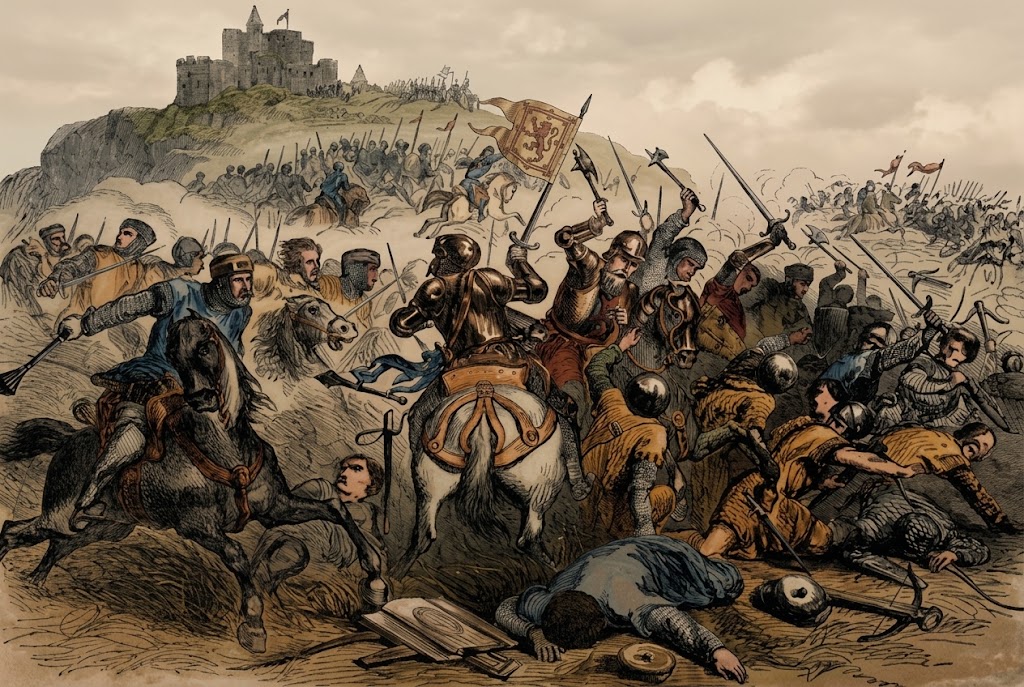
Fighting began on June 23, when an English vanguard advanced ahead of the main army and ran into Bruce’s forces near the edge of the woods, producing the chance encounter that ended with Henry de Bohun’s death at Bruce’s own hand. That same day, a separate force of English cavalry under the Earl of Gloucester attempted to slip past the Scottish line toward Stirling and was met head-on by the schiltron commanded by Thomas Randolph, Earl of Moray, whose spearmen held formation against repeated mounted charges and drove the English horsemen back in confusion. Both encounters, small compared to what followed, did enormous damage to English confidence and Scottish morale alike, and by nightfall Edward’s army had crossed the Bannock Burn to camp on the confined, marshy carse below Bruce’s position, a decision that would prove disastrous the following day.
On the morning of June 24, Bruce advanced his schiltrons from the tree line onto the same cramped ground, catching the English army still forming up and pinned between the burn at its back and the Scottish spear wall advancing from the front. The terrain that Edward’s men had camped on the night before now worked entirely against them: there was no room for the English cavalry to build momentum for a charge, and the longbowmen who might have broken up the Scottish formations from a distance found themselves crowded out of position or driven off by a small detachment of Scottish light cavalry sent specifically to disrupt them before they could establish an effective firing line. Pressed shoulder to shoulder, English knights and infantry were driven back onto their own second lines, unable to maneuver or retreat in good order as the schiltrons pushed steadily forward, their long spears keeping mounted knights at a distance no individual rider could close. Advancing rather than simply holding their ground, as Bruce had trained them to do, the schiltrons denied the English the room they needed to regroup or bring their numerical advantage to bear.
The battle turned into a rout when a group of Scottish camp followers, sometimes called the “small folk,” appeared on a nearby hill waving improvised banners, and panicked English soldiers, already reeling, mistook them for Scottish reinforcements arriving to finish the fight. What discipline remained in the English ranks collapsed. Men fled toward the Bannock Burn and the River Forth beyond it, and many drowned attempting to cross or were cut down in the chaos of the retreat; the Lanercost Chronicle, an English source with no reason to flatter Bruce, describes the disorder and heavy losses of that retreat in blunt, unsparing terms. Edward II himself was pulled from the field by his own bodyguard and fled first to Stirling Castle, which refused to admit him given the terms of its surrender agreement, and then rode hard for the safety of Dunbar, from which he escaped by ship back to England, leaving his shattered army behind him. Scottish forces pursued the fleeing English for miles, and the losses among the English nobility and knighthood were severe enough that the defeat sent shockwaves through the English political establishment for years afterward, with a substantial number of prominent lords and knights killed, captured, or drowned in the retreat.
The Legacy of Bannockburn
Bannockburn did not end the war with England, which dragged on for another fourteen years, but it secured Scotland’s practical independence and cemented Robert the Bruce’s authority beyond serious challenge from rival Scottish claimants. Stirling Castle surrendered as agreed, and with it the last major English foothold north of the border fell away, leaving Bruce in effective control of the kingdom he had spent nearly a decade fighting to secure. The battle’s memory fed directly into the Scottish cause internationally, reinforcing the argument, later made explicit in the Declaration of Arbroath in 1320, that Scotland was a sovereign nation fighting a war of survival rather than a rebellious province. England would not formally recognize Scottish independence until the Treaty of Edinburgh-Northampton in 1328, but Bannockburn had already settled the question on the ground.
Visiting Bannockburn Today
The battlefield sits just south of Stirling, and the National Trust for Scotland operates the Battle of Bannockburn Experience on part of the site, a visitor centre built around a sixty-minute immersive 3D Battle Room presentation that recreates the two days of fighting through a combination of digital projection and a large-scale model of the battlefield. Grounds access to the wider site is free, while the Battle Room show and exhibition carry a separate admission charge, and the centre is open daily throughout the year. Because the historical topography, the marshy carse land and the burn itself, has changed considerably over seven centuries of drainage and development, the exhibit relies heavily on reconstruction and interpretation rather than an intact battlefield landscape, which makes the guided elements of a visit especially valuable for understanding what the ground actually looked like in 1314.
Bannockburn pairs naturally with two other major Stirling-area sites associated with the wars of independence: Stirling Castle itself, the prize both armies were fighting over, and the Wallace Monument, commemorating Bruce’s predecessor William Wallace, making a combined day trip a common way to see all three and a popular route for visitors tracing the broader arc of the independence wars. The site is fully wheelchair accessible, with sensory accommodations available on request for visitors who need them, and the on-site guides are frequently credited with making sense of a battle whose terrain no longer looks the way it did when Bruce chose it, since seven centuries of drainage and development have reshaped the ground far beyond what any visitor could reconstruct unassisted.
Remembrance at Bannockburn
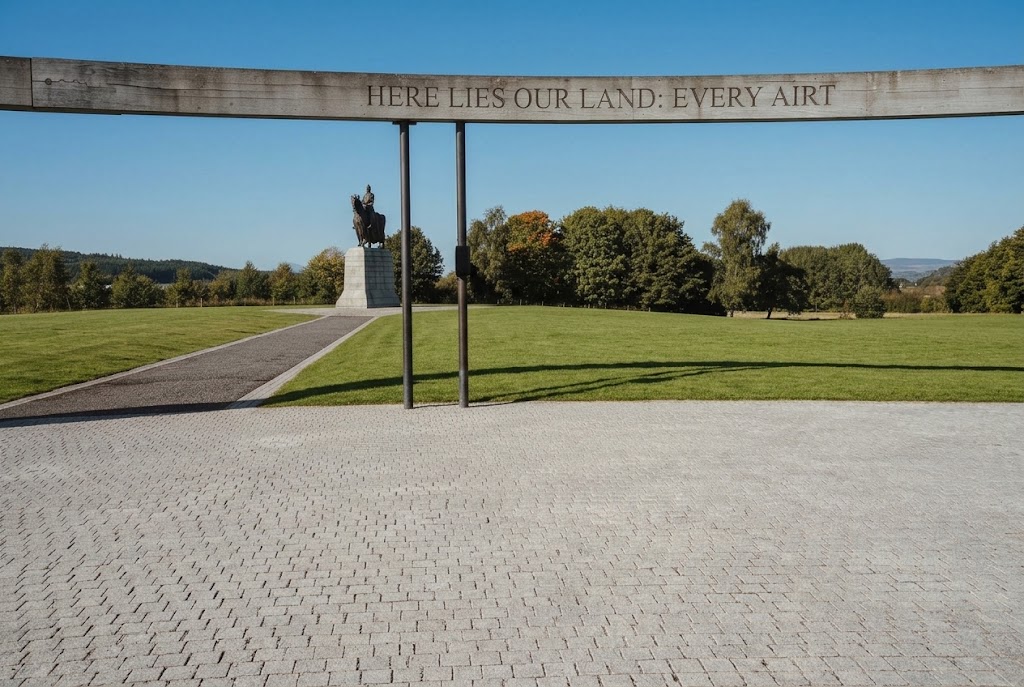
Bannockburn occupies an outsized place in Scottish national memory, invoked for centuries afterward as the clearest example of a smaller Scottish force overcoming a larger English one through discipline, ground selection, and resolve. The National Trust for Scotland holds an annual commemoration around the June 23-24 anniversary weekend, featuring costumed re-enactments and guided walks across the battlefield that draw visitors well beyond the usual tourist season. The battle’s memory also survives well outside academic history, echoed in Scottish song, literature, and popular culture as a touchstone of national identity in a way relatively few medieval battles anywhere in Europe can claim. John Barbour’s fourteenth-century poem The Brus, composed under the patronage of Bruce’s own grandson roughly sixty years after the fighting, did much to fix the battle’s most memorable details, including Bruce’s duel with Henry de Bohun, in the popular imagination, even as historians treat its more dramatic flourishes as reconstructed narrative rather than eyewitness fact. Modern Scottish identity still leans on Bannockburn as shorthand for national resolve, and the battle remains a foundational episode in Scottish history, its details kept in circulation well beyond the small circle of medieval military historians who study the wars of independence in depth.
Visitor Info: Book titled “Bannockburn 1314: A New History” (Chris Brown, 2008)
Location: Bannockburn, Glasgow Road, Whins of Milton, Stirling FK7 0LJ, Scotland, United Kingdom
Site Status: National Park / Managed Historic Site
Visitation Notes: The National Trust for Scotland’s Battle of Bannockburn Experience sits near Stirling, about 2 miles away, and pairs naturally with Stirling Castle and the Wallace Monument for a combined day trip. The centre runs a 60-minute immersive 3D Battle Room show and is open daily year-round; grounds access is free, with the exhibit priced separately. An annual commemoration is held around the June 23-24 anniversary weekend with re-enactments and guided battlefield walks, and the site is fully wheelchair accessible with sensory accommodations available on request.
Google Map
Visitor Comments
Claire praised their guide as brilliant, extremely knowledgeable, professional, and friendly, calling the whole experience really interesting.
— from TripAdvisor
A more critical visitor, Naomi S, reported that the 3D element wasn’t working during their visit, with the interactive features and even the battle room discussion lights out of action — a fair reminder that the exhibit’s technology doesn’t always run smoothly.
— from TripAdvisor
Debbie D said they came away understanding so much more about why the battle mattered and how such a comparatively small army achieved such an astonishing success.
— from Google Reviews
A visitor writing for an accessibility-focused review site said they weren’t sure what to expect but ended up having a really good morning, praising the ample disabled parking, fully accessible exhibition and grounds, and helpful, welcoming staff.
— from Euan’s Guide