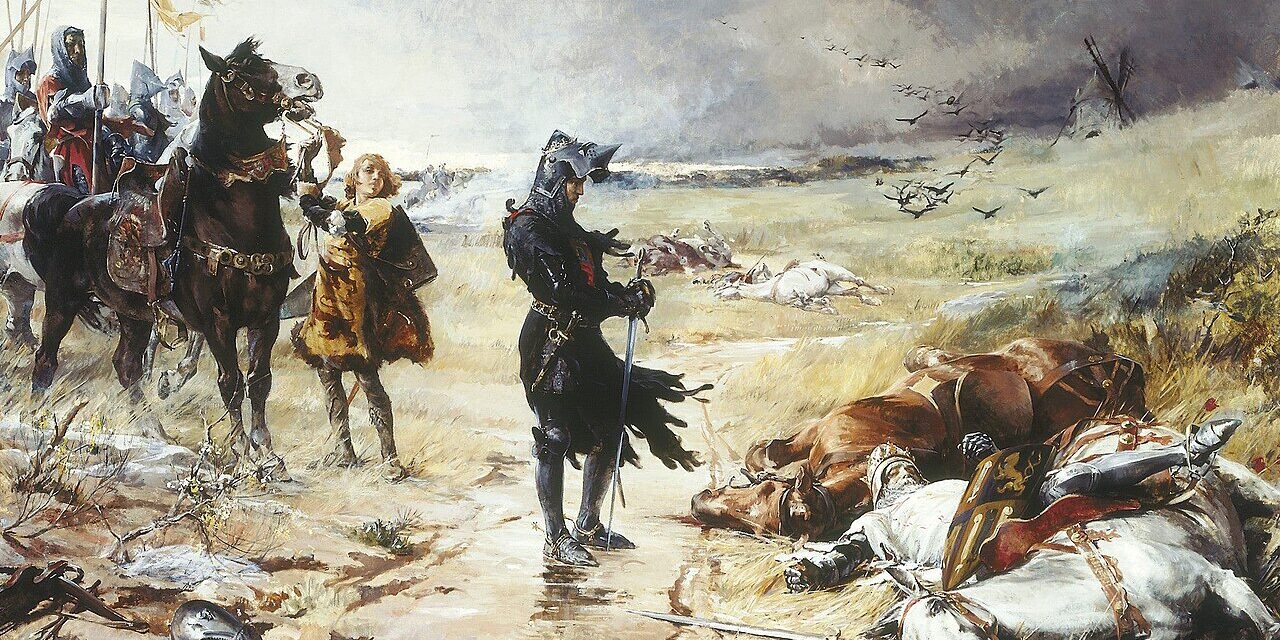
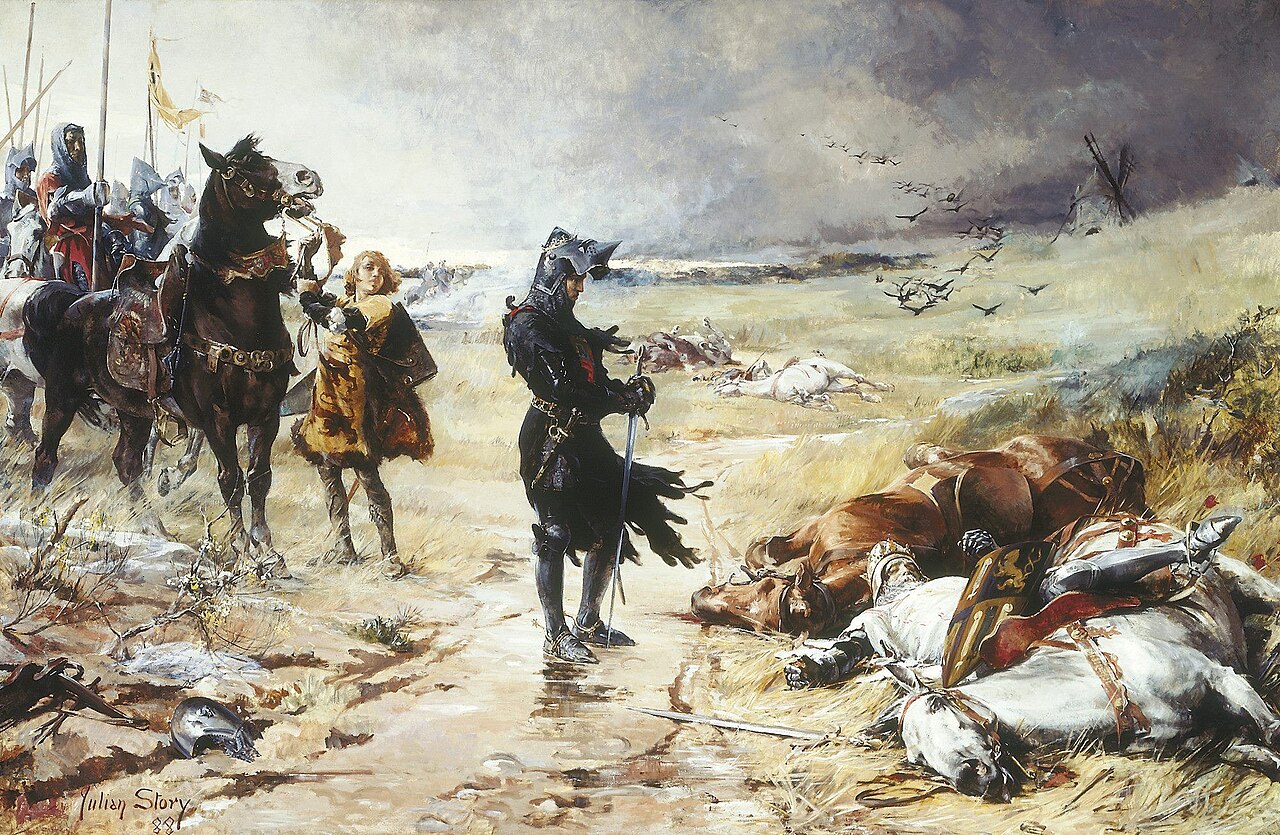
A blind king who could not see a single blow of the battle he was about to enter ordered his knights to tie his horse’s bridle to theirs so that he could still ride into the fighting at Crécy, determined to strike at least one blow with his own sword before he died. John of Bohemia got his wish and nothing more: he and the knights bound to him were cut down together in the melee, a small, deliberate act of doomed courage inside a battle that would otherwise be remembered as the day English arrows made continental chivalry look obsolete. His death, and the emblem his son adopted in tribute afterward, would outlive almost everything else that happened on that Picardy hillside on August 26, 1346.
Crécy: The Road to Battle
By the summer of 1346, King Edward III of England had landed an invading army in Normandy as part of the opening phase of what would become the Hundred Years’ War, pressing a dynastic claim to the French throne while raiding deep into French territory to weaken King Philip VI’s authority and treasury. After months of marching and skirmishing across northern France, Edward’s smaller army found itself pursued by a much larger French force and chose to make a stand on a gently sloping hillside near the village of Crécy-en-Ponthieu, a position that gave the English time to prepare defensive ground rather than being caught in the open on the march. Edward arrayed his forces with characteristic discipline, placing dismounted men-at-arms and, crucially, thousands of English and Welsh longbowmen on the flanks and forward slopes, where they could pour arrows into any approaching force from a protected, elevated position.
The French army that arrived on the afternoon of August 26 was substantially larger and included a contingent of Genoese crossbowmen hired as mercenaries, but the French nobility’s eagerness for immediate battle led Philip VI’s commanders to order an attack late in the day, after a long march, and in weather that had left the Genoese crossbow strings dangerously slack from rain while the English longbows, protected differently, remained largely unaffected. King John of Bohemia, blind for years by this point in his life, had allied his forces with the French cause and insisted on taking part personally in the coming fight despite his condition, a decision that would cost him his life within hours. As dusk approached, the Genoese crossbowmen advanced first, outranged and outmatched by the English longbows, and began falling back in disarray even before French cavalry had fully engaged, setting the stage for a chaotic and piecemeal French assault rather than the coordinated attack Philip’s commanders had likely intended.
The Battle of Crécy
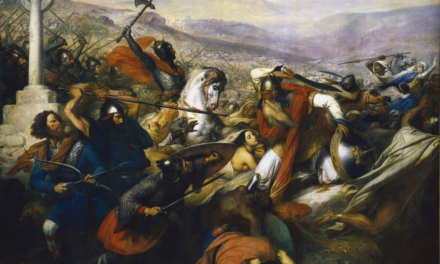
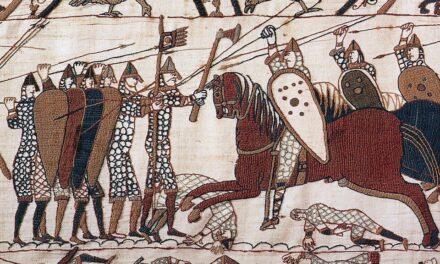
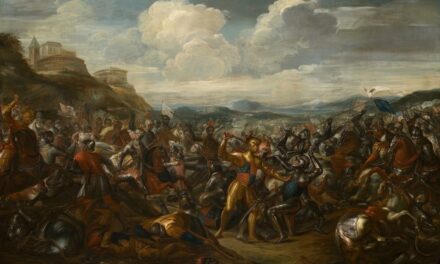
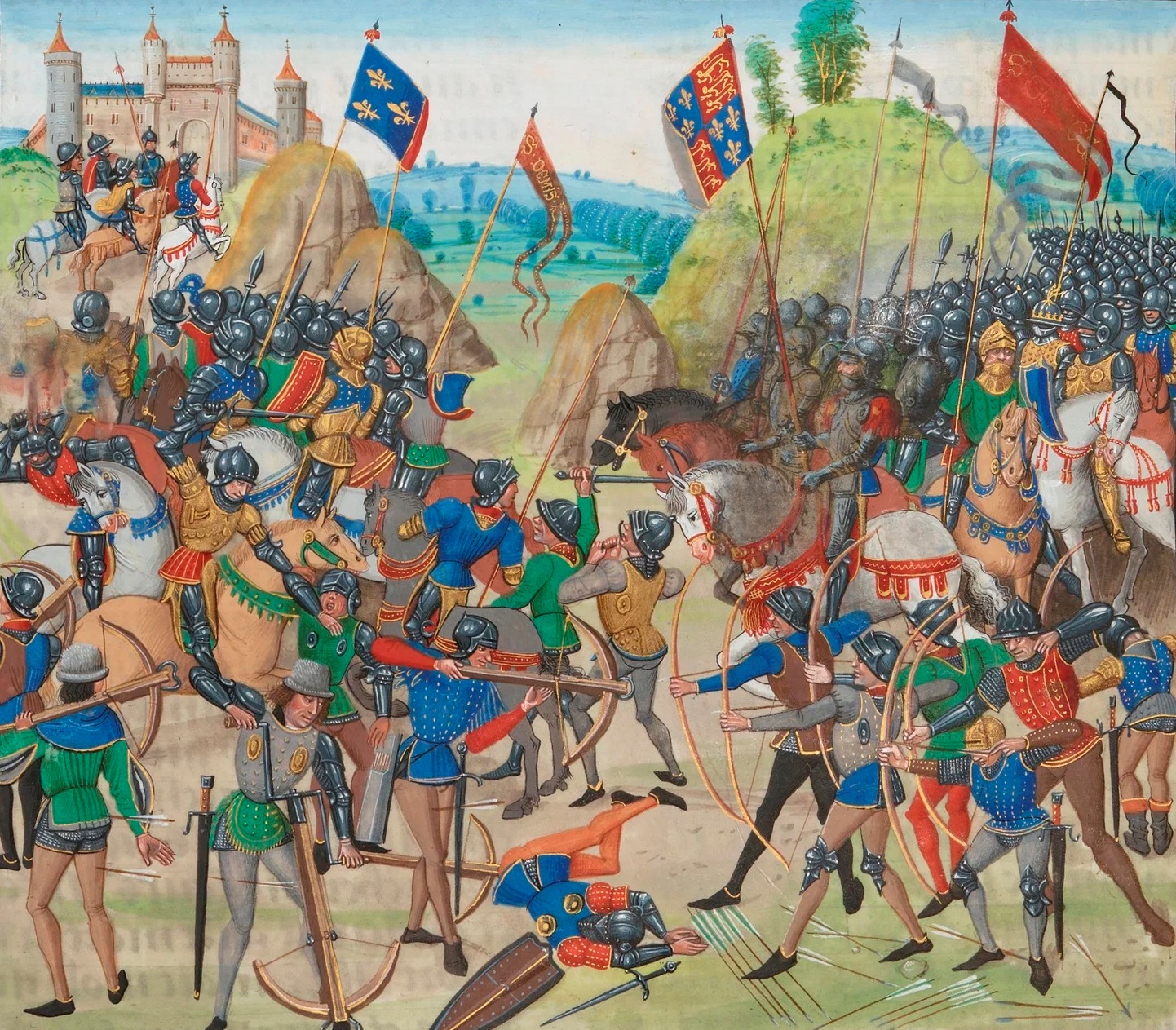
The battle unfolded as a series of repeated, uncoordinated charges by French cavalry against the entrenched English position, with wave after wave of mounted knights riding into a storm of arrows loosed by English and Welsh longbowmen capable of firing far more rapidly than the retreating Genoese crossbowmen ever could. The retreating Genoese, blocking the path of the advancing French cavalry, were reportedly ridden down by their own allies in the confusion, a grim detail that captures how quickly the French attack degenerated into disorganized chaos rather than disciplined battlefield maneuver. Edward, the Black Prince, just sixteen years old, commanded the vanguard of the English line and bore the brunt of the heaviest fighting, withstanding repeated charges at the front in what would become the defining trial of his young military career.
According to the chronicler Jean Froissart, when the prince came under such heavy pressure that his commanders sent word to King Edward III requesting reinforcements, the king, watching from a windmill on higher ground, refused to send them, reportedly saying he wished to “let the boy win his spurs” and allow his son to earn the day’s victory and glory on his own; modern historians treat this famous line with some caution, since it survives through chronicle tradition rather than a verified contemporary transcript, but it captures a widely accepted memory of the king’s confidence in his son and in the strength of the English position regardless of its exact wording. Among the French dead was King John of Bohemia, who despite his blindness had his horse’s bridle bound to those of his household knights so he could still charge into the fighting, and who was killed alongside them in the melee at a spot on the field still marked today. Charge after charge broke against the English line as the light failed, French knights and men-at-arms falling in devastating numbers to the sustained arrow fire and the disciplined dismounted defense, while English casualties remained remarkably light by comparison, a lopsidedness in outcome that stunned observers on both sides in the battle’s immediate aftermath.
Estimates of French losses that night range into the thousands, including a strikingly high proportion of titled nobility, since the mounted charges concentrated exactly the men most likely to be recorded by name in contemporary chronicles directly into the killing zone the English archers had prepared for them. By the time darkness finally ended the fighting, the French army had suffered catastrophic losses among its nobility, including several great lords and thousands of knights and men-at-arms, while Philip VI himself narrowly escaped the field, having had two horses killed beneath him during the fighting and reportedly riding through the night to reach the safety of a nearby castle. The scale of the French defeat at Crécy sent shockwaves through European aristocratic circles, since it demonstrated with brutal clarity that disciplined infantry archery could annihilate the mounted, armored chivalry that had dominated European battlefields for centuries, undermining assumptions about class, cavalry, and combat that had gone largely unchallenged until that August afternoon. The battle also carried a grim logistical postscript: because so many French dead were left on the field, English soldiers spent the following day searching the ground for wounded survivors and stripping the fallen for arms and armor, a practice that further embittered French chroniclers already struggling to explain how their kingdom’s finest knights had been humbled by common-born archers wielding a weapon many continental nobles still regarded as beneath serious battlefield consideration.
The Legacy of Crécy
Crécy became one of the most consequential early demonstrations that longbow-armed infantry could defeat heavily armored cavalry through disciplined positioning and sustained firepower, a lesson English commanders would apply again at Poitiers and Agincourt across the following decades of the Hundred Years’ War. The battle also launched the reputation of Edward, the Black Prince, who would go on to become one of the most celebrated English commanders of the entire war, his conduct at Crécy establishing him as a formidable military leader from an unusually young age. King John of Bohemia’s death produced an enduring symbolic legacy far beyond the battlefield itself: his son and successor adopted his ostrich-feather badge and “Ich dien” motto in tribute, a heraldic tradition still carried by the Prince of Wales today, centuries after the battle that killed him.
Visiting Crécy Today
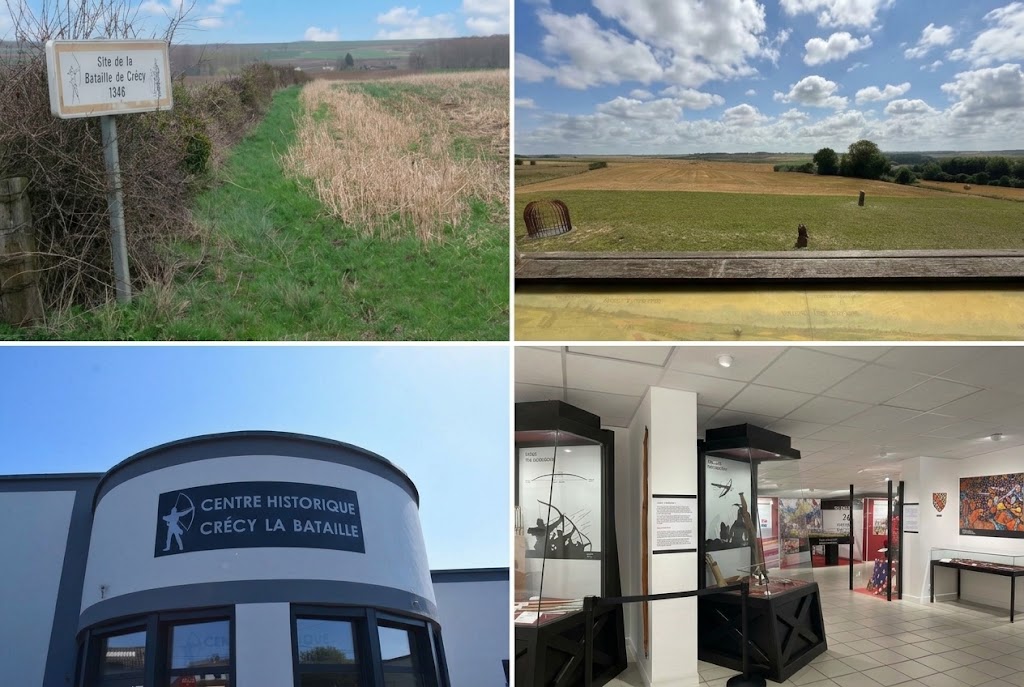
Visitors to the Crécy battlefield today will find a quiet rural stretch of Picardy farmland marked chiefly by a wooden observation tower built on the site of the old windmill from which Edward III is said to have watched the battle unfold, offering sweeping views across the gently sloping ground where the fighting took place. Surrounding the tower is a small sculpture garden featuring six steel king silhouettes, a modern artistic touch that helps visitors visualize the medieval nobility who fought and died across this now-peaceful landscape. A short distance away stands the Croix de Bohême, a stone cross marking the traditional spot where the blind King John of Bohemia fell with his knights, a modest but evocative memorial to one of the battle’s most memorable individual episodes.
The site offers picnic tables and free parking, making it an easy stop for visitors touring the wider Somme region’s historical sites, though a small on-site museum exists with hours that can be limited and inconsistent, so visitors hoping to see it should check ahead before making the trip. Because Crécy is a comparatively modest, lightly staffed site rather than a fully built-out visitor attraction, travelers should treat the observation tower and its surrounding sculpture garden as the heart of the experience rather than expecting an extensive indoor exhibition to accompany it. The gentle slope where the English archers stood and the lower ground the advancing French cavalry had to cross remain visible from the elevated platform, giving visitors a genuine sense of the terrain’s role in shaping the battle’s outcome even without extensive built interpretation. The surrounding countryside remains largely agricultural, much as it would have appeared in 1346, and the quiet, unhurried atmosphere of the site today stands in deliberate contrast to the violence that once unfolded across these same fields on a single August evening nearly seven centuries ago.
Remembrance of Crécy
Jean Froissart’s fourteenth-century chronicle remains the primary narrative source historians rely on for understanding the battle’s events, including the famous account of Edward III’s refusal to reinforce his son and the death of John of Bohemia, though modern scholars treat some of its more quotable details, like the “win his spurs” line, with appropriate caution given the chronicle tradition’s tendency toward dramatic embellishment. The Croix de Bohême standing on the battlefield today continues to anchor popular memory of the blind king’s doomed charge, a story that has circulated in various forms since the fourteenth century and remains one of the most frequently retold individual episodes from the entire Hundred Years’ War. Visitors who make the trip to this quiet corner of Picardy continue to grapple with the same tension noted by generations of historians: a modest, thinly interpreted rural site that nonetheless marks one of the genuinely pivotal battles in the history of medieval European warfare.
Visitor Info: Centre Historique Crécy la Bataille (Office de Tourisme de la Baie de Somme)
Location: Site de la Bataille de Crécy, Route de Wadicourt, 80150 Crécy-en-Ponthieu, Somme, Hauts-de-France, France
Site Status: Marker or Monument Only
Visitation Notes: A wooden observation tower marks the old windmill site, surrounded by a small sculpture garden of six steel king silhouettes. Nearby stands the Croix de Bohême, marking where the blind King of Bohemia fell. The site offers picnic tables and free parking, plus a small on-site museum whose hours are limited and can be inconsistent, so visitors should check ahead.
Google Map
Visitor Comments
Paul B rated his visit 3 out of 5, feeling the visitor center was thin on information and comparing it unfavorably to the more developed center at Agincourt.
— from TripAdvisor
Ann F gave the site 4 out of 5, praising the clear signage, the battlefield map, and the orientation offered from the observation tower.
— from TripAdvisor
cnb134 rated the visit 3 out of 5, noting the site was poorly signposted from the road, but appreciated the view from the tower and was disappointed to find the small museum closed.
— from TripAdvisor
ChefCliveM rated the visit 3 out of 5, saying the elevated view from the tower helped him understand the tactical flow of the battle.
— from TripAdvisor