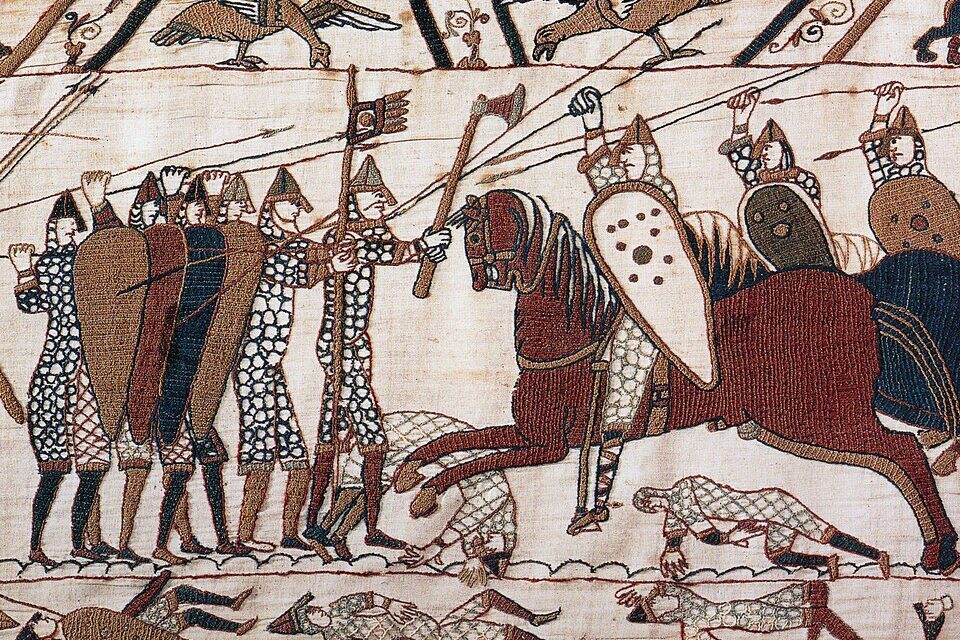
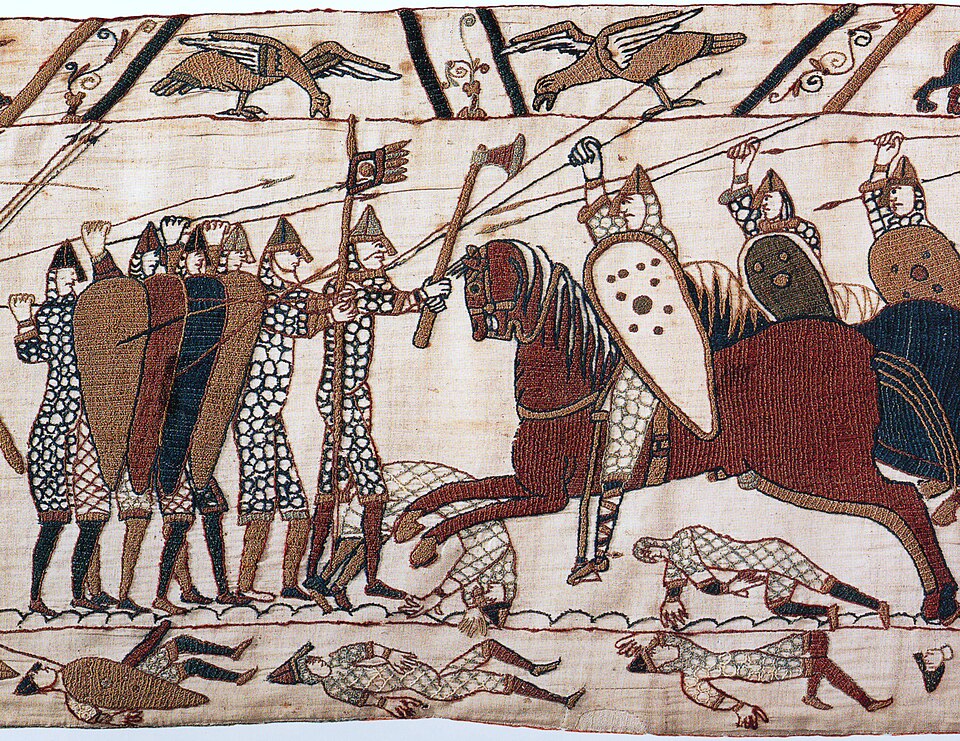
An arrow through the eye is the image most people carry of the Battle of Hastings, immortalized in a strip of embroidered linen sewn within a few decades of the fighting. Historians today are far less certain the Bayeux Tapestry actually shows that at all, and the uncertainty is oddly fitting, because the battle that decided who would rule England for the next thousand years is, in its details, far messier and more contested than the schoolbook version suggests.
Hastings: The Road to Battle
The crisis began with the death of King Edward the Confessor in January 1066, leaving no clear heir and at least three men convinced the English throne belonged to them: Harold Godwinson, the powerful English earl Edward’s council elected king; Duke William of Normandy, who claimed Edward had promised him the throne years earlier and that Harold himself had sworn an oath in Normandy to support that claim; and King Harald Hardrada of Norway, who launched his own invasion of northern England that September. Harold marched his army north and crushed Hardrada’s Norwegian force at the Battle of Stamford Bridge on September 25, a decisive victory that effectively ended the Viking Age of English invasion, only to receive word days later that William had landed his own invasion force on the southern coast near Pevensey while Harold’s army was still recovering thirty miles away.
The traditional account has Harold immediately force-marching his exhausted army some 200 miles south in under two weeks to meet William, an extraordinary feat of endurance that later chroniclers held up as proof of Harold’s decisive leadership and personal daring, choosing speed over caution in order to catch William’s army before it could fully entrench or push further inland. Historian Tom Licence of the University of East Anglia has challenged much of this in a 2026 study as a Victorian-era embellishment, arguing instead that Harold moved a significant portion of his force south by ship along the coast and navigable rivers rather than entirely on foot, which would have preserved his army’s strength far better than the legendary forced march suggests, though it would have made for a less romantic story than the one that took hold in later centuries. Whichever route his army actually took, Harold reached the area near Hastings by October 13 with a force weakened by the Stamford Bridge campaign and gave battle the following morning atop Senlac Hill, a defensible ridge that forced William’s army to attack uphill into a dense English shield wall rather than choosing more favorable ground of his own.
The Battle of Hastings
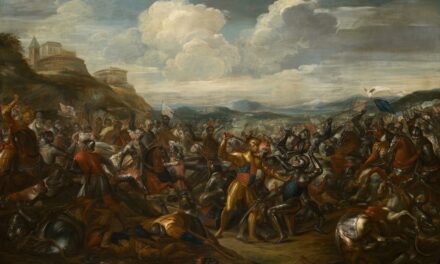
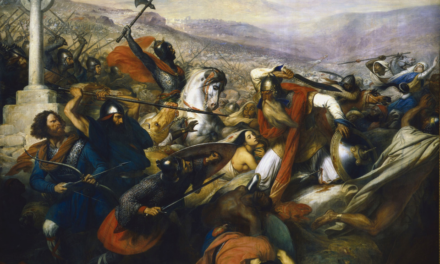
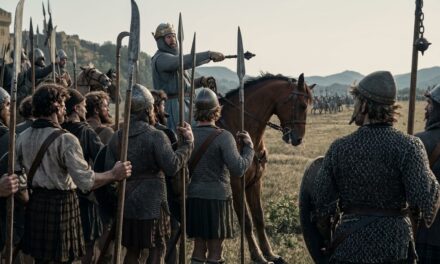
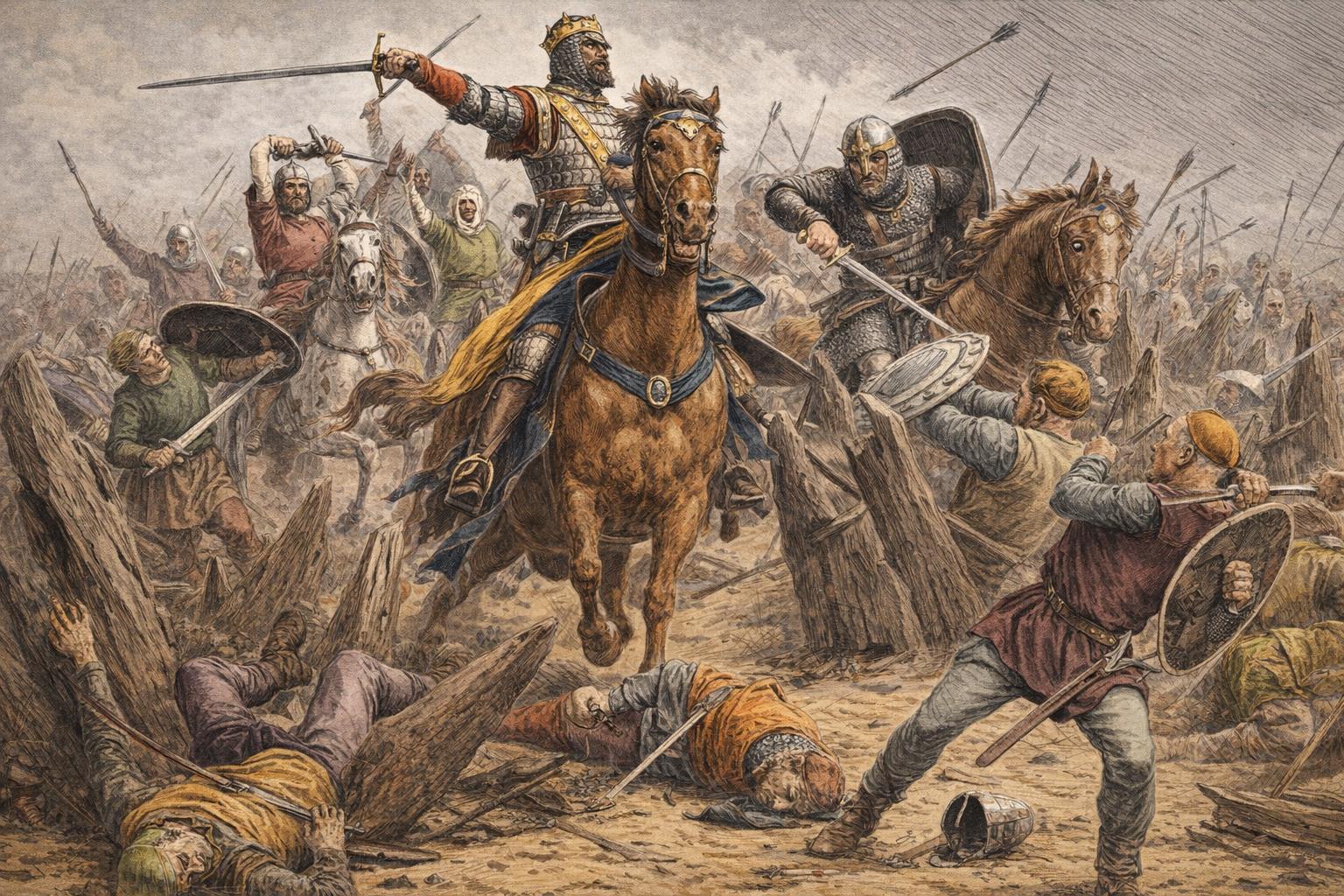
On the morning of October 14, 1066, William’s combined force of infantry, archers, and mounted cavalry advanced repeatedly against the English shield wall, a dense formation of housecarls and levied fighters holding the high ground with spears, axes, and shields locked together, and for hours the Norman assaults made little headway against a defense that simply would not break under direct pressure. Norman archers loosed volleys uphill into the packed English ranks with limited effect, since the housecarls’ shields and the tight formation itself absorbed much of the damage, and Norman infantry attacking directly into the wall suffered heavily for every yard gained, a stalemate that by midday had left William’s reputation and the entire invasion hanging on finding some way to break the English line before his own army’s morale collapsed. William’s cavalry then began staging feigned retreats down the slope, a tactic that, whether by original design or discovered opportunistically after a genuine retreat briefly panicked part of the Norman line, proved devastating: sections of the English shield wall broke formation to pursue the fleeing horsemen, and once in the open, the pursuing English fighters were cut down by cavalry that turned and closed on them, weakening the wall with each repetition.
By late afternoon, after some eight hours of brutal, exhausting combat, the depleted English line finally gave way, and Harold himself was killed in the fighting near the battle’s end, in circumstances no contemporary source records with full confidence; the famous Bayeux Tapestry image widely remembered as an arrow through Harold’s eye is itself disputed by historians, some of whom argue the tapestry originally showed him cut down by a sword rather than struck by an arrow at all, with the arrow detail possibly the result of later restitching. Bishop Odo of Bayeux, William’s own half-brother, fought alongside the Norman army despite his clerical status, and the tapestry he is thought to have commissioned shows him in armor wielding a mace rather than a bladed weapon, since canon law forbade clergy from shedding blood, its caption crediting him with rallying Norman troops at a critical moment when the English defense still held firm. A later chronicle tradition, absent from the tapestry itself and treated by most historians as legend rather than fact, holds that a jongleur named Taillefer rode out ahead of William’s army singing the Song of Roland and juggling his sword, killing an English soldier before charging alone into the shield wall and striking what tradition remembers as the battle’s opening blow.
The Legacy of Hastings
William was crowned King of England at Westminster Abbey on Christmas Day 1066, though the conquest was far from complete on that single day, and the years that followed saw repeated English uprisings put down with increasing severity, culminating in the brutal campaign historians call the Harrying of the North, in which William’s forces devastated large parts of northern England to crush resistance once and for all. The Norman Conquest reshaped nearly every institution in English life over the following decades: the English aristocracy was almost entirely dispossessed and replaced by Norman lords loyal directly to William, castles rose across the landscape as instruments of occupation and control rather than simply defense, and Norman French became the language of the court, the law, and the ruling class for generations, permanently altering the vocabulary and structure of the English language itself in ways still visible in modern English today. The feudal landholding system William imposed, formally recorded decades later in the Domesday Book, restructured English governance so thoroughly that its effects on land ownership and legal tradition persisted for centuries after the conquest itself was complete. Hastings remains, to this day, the last successful invasion of England — a single afternoon of close-fought combat on one Sussex hillside that determined the trajectory of a language, a legal system, and a nation for a thousand years afterward.
Visiting Battle Abbey Today
William the Conqueror later built Battle Abbey directly on the site of his victory, reportedly positioning its high altar to mark the exact spot where Harold fell, and the abbey’s ruins and surrounding battlefield grounds are now managed by English Heritage. An included audio guide leads visitors along a battlefield trail and through the abbey buildings, tracing the course of the fighting across the same slope where the shield wall once stood, and the site includes a small museum, a gift shop, and the Battle Abbey Cafe for light lunches or afternoon tea. Admission is modest, with online booking often available at a discount, and a shuttle bus is available on site for visitors with mobility needs.
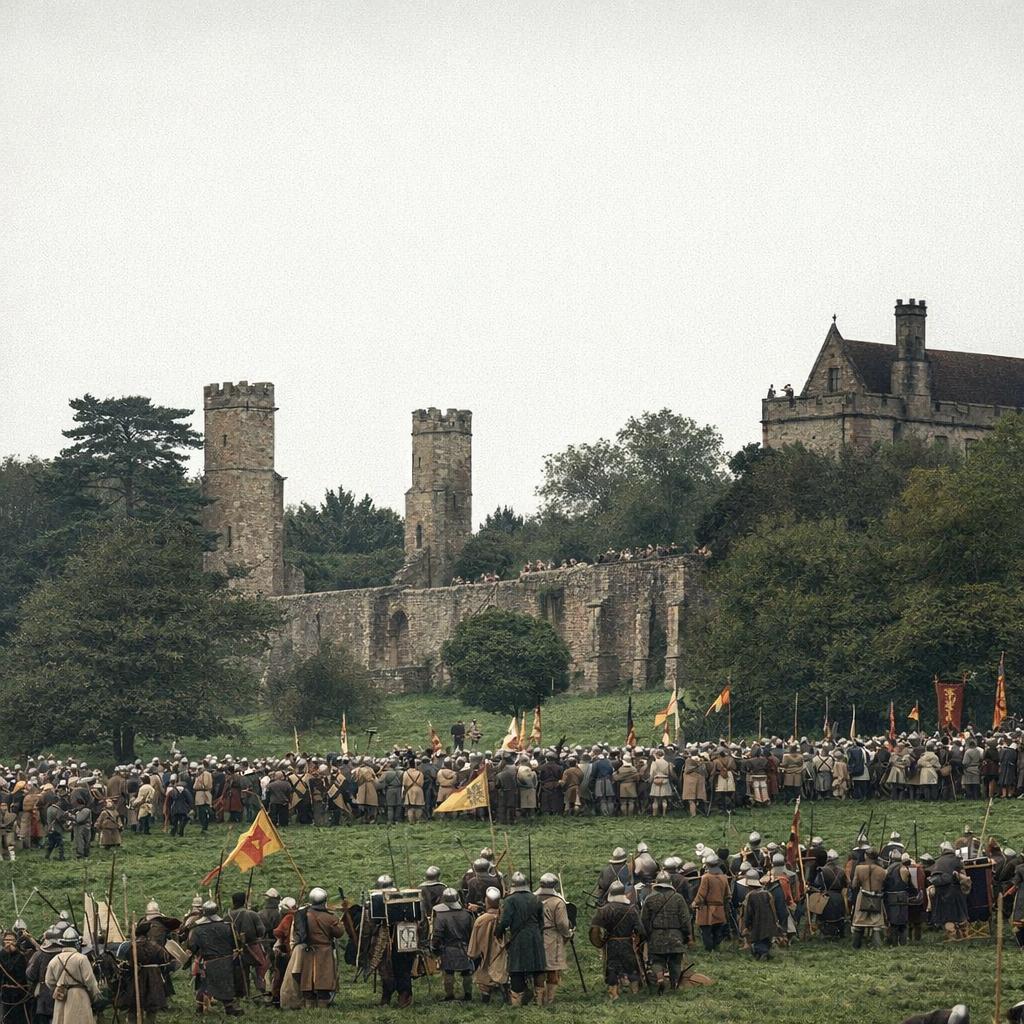
The site hosts a major reenactment weekend each October timed to the battle’s anniversary, drawing costumed camps and a staged battle performance that recreates the fighting on the actual ground where it occurred, an event several visitors describe as the highlight of a visit precisely because it makes the history tangible in a way static ruins alone cannot. Some visitors have noted that the battlefield presentation itself can feel underdeveloped relative to how central this single day is to English history, and that the modern town of Hastings a few miles away offers little to complement the abbey visit, so most recommend planning to spend real time at the site itself rather than treating it as a brief stop.
Remembrance at Hastings
Few single days in English history carry the historical weight of October 14, 1066, and Battle Abbey’s position as the physical marker of where an entire ruling dynasty and its language were displaced gives the site an unusual gravity among medieval battlefields. Visitors consistently describe the annual reenactment as transformative for how it lands the history, with one recalling that a childhood visit at age six sparked a lifelong passion for the past that classroom lessons alone never produced, a testament to how directly the site connects modern visitors to the consequences of a single afternoon’s fighting nine and a half centuries ago. The abbey ruins themselves, built as an act of penance and commemoration by the victor on the very ground where the vanquished king died, stand as one of the more pointed monuments in English history to how completely one battle can rewrite a nation’s future.
Visitor Info: www.english-heritage.org.uk
Location: Battle Abbey, High Street, Battle, East Sussex, TN33 0AD, United Kingdom
Site Status: National Park / Managed Historic Site
Visitation Notes: Battle Abbey was built by William the Conqueror on the site of the battlefield, reportedly with its high altar marking the spot where King Harold fell, and its ruins and grounds are now run by English Heritage. An included audio guide leads visitors around the battlefield trail and abbey buildings, and there is a small museum, gift shop, and Battle Abbey Cafe on site for light lunches or afternoon tea. One recent visitor reported paying around 11 pounds for admission, though prices vary with online booking discounts, and a shuttle bus is available for visitors with mobility needs. The site hosts a major reenactment weekend each October around the anniversary of the battle, with costumed camps and a staged battle performance.
Google Map
Visitor Comments
JakeHalsey, who traveled from Launceston, United Kingdom, timed their visit for the annual Battle of Hastings reenactment held each October. They found the abbey ruins spectacular and called the reenactment a treat for history enthusiasts, though they noted the nearby town of Hastings itself was a bit of a letdown compared to the abbey and battlefield.
— from TripAdvisor
zoewortt, from Southampton, United Kingdom, first visited the site at age six and credits it with sparking a lifelong passion for history, saying it made the past far more engaging than classroom lessons ever did. She praised the audio tour and recently returned for the 952nd anniversary reenactment weekend.
— from TripAdvisor
Paul L used the audio guide, which added a lot to the experience, and caught the short introductory film shown in the visitor centre that helps make sense of the site’s layout before heading out.
— from Google Reviews
700johnf, visiting from Cork, Ireland, felt the roughly 11-pound entrance fee was only really worth it if you commit to exploring the whole site thoroughly. He thought the battlefield presentation itself felt somewhat underdeveloped given how central the battle is to English history, though he still found the visit worthwhile overall.
— from TripAdvisor