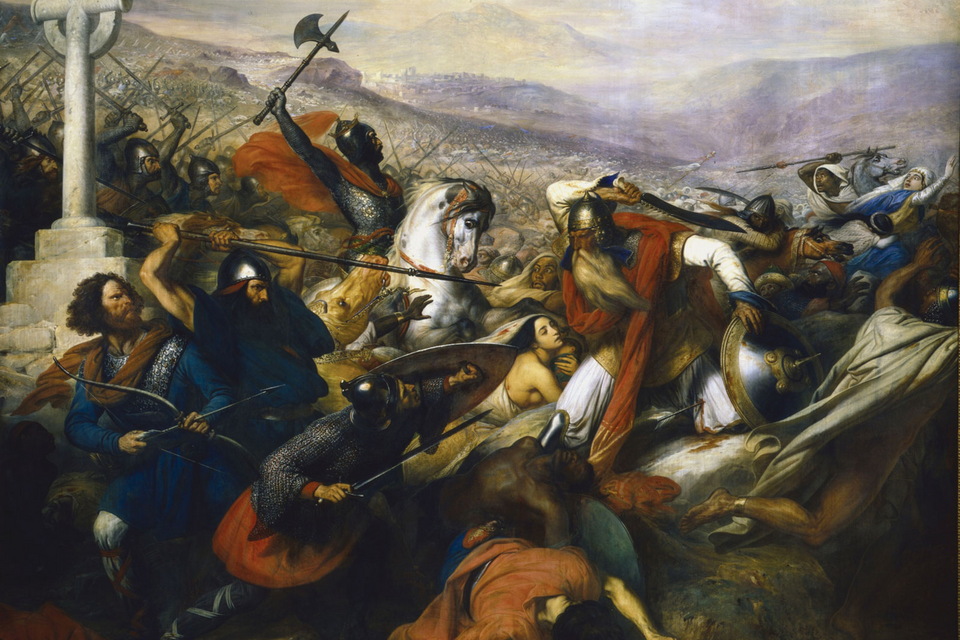
For nearly a week, two armies stood facing each other across a stretch of open ground between Tours and Poitiers and did almost nothing. Small parties skirmished at the edges, but neither side committed to a full attack, each waiting for the other to make the first costly move while the tension of the standoff dragged on day after day. Then, on the day the fighting finally came, the outnumbered defenders formed into a dense, unbroken mass of infantry and simply held their ground, wave after wave of cavalry breaking against a line that would not move no matter how many times it was struck. One contemporary chronicler described the defenders as standing as still as a wall, packed together like a sheet of ice that would not crack under repeated blows.
Tours: The Road to Battle
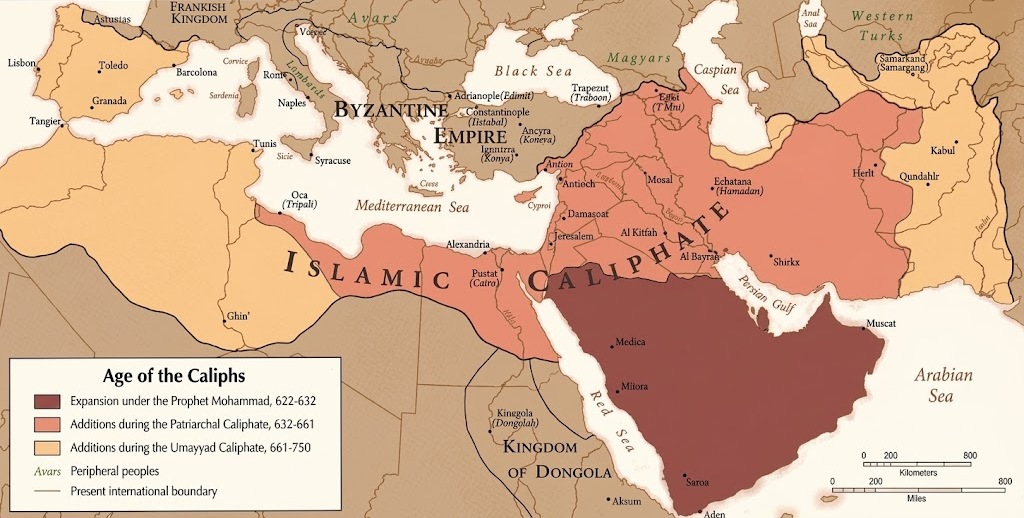
By the early 730s, Umayyad forces had controlled most of the Iberian Peninsula for roughly two decades, having overrun the Visigothic kingdom there in a rapid conquest beginning in 711 that left the Umayyad Caliphate the dominant power across most of the peninsula. From that base, Umayyad governors periodically launched raiding expeditions north across the Pyrenees into Aquitaine, the semi-independent Frankish duchy ruled by Duke Odo, probing for plunder and territory along the caliphate’s northern frontier. Odo had beaten back an earlier incursion at the Battle of Toulouse in 721, but in 732 a new governor-general of al-Andalus, Abd al-Rahman al-Ghafiqi, led a much larger force across the mountains, defeated Odo decisively at the Battle of the River Garonne, and sacked and burned Bordeaux before continuing north with his army largely intact. The expedition’s apparent target was the wealthy Abbey of Saint Martin of Tours, one of the most important pilgrimage shrines in western Christendom and a source of considerable plunder, drawing the raiding force ever deeper into Frankish territory.
Odo, having lost his own army at the Garonne, appealed for help to Charles Martel, the Mayor of the Palace who effectively ruled the Frankish kingdoms on behalf of a figurehead Merovingian king, despite years of prior rivalry and open conflict between the two men that made the appeal itself a considerable concession on Odo’s part. Charles agreed, recognizing the threat a raiding force of that size posed to Frankish territory beyond Aquitaine’s borders, and gathered an army built around seasoned infantry veterans of his own earlier campaigns against Frisians and Saxons rather than the cavalry-heavy forces some neighboring powers relied on. He moved quickly to intercept the Umayyad column before it could reach Tours, choosing to make his stand on wooded, elevated ground between Tours and Poitiers where dense terrain would blunt the effectiveness of the Umayyad army’s mounted forces and force the campaign onto ground of his own choosing.
The Battle of Tours
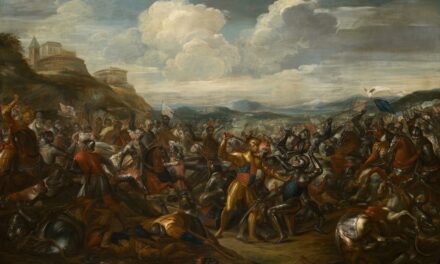
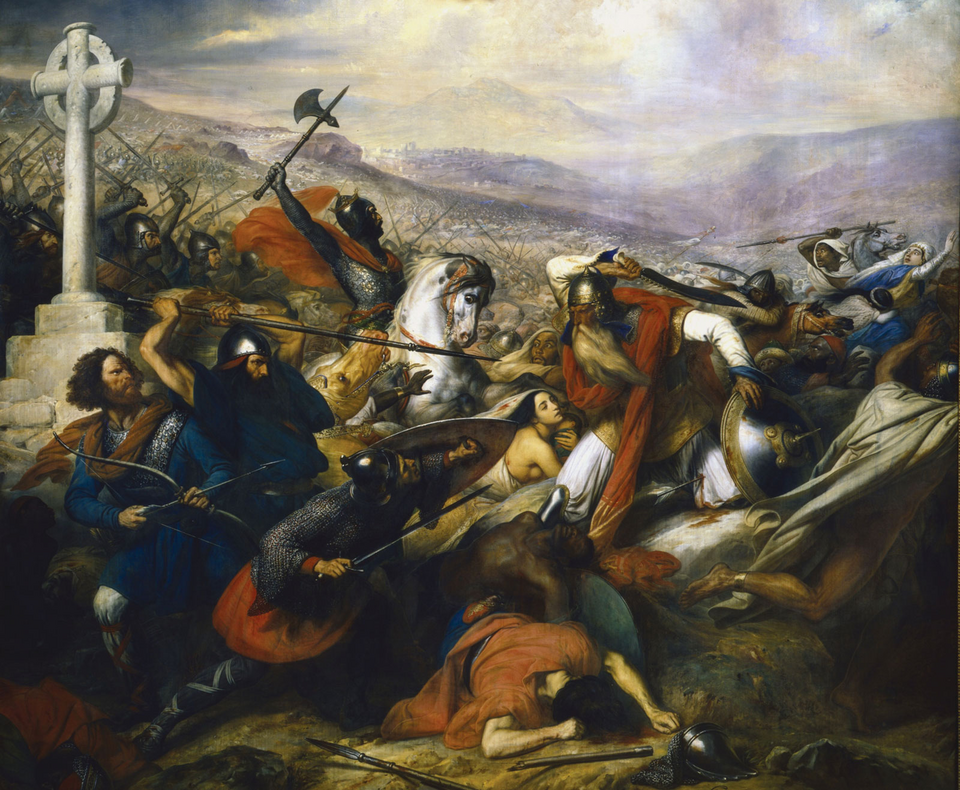
The two armies arrived within sight of one another and then, unusually for the period, spent roughly a week facing off with only minor skirmishing while each side assessed the other’s strength and waited for more favorable conditions. Charles used the delay to his advantage, keeping his infantry drawn up in a tight defensive formation on the high, wooded ground he had chosen, denying the Umayyad cavalry the open terrain it needed to maneuver freely and build momentum for a charge. The choice of ground mattered enormously: Umayyad forces had built their reputation across North Africa and Iberia largely on the strength of fast, mobile cavalry, and a battlefield that neutralized that advantage forced al-Ghafiqi’s army to fight in conditions it was not built for. The standoff finally broke on the day tradition places as October 10, when Umayyad forces launched a full assault against the Frankish position rather than continuing to wait for an opening that never came.
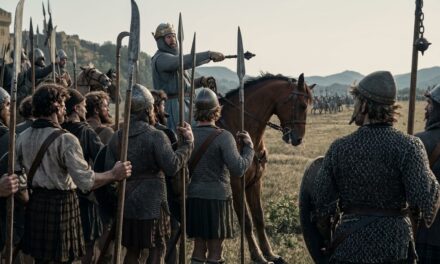
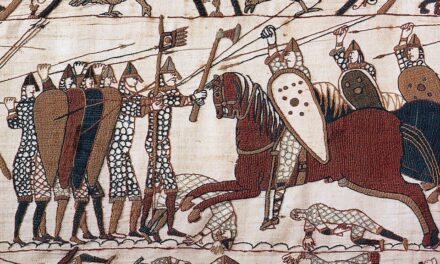
The Frankish infantry, formed into a dense square or block formation and equipped mainly with swords, axes, and heavy shields rather than the light, fast-moving gear favored by much of the Umayyad cavalry, absorbed repeated cavalry charges without breaking, a discipline remarkable enough that the Mozarabic Chronicle of 754, written by a near-contemporary Christian chronicler living under Umayyad rule in Iberia and considered the most reliable surviving account of the battle, described the Franks standing motionless as a wall and holding together as tightly as a sheet of ice under repeated blows. Wave after wave of Umayyad horsemen broke against the Frankish line without dislodging it, charge after charge failing to find a gap wide enough to exploit, a stalemate that favored Charles’s disciplined defenders over an attacking force accustomed to faster, more mobile warfare that depended on speed and maneuver rather than grinding, static combat.
Partway through the fighting, reports reached the Umayyad ranks, whether accurate or exaggerated in the retelling, that Frankish soldiers were threatening the army’s camp and the considerable plunder taken during weeks of raiding across Aquitaine, and a portion of the cavalry broke off from the main assault to defend it. That withdrawal, coming in the middle of an already inconclusive battle, spread confusion through the rest of the Umayyad force at a critical moment when cohesion mattered most. In the disorder, Abd al-Rahman al-Ghafiqi himself was killed attempting to rally his cavalry and restore order, cut down while trying to reorganize troops who had begun to waver, and with their commander dead the Umayyad army’s cohesion collapsed entirely. Command structures in armies of the period depended heavily on the personal authority and battlefield presence of a single leading general, and the sudden loss of that figure in the middle of a confused engagement left no clear chain of command to hold the retreat together or organize a renewed assault at first light. Rather than renew the attack the following morning, the surviving Umayyad forces withdrew overnight under cover of darkness, abandoning much of their camp and plunder rather than risk another day against a line that had refused to break, and retreated back south toward Iberia, leaving the field and the road to Tours to Charles’s army.
The Legacy of Tours
Tours halted the immediate Umayyad advance into Frankish territory and confirmed Charles Martel as the dominant military power north of the Pyrenees, a reputation that helped secure his family’s hold on power; his son Pepin the Short would become the first Carolingian king, and his grandson Charlemagne would build the dynasty into an empire that eventually spanned most of western Europe. Later Western historians, writing centuries afterward, sometimes cast the battle as the moment that saved Christian Europe from conquest, though most modern historians view it more narrowly as the defeat of a large raiding expedition rather than an attempted permanent conquest of Francia, since Umayyad expansion in western Europe was already nearing its practical limits by the 730s regardless of the outcome at Tours, strained by distance from Damascus, the difficulty of supplying an army so far from its base, and internal political pressures within the caliphate.
What Remains at Tours
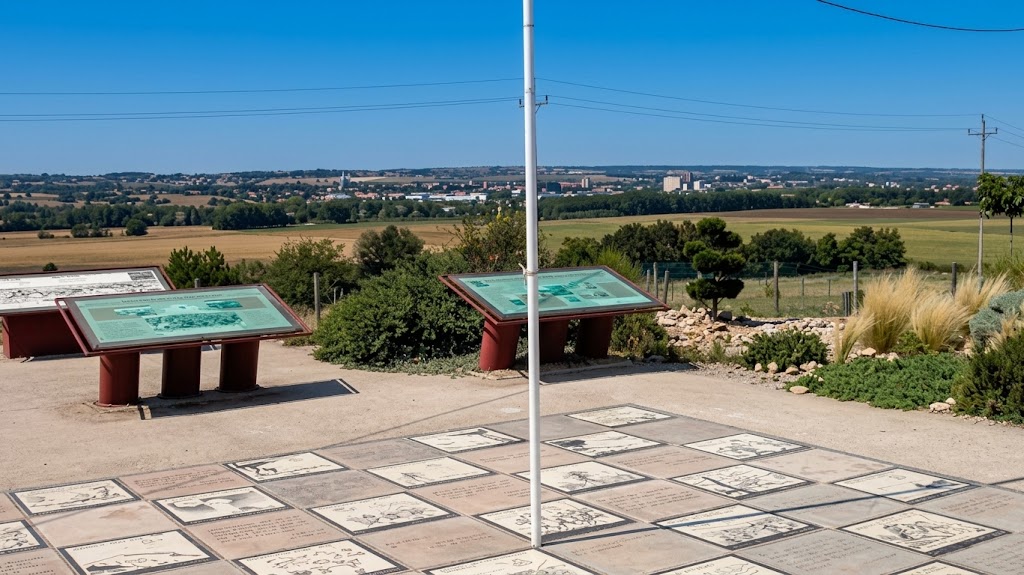
The precise location of the battlefield has never been confirmed by historians, and no fortifications, mass graves, weapon caches, or other physical remains from 732 have been definitively identified anywhere on the ground. What exists instead is a commemorative open-air interpretation site near the village of Vouneuil-sur-Vienne, roughly midway between Poitiers and Tours near Chatellerault, built on a best-guess location rather than a verified one. The site takes the form of a walkable “chessboard,” its interpretive panels laid out across the ground in French and English to explain the campaign and battle in sequence as visitors move through the space, a design that leans into the uncertainty around the exact site rather than pretending to mark an exact spot.
Admission to the site is free, and the grounds are wheelchair- and stroller-accessible, with a picnic area available for visitors who want to make a longer stop and take in the surrounding countryside. Audio guides covering the battle and its broader context in greater depth can be arranged through the Grand Chatellerault Tourist Office for visitors who want more than the panels alone provide, filling in details of the campaign that a short walk through the chessboard layout cannot fully convey on its own. Visitors should expect a modest, low-key, quiet local memorial rather than a major tourist attraction, appropriate to a battle whose exact ground remains genuinely unknown even after nearly thirteen centuries of scholarly interest, and the site’s honesty about that uncertainty is itself part of what makes a visit worthwhile for anyone curious about how historians reconstruct battles from incomplete and contradictory sources rather than expecting a neatly preserved battlefield.
Remembrance at Tours
The battle’s memory has been shaped as much by later retelling as by the events themselves. The Continuations of Fredegar’s Chronicle, a Frankish account closely tied to the Carolingian court and written to celebrate Charles Martel’s achievements, provided the narrative framework most later Western historians relied on, but its casualty figures for the defeated Umayyad army were wildly inflated even by the standards of medieval chronicle writing, and modern historians treat those numbers with considerable skepticism while still drawing on its account of the battle’s sequence. Enlightenment-era historians, most famously Edward Gibbon, later amplified the battle’s symbolic importance well beyond what contemporary sources support, embedding Tours in Western popular memory as a hinge point of European history and speculating, famously, about how differently the continent’s religious and cultural map might have looked had the battle gone the other way. That outsized reputation persists even as historians debate how decisive the battle actually was, making Tours a rare case where the argument about a battle’s meaning has become almost as significant as the battle itself, studied as much for what later generations made of it as for what happened on the ground between Tours and Poitiers.
Visitor Info: Book titled “The Age of Charles Martel” (Paul Fouracre, 2000)
Location: Echiquier de Moussais la Bataille, Chemin de la Baudette, 86210 Vouneuil-sur-Vienne, France (traditional/commemorative site near the presumed battlefield; the precise location remains undetermined)
Site Status: Marker or Monument Only
Visitation Notes: The exact battlefield is undetermined by historians, so this open-air interpretation site near Vouneuil-sur-Vienne (close to Chatellerault, roughly midway between Poitiers and Tours) is a commemorative best-guess location rather than a confirmed one. Its walkable “chessboard” design uses interpretive panels in French and English to explain the battle; the site is free, wheelchair- and stroller-accessible, and has a picnic area, though visitors should expect a modest local monument rather than a major attraction. Audio guides are available through the Grand Chatellerault Tourist Office.
Google Map
Visitor Comments
GeoTRouveTout who returned to the site described it as very well designed and built in the past, but now in a state of vandalism affecting the steles and the audio system that gave the place its historical interest — heartbreaking to see, and needing intervention to save it before it stops attracting visitors.
— from TripAdvisor
According to FELIPE7, this open-air “museum” is meant to mark the supposed site of the 732 battle between Charles Martel’s Franks and Abd al-Rahman’s Arab armies — given the battle’s historical weight, it deserved better than a few panels stuck at the edge of a field. A shame.
— from TripAdvisor
According to Christian F, this small, free open-air museum explains the famous Battle of Poitiers of 732 (or maybe 733) — quite different from what we were taught in school.
— from TripAdvisor