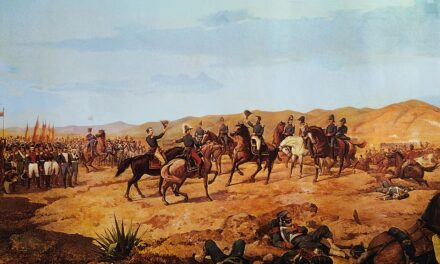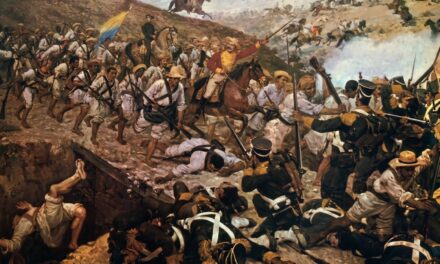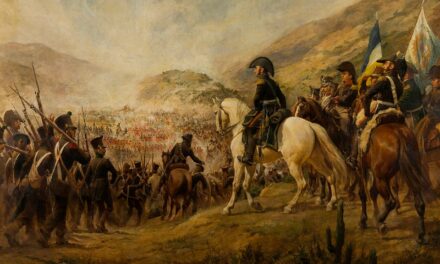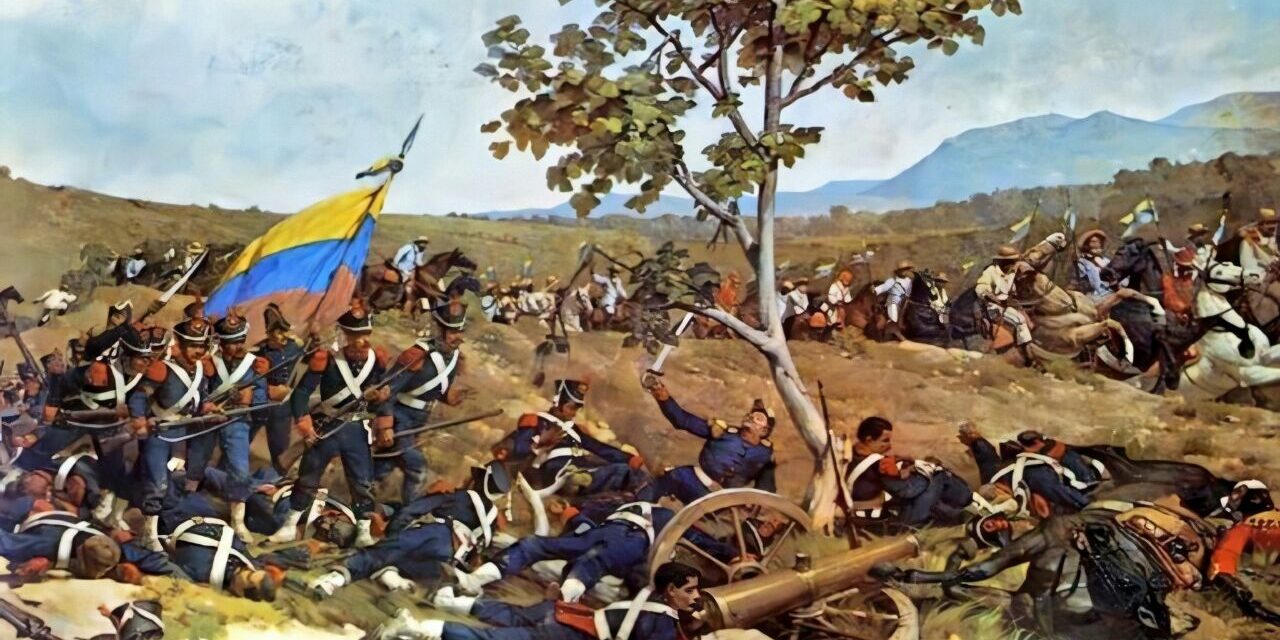
Colonel Thomas Ilderton Ferrier led his foreign volunteers straight up an exposed hillside into massed Spanish gunfire, a deliberately costly diversion meant to hold royalist attention while Venezuelan cavalry swept wide around the flank. Ferrier died there, one of 119 men of the British Legion killed in a single frontal assault against high ground they had little realistic hope of actually taking. Simón Bolívar, watching the flanking charge break the royalist line only minutes later, singled out these foreign volunteers by name in his official battlefield dispatch, calling them the “Saviors of my Fatherland” — an extraordinary tribute to soldiers who held no personal stake in Venezuela’s independence, sent forward to bleed and die simply to open a path for someone else’s victory on someone else’s continent. Few of them would live to see what their sacrifice ultimately purchased.
Carabobo: The Road to Battle
By 1821, Venezuela’s decade-long war for independence from Spain had ground through repeated reversals, and Simón Bolívar’s patriot army faced one final concentrated royalist force standing between the rebellion and effective control of the country. Spanish commanders had positioned their troops on strong defensive high ground near the Carabobo valley, a natural chokepoint along the route Bolívar’s combined forces needed to take toward Valencia and, ultimately, Caracas itself. Bolívar’s army was a genuinely international coalition assembled over years of campaigning: Venezuelan and New Granadan regulars, the fiercely effective llanero cavalry recruited from the vast interior plains, and hardened European mercenaries and volunteers, prominently including the British Legion, who had crossed the Atlantic to fight in a war that was not their own.
General José Antonio Páez commanded the llanero horsemen, irregular cavalry whose mastery of the open plains terrain made them a uniquely mobile and unpredictable threat that conventional European-trained royalist infantry struggled to counter effectively. The Spanish royalist force, though outnumbered, held a naturally strong position and had spent the preceding campaign season fortifying it, forcing Bolívar to choose between a costly direct assault or an elaborate flanking maneuver across genuinely difficult terrain that could easily go wrong. As both armies settled into position on the morning of June 24, 1821, the stakes were unmistakable: a decisive patriot victory here would all but end effective Spanish resistance in Venezuela, while a defeat could unravel years of hard-won revolutionary momentum in a single afternoon. Bolívar himself had spent the preceding weeks maneuvering to force exactly this kind of decisive confrontation, aware that a war fought largely through raids, sieges, and inconclusive skirmishes needed one unambiguous field victory to convert years of grinding campaign gains into an irreversible political fact. Both commanders understood the terrain intimately by this point in the campaign, and the choice of ground at Carabobo reflected months of prior maneuvering rather than any accident of circumstance.
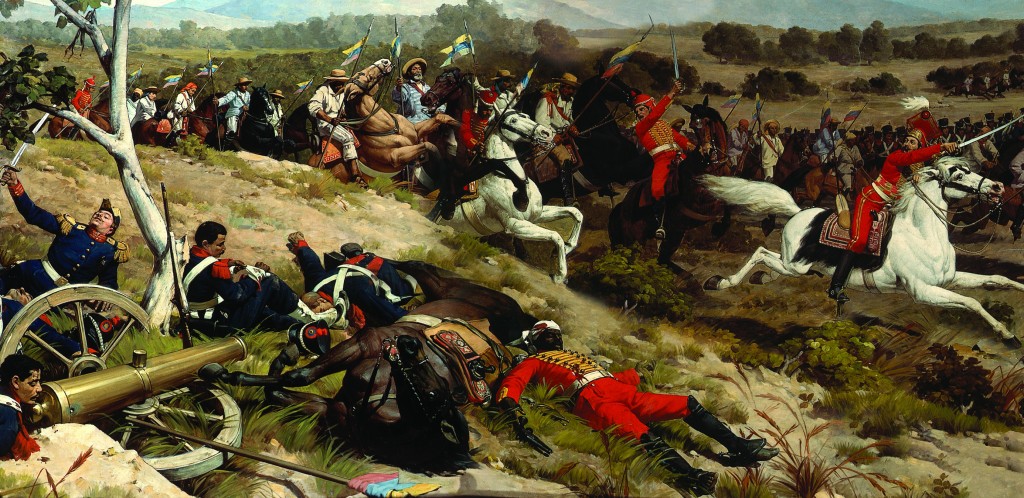
The Second Battle of Carabobo
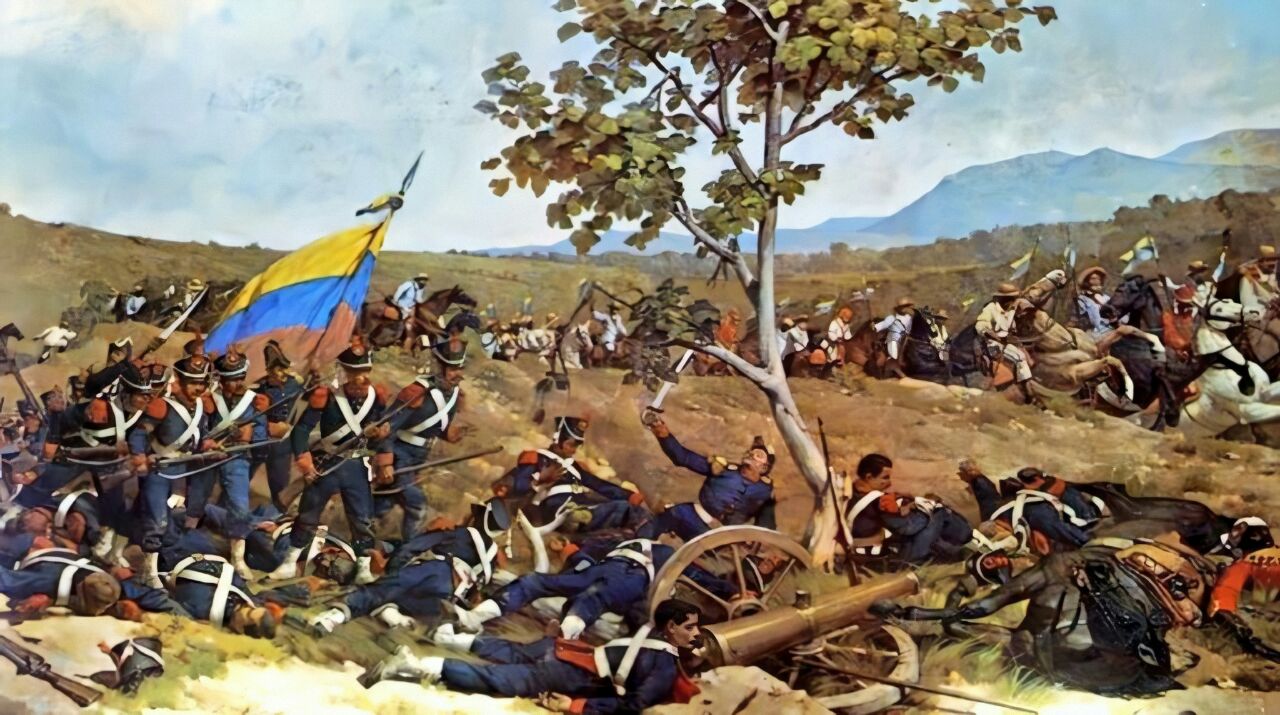
The battle opened with Bolívar committing the British Legion and allied infantry to a direct frontal assault against the royalist position on the high ground, a deliberately punishing maneuver intended less to break the line outright than to fix Spanish attention and reserves squarely on the center of the field. Colonel Ferrier’s volunteers advanced under withering fire up exposed terrain with minimal cover, absorbing devastating casualties as royalist defenders poured volleys into their ranks from prepared positions above. While the Legion and supporting infantry bled in that costly frontal engagement, Páez led his llanero cavalry on a wide sweeping maneuver around the Spanish flank, exploiting difficult terrain that royalist commanders had judged too impractical for a serious cavalry threat to traverse in force.
The llaneros’ charge, once it fell upon the exposed Spanish flank, struck with a speed and ferocity that stunned defenders who had committed most of their attention to the punishing frontal assault still unfolding in the center. Royalist cohesion began collapsing rapidly once the flank gave way, as units that had held firm against the direct assault found themselves suddenly threatened from an unexpected direction with no organized way to reposition under pressure. Bolívar, recognizing the decisive moment as Páez’s cavalry tore into the Spanish position, is reported to have promoted Páez to General-in-Chief on the battlefield itself, an on-the-spot honor reflecting just how completely the flanking charge had turned the engagement. Royalist officers who had positioned their strongest units to meet a frontal assault now found those same units effectively useless, unable to reorient quickly enough on difficult terrain to face a cavalry threat arriving from a direction they had judged impassable to any serious mounted force. Some royalist companies attempted to form improvised defensive lines facing the new threat, but the speed of the llanero charge and the psychological shock of being outflanked on supposedly secure ground overwhelmed whatever cohesion those hurried formations briefly managed to hold.
Within a remarkably short span of fighting, the royalist line broke into full retreat, its cohesion shattered by the combined pressure of Ferrier’s costly diversion and Páez’s decisive flank attack landing in close succession. Spanish forces that had held a strong defensive position that morning were, by early afternoon, streaming from the field in disorganized retreat, their capacity to mount further serious resistance in the region effectively broken by the scale and speed of the collapse. The battle had lasted only a few hours from first contact to royalist collapse, an unusually compressed timeline for an engagement of such lasting strategic consequence, and patriot casualties, while real, were far lighter than the losses inflicted on the fleeing Spanish force. Contemporary accounts describe the field afterward as littered with abandoned royalist equipment and supplies, testament to how completely organized resistance had dissolved once Páez’s cavalry struck home, and Bolívar wasted little time exploiting the opening, moving quickly to consolidate control over Valencia and the surrounding region before scattered Spanish garrisons could regroup or coordinate any meaningful counterattack.
The Legacy of Carabobo
The victory at Carabobo effectively secured Venezuelan independence in practical terms, even though scattered royalist resistance would persist elsewhere in the country for several more years before Spanish power was fully extinguished. Bolívar’s public tribute to the British Legion, delivered in the immediate aftermath, cemented the battle’s reputation as a case study in how foreign volunteers, motivated by ideology rather than national interest, could decisively shape the outcome of another people’s revolution. Páez’s battlefield promotion and the llanero cavalry’s central role in the victory also elevated the plains horsemen to a lasting place in Venezuelan national memory as symbols of homegrown martial ingenuity triumphing over conventional European military doctrine. Carabobo has since become one of the defining reference points of the entire South American independence era, cited alongside Boyacá and Ayacucho as proof that Spain’s centuries-old grip on the continent could be broken through coordinated, multinational revolutionary effort rather than any single nation’s isolated uprising.
Visiting Carabobo Today
The battlefield survives today as a preserved national monument built up gradually across a full century of commemoration, centered on a triumphal arch erected for the battle’s 1921 centennial and expanded with a 31-meter sword monument added for the 2021 bicentennial. Beneath the arch, a tomb of the unknown soldier stands under permanent guard by soldiers in period uniform, while the nearby Altar de la Patria gathers statues of Bolívar and his generals into a single formal commemorative space along a long ceremonial avenue. It is among the best-maintained historic sites tied to South America’s independence wars, government-funded and expanded as recently as the 2021 bicentennial.
The monument complex, known as the Campo de Carabobo, lies on the open plain near the town of Tocuyito, in Carabobo State, about 30 kilometres south-west of the city of Valencia. Walking the length of the ceremonial avenue gives a sense of the scale of the plain on which the armies met, and the complex is large enough to need an hour or two to explore properly. From the higher ground around the monuments, visitors can look out across the field and trace the course of the battle: the rising ground the royalists held, the exposed slopes up which the British Legion advanced under fire, and the broken country on the flank through which Páez’s llaneros made their decisive charge. The plain is hot and exposed for much of the year, so an early start is wise, and a local guide can help bring the story of the battle to life on the ground.
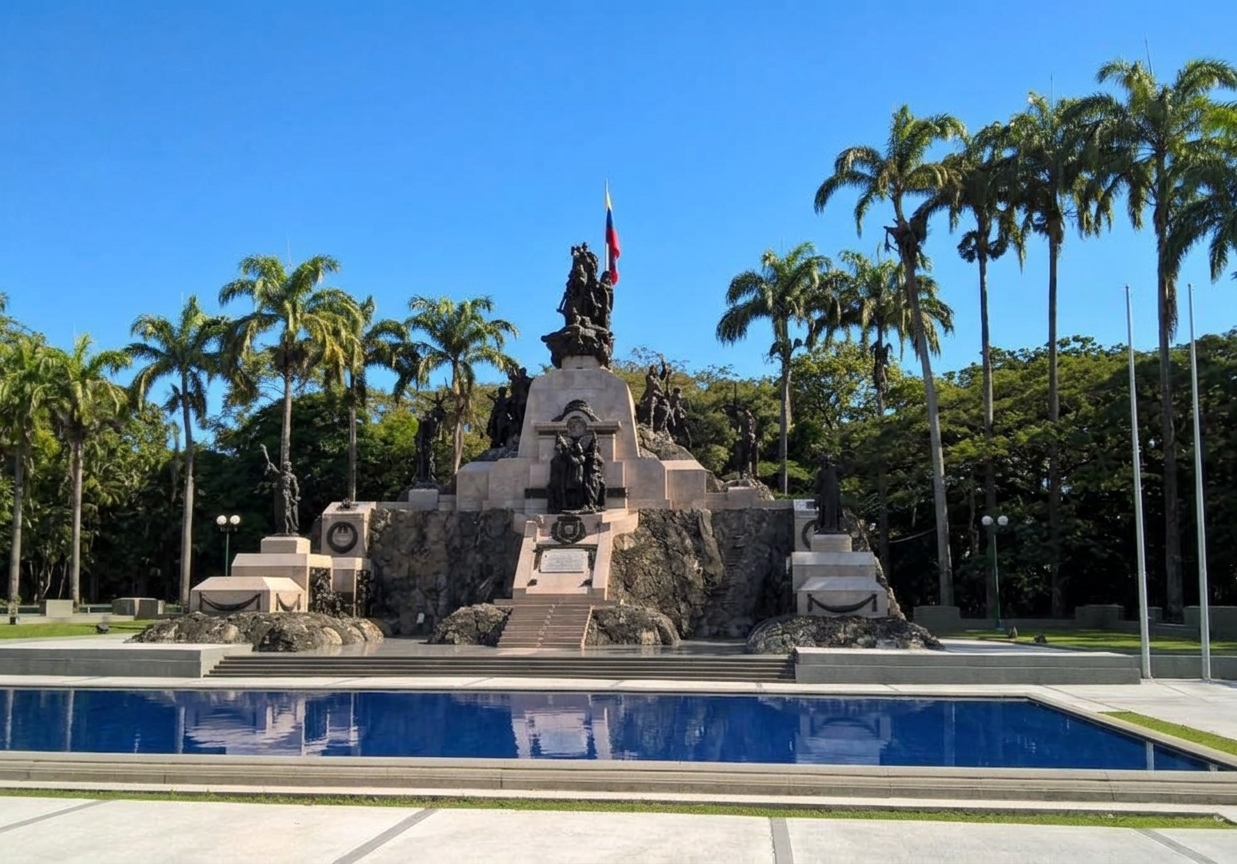
Remembrance of Carabobo
Bolívar’s own dispatch after the battle remains the single most consequential piece of testimony from Carabobo, since his decision to single out foreign volunteers by name for extraordinary praise shaped how the battle would be remembered for the next two centuries. The steady expansion of the monument complex, from the original 1921 centennial arch through the 2021 bicentennial sword addition, reflects a Venezuelan state that has continued actively investing in the site’s commemorative infrastructure even through periods of severe national instability and hardship. Páez’s cavalry and the sacrifice of the British Legion are now woven together into a single national narrative of the battle, one crediting both the plains horsemen’s decisive maneuver and the volunteers’ costly diversion as equally essential to the day’s outcome. Every 24 June, the anniversary of the battle, Venezuela marks the Battle of Carabobo and Army Day as a national holiday, and the main ceremonies are held at the monument on the field itself. For visitors who stand beneath the arch, beside the guarded tomb of the unknown soldier, the plain of Carabobo offers a direct link to the afternoon when Páez’s horsemen swept around the flank and Ferrier’s volunteers climbed into the Spanish guns, and to all the soldiers on both sides who died there.
Further Exploration: Article titled “Venezuela’s Independence Wars Ended Exactly 200 Years Ago” (Caracas Chronicles, 2021)
Location: Conjunto Monumental Campo de Carabobo, near Tocuyito, Libertador Municipality, Carabobo State, Venezuela (exact GPS approximate)
Site Status: National Park / Managed Historic Site
Visitation Notes: The site is preserved as a national monument centered on a triumphal arch built for the battle’s 1921 centennial, with a tomb of the unknown soldier guarded by soldiers in period uniform beneath it, an Altar de la Patria featuring statues of Bolivar and his generals, and a 31-meter sword monument added for the 2021 bicentennial. The complex lies on the open plain near Tocuyito, about 30 km south-west of Valencia, and a long ceremonial avenue leads to the arch; the plain is hot and exposed, so an early start is wise.
Google Map
Visitor Comments
andodeturista describes the monument’s commemoration of Venezuela’s path to independence, and advises visitors to bring water and sun protection given temperatures of 28-36°C in the park.
— from TripAdvisor
Venezuela2013 calls it a site with “extraordinary sculptures” honoring Simón Bolívar and the heroes of independence, recommends hiring a guide for the history, but cautions visitors to be careful about safety given the location.
— from TripAdvisor
rosroch03 praises Campo De Carabobo as “a beautiful site recognizing our Independence History,” highlighting the park’s recreation options (bikes, roller skates) and abundant mango and avocado trees.
— from TripAdvisor