Ludwig von Benedek lost the battle that decided who would rule Germany, and lost his career along with it, but the Austrian high command did not stop there. When a newspaper article publicly laid the entire catastrophe at his feet, Emperor Franz Joseph halted the court-martial that might have let Benedek answer the charges and instead ordered him never to discuss the defeat publicly again, for the rest of his life. Stripped of his command and forbidden from defending his own name, the general who lost Königgrätz spent his remaining years in silence, unable to explain, excuse, or even describe what had actually happened on that single decisive afternoon in Bohemia.
Königgrätz: The Road to Battle
By the summer of 1866, tensions between Prussia and Austria over dominance within the German Confederation had escalated into open war, a conflict both powers had anticipated for years as the question of which state would ultimately lead a unified Germany moved from diplomatic maneuvering toward military confrontation. Prussia’s chief of staff, Helmuth von Moltke the Elder, had spent years modernizing Prussian military logistics and command structures, and he now put those reforms into practice by coordinating three separate Prussian armies advancing along different railway routes toward a planned convergence in Bohemia, a level of logistical sophistication well beyond anything the Austrian command structure could match. The Austrian army, under the reluctant leadership of Ludwig von Benedek, a commander who had reportedly expressed doubts about his own suitability for the role even as he accepted it, took up a strong defensive position near the town of Königgrätz, anchored around the village of Chlum on high ground overlooking the surrounding Bohemian farmland.
Benedek’s force significantly outnumbered the Prussian First Army and the allied Elbe Army already in the field, and had he been able to defeat them decisively before Crown Prince Friedrich’s Second Army, roughly one hundred thousand men strong, arrived from the north, the strategic picture might have shifted dramatically in Austria’s favor. Prussian infantry, equipped with the breech-loading Dreyse needle gun that allowed for a substantially faster rate of fire than the muzzle-loading rifles still standard in the Austrian army, held a significant tactical advantage in any sustained infantry engagement, a technological edge that would prove decisive as the battle unfolded. As Moltke’s carefully coordinated armies converged on the battlefield from separate directions, both sides understood that the outcome of the engagement now approaching would settle, in a single day, a rivalry over German leadership that had simmered for generations.
The Battle of Königgrätz
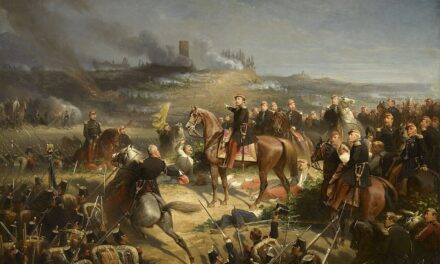
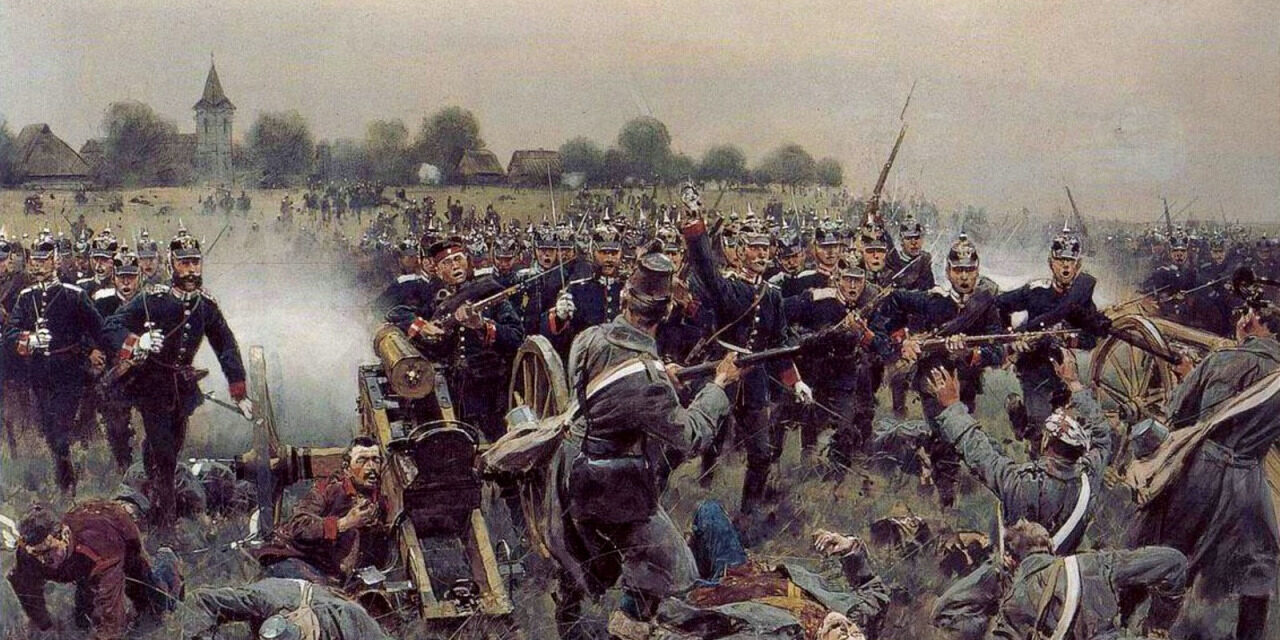
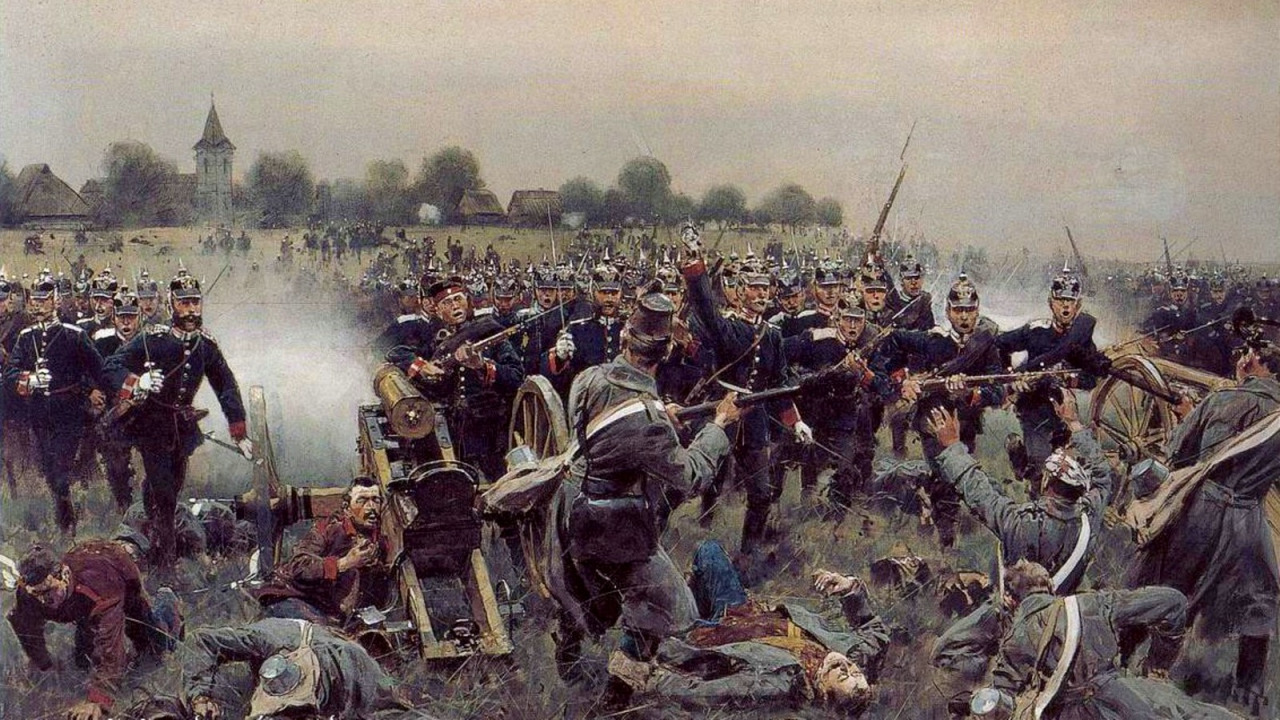
The battle opened in the early morning as the Prussian First Army and the allied Elbe Army launched attacks against the strong Austrian defensive positions around Königgrätz, advancing into fortified ground that Benedek’s forces had spent considerable effort preparing in the days before the engagement. Austrian infantry, deployed in dense traditional columns rather than the more dispersed formations increasingly favored by modern military thinking, suffered devastating casualties from Prussian rifle fire, since the needle gun’s superior rate of fire allowed Prussian infantrymen to load and fire from a prone position while their Austrian counterparts were still working the muzzles of their slower weapons standing upright and exposed. Despite these losses, the disciplined Austrian artillery, generally considered superior to its Prussian counterpart in both quality and handling, inflicted serious casualties on the advancing Prussian infantry, and for much of the morning the battle hung in a bloody and uncertain balance as neither side’s initial assault achieved a decisive breakthrough.
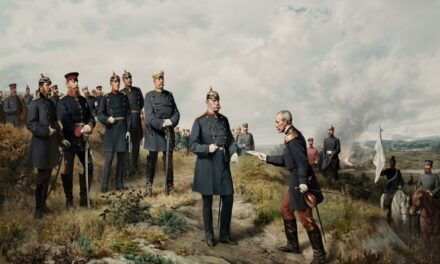
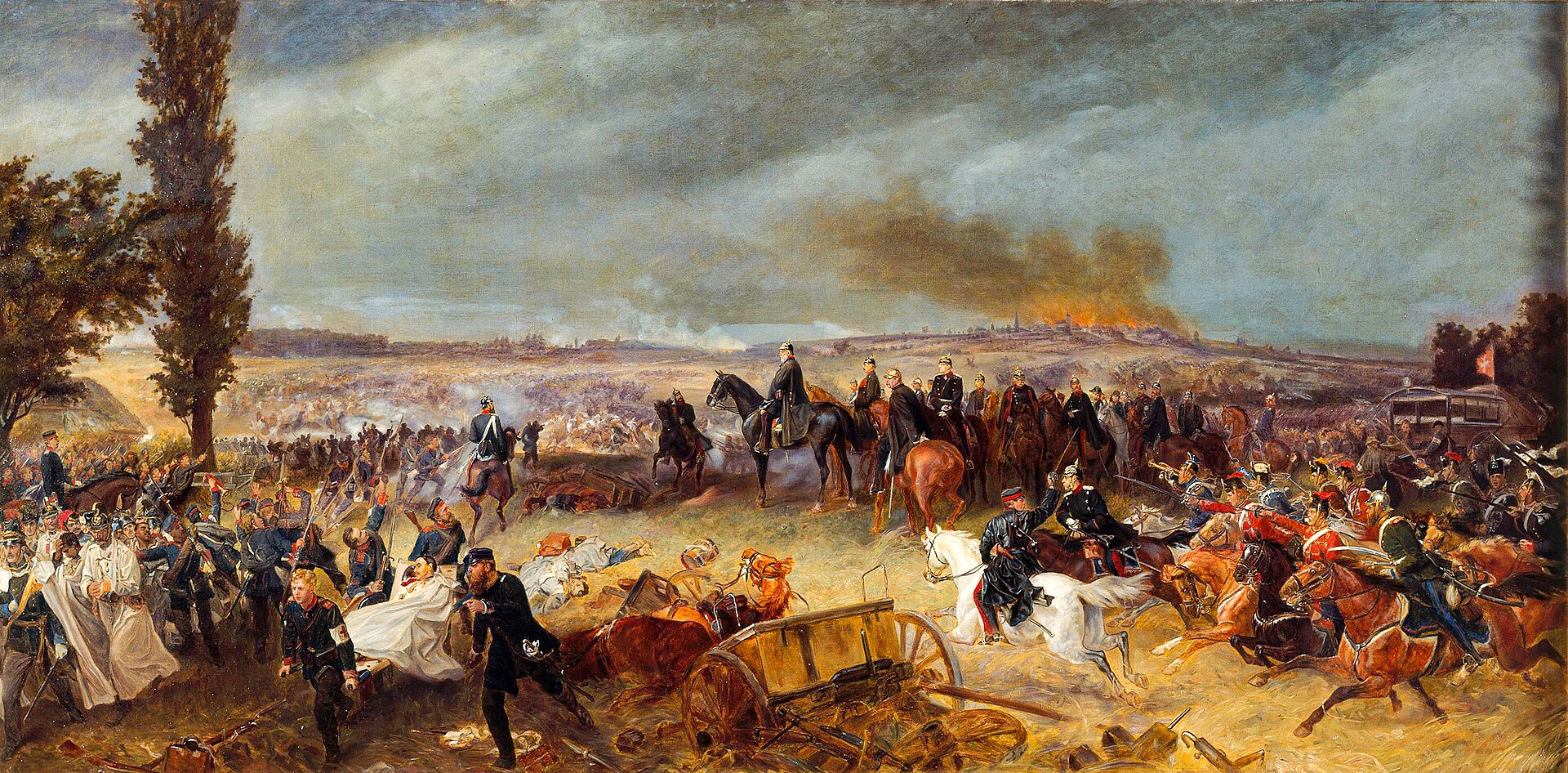
As the fighting in the center intensified through the late morning and casualties mounted steadily on both sides, King Wilhelm I of Prussia, personally present on the battlefield and increasingly alarmed by the scale of the losses his forces were sustaining, reportedly grew anxious enough to raise the possibility of ordering a general withdrawal before the battle could be fully decided. Moltke, confident in the timing of his carefully coordinated troop movements, firmly insisted there would be no retreat, arguing that the arrival of Crown Prince Friedrich’s Second Army was imminent and would prove decisive if the Prussian center could simply hold its ground a while longer against the Austrian pressure. That confidence was vindicated in the early afternoon when the Second Army, having completed a demanding forced march from the north, arrived unexpectedly on the exposed Austrian right flank near Chlum, catching Benedek’s forces in a position they had not adequately prepared to defend against an attack from that direction.
Moltke’s order redirecting elements of the Prussian force to exploit this flank as the Second Army pressed in from the north proved to be the single decisive tactical stroke of the entire battle, threatening to encircle the Austrian army entirely rather than merely to defeat it in a straightforward frontal engagement. As Prussian forces began rolling up the Austrian right flank while continuing to press the already-weakened center, Benedek recognized that his position around Chlum was rapidly becoming untenable and that further resistance risked the complete destruction rather than the mere defeat of his army. He ordered a general withdrawal in the early evening, and while the retreat itself was executed with enough discipline to avoid the total encirclement Moltke’s converging forces had threatened, the Austrian army had already suffered catastrophic losses, both in casualties and in the collapse of any realistic hope of reversing the campaign’s outcome. By nightfall, the battlefield around Königgrätz had produced one of the most one-sided and consequential single-day engagements of nineteenth-century European warfare, with Austrian losses dramatically exceeding those suffered by the victorious Prussian forces.
The Legacy of Königgrätz
The crushing defeat at Königgrätz effectively ended Austria’s centuries-long bid to lead the German states, clearing the path for Prussia’s subsequent unification of Germany under its own leadership over the following years, a transformation that would fundamentally reshape the balance of power across all of Europe. Benedek’s career ended in disgrace immediately after the battle, and Austria’s military leadership initially moved toward a formal court-martial before Emperor Franz Joseph intervened, halting the proceeding and instead sentencing the general to a lifetime of enforced public silence about the defeat, a punishment perhaps crueler in its way than any formal military tribunal might have imposed. Moltke’s demonstration of railway-coordinated mass mobilization at Königgrätz became a foundational case study in modern military logistics, studied and emulated by military planners across Europe for decades afterward as armies grew larger and more dependent on efficient rail transport for rapid deployment. The war’s swift conclusion, decided in barely seven weeks with Königgrätz as its single overwhelming battle, also demonstrated to European observers just how decisively a well-organized modern army equipped with superior infantry weapons and disciplined leadership could overwhelm a numerically comparable but less coordinated opponent.
Visiting Königgrätz Today
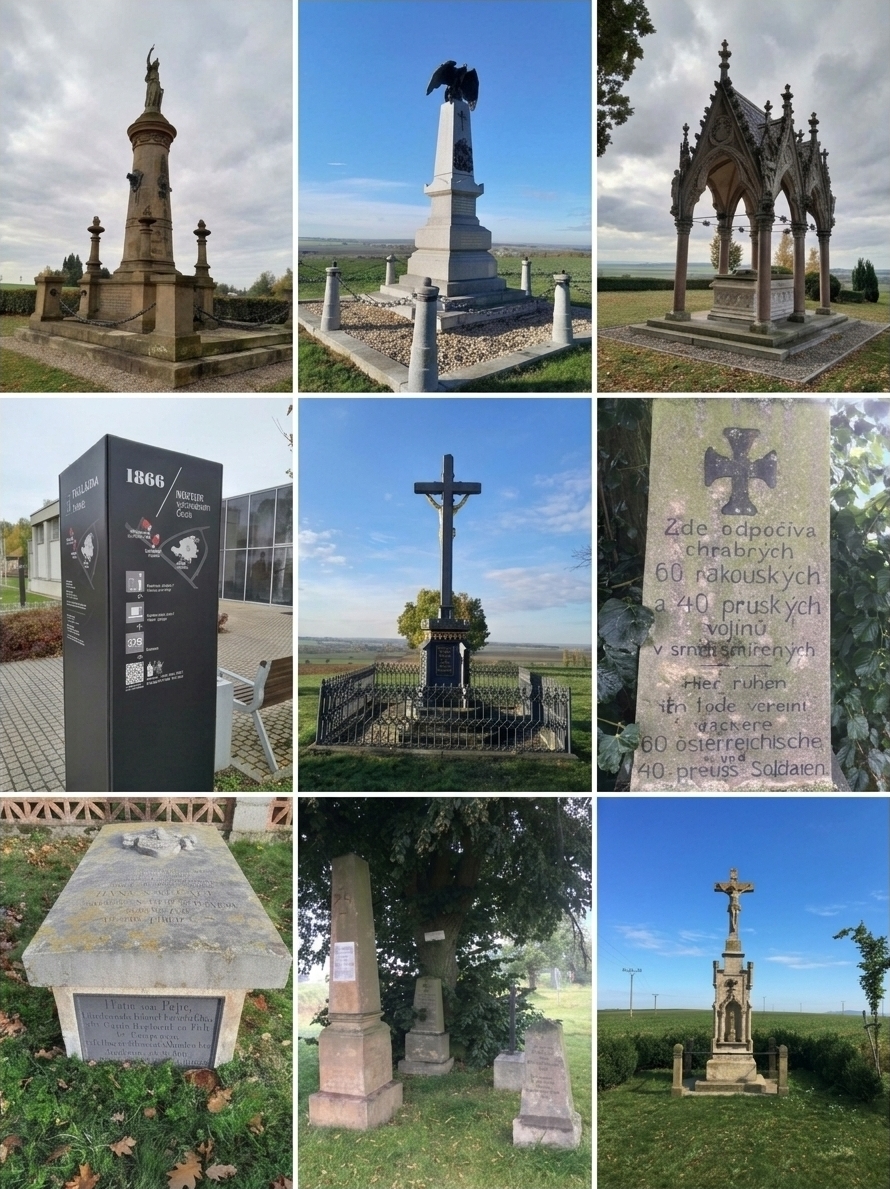
The battlefield around Königgrätz survives today as open farmland dotted with roughly four hundred seventy-five individual monuments, erected over the decades that followed by regiments, veterans’ associations, and grieving families seeking to mark the specific spots where their units fought or their loved ones fell. The War of 1866 Museum at Chlum, anchoring the site at the heart of the old Austrian defensive position, underwent a significant recent renovation that added augmented-reality features allowing visitors to visualize troop movements across the landscape, period military gear that visitors can try on for a hands-on sense of the era’s equipment, and a climbable lookout tower offering sweeping views across the surrounding battlefield terrain. The extensive forest surrounding the museum holds numerous smaller memorials to fallen soldiers scattered throughout its paths, though visitors reviewing the site note that it is easy to lose one’s bearings while exploring the wooded terrain, making a map or guided approach worthwhile for anyone hoping to see the more scattered and remote memorials.
A network of cycling and hiking routes connects the museum at Chlum to other landmarks scattered across the wider battlefield, allowing more ambitious visitors to trace the movements of Moltke’s converging armies and the Austrian defensive positions they eventually overwhelmed across a considerably larger area than the museum grounds alone. Because the battlefield covers such an extensive stretch of still-active farmland rather than a single compact and fully preserved historical park, visitors benefit from allocating a full day to properly explore both the museum’s modern interpretive features and the wider network of monuments and trails scattered across the surrounding countryside. The sheer density of individual memorials scattered across the farmland, each placed by a different regiment or family in the decades following the battle, gives Königgrätz an unusually personal and cumulative sense of loss that becomes apparent only to visitors willing to explore beyond the museum’s immediate grounds.
Remembrance of Königgrätz
Contemporary accounts from both Prussian and Austrian sources documented the battle’s dramatic swings, from the morning’s uncertain infantry struggle through Moltke’s calm insistence on holding the line to the decisive arrival of the Second Army on the Austrian flank, and these records remain essential to how historians reconstruct the day’s rapidly shifting fortunes. The War of 1866 Museum’s recent renovation reflects a broader modern effort to make the battle’s complex troop movements and technological contrasts, particularly the decisive role of the Prussian needle gun, more accessible to visitors than static historical markers alone could manage. The hundreds of scattered regimental and family memorials across the surrounding farmland stand as an enduring, decentralized form of remembrance quite different from the single official monument or museum found at many other historical battlefields, reflecting how deeply the battle’s losses were felt across the many different communities and units that fought there. Benedek’s enforced silence about the battle that defined and ended his career remains one of the most quietly tragic footnotes to Königgrätz, a reminder that the consequences of the single afternoon that decided the future of Germany fell most heavily, and most permanently, on the man ordered never to speak of it again.
Further Exploration: Book titled “The Austro-Prussian War: Austria’s War with Prussia and Italy in 1866” by Geoffrey Wawro (Cambridge University Press, 1996)
Location: War of 1866 Museum at Chlum (Muzeum valky 1866), Chlum 66, 503 12 Vsestary, Czech Republic
Site Status: Marker or Monument Only
Visitation Notes: The battlefield remains open farmland dotted with roughly 475 individual monuments erected over the decades by regiments and families, anchored by the War of 1866 Museum at Chlum, which was recently renovated with augmented-reality features, period gear visitors can try on, and a climbable lookout tower. The surrounding forest holds many smaller memorials to fallen soldiers, though reviewers note it’s easy to lose your bearings while exploring it. Cycling and hiking routes connect the museum to other landmarks across the wider battlefield.
Google Map
Visitor Comments
Liesekatze reflects on the site’s mass graves and cynical wartime inscriptions, citing the battle’s scale of over 400,000 soldiers clashing across the field and calling war’s toll “incomprehensible senselessness.”
— from TripAdvisor