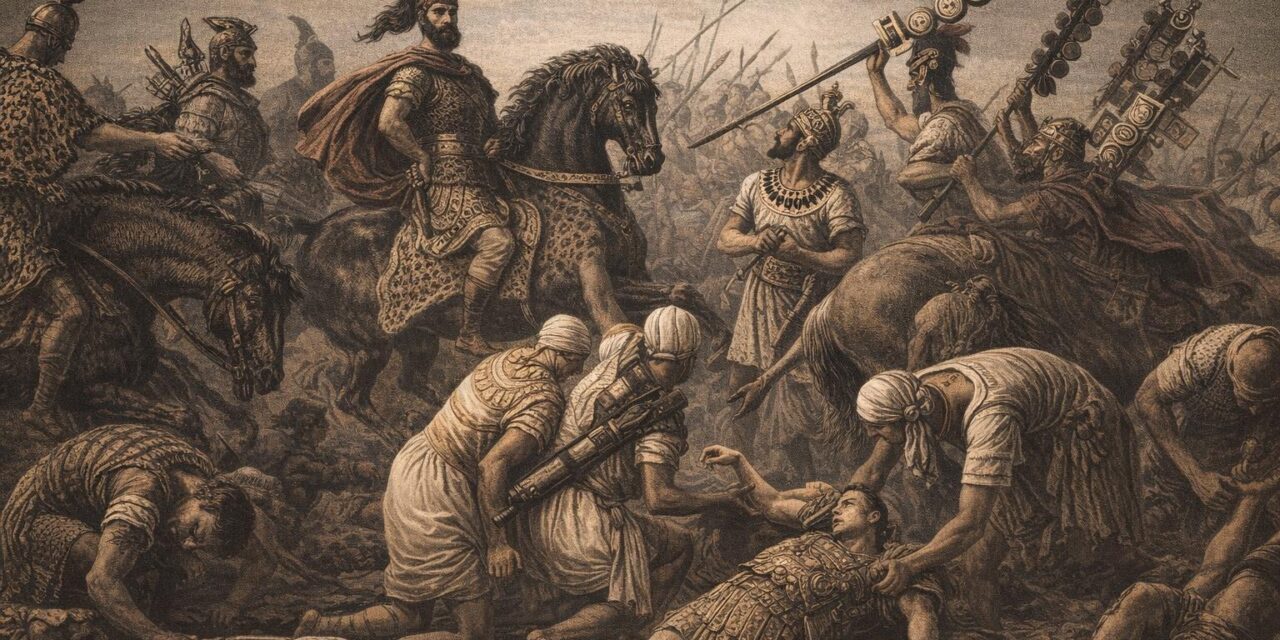
In a single afternoon on the plains of southern Italy, a Carthaginian general with an army half the size of the force in front of him destroyed it so completely that his name became a byword for annihilation, and military academies still teach the maneuver he used more than two thousand years later. The Battle of Cannae remains the textbook example of tactical envelopment, a single day’s fighting so total in its result that Rome, which had already survived two earlier catastrophes at Hannibal’s hands, came closer to outright collapse than at almost any other point in its history.
Cannae: The Road to Battle
By 216 BC, Hannibal Barca had already inflicted two major defeats on Roman armies since crossing the Alps into Italy two years earlier, first at the Trebia River and then in a devastating ambush at Lake Trasimene, where an entire Roman army was destroyed in a single morning. Rome responded to these disasters by raising an unprecedented force, reportedly some eight legions alongside allied troops, placing roughly 80,000 to 90,000 soldiers under the joint command of that year’s two consuls, Lucius Aemilius Paullus and Gaius Terentius Varro, operating under Rome’s peculiar system of alternating daily command between them. Paullus, distrustful of the open plain near Cannae that Hannibal had chosen and wary of the room it gave the enemy’s superior cavalry to maneuver, argued against giving battle there at all, but the decision to engage fell to Varro on the day command rotated to him, and he pressed for the aggressive assault he believed Rome’s overwhelming numerical advantage would settle in Rome’s favor.
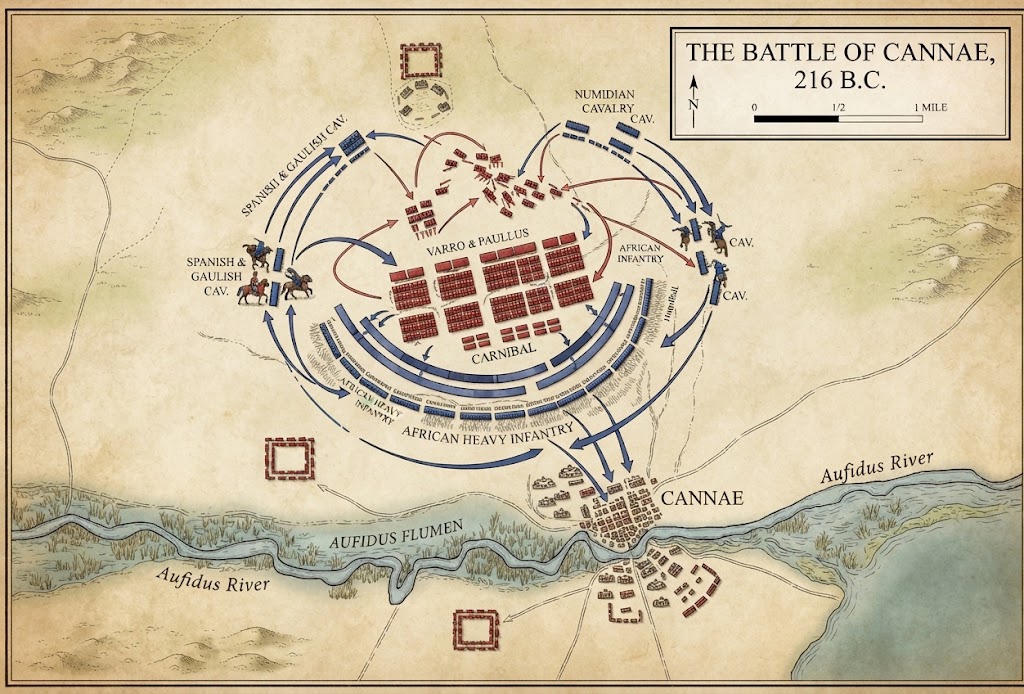
Hannibal, whose army was outnumbered by roughly two to one, chose ground that suited his cavalry, drawn from Numidian and Spanish horsemen who were markedly superior to Rome’s mounted forces, and arranged his infantry in a formation built around a calculated weakness rather than strength, banking everything on the Roman commanders taking the bait of an apparently vulnerable center. The open, dusty plain also favored his heavier cavalry’s mobility over the Roman legions’ preference for closer, more broken terrain, and a hot, dry wind blowing dust into the Roman ranks that day, according to some ancient accounts, only compounded the disadvantage of the ground Varro had chosen to fight on.
The Battle of Cannae
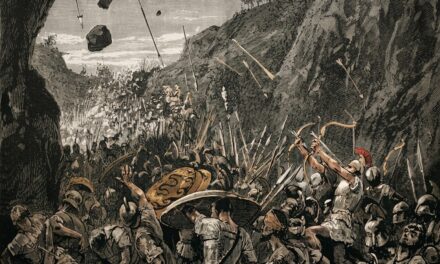
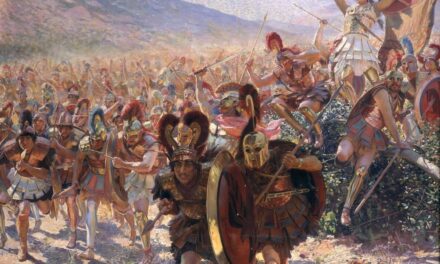
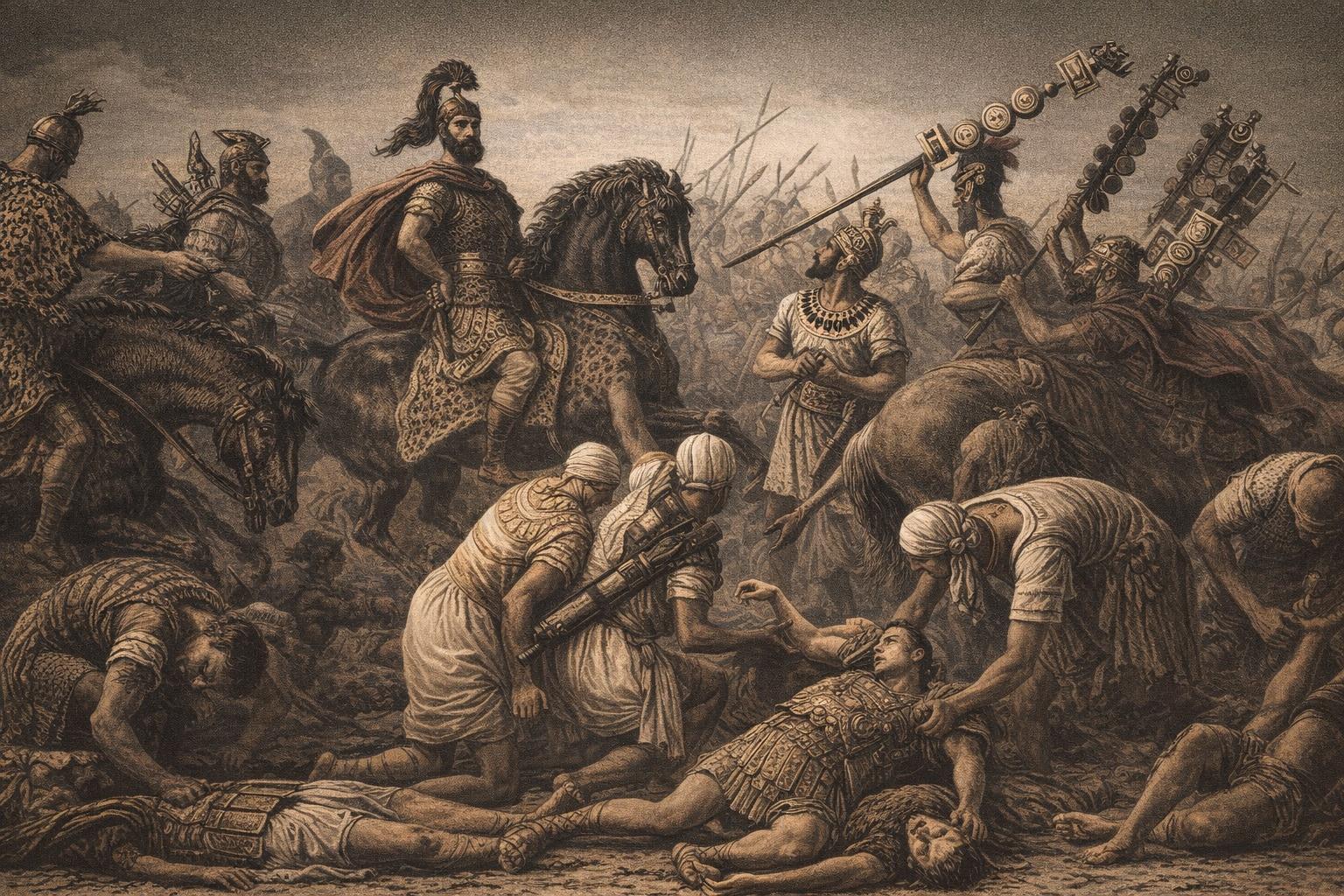
Hannibal deliberately shaped his center into a crescent that bowed outward toward the advancing Romans, packing his least reliable Gallic and Spanish infantry into that forward bulge and instructing them to give ground slowly as the pressure mounted, while his more disciplined African infantry waited in reserve on the flanks. As the dense Roman legions pushed into what looked like a collapsing enemy center, the crescent bent backward into a pocket, drawing the Roman formation deeper and tighter until it had lost the room to maneuver or bring its full numbers to bear. At the same time, Hannibal’s cavalry, having already routed the outmatched Roman horse on both wings, swept around behind the Roman army entirely, and his African infantry wheeled inward from the flanks, closing a ring around as many as 50,000 Roman and allied troops trapped with no avenue of escape.
What followed was less a battle than a slaughter, as the encircled Roman army, packed too tightly to fight effectively or retreat, was cut down over the following hours in one of the single bloodiest days in ancient warfare, with estimates of Roman dead ranging as high as 50,000 to 70,000 men killed in a single afternoon, a toll so extreme that ancient historians themselves debated the exact figures for centuries afterward, since no comparably documented single-day battle in the ancient world approached it in scale. Paullus fought and died in the collapsing center, one of roughly 80 Roman senators and a comparable share of the army’s military tribunes lost that day, a single battle’s toll of political and military leadership that shook the Republic to its foundations. Varro, who had pressed for the engagement, was among the few senior officers to escape the encirclement, riding to the nearby town of Venusia to begin rallying what remained of Rome’s shattered forces; later Roman tradition largely blamed him for the disaster, though the Senate itself formally thanked him for not despairing of the Republic in its darkest hour.
The Legacy of Cannae
In the hours after the victory, Hannibal’s cavalry commander Maharbal reportedly urged an immediate march on an undefended Rome, arguing the war could be won within five days, but Hannibal, lacking siege equipment and wary of the risks of assaulting Rome’s walls without reinforcement, declined to advance, a decision historians have debated for two thousand years as either sound caution given the practical realities of siege warfare against a still-defended capital, or the single greatest missed opportunity in ancient military history. According to the Roman historian Livy, Maharbal replied that the gods had not given any one man all their gifts, since Hannibal knew how to win a victory but not how to use one, a line historians still debate as either fair tactical criticism or hindsight-laden legend invented well after the fact. Rome, rather than collapsing after Cannae as many expected, refused to negotiate and instead adopted a deliberately cautious strategy under the general Quintus Fabius Maximus, avoiding pitched battle with Hannibal while grinding down his position in Italy over years of attrition rather than seeking the decisive confrontation he wanted, an approach so at odds with Roman military tradition that Fabius earned the nickname Cunctator, or “the delayer,” for his patience. That strategy, however unglamorous compared to the battlefield heroics Rome preferred to celebrate, ultimately outlasted Hannibal’s campaign in Italy, and Rome went on to defeat Carthage decisively at the Battle of Zama in 202 BC, ending the Second Punic War on Roman terms less than fifteen years after the catastrophe at Cannae. Hannibal lost the war, but he won something else: a tactical blueprint so complete that generals have studied and consciously imitated his crescent envelopment for more than two thousand years, longer than almost any other idea in the history of warfare.
Visiting the Cannae Battlefield Today
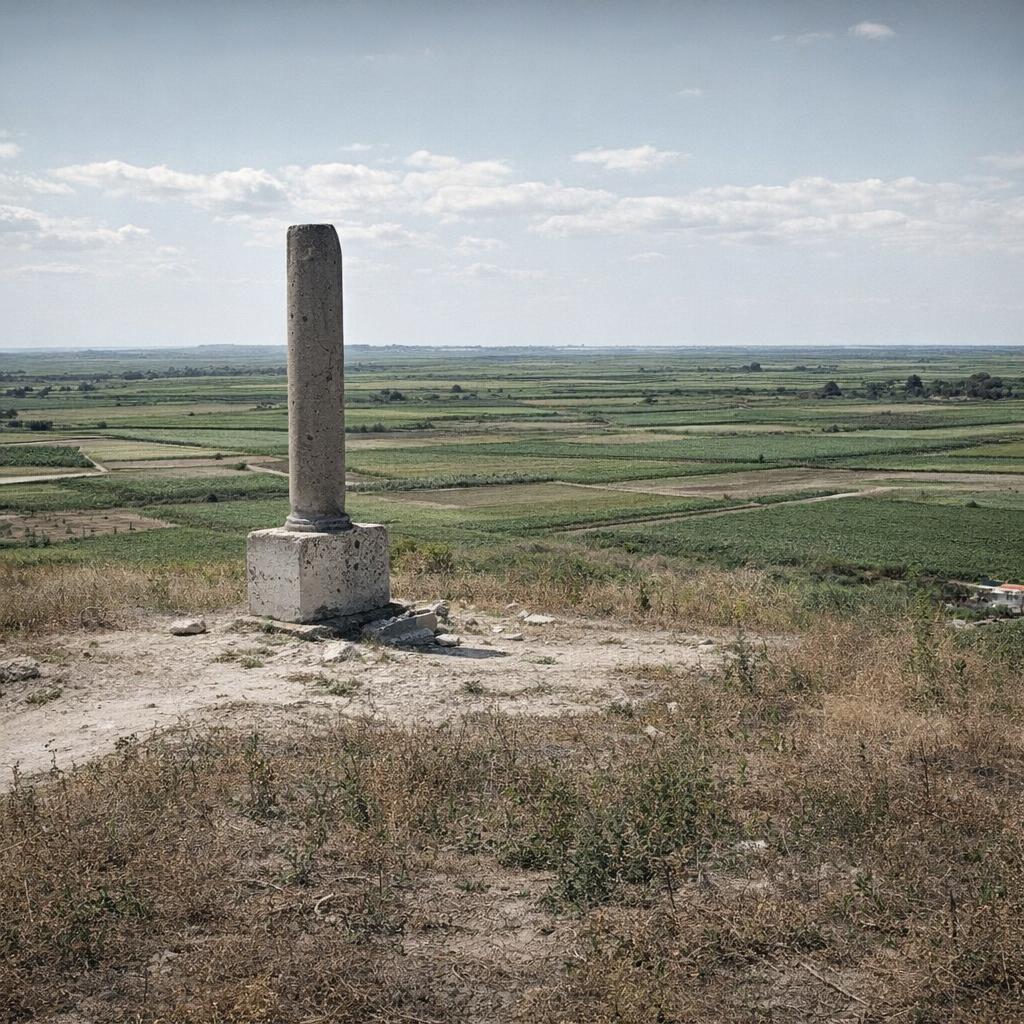
The Antiquarium e Parco Archeologico di Canne della Battaglia occupies a hilltop citadel near Barletta in Puglia, overlooking the open plain below where Hannibal’s forces destroyed the Roman army in 216 BC, and admission to the site is free. Hours vary by season and can even shift on certain weeks of the month, so visitors are advised to check current opening times before planning a trip. The antiquarium’s multimedia room, opened in 2017, features a 3D video reconstruction of the battle that helps visitors picture how Hannibal’s encirclement actually unfolded across the terrain below.
Two walking routes cover the site, one through the remains of a Roman fortress and a later medieval citadel built on the same hilltop, the other past early Christian basilicas and the ruins of an even older Daunian settlement that predates the battle itself by centuries. Several visitors have found the on-site wayfinding and signage confusing despite the quality of the underlying exhibits, and English-language information is limited, so reading up on the battle beforehand makes for a considerably richer visit; the nearby town of Barletta offers restaurants and lodging for those extending their stay in the area.
Remembrance at Cannae
Cannae occupies a strange place in military memory, remembered less as a monument to any particular army’s valor than as the purest surviving example of a specific tactical idea, the double envelopment, studied by military strategists for two millennia after the fact, including, by their own later accounts, generals planning encirclement operations in the twentieth century. Visitors today describe the hilltop site as quiet and largely uncrowded, offering sweeping views over the plain that help convey the sheer scale of the battlefield below, though several note that the archaeological focus of the exhibits, oriented more toward specialists than casual visitors, leaves the human scale of the disaster somewhat underexplained on site. What the ruins cannot fully convey is the scale of loss recorded by ancient historians, a single afternoon’s toll that ancient Rome would not see matched again for centuries, memorialized more through the battle’s enduring name in military history than through any grand monument at the site itself.
Visitor Info: musei.beniculturali.it
Location: Antiquarium e Parco Archeologico di Canne della Battaglia, Frazione Canne della Battaglia, 70051 Barletta, Italy
Site Status: National Park / Managed Historic Site
Visitation Notes: The Antiquarium e Parco Archeologico di Canne della Battaglia sits on a hilltop citadel near Barletta in Puglia, overlooking the plain where Hannibal’s forces destroyed a much larger Roman army in 216 BC. Admission is free. Hours vary by season and can even shift on certain weeks of the month, so visitors are advised to check current opening times before planning a trip. The antiquarium’s multimedia room, opened in 2017, features a 3D video reconstruction of the battle. Two walking routes cover the site: one through the Roman fortress and medieval citadel remains, another past early Christian basilicas and ancient Daunian settlement ruins. Several visitors have found the on-site wayfinding and signage confusing despite the quality of the exhibits, so budget extra time and don’t expect much English-language signage. The nearby town of Barletta offers restaurants and lodging for visitors extending their stay.
Google Map
Visitor Comments
neillbarber, visiting from Jamestown, Rhode Island, says there are marvelous views over the plain and well-preserved ruins, plus a small museum with artifacts from the site. The only downside was the lack of English translations on most of the informational panels, so it helps to read up on the battle beforehand.
— from TripAdvisor
According to Robert d from Amstelveen, Netherlands, the site is disappointing given the historical significance of the site. There’s almost no directional signage and very little in the way of battle-focused exhibits, it feels arranged for archaeologists rather than general visitors. Worth a stop if you’re already in the area, but don’t expect much interpretation.
— from TripAdvisor
avidtraveller195 from Melbourne, Australia found this genuinely interesting, especially with a bit of background reading beforehand. Good photo opportunities from the hilltop over the plain, wheelchair accessible, and free entry. Budget 45 minutes to an hour to see everything.
— from TripAdvisor
According to Janez Z from Ljubljana, Slovenia, its a little archeological jewel, peaceful and quiet with almost no other visitors when we went. The setting on the hill really helps you picture the scale of the battlefield below. Well worth the detour if you’re interested in ancient history.
— from TripAdvisor