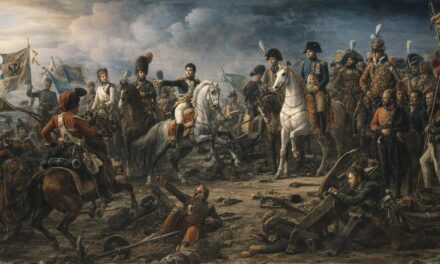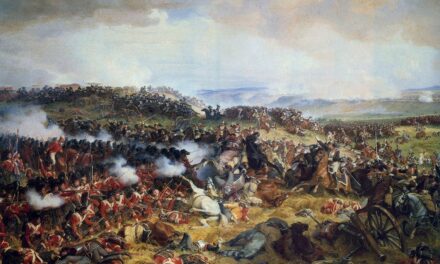
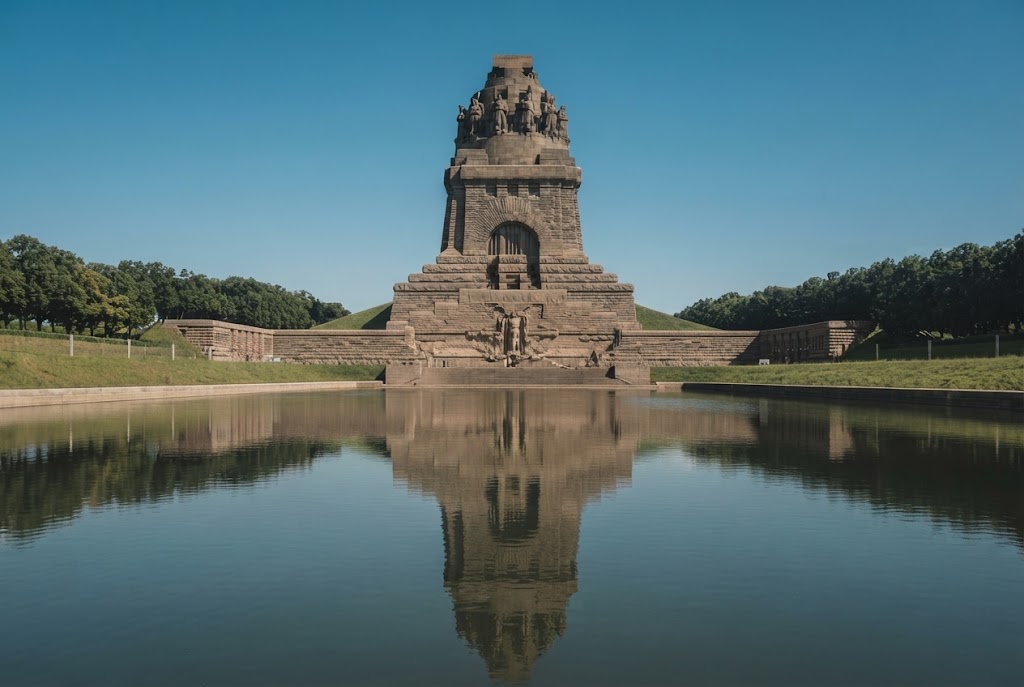
Rising more than three hundred feet above the flat Saxon plain outside Leipzig stands one of the largest monuments in Europe, a granite mountain of a building visible for miles before a visitor ever reaches its base. Few first-time visitors immediately grasp what it actually marks: not a single dramatic charge or one general’s finest hour, but four days in October 1813 during which more soldiers fought in a single place than had ever fought together in European history up to that point. Well over half a million men from a dozen nations converged on the villages and fields ringing Leipzig, and when the fighting finally ended, Napoleon’s grip on Germany, and with it much of his hold on continental Europe, had been broken for good. Contemporaries gave the battle a name that has stuck ever since: the Battle of the Nations.
Leipzig: The Road to Battle
Napoleon’s Grand Armee had been gutted by the catastrophic 1812 invasion of Russia, which cost the French emperor the great majority of the roughly half a million men he had led east the previous summer. Rather than seek peace, Napoleon spent the early months of 1813 rebuilding his forces through mass conscription, fielding a new army built heavily around inexperienced recruits and a badly depleted supply of veteran cavalry that could no longer scout and screen his movements the way his prewar cavalry once had.
His enemies used the same months to their advantage. Russia and Prussia had already allied against France that spring, and a summer armistice, intended by Napoleon to buy time to rebuild his army, instead gave his opponents time to organize as well: Austria abandoned its uneasy alliance with France and joined the coalition in August, followed soon after by Sweden under Crown Prince Bernadotte, a former French marshal now turned against his old emperor. Russia, Prussia, Austria, and Sweden together formed the Sixth Coalition, uniting former rivals against a common French threat and placing their combined field armies under the nominal command of the Austrian prince Karl Philipp von Schwarzenberg, even as Prussian and Russian commanders such as Gebhard von Blucher and Levin von Bennigsen retained considerable independence over their own forces.
Through the summer and early autumn, Coalition armies advancing from the north, east, and south maneuvered deliberately to converge on Napoleon’s positions in Saxony rather than risk facing his main force alone, a strategy that traded any chance of quick victory for the certainty of eventually overwhelming French numbers on a single battlefield. By the second week of October, three separate Coalition armies numbering well over three hundred thousand men combined were closing on Leipzig from different directions at once, drawing Napoleon’s roughly two hundred thousand troops into a battle on ground he had not fully chosen and against a combined force considerably larger than his own.
The Battle of Leipzig
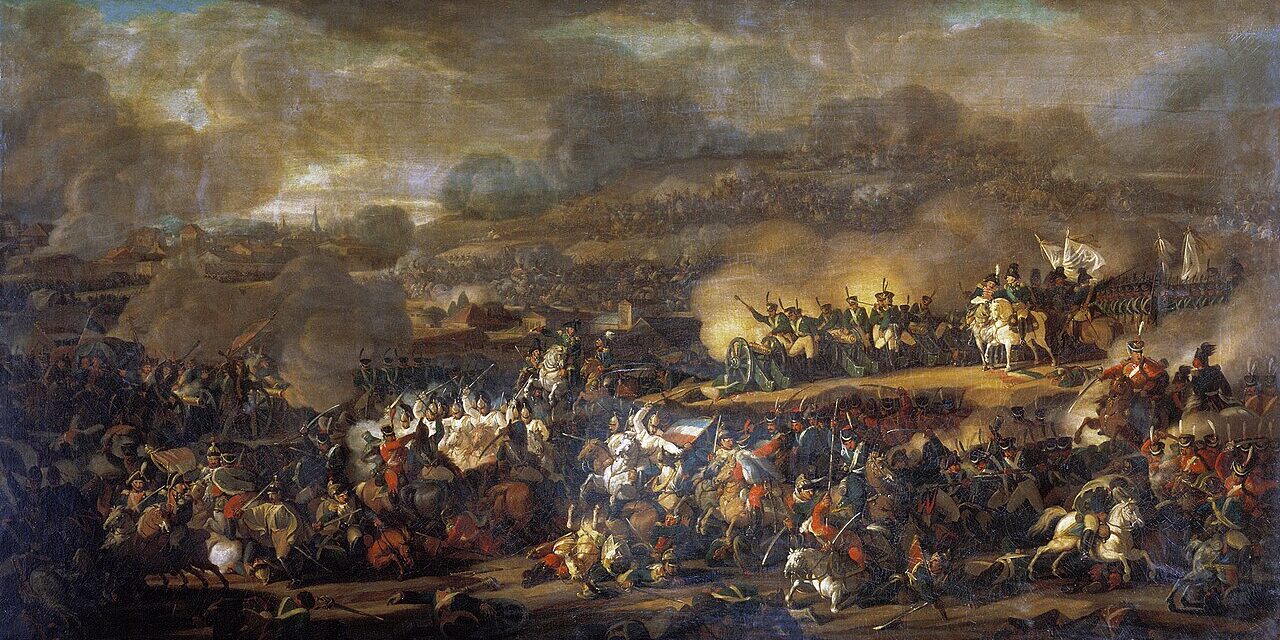
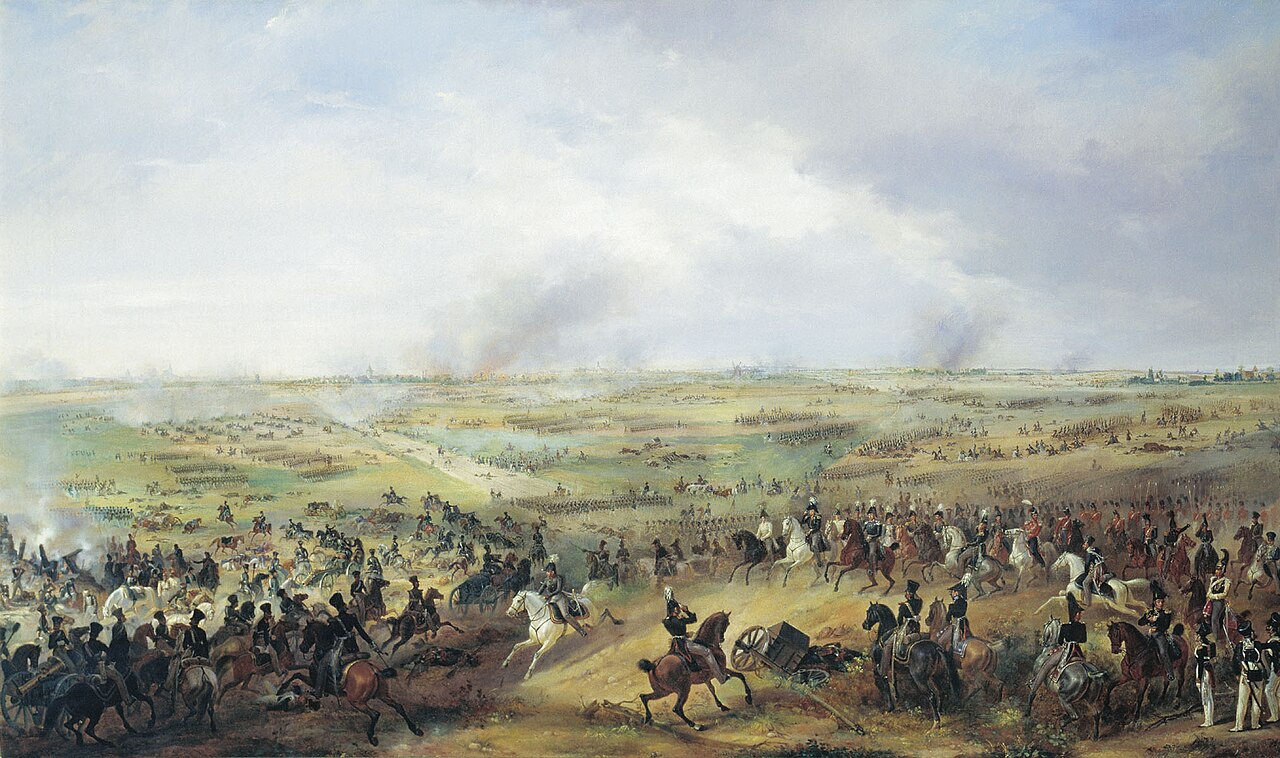
Fighting opened in earnest on October 16 with brutal clashes south of the city around the village of Wachau and to the north near Mockern, as Schwarzenberg’s Austrian-led army and Blucher’s Prussian army each attacked Napoleon’s flanks in coordinated but costly assaults that gained little decisive ground on either side despite ferocious fighting that saw villages change hands repeatedly over the course of the day. Unusually for a Napoleonic battle, three reigning monarchs, Tsar Alexander I of Russia, Emperor Francis I of Austria, and King Frederick William III of Prussia, watched portions of the fighting from a nearby hilltop alongside Schwarzenberg, giving the engagement a symbolic weight beyond the battlefield itself as the crowned heads of the Coalition witnessed their combined armies test Napoleon’s power directly. Casualties on that first day alone reportedly reached into the tens of thousands on both sides combined, yet neither side managed to break the other’s line, and both armies spent October 17 largely regrouping, tending to the enormous number of wounded, and waiting for reinforcements rather than renewing the assault immediately.
That pause worked overwhelmingly against Napoleon, since the arriving Coalition reinforcements, including Bennigsen’s Russian army from the east and Bernadotte’s Swedish-led northern army, swelled Coalition numbers to roughly a third again as large as the French force they faced, while Napoleon had no comparable reserves left to call upon. When the fighting resumed at full scale on October 18, Coalition armies attacked Napoleon’s positions from multiple directions simultaneously across a battlefront that stretched for miles around the city, steadily compressing the French line back toward Leipzig itself over a long day of exhausting, attritional combat fought village by village. The battle turned further against Napoleon that afternoon when several thousand Saxon troops fighting alongside the French abruptly switched sides in the middle of the fighting and turned their guns on their former allies, a defection that shattered French confidence in the reliability of Napoleon’s remaining German allies at the worst possible moment and opened a gap in the French line.
By nightfall, Napoleon’s exhausted and heavily outnumbered army had been pushed into and through the streets of Leipzig itself, fighting from house to house in places, with no realistic option left but retreat westward across the Elster River on a single narrow crossing. That withdrawal turned catastrophic on October 19 when French engineers, following orders to destroy the key bridge over the Elster the moment Coalition troops approached it, detonated the charges prematurely while thousands of French soldiers, including the entire rearguard still fighting a desperate holding action in the city, remained trapped on the wrong side of the river with no way across. Panicked men attempted to swim the river under fire from pursuing Coalition troops, and Marshal Jozef Poniatowski, a Polish nobleman who had received his marshal’s baton from Napoleon only two days earlier, drowned attempting the crossing along with an unknown but substantial number of other soldiers, turning an already costly defeat into a chaotic rout that Napoleon’s army would spend weeks recovering from during its retreat toward the Rhine.
The Legacy of Leipzig
Leipzig cost both sides a combined total approaching one hundred thousand casualties, making it by far the bloodiest single battle Europe had witnessed to that point and a scale of combat that would not be matched again until the First World War a century later. Napoleon’s defeat ended any realistic hope of holding German territory, and the German states of the Confederation of the Rhine that had fought alongside France abandoned him within weeks, joining the Coalition instead and shrinking the French empire back toward its own borders almost overnight. The road to Paris now lay open, and the Allied invasion of France that followed within months forced Napoleon’s first abdication the following spring, ending more than a decade of French dominance over continental Europe.
Visiting Leipzig Today
The battle is commemorated by the Volkerschlachtdenkmal, or Monument to the Battle of the Nations, a colossal granite structure completed in 1913 to mark the battle’s centennial and still ranked among the largest monuments anywhere in Europe, rising well over two hundred and ninety feet above a reflecting pool at its base. Its interior holds a somber crypt lined with oversized stone guardian figures honoring the fallen, beneath a domed hall ringed by monumental statuary representing the virtues that were said to have secured the Coalition’s victory. The site sits roughly two and a half miles southeast of central Leipzig and is easily reached by tram line 15 or by suburban S-Bahn train, making it one of the more convenient major battlefield monuments to visit without a car. It is open daily year-round, with longer hours running from April through October and a shorter winter schedule from November through March, closing only on December 24 and 31.
Visitors can ride an elevator up to an enclosed viewing gallery partway up the structure, or climb several hundred steps to an open-air platform near the summit for sweeping views across the city and the flat surrounding terrain where the fighting once raged. Wheelchair access extends to the elevator gallery level, though the uppermost open-air platform remains reachable only by stairs. The adjacent Forum 1813 museum, housed in a separate building near the monument’s base, provides historical context on the battle and the era surrounding it through exhibits and artifacts, and is generally included with monument admission. Late October, around the anniversary of the fighting, typically brings commemorative events and increased visitor traffic to the site, so travelers seeking a quieter visit may prefer another season, while those interested in the battle’s history specifically may find the anniversary period the most rewarding time to come.
Remembrance of Leipzig
The battle survives today through eyewitness accounts written from strikingly different vantage points, together forming a fuller picture than any single witness could have provided alone. A French cavalry officer commanding a light regiment fought through the opening bombardment before being knocked unconscious by a cannonball and taken prisoner, later describing in his memoirs the depleted, exhausted state of French cavalry that had never fully recovered from the Russian campaign the year before. A Saxon officer serving at Napoleon’s own headquarters recorded the emperor’s command decisions from unusually close range, including the final, difficult calculations behind the retreat across the Elster. From the opposing side, a British officer attached to the allied Russian, Austrian, and Prussian headquarters as an official military observer documented Coalition strategy in a diary published only after his death, while a senior Prussian staff officer, who would later serve as Blucher’s chief of staff at Waterloo two years afterward, left his own detailed account of the campaign from the Prussian high command’s perspective. Read side by side, the four accounts reveal a battle that looked strikingly different depending on which uniform, and which side of the Elster, a soldier happened to be standing on.
Further Exploration: Book titled “1813 Leipzig: Napoleon and the Battle of the Nations” by Digby Smith (Greenhill Books, 2001)
Location: Volkerschlachtdenkmal, Strasse des 18. Oktober 100, 04299 Leipzig, Germany
Site Status: National Park / Managed Historic Site
Visitation Notes: The Volkerschlachtdenkmal sits about 2.5 miles southeast of central Leipzig, reachable by tram line 15 or S-Bahn, and is open daily (10am-6pm April-October, 10am-4pm November-March, closed December 24 and 31). Visitors can reach an enclosed viewing gallery by elevator or climb roughly 364-500 steps to an open-air rooftop platform for 360-degree views over the city; the adjacent Forum 1813 museum covers the battle’s history and context. Wheelchair access is available to the elevator gallery level but not the summit. Late October, around the battle’s anniversary, brings commemorative events to the city.
Google Map
Visitor Comments
According to Guillermo B “The monumental character of the interior in granite almost seems to have been taken from a fantasy book.” He calls it Europe’s greatest monument, praising the panoramic views from the top.
— from TripAdvisor
“After 364 steps, you will be rewarded with a phenomenal 360-degree view.” says Ulrike Schmidt.
— from TripAdvisor
“An extraordinary bombastic piece of architecture and sculpture” says Paul H, noting easy tram access and the elevator for reaching the upper levels.
— from TripAdvisor
Described as “a monument to death, victory, and fantasy architecture” that “feels too large and strange to have been made by human hands” — a more atmospheric, less conventional framing than a typical war monument. — Atlas Obscura