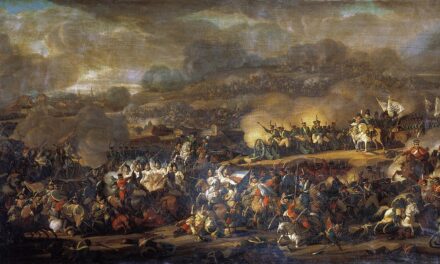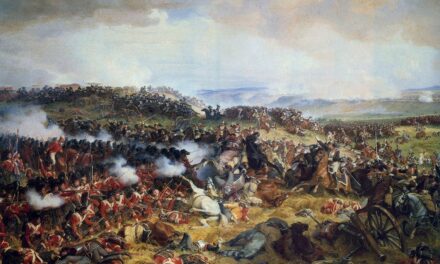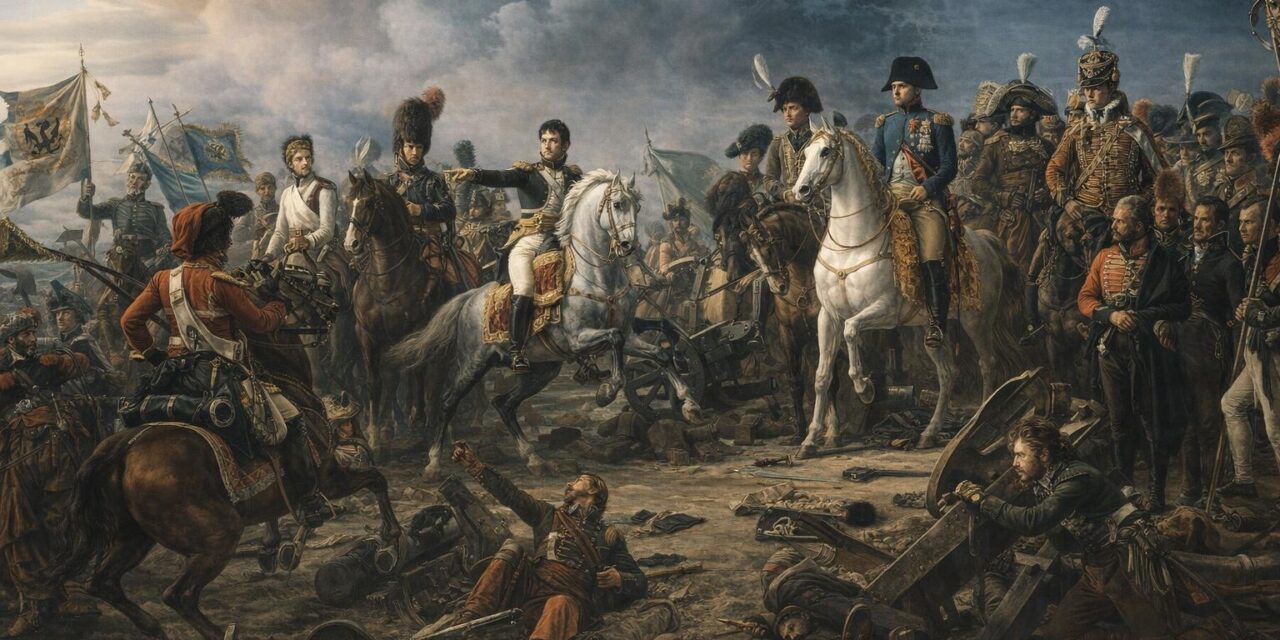
Around 8:45 that morning, Napoleon asked Marshal Nicolas Soult how long it would take his corps to storm the fog-shrouded heights rising ahead of them. Soult reportedly answered less than twenty minutes, and within the hour his men had done exactly that, seizing ground the enemy had abandoned to him as bait only hours before. What looked to the Allied commanders like a fleeting opportunity to crush a weak French flank was, in fact, the trap closing around them, and by the time the fog burned off the valley below, the battle that would define Napoleon’s reputation as Europe’s most dangerous general was already decided.
Austerlitz: The Road to Battle
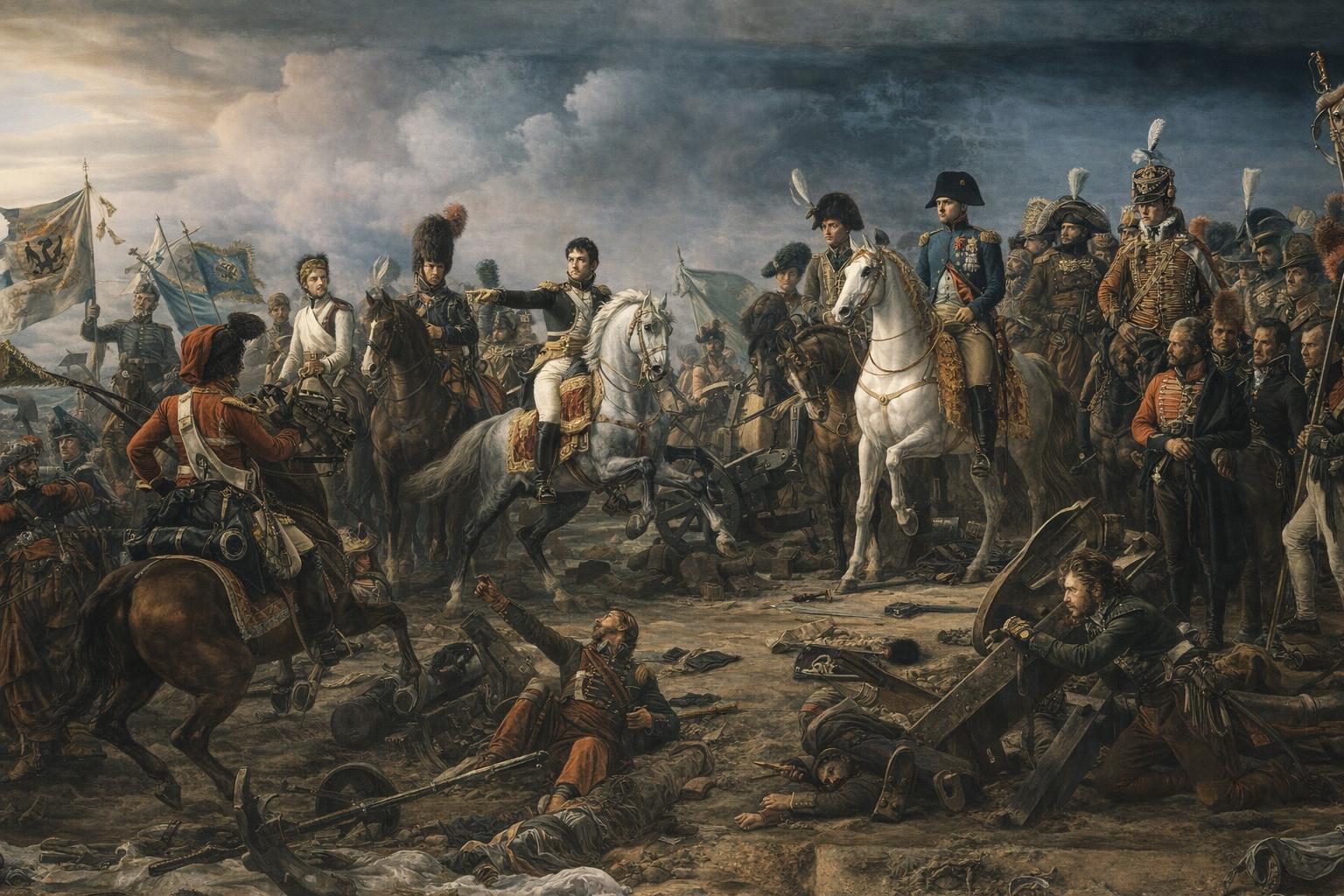
By late 1805, Napoleon’s Grande Armée had marched deep into Central Europe to confront the Third Coalition, an alliance of Austria, Russia, and Britain formed to check French power after Napoleon crowned himself emperor the previous year. A rapid campaign had already forced an Austrian army to surrender at Ulm in October, a maneuver campaign widely admired for its speed and coordination, and Napoleon pressed on to occupy Vienna itself. Yet a combined Austro-Russian army under the nominal command of Russian General Mikhail Kutuzov, accompanied in person by both Tsar Alexander I and Austrian Emperor Francis II, remained in the field and continued to threaten his overextended supply lines, which stretched back hundreds of miles into French and allied German territory. Rather than retreat to safer ground as his exhausted troops and stretched logistics might have counseled, and with a Prussian army still weighing whether to join the coalition against him, Napoleon chose the opposite course, deliberately positioning his army near the town of Austerlitz in a way designed to look weaker and more vulnerable than it actually was, and even withdrawing from strong defensive ground to encourage exactly that impression.
Napoleon’s central gambit was to abandon the Pratzen Heights, the dominant high ground on the battlefield, making his right flank appear dangerously exposed and inviting an attack there; he even received an Allied envoy in a deliberately shabby uniform and staged conversation designed to reinforce the impression of a demoralized, overextended French army eager to negotiate rather than fight. Kutuzov, the senior Allied commander and by far the most experienced general present, argued against advancing off the high ground to attack what might well be a trap, correctly suspecting Napoleon’s apparent weakness was a deception, but younger officers advising the young and inexperienced Tsar pushed for an aggressive strike that promised a quick, decisive victory, and Kutuzov was overruled by his own nominal superiors despite his seniority in the field. On the morning of December 2, 1805, a thick fog blanketed the valley as Allied troops began descending from the Pratzen Heights to attack the French right, exactly as Napoleon had hoped they would; that same fog burned away into clear skies later that morning just as the French counterattack began, a moment of bright winter sunlight later immortalized in French memory as the “sun of Austerlitz.”
The Battle of Austerlitz
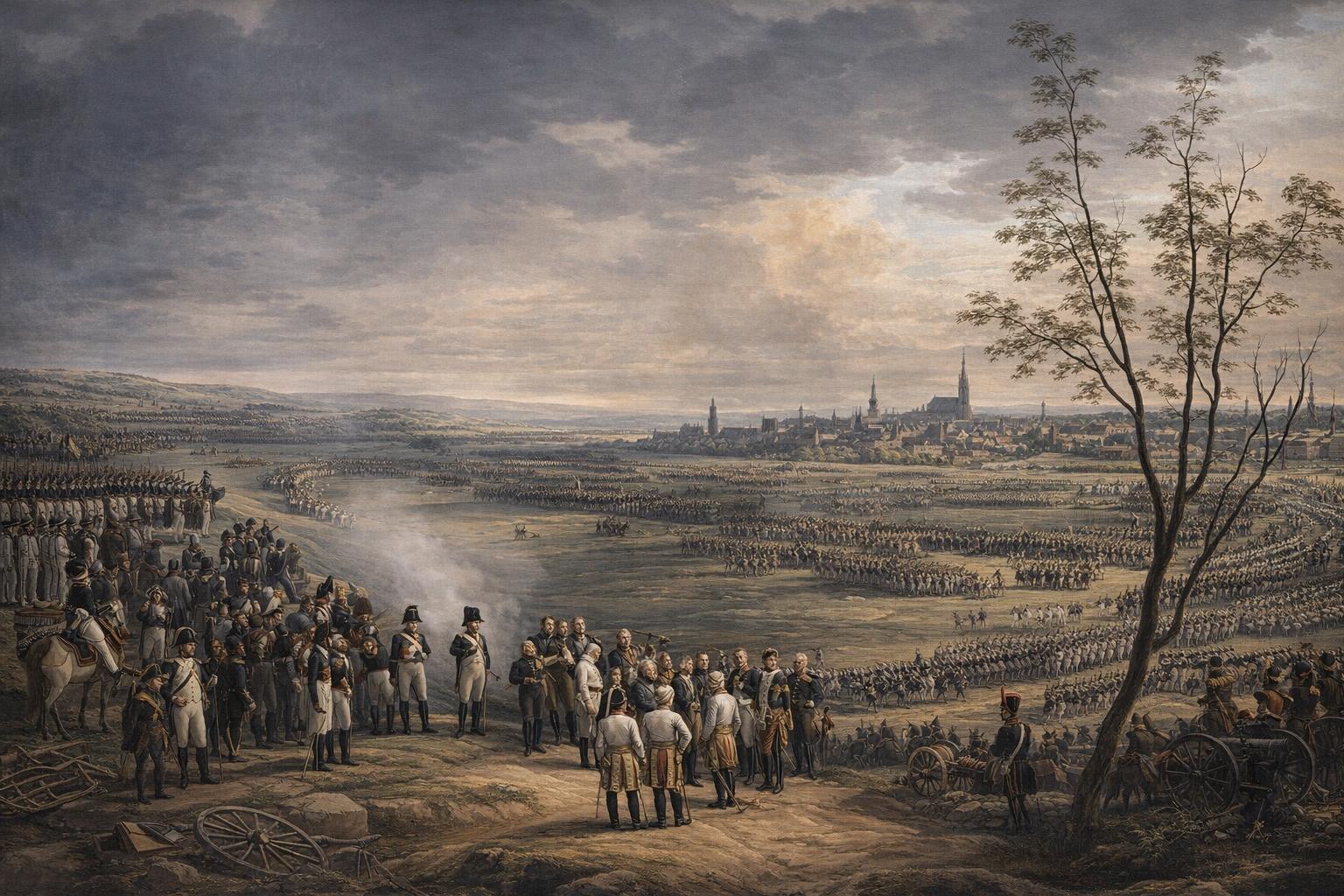
As Allied forces committed themselves to the low ground, Napoleon unleashed the trap, ordering Marshal Soult’s IV Corps to storm the now lightly held Pratzen Heights and split the Allied army in two. Soult’s troops surged up through the fog and seized both summits of the heights within the timeframe Soult had promised, then held them through a day of repeated Allied counterattacks aimed at winning back the vital high ground, including a major cavalry clash on the plateau between the French Imperial Guard cavalry and elite Russian Guard units that Napoleon had held in reserve for exactly this moment. With the Allied army cut in half and its coordination collapsing, French forces on the flanks pressed their own attacks, driving the disorganized Austro-Russian units back with mounting losses across the southern sector around the villages of Telnitz and Sokolnitz, where French troops under Marshals Davout and Legrand had earlier absorbed the heaviest initial Allied assaults before the Pratzen breakthrough turned the tide decisively in France’s favor.
Kutuzov, watching his careful warnings vindicated in the worst possible way, tried to redirect reserves to seal the widening gap at Pratzen village once Soult’s breakthrough became clear, only to be drawn personally into the collapsing fighting; he was wounded in the chaos and forced to fall back to safety alongside a retreating Austrian unit. Emperor Francis II of Austria, present with the army but holding little real influence over a command structure dominated by Russian officers advising the Tsar, could do little more than watch the disaster unfold around him. By the day’s end, the Allied army had suffered catastrophic losses, with thousands killed, wounded, or captured and its remaining units scattered in a chaotic retreat, some fleeing across a frozen pond whose ice French artillery fire reportedly broke beneath them, drowning stragglers who had thought they’d found an escape route. Two days after the rout, Francis II met Napoleon in person under a flag of truce to negotiate an armistice, reportedly leaving the meeting in noticeably better spirits than he had arrived, and Austria soon accepted the harsh terms of the Peace of Pressburg, ceding territory and formally withdrawing from the war.
The Legacy of Austerlitz
Austerlitz is widely regarded as Napoleon’s tactical masterpiece, a battle won as much through deliberate deception and psychological insight into his opponents as through raw combat power, and it remains a staple case study at military academies for its lesson in luring an enemy into a fatal overextension. Napoleon himself reportedly called it the finest battle he ever fought, a judgment later generations of military historians have largely endorsed given how completely the outcome matched his prebattle intentions down to the smallest detail. The victory shattered the Third Coalition outright, forcing Austria out of the war within days and leaving Russia’s battered army to withdraw eastward, a diplomatic and military triumph that cemented French dominance over Central Europe for years afterward. The battle also marked the effective end of the centuries-old Holy Roman Empire, which Francis II formally dissolved the following year under the pressure of France’s new supremacy, ending an institution that had nominally governed Central Europe since the early Middle Ages. It also helped set the stage for a Franco-Russian rapprochement that would hold, uneasily, for the better part of the next six years before collapsing into Napoleon’s disastrous invasion of Russia in 1812. No battle is more closely tied to the idea of Napoleon at the very height of his powers than this one — a single December morning of deliberate deception that redrew the map of Europe for a decade to come.
Visiting the Cairn of Peace Memorial Today
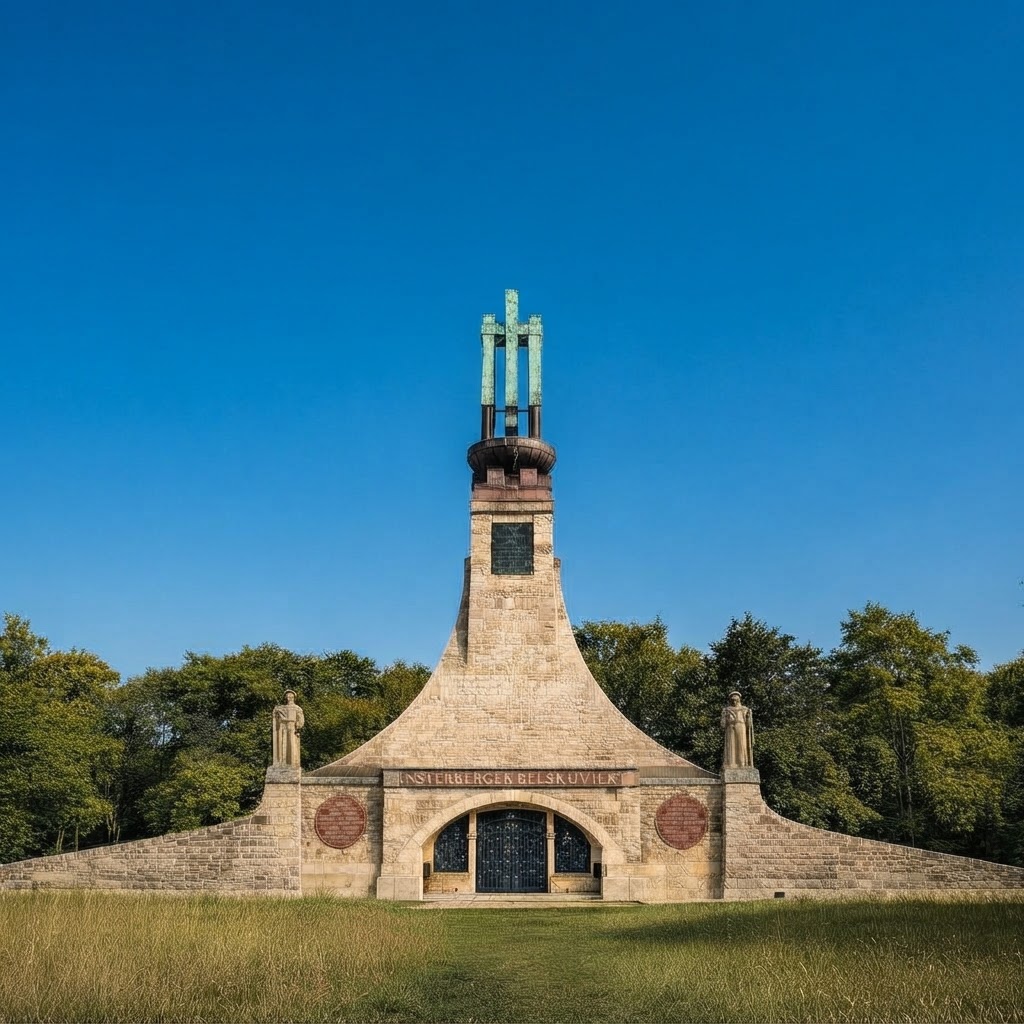
The battlefield today is anchored by the Cairn of Peace Memorial, known locally as Mohyla míru, which sits directly atop the Pratzen Heights near the village of Prace, about 20 kilometers southeast of Brno in the Czech Republic. The memorial houses a permanent exhibition titled The Battle of the Three Emperors, 1805, featuring interactive displays and period artifacts, along with a small chapel still used for weddings and a seasonal café open in the warmer months. Hours run longer through the summer and shorter the rest of the year, with a modest adult admission and a separate small fee for the chapel — worth confirming current pricing and hours before a visit, since both shift seasonally.
The memorial also anchors a marked, 21-stop battlefield trail with audio commentary covering other key sites from the fighting, including Zuran Hill, Santon Hill, and Sokolnitz, and local guided tours can be arranged for visitors who want a more detailed walk through the terrain, with at least one private historian-led tour reported to run a full day and take in Telnitz, Sokolnitz Castle, and several of Napoleon’s headquarters locations. Many visitors combine a stop at the memorial with a visit to nearby Slavkov Chateau, where Napoleon reportedly stayed before the battle and which lends the town its Czech name, Slavkov u Brna, and no advance booking is required for a general visit to the memorial itself.
Remembrance at Austerlitz
The Cairn of Peace Memorial, dedicated in 1905 on the battle’s hundredth anniversary, stands as the primary site of remembrance on ground that saw one of the era’s most consequential single-day battles. Its modern sound-and-light presentation of the fighting, paired with the museum’s interactive displays, has drawn consistent praise from visitors for making a complex, multi-stage battle understandable to travelers with little prior background in Napoleonic history. The chapel built into the memorial complex serves double duty as both a place of quiet remembrance for the tens of thousands of casualties from the battle and, more unusually, an active wedding venue, a juxtaposition that reflects how thoroughly the site has been folded into the ordinary life of the surrounding Moravian countryside rather than sealed off as a purely solemn monument. The 21-stop battlefield trail linking Zuran Hill, Santon Hill, and Sokolnitz to the central memorial lets visitors trace the day’s action across the same rolling terrain where Soult’s corps stormed the heights and Kutuzov’s lines collapsed.
Visitor Info: mohylamiru.muzeumbrnenska.cz
Location: Památník Mohyla míru (Cairn of Peace Memorial), K Mohyle míru 200, 664 58 Prace, Czech Republic
Site Status: National Park / Managed Historic Site
Visitation Notes: The Cairn of Peace Memorial (Mohyla míru) sits on the Pratzen Heights near the village of Prace, about 20 km southeast of Brno. It houses a permanent exhibition, “The Battle of the Three Emperors, 1805,” with interactive displays and period artifacts, plus a small chapel and a seasonal café open June through August. Hours run longer through the summer and shorter the rest of the year; admission is modest, with a separate small fee for the chapel. Both hours and pricing are worth confirming before a visit, since they shift seasonally. The memorial also anchors a marked, 21-stop battlefield trail with audio commentary covering other key sites such as Zuran Hill, Santon Hill, and Sokolnitz, and guided tours can be arranged locally. Visitors typically combine a stop here with nearby Slavkov Chateau, and no advance booking is required for a general visit.
Google Map
Visitor Comments
sen1947, visiting from Kolkata, India, took a full battlefield tour covering Zuran Hill, Santon Hill, and the Pratzen Heights, and called the museum at the old post house excellent. They noted that the memorial’s chapel is still used for weddings today.
— from TripAdvisor
Steve D, from Liverpool, United Kingdom, reached the memorial by bus from Brno and called it a very good monument, dedicated back in 1905. He was especially impressed by the splendid museum inside, with its modern sound and light presentation of the battle.
— from TripAdvisor
Pepa Daniel called it an excellent museum, noting that despite its narrow historical focus, the exhibition holds the attention of both children and adults.
— from Mapy.cz reviews
barondelempire, visiting from Dallas, Texas, booked a private seven-hour guided tour with local historian Helena Svedova in May 2018, customized around their interest in Napoleonic history. The tour covered Telnitz, Sokolnitz Castle, Napoleon’s headquarters locations, several museums, and Austerlitz Chateau, and they called it excellent, praising Helena’s deep knowledge of the battle.
— from TripAdvisor