For more than eleven hundred years, a single line of stone kept the greatest city in the medieval world safe from conquest. Built in the fifth century and never successfully breached by direct assault in all that time, the triple land walls of Constantinople turned back Avars, Arabs, Rus raiders, and Bulgarian armies, earning a reputation as the most formidable fortification in the world. What finally brought them down was not a failure of design but a revolution in siege warfare: gunpowder artillery large enough to do in weeks what centuries of armies had failed to do at all. The 1453 siege that ended the Byzantine Empire was, in a very real sense, a contest between the last great fortress of antiquity and the first great cannon of the modern age.
The Walls of Constantinople: The Road to Battle
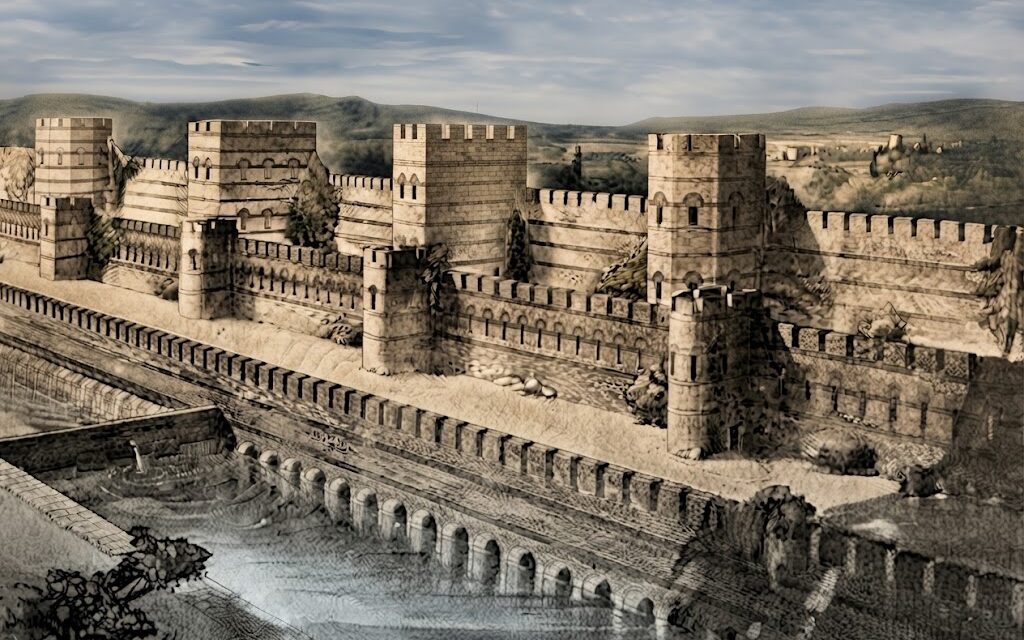
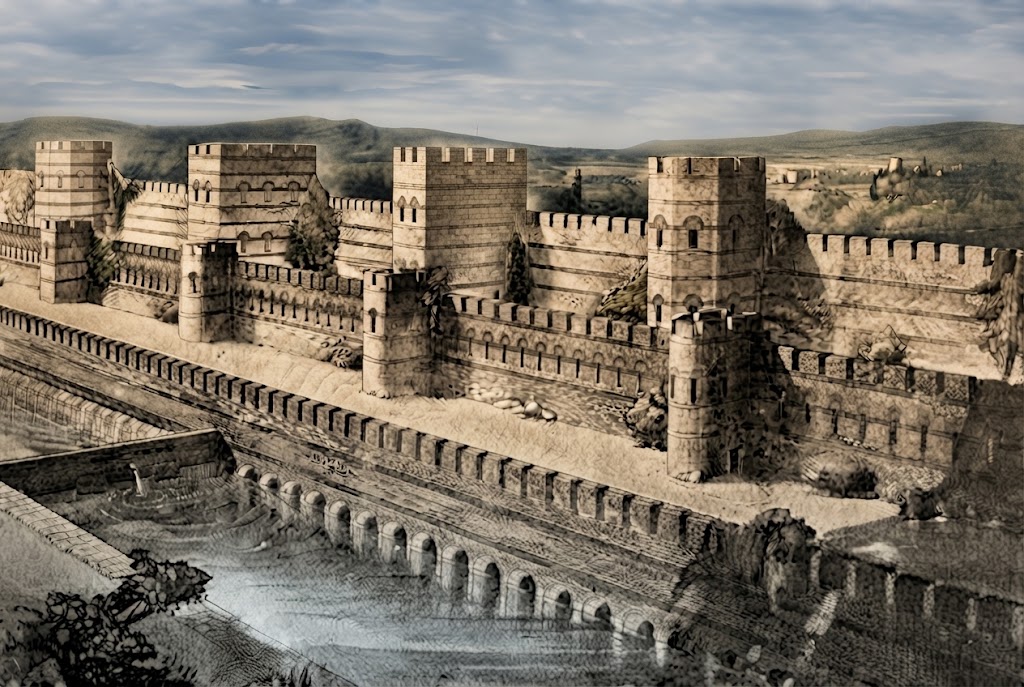
The Theodosian Walls took their name from the emperor Theodosius II, under whom the land walls reached their final form in the early fifth century, replacing an earlier, smaller circuit as the city outgrew its original boundaries. The completed system was a triple line of defense: an outer moat, a low outer wall, and a massive inner wall studded with dozens of towers, designed so that any attacker breaching one line still faced another behind it. For a thousand years the design worked. Sieges by Avars and Persians in 626, by Arab armies in the 670s and again in 717, and by Rus raiders and Bulgarian rulers in later centuries all broke against the walls without taking the city by force, cementing Constantinople’s reputation as effectively impregnable to conventional assault.
By the mid-fifteenth century, however, the empire the walls protected had shrunk to little more than the city itself, surrounded on all sides by Ottoman territory that had been expanding for generations. The young sultan Mehmed II, who came to the Ottoman throne determined to succeed where his predecessors had failed, made the conquest of Constantinople his central ambition and prepared for it methodically, building a fortress on the Bosphorus to control the strait and commissioning an enormous bronze cannon from a Hungarian engineer named Orban, whose gun-founding skills the Byzantines had been unable to afford. In spring 1453, Mehmed marched an army of roughly eighty thousand men to the walls, against a Byzantine garrison of only a few thousand defenders under Emperor Constantine XI, supported by a contingent of Genoese soldiers led by the professional commander Giovanni Giustiniani Longo. Constantine had appealed to the states of western Europe for aid in the months before the siege, but the response was limited to a handful of volunteer contingents rather than the coordinated relief force the beleaguered emperor had hoped for, leaving the city to face the largest army it had encountered in centuries with only a fraction of the manpower its walls were built to defend.
The Battle of the Walls of Constantinople
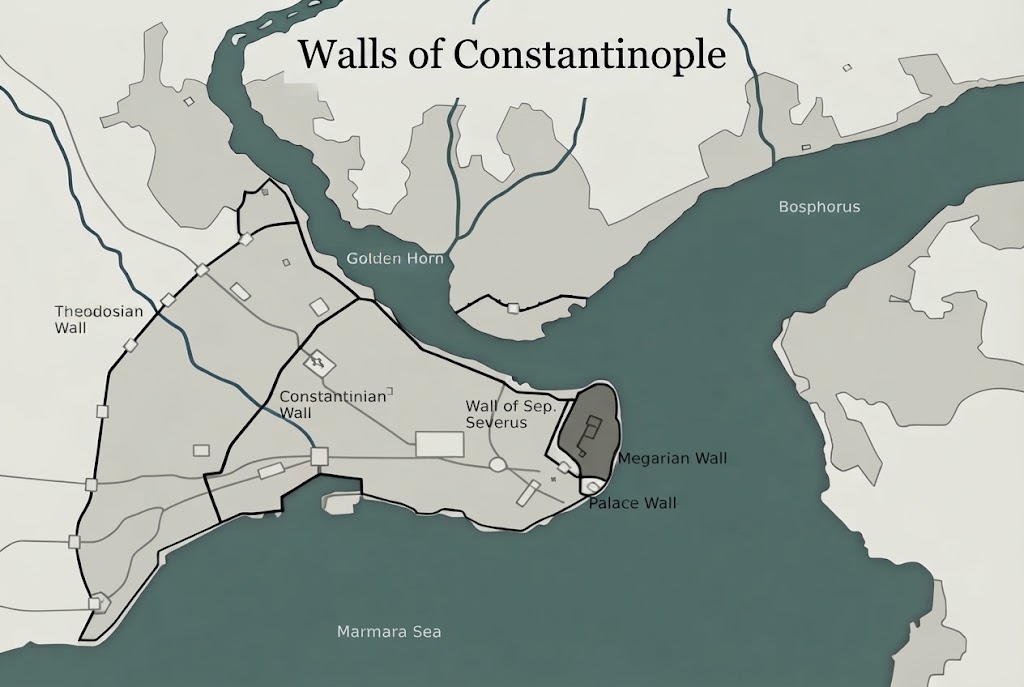
The siege opened on April 6, 1453, when Ottoman forces began a sustained bombardment of the land walls using Orban’s massive cannon alongside dozens of smaller guns, a bombardment that pounded the same stretches of masonry day after day in a way no medieval siege had ever attempted. Some sections of the outer wall, battered continuously for hours at a time, began to crumble within days, a rate of destruction that stunned defenders accustomed to fortifications that had shrugged off centuries of conventional siege engines. The defenders worked through each night to repair breaches with timber, rubble, and packed earth, a desperate cycle of destruction and reconstruction that held the line far longer than the Ottomans had anticipated, buying the defenders precious weeks even as the walls grew steadily weaker under the daily pounding. Constantine XI personally organized the defense along the most threatened sections, moving between gates to steady the garrison, while Giustiniani’s professional soldiers formed the core of the mobile reserve that plugged whatever gap opened next, a role that placed enormous strain on a force never intended to cover so long a perimeter with so few men.
Unable to force the Golden Horn by sea because the Byzantines had stretched a massive chain across its mouth, Mehmed ordered dozens of his ships hauled overland on greased logs across a hillside route north of the city, an engineering feat that stunned the defenders when the fleet appeared inside the harbor within a single night, launching a fleet directly into the waters the chain was meant to protect and forcing the defenders to stretch their already thin garrison to cover the sea walls as well. Weeks of bombardment, mining, and repeated assaults wore down both the physical defenses and the defenders’ dwindling numbers, with the Ottomans probing for weaknesses along the entire circuit while the exhausted garrison found itself with fewer and fewer men to cover an ever-lengthening list of damaged sections. Byzantine sappers countermined several Ottoman tunneling attempts beneath the walls, collapsing them before they reached the foundations, a series of underground engagements fought largely in the dark that received far less attention than the bombardment above but proved just as important to the defense holding as long as it did. The decisive assault came in the early hours of May 29, when Mehmed committed his elite Janissary troops after waves of lesser units had already worn down the defenders, and Giustiniani was severely wounded and carried from the walls, a loss that spread panic through the Genoese contingent and opened a gap the Ottomans immediately exploited.
With the line broken near the Gate of Saint Romanus, Ottoman troops poured into the city while Constantine XI, according to multiple contemporary accounts, threw off his imperial insignia and died fighting in the breach alongside his remaining soldiers rather than survive the fall of his capital, his body never conclusively identified afterward among the dead. By mid-morning the city was in Ottoman hands, its last emperor dead and its thousand-year run as an unconquered fortress ended not by a failure of its defenders but by an army and an artillery train larger, and more patient, than any the walls had ever faced before.
The Legacy of the Walls of Constantinople
The fall of Constantinople ended the Byzantine Empire and gave the Ottomans a capital that would anchor their power for the next several centuries, renamed Istanbul and rebuilt as the center of a growing empire under Mehmed II, who took the title “Fatih,” or Conqueror, in honor of the victory. The event is often treated by historians as a symbolic marker for the end of the medieval period in Europe, and the disruption of established overland trade routes to Asia is frequently cited among the pressures that pushed European states toward the maritime exploration that opened the Atlantic world in the decades that followed. The siege also stands as one of the clearest turning points in military history, the moment gunpowder artillery definitively proved it could bring down fortifications that had defied every earlier form of siege warfare for a thousand years.
Visiting the Walls of Constantinople Today
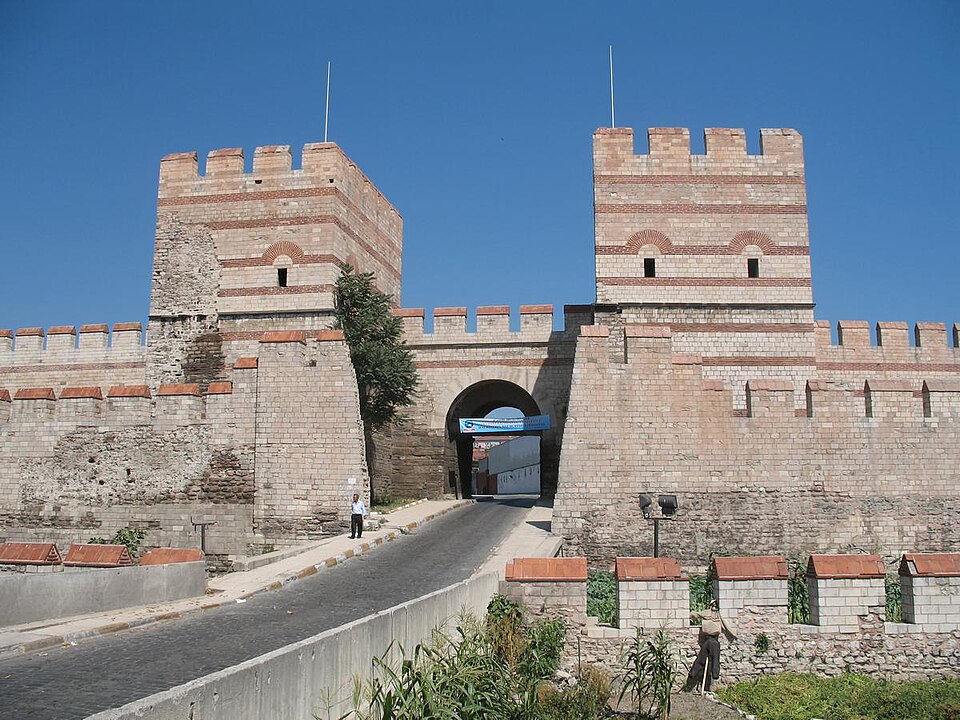
The best-preserved stretches of the Theodosian land walls run through Istanbul’s Fatih district and can be walked freely year-round, with spring and fall offering the most comfortable conditions along the exposed, uneven ground of the circuit. Visitors should look for the restored Palace of the Porphyrogenitus near the Edirnekapi end of the walls, known historically as the Gate of Charisius, and the Golden Gate enclosed within Yedikule Fortress, which operates as its own separate site with its own museum admission and hours. There is no single ticketed entry or visitor center covering the wall circuit as a whole, and conditions vary considerably along its length, from carefully restored sections to others left substantially ruined, so comfortable walking shoes are essential for anyone hoping to see more than a single gate or tower.
The walls form part of the UNESCO-listed Historic Areas of Istanbul, inscribed in 1985, a designation that reflects both their scale and their unusual survival as a nearly continuous fortification line through the heart of a modern metropolis of over fifteen million people. Because facilities are minimal and signage inconsistent along much of the route, visitors researching specific gates or towers beforehand tend to get considerably more out of a walk along the walls than those who arrive without a plan for which stretches to prioritize, since the circuit runs for several miles and no single visit on foot is likely to cover it in full.
Public transit reaches several points along the wall line, and many visitors combine a walking stretch near one gate with a tram ride to another rather than attempting the entire circuit in one outing. The contrast between restored sections and stretches left to weather naturally is, for many visitors, part of the appeal rather than a drawback.
Remembrance at the Walls of Constantinople
The siege left behind an unusually rich body of eyewitness testimony from both sides of the walls. Niccolo Barbaro, a Venetian ship’s surgeon present in the city throughout the siege, kept a day-by-day diary recording the bombardment, the defenders’ mounting desperation, and the city’s final fall, later translated and published as an eyewitness account still consulted by historians as one of the most detailed Western sources on the siege. George Sphrantzes, a Byzantine court official and close confidant of Constantine XI, was present as well and later wrote his own chronicle recounting the siege from inside the imperial government, including an account of the emperor’s final actions before the walls were breached.
Together these accounts, one from a foreign observer and one from inside the emperor’s own circle, have shaped how historians reconstruct the siege’s final weeks, and their survival is part of why the fall of Constantinople remains one of the most thoroughly documented sieges of the medieval world. The walls themselves, still standing across much of their historic length nearly six centuries later, remain the most direct physical link between that record and the ground where the Byzantine Empire’s thousand-year history came to an end.
Visitor Info: Book titled “The Walls of Constantinople AD 324-1453” by Stephen Turnbull (Osprey Publishing, 2004)
Location: Theodosian Walls (Istanbul Land Walls), Fatih, Istanbul, Turkey
Site Status: Preserved Site, Minimal Facilities
Visitation Notes: The best-preserved stretches of the Theodosian land walls run through Istanbul’s Fatih district and can be walked freely year-round, with spring and fall offering the most comfortable conditions; look for the restored Palace of the Porphyrogenitus near the Edirnekapi (Gate of Charisius) end and the Golden Gate enclosed within Yedikule Fortress, which has its own separate museum admission and hours. There is no unified visitor center or ticketed entry for the wall circuit itself, and conditions vary from well-restored to substantially ruined, so comfortable walking shoes are recommended. The walls form part of the UNESCO-listed Historic Areas of Istanbul (inscribed 1985).
Google Map
Visitor Comments
“A raw & rare 360 degree view of the old city” from a defensive tower near the Chora Church — the surrounding neighborhoods are very urban, but I felt completely safe here during the day, with almost zero tourist traffic comments The_Pale_Ridah.
— from TripAdvisor
Geo689 commented that walking along the entire length of the walls from the Marmara Sea to the Golden Horn, past historical inscriptions on gates and towers, was one of the most satisfying outings in this great city — an exciting adventure!
— from TripAdvisor
The Theodosian Walls are crumbling in many places, but they’re still standing centuries after the Ottoman conquest — I walked to the Topkapi gate area where Mehmed II punched a hole in the walls, and to the restored Palace of the Porphyrogenitus for a vast panorama of modern Istanbul’s sprawl.
— from Ryan Murdock, travel blog