A single bullet hole in a preserved wool coat is nearly all that survives to touch directly of the man who won the battle that made Britain unchallenged at sea for the next hundred years. Vice-Admiral Horatio Nelson wore that coat on the deck of HMS Victory on October 21, 1805, when a French sharpshooter’s musket ball found him during the opening hour of a battle he would not live to see the end of. By the time the guns fell silent off Spain’s Cape Trafalgar, Nelson was dead, but the combined French and Spanish fleet that had threatened Napoleon’s invasion of England lay shattered, and the Royal Navy’s dominance of the world’s oceans was no longer seriously in question.
Trafalgar: The Road to Battle
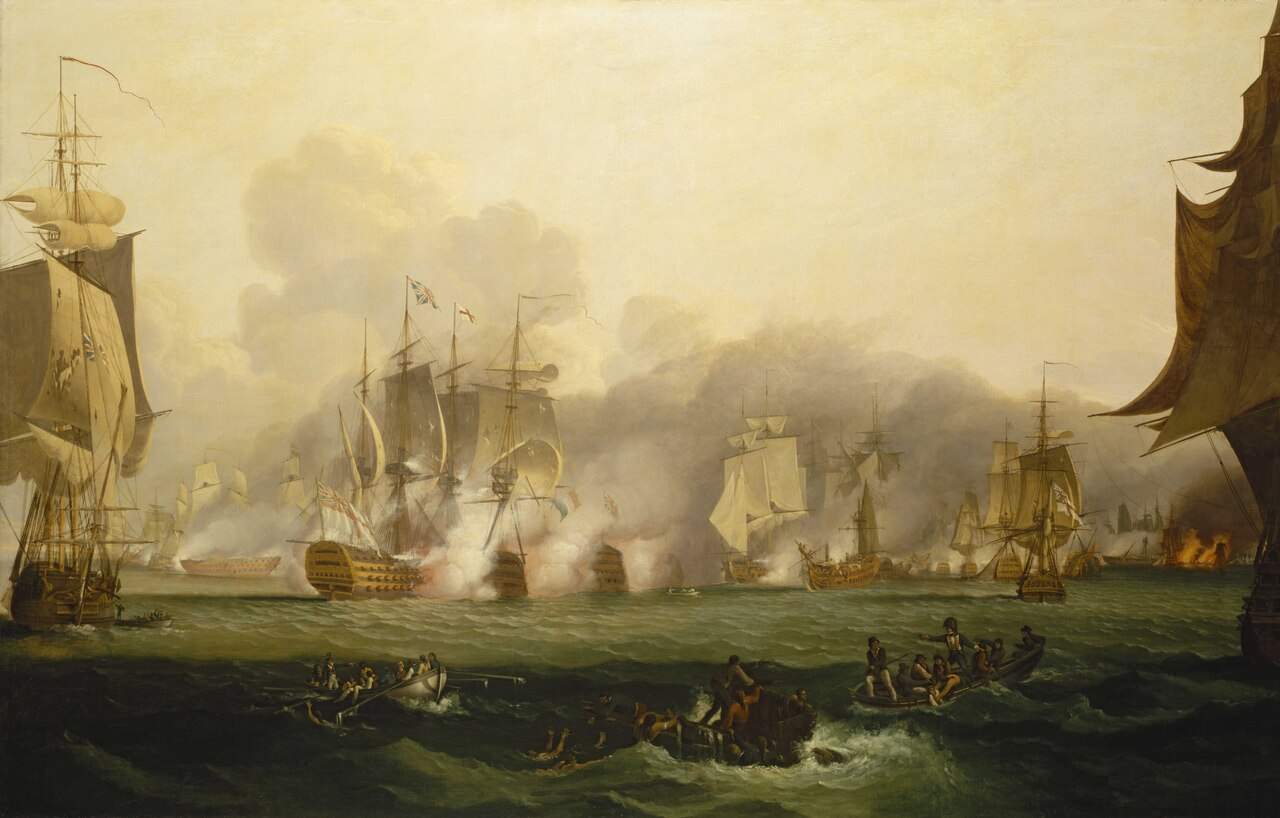
By 1805, Napoleon had assembled a large invasion force on France’s Channel coast, but crossing required first winning control of the English Channel from the Royal Navy, a task that depended on combining France’s scattered fleets into a force large enough to challenge British naval supremacy directly, if only for the few days a crossing would take. Admiral Pierre-Charles de Villeneuve commanded the main French fleet, reinforced by allied Spanish ships under Admiral Federico Gravina, and spent much of that year attempting to break out of blockade and rendezvous with other French squadrons scattered across the Atlantic before Nelson’s pursuing British fleet could intervene and pin them down. Those plans repeatedly failed, undone by missed rendezvous, cautious captains, and a British navy that seemed always to be exactly where it was least wanted, and by late summer Villeneuve’s combined fleet of roughly thirty-three ships of the line had taken shelter in the Spanish port of Cadiz, blockaded there by a British fleet under Nelson that, though smaller at around twenty-seven ships, had spent years perfecting its gunnery and seamanship under Nelson’s demanding, closely personal style of command. Under pressure from Napoleon to act decisively, and aware that a replacement admiral was already being sent to relieve him of command, Villeneuve reluctantly put to sea on October 19 and 20, hoping to slip past the British blockade and reach the Mediterranean before he could be brought to a general battle he privately doubted he could win. Nelson’s frigates shadowed the combined fleet closely as it emerged from port, relaying its position back to the main British fleet waiting further out at sea using a system of signal flags Nelson himself had helped refine over years of command. By the morning of October 21, the two fleets were converging off Cape Trafalgar on Spain’s Atlantic coast, with a decisive battle now unavoidable for both sides regardless of which admiral might have preferred otherwise.
The Battle of Trafalgar
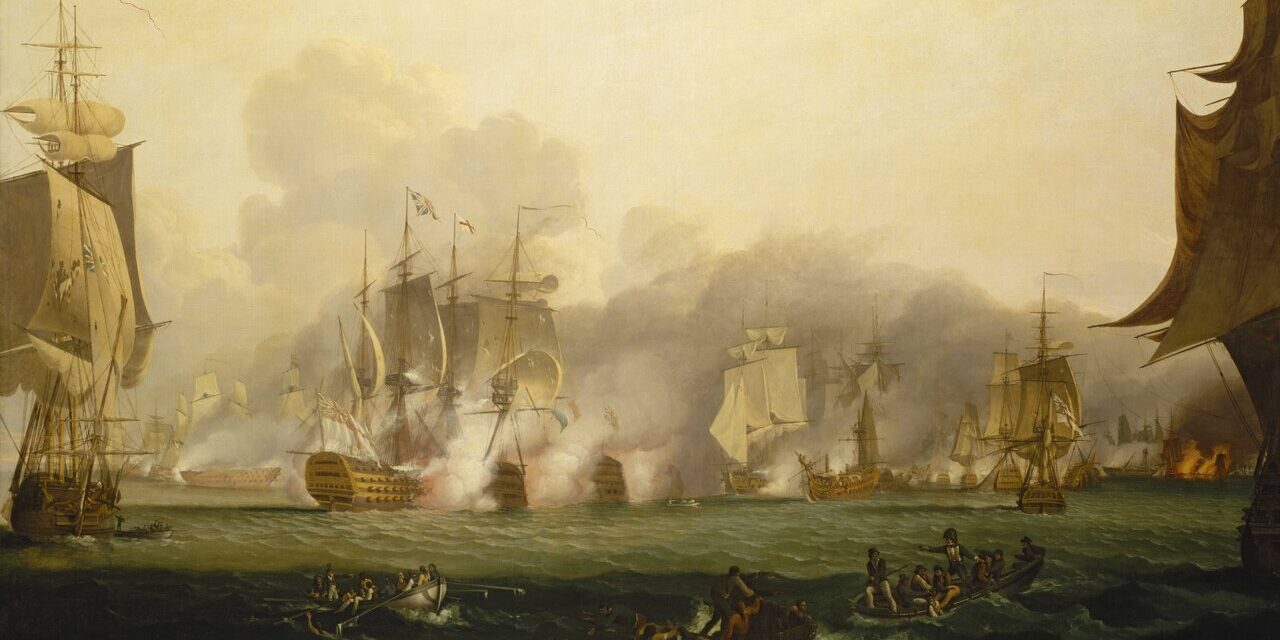
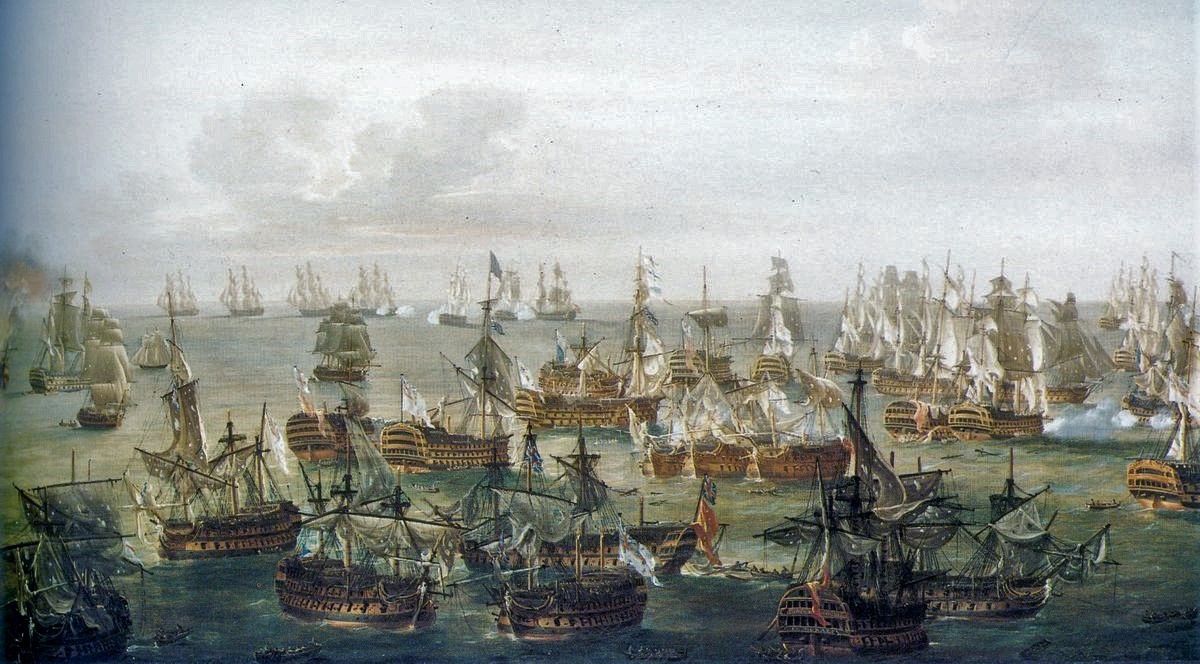
Rather than forming the traditional single parallel line that naval convention favored, where two fleets exchanged broadsides while sailing past each other, Nelson split his fleet into two columns and sailed them directly at the combined fleet’s line at a right angle, a deliberately unconventional and risky tactic that exposed his lead ships to raking fire for a prolonged, dangerous approach before they could bring their own guns to bear on the enemy at all. Nelson gambled that once his columns punched through the enemy line and broke it into isolated, disorganized clusters cut off from mutual support, the superior speed and accuracy of British gunnery crews, drilled to fire far faster than their French and Spanish counterparts, would decide the resulting close-range melee decisively in Britain’s favor even against a numerically larger fleet. Before the fleets closed, Nelson ordered a signal run up Victory’s masts that has since become one of the most famous messages in naval history, urging every man in the fleet to do his duty, a message that reportedly drew mixed reactions among officers more focused on the imminent, terrifying approach than on inspiration in the moment. HMS Victory led one column and HMS Royal Sovereign, under Vice-Admiral Cuthbert Collingwood, led the other, both ships absorbing punishing, unanswered broadsides during their long approach before finally breaking through the combined fleet’s line and touching off a sprawling, close-range battle that quickly dissolved into dozens of individual ship-to-ship duels scattered across miles of open ocean. Aboard Victory, Nelson was struck in the shoulder by a musket ball fired from the rigging of the French ship Redoutable, the bullet driving down through his spine, and he was carried below to the ship’s surgeon, who could do nothing beyond making him as comfortable as possible as the battle raged on overhead for several more hours. Nelson lived long enough to learn that the battle was won decisively, reportedly asking repeatedly for updates from his flag captain, Thomas Hardy, and for word of individual ships and officers, before dying that evening having secured, in his own words, the knowledge that he had done his duty. Elsewhere along the broken line, Collingwood’s column fought its own separate battle against the rear of the combined fleet, engaging several Spanish ships in succession and suffering heavy damage to Royal Sovereign before reinforcing British ships arrived to help finish the fight. The French ship Redoutable, whose marksmen had shot Nelson, fought with particular desperation at close quarters against both Victory and the much larger British ship Temeraire, attempting unsuccessfully to board one of them before being battered into a wreck and surrendering with catastrophic losses among her crew. By the time the fighting ended in the late afternoon, the British fleet had captured or destroyed roughly twenty of the combined fleet’s thirty-three ships without losing a single vessel of its own, an overwhelming and one-sided result that stunned observers on both sides, though a violent storm in the battle’s immediate aftermath scattered and wrecked many of the captured prizes before they could be brought safely into a British port, drowning still more sailors from both fleets in the days that followed.
The Legacy of Trafalgar
Trafalgar permanently ended any realistic prospect of a French invasion of Britain and established a level of British naval dominance that would go largely unchallenged for the following century, underpinning Britain’s global trade and expanding empire through the remainder of the Napoleonic Wars and well beyond them. British casualties, roughly 1,500 killed and wounded, were a fraction of the losses suffered by the combined fleet, which lost well over four thousand men killed or wounded and thousands more taken prisoner, a lopsided outcome that cemented the Royal Navy’s reputation for decades to come. Nelson’s death at the moment of his greatest victory transformed him into Britain’s preeminent national hero almost overnight, and his body, preserved in a cask of brandy for the voyage home, was met with a funeral procession and burial at St Paul’s Cathedral that drew crowds on a scale rarely seen in the country before or for many years after.
Trafalgar Today
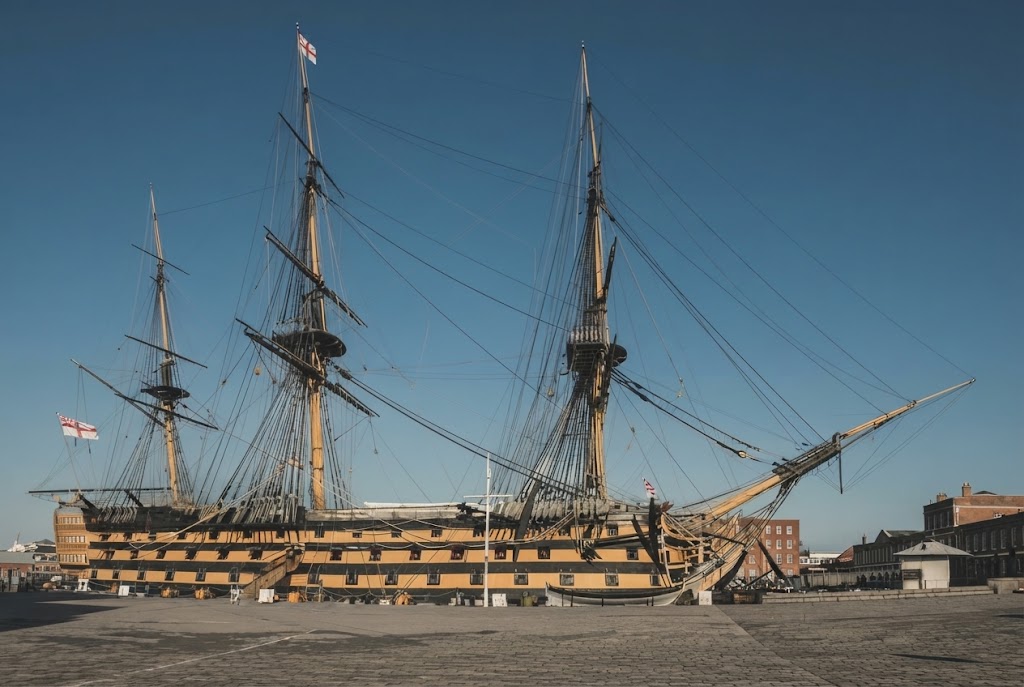
There is no battlefield to visit at Trafalgar itself, since the entire engagement was fought several miles out at sea off Spain’s Cape Trafalgar and left no physical site on land connected to the fighting, unlike most of the land battles this site typically documents. The closest thing to standing where Nelson stood is HMS Victory herself, Nelson’s actual flagship, remarkably preserved in dry dock at the Portsmouth Historic Dockyard in England, with the exact spot on deck where he fell marked with a plaque for visitors to see. Tours cover multiple decks of the ship, from the officers’ quarters at the stern down through the gun decks and workshops to the lower holds and magazines, giving visitors an unusually detailed sense of shipboard life aboard a warship in Nelson’s navy. Admission is typically bundled with nearby attractions at the dockyard, including the Tudor warship Mary Rose and the National Museum of the Royal Navy, making it possible to spend a full day exploring several centuries of British naval history without leaving the dockyard grounds. Ongoing conservation work periodically obscures parts of the ship from view behind protective coverings, and some visitors have found the on-site interpretive material relatively thin in places, with the ship’s own physical presence doing most of the work of telling its story rather than extensive signage or exhibits, a limitation worth knowing before a visit. Accessibility is also limited in places, given the ship’s narrow original stairways, steep ladders, and low deck heights, a genuine constraint of touring an authentic early nineteenth-century warship rather than a modern museum built with wide, level walkways in mind.
Remembrance at Trafalgar
Much of what is known about Nelson’s final hours comes from William Beatty, the ship’s surgeon, who treated him in Victory’s cockpit and later published a detailed account of his decline and death, including his often-quoted final words. Thomas Hardy, Nelson’s flag captain, remained at his side through those final hours and is the source, passed down through later published accounts, for Nelson’s reported request that Hardy kiss him as he lay dying. A very different perspective survives from Captain Jean-Jacques-Etienne Lucas, commander of the French ship Redoutable, whose sniper had fired the fatal shot; his official report described his own ship’s desperate fight against Victory and another British ship, an attempted boarding, and catastrophic losses among his crew. A far less prominent account comes from James Bagley, an ordinary sailor aboard Victory, who described his own experience of the battle in a letter home to his sister written just weeks afterward from Spithead, a modest but valuable manuscript that survives today in a London maritime archive alongside the far more famous testimonies of officers and commanders. Together, these four voices, an admiral’s surgeon, a flag captain, an enemy commander, and an anonymous seaman, sketch a battle whose human cost reached across every rank and every side of the fighting.
Visitor Info: Book titled “Nelson’s Trafalgar: The Battle That Changed the World” by Roy Adkins (Penguin Books, 2005)
Location: Cape Trafalgar (Cabo de Trafalgar), Barbate, Cadiz province, Spain — the battle was fought at sea, several miles off this cape; no land battlefield exists to visit.
Site Status: Site No Longer Exists
Visitation Notes: The battle was fought entirely at sea, so there is no battlefield to visit — but Nelson’s actual flagship, HMS Victory, survives in dry dock at Portsmouth Historic Dockyard, England, with the spot where he fell marked on deck. Visitors can tour multiple decks, from the admiral’s cabin down to the hold, with year-long admission typically bundled with the adjacent Mary Rose and National Museum of the Royal Navy. Expect some areas obscured during ongoing conservation work, and note that interpretive signage has been criticized as thin in places, leaning on the ship itself to carry the story.
Google Map
Visitor Comments
“This is the second time we’ve visited and we were really impressed. It really is fascinating and stepping onto it really makes you appreciate what it was like.” says LallySurrey.
— from TripAdvisor
“The iconic ship HMS Victory is a must-see” remarked T H. But with the present restoration process, much of the beauty of this warship is hidden under a huge tent.”
— from Google Reviews (via Wanderlog)
Basically the entire ship is accessible says Alsadius. You can go into the admiral’s cabin, see the carpenter’s shop, the magazines, and even the lower holds. He also noted that the interpretive signage was thin in places, leaning on the ship itself to carry the story of the visit.
— from Naval Gazing (blog)
Debbie Kilroy says its “one of the most important ships it is possible to visit,” rating its historical significance 10 out of 10, though noting it can get very busy and that accessibility is severely limited.
— from Get History (blog)