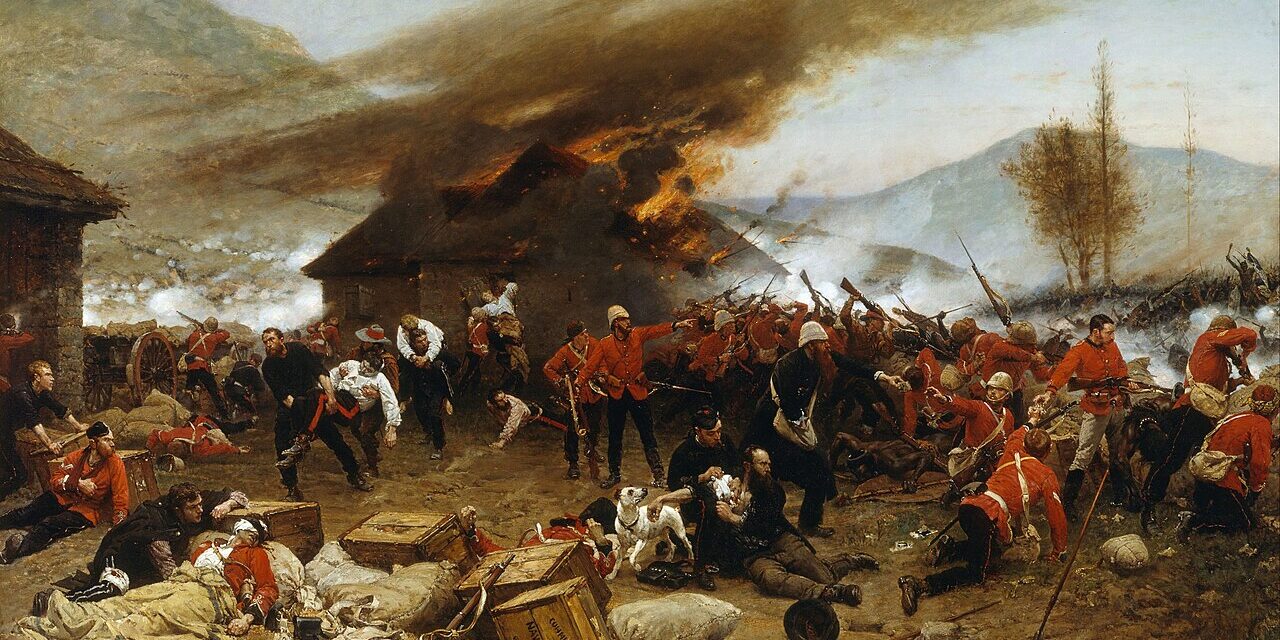
No single action in the history of the British Army has ever produced more Victoria Crosses than the defense of Rorke’s Drift. Eleven men received the empire’s highest award for gallantry for a single night and day of fighting at a remote mission station in Natal, a record that has stood for well over a century and is unlikely ever to be matched. The defenders earned it holding a hastily fortified supply post through a single night against a Zulu force that outnumbered them by roughly thirty to one, on the same day a much larger British force had just been annihilated a few miles away in one of the worst defeats in the history of British colonial warfare.
Rorke’s Drift: The Road to Battle
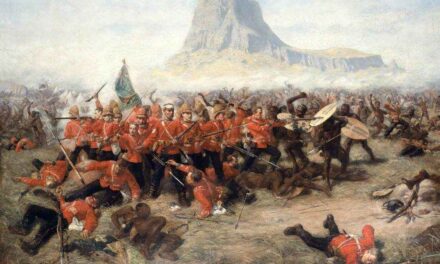
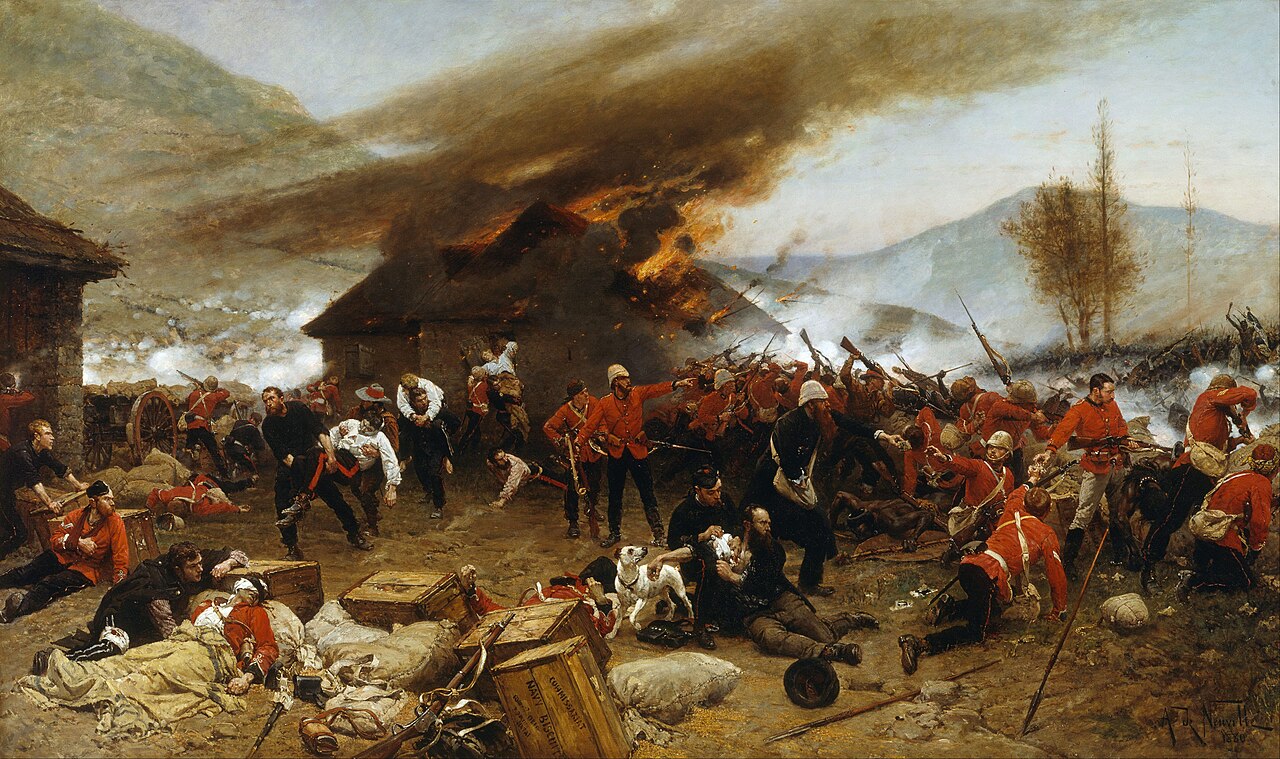
On January 22, 1879, a large Zulu army destroyed the main British invasion column at the Battle of Isandlwana, a catastrophic defeat that killed well over a thousand British and colonial soldiers in a matter of hours and marked one of the worst disasters in the history of British colonial warfare in Africa, coming as a profound shock to a military establishment accustomed to victory over poorly armed indigenous forces. The disaster occurred in the opening weeks of the Anglo-Zulu War, a conflict British colonial administrators in southern Africa had engineered through a deliberately unacceptable ultimatum to the Zulu king Cetshwayo, intended to provide a pretext for the invasion of the independent Zulu kingdom. Unknown to the roughly 150 British and colonial troops garrisoning the small mission station and supply depot at Rorke’s Drift, several miles from Isandlwana along the Buffalo River, a separate Zulu reserve force of several thousand warriors under Prince Dabulamanzi kaMpande, having missed the main battle at Isandlwana entirely, turned its attention toward the lightly defended post as a fresh target that same afternoon, against the wishes of the Zulu king, who had ordered his forces not to cross into British territory. Warning of the disaster at Isandlwana and the approaching Zulu force reached the garrison at Rorke’s Drift in the early afternoon, delivered by exhausted survivors fleeing the earlier battle, giving the small detachment under Lieutenant John Chard of the Royal Engineers and Lieutenant Gonville Bromhead only a few hours to prepare before the Zulu reserve force arrived at the station. Rather than attempting to retreat across open country with wagons and hospital patients who could not be safely evacuated in time, a retreat that would likely have left the entire garrison exposed and vulnerable in open ground, Chard and Bromhead made the decision to fortify the station itself, using stacked mealie-bags and wooden biscuit boxes to build barricades connecting the post’s storehouse and hospital buildings into a single defensible perimeter around the small mission compound. The garrison, a mix of British regulars from the 24th Regiment of Foot and colonial troops, many of them already exhausted from earlier duties and some recovering as patients in the hospital building, completed the makeshift fortifications just as the leading elements of the Zulu force, estimated at three to four thousand warriors, came into view across the surrounding grassland in the late afternoon light.
The Battle of Rorke’s Drift
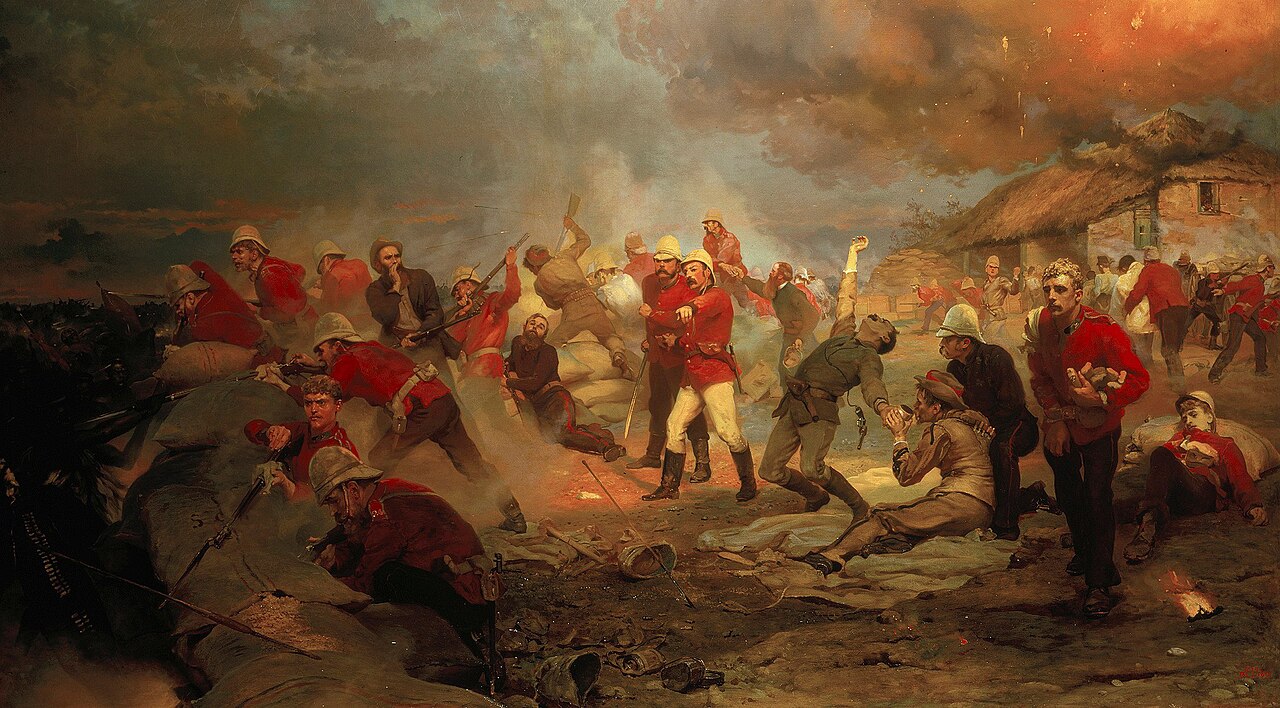
The Zulu assault began in the late afternoon of January 22, opening with an initial rush of several hundred warriors against the barricade’s south wall that the garrison’s disciplined volley fire managed to blunt before it could reach the defensive line, and continued through the night into the early hours of January 23, with wave after wave of warriors charging the makeshift barricades in a series of determined and repeated attacks that tested the garrison’s defenses at multiple points along the perimeter. Early Zulu attacks focused on the hospital building at the perimeter’s most vulnerable corner, a structure never designed for defense and honeycombed with small, disconnected rooms that made a coordinated interior stand extremely difficult, and as fighting intensified the building caught fire, forcing the small number of defenders inside, including Private Henry Hook and Private John Williams, to fight room to room while evacuating patients through holes hurriedly broken in the interior walls, a desperate defense conducted largely in darkness and choking smoke as the flames spread from room to room behind them. As the hospital burned and its surviving defenders fell back carrying or dragging patients with them, Chard’s remaining garrison contracted their perimeter to a smaller, more defensible line built around biscuit-box redoubts erected in the storehouse yard, continuing to repel repeated Zulu assaults through the night with disciplined volley fire that inflicted heavy casualties on the attacking warriors each time they pressed close to the barricades under cover of darkness. The fighting continued in intense, repeated surges for most of the night, with Zulu warriors probing different sections of the perimeter, occasionally breaching outer defenses at the corners of the position before being driven back by the garrison’s concentrated rifle fire and, at the closest quarters, bayonet fighting along the barricade line itself, the exhausted defenders reloading and firing for hour after hour with little pause between assaults. By the early morning hours of January 23, Zulu attacks began to slacken as the exhausted warriors, themselves having marched and fought without rest since the previous day and having suffered severe losses throughout the night’s repeated assaults, gradually withdrew from the immediate vicinity of the station rather than risk a final attack against a garrison that showed no sign of breaking. By daylight the surviving garrison found itself still holding the smoldering ruins of the post, their ammunition nearly exhausted after a night of near-continuous firing but the position itself intact. A relief column arriving later that morning found roughly 350 Zulu dead around the perimeter against a garrison loss of seventeen killed and roughly a dozen more wounded, an extraordinarily lopsided outcome for a defending force so heavily outnumbered across a single night of sustained, close-quarters fighting.
The Legacy of Rorke’s Drift
News of the successful defense at Rorke’s Drift reached Britain within weeks of the disaster at Isandlwana, and the contrast between the two events, catastrophic defeat followed almost immediately by an against-the-odds defense at a nearby post, made the smaller action an irresistible story for a British public eager for reassurance after the shock of Isandlwana’s losses. The eleven Victoria Crosses awarded for the defense, still the most ever given for a single action in British military history, cemented Rorke’s Drift’s place in British popular memory far beyond its actual strategic significance in the wider Anglo-Zulu War, which continued for several more months before the eventual British conquest of the Zulu kingdom. Some historians have since argued that the scale of official recognition for Rorke’s Drift was influenced in part by a wish to offset the embarrassment of Isandlwana with a more palatable story of heroism. The battle’s popular memory has endured for well over a century, sustained in large part by its dramatic retelling in later popular culture, most notably the 1964 film Zulu, which introduced the story to generations of viewers far removed from the original events.
Visiting Rorke’s Drift Today
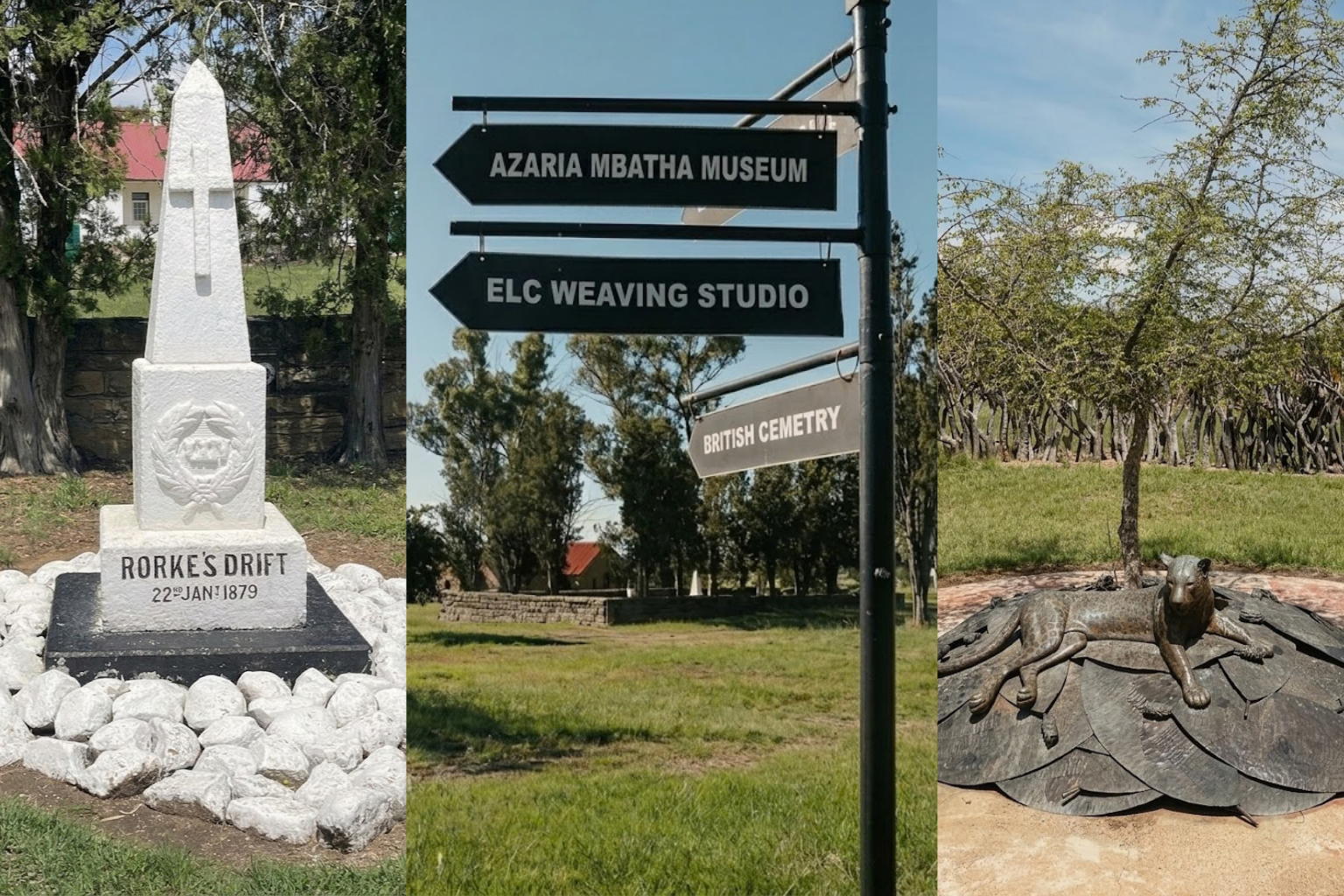
The Rorke’s Drift Battlefield and Museum, reached via gravel roads off the R68 or R33 near the town of Dundee in KwaZulu-Natal, occupies the site of the original mission station and offers an on-site museum and interpretation centre displaying artifacts connected to the battle alongside detailed exhibits on its course and aftermath. Admission is paid, and a local guide is strongly recommended for visitors, often arranged as part of a combined tour with the nearby Isandlwana battlefield, since guided context adds considerably to a visit to ground that otherwise offers relatively little standing structure from 1879 itself. Adjacent to the battlefield site stands the ELC Arts and Crafts Centre, a still-functioning Lutheran mission craft studio connected to the site’s ongoing religious and community history beyond its military significance. Dry winter months are generally favored for battlefield walking tours, offering more comfortable conditions than the region’s wetter summer season, and an annual commemoration held around January 22 and 23 now includes Rorke’s Drift alongside the older, more established Isandlwana ceremony that has long marked the anniversary of both battles together. The access roads to the site are rural and unpaved, so visitors with mobility considerations are advised to check conditions ahead of a planned visit, and those combining Rorke’s Drift with Isandlwana on the same trip should budget a full day to properly cover both sites and their connected guided tours.
Remembrance at Rorke’s Drift
Lieutenant John Chard, the Royal Engineers officer who commanded the defense, wrote a detailed narrative account specifically requested by Queen Victoria herself in January 1880, covering his arrival at Rorke’s Drift, the warning received from Isandlwana, the construction of the mealie-bag and biscuit-box barricades, the course of the battle including the burning hospital and repeated Zulu assaults, and the action’s aftermath, an official and well-corroborated senior-officer perspective on the entire engagement. A very different vantage point survives in Private Henry Hook’s own first-person account, published in the Royal Magazine in February 1905 decades after the battle, which covers the alarm from Isandlwana, the barricade construction, and Hook’s own harrowing experience defending and evacuating patients from the burning hospital building at the height of the fighting. Together, Chard’s official narrative and Hook’s enlisted man’s account of the hospital’s desperate close-quarters defense preserve the battle from opposite ends of the garrison’s command structure, one written within a year of the fighting for the queen herself and the other recorded a generation later from the perspective of a man who had fought hand to hand inside the burning building. The gap between the two accounts, an officer’s formal report composed almost immediately and a private soldier’s recollection published decades afterward, also illustrates how differently the same night could be remembered depending on where within the perimeter a man had spent it.
Visitor Info: Feature film titled “Zulu” (Diamond Films, 1964)
Location: Rorke’s Drift Battlefield & Museum, near Dundee, KwaZulu-Natal, South Africa
Site Status: Preserved Site, Minimal Facilities
Visitation Notes: The site, near Dundee via gravel roads off the R68 or R33, has an on-site museum and interpretation centre with battle artifacts, plus the adjacent ELC Arts & Crafts Centre, a working Lutheran mission craft studio. Admission is paid, and a local guide is strongly recommended and often built into visits combined with nearby Isandlwana. Dry winter months are generally favored for battlefield walking tours, and an annual commemoration around 22-23 January now includes Rorke’s Drift alongside the traditional Isandlwana ceremony. Access roads are rural and gravel, so check ahead for mobility needs.
Google Map
Visitor Comments
The site doesn’t take long to walk says Ian D, but that’s part of what makes it so striking — it remains almost as it was in 1879, so it’s easy to picture exactly where the barricades and burning hospital once stood.
— from TripAdvisor
With a superb guide walking us through the events, it became such an evocative place — genuinely easy to visualize exactly how that day unfolded says Merrowmum.
— from TripAdvisor
Our local Zulu guide made the history feel so real says Karen R — an excellent storyteller who brought both sides of the battle to life rather than just reciting dates and names.
— from TripAdvisor
According to Taylor Downing, the on-site museum is modest and shows some signs of underfunding, but it still presents a genuinely fascinating record of the events of January 1879 for visitors willing to look past the wear.
— from Military History Matters / The Past