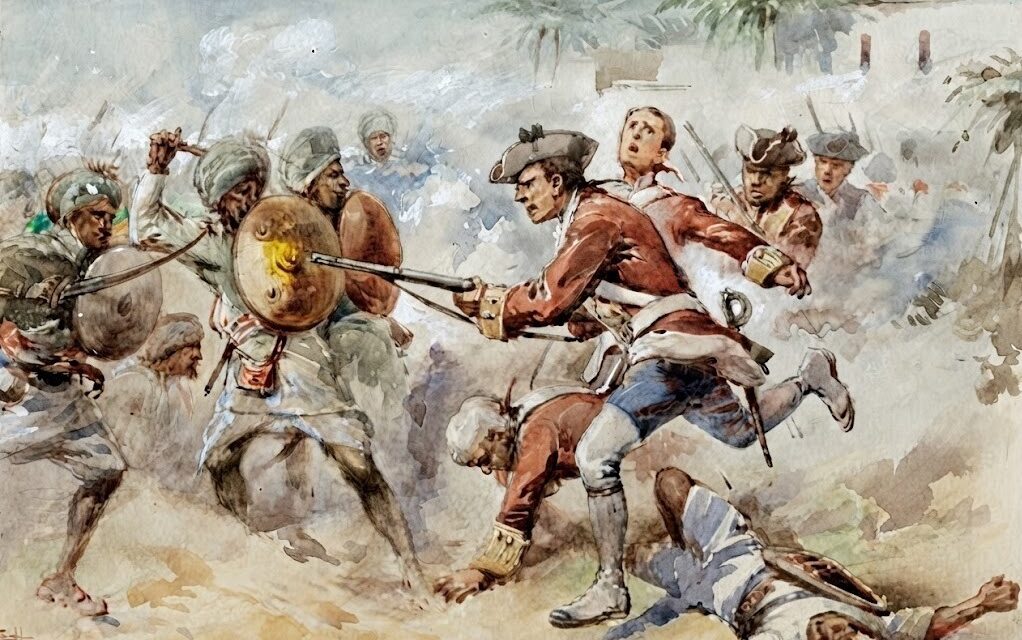
A brief monsoon downpour on the afternoon of June 23, 1757, did more to decide the fate of Bengal than either army’s own maneuvering. When the rain swept across the mango grove outside the village of Palashi, the East India Company’s gunners rushed to cover their powder and cannon with tarpaulins; the Nawab of Bengal’s much larger artillery train, caught without the same protection, was left soaked and useless within minutes. It was a small, almost accidental turn of weather, on an afternoon that had already been quietly decided in advance by a very different kind of preparation, and together the two forces opened the door to two centuries of British rule over the Indian subcontinent.
Plassey: The Road to Battle
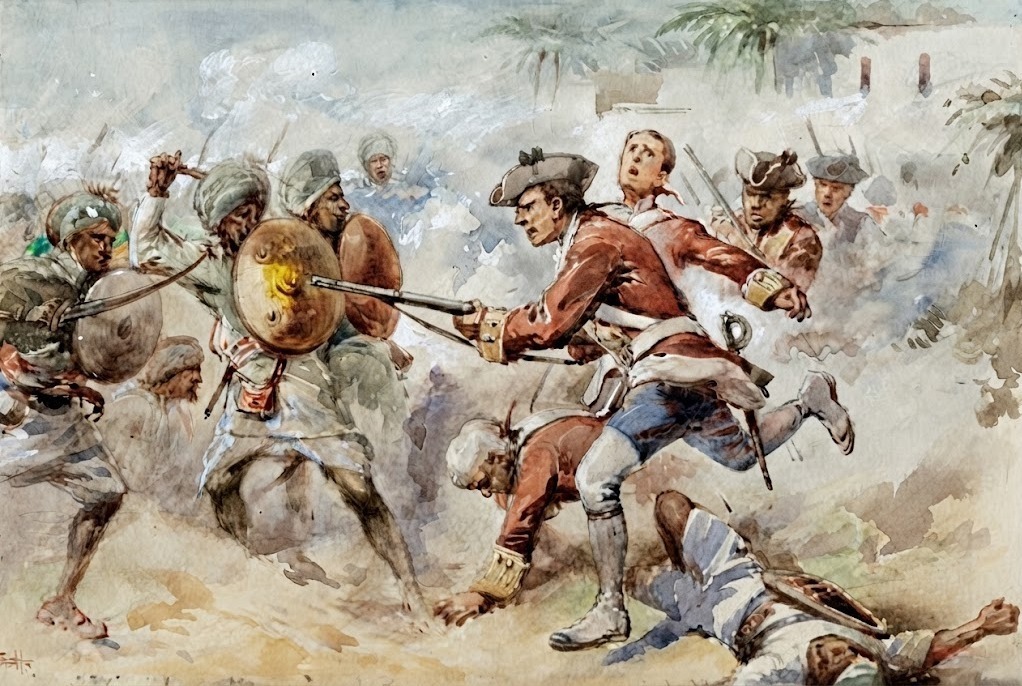
By the mid-eighteenth century, the British East India Company had built a substantial trading and military presence in Bengal, operating under charters and concessions from successive Mughal-era Nawabs while steadily expanding its own fortifications and armed forces beyond what those agreements technically permitted, a slow accumulation of leverage that increasingly alarmed the Nawab’s court in Murshidabad. Tensions came to a head after Siraj-ud-Daulah succeeded his grandfather as Nawab of Bengal in 1756 and moved quickly to curb what he saw as Company overreach, culminating in his capture of the Company’s stronghold at Calcutta that June, an episode that included the notorious and still-disputed “Black Hole of Calcutta” incident in which a number of British prisoners died overnight in a cramped detention cell, an event that British accounts would seize on in the following months to help justify military retaliation. Robert Clive, already an experienced Company military officer with a reputation built on earlier campaigns in southern India during the Company’s rivalry with French forces there, led a retaliatory expedition north from Madras that recaptured Calcutta in early 1757 and then turned to a broader confrontation with Siraj-ud-Daulah’s much larger Bengali army, backed by a fleet under Admiral Charles Watson that had helped ferry Company troops up the Hooghly River. Rather than relying on battlefield force alone, Clive and Company officials in Calcutta, including the Bengali merchant and financier Jagat Seth, simultaneously pursued a secret political conspiracy with several of Siraj-ud-Daulah’s own senior commanders, most importantly Mir Jafar, the Nawab’s own military chief, who agreed in advance to withhold his forces from serious fighting in exchange for being installed as the new Nawab once Siraj-ud-Daulah was removed, an arrangement negotiated through intermediaries and formalized in a written agreement in the weeks before the battle. By the time the two armies converged near the village of Palashi in late June, Clive’s roughly three thousand Company troops, a mixed force of British regulars and Company-trained Indian sepoys supported by a modest artillery train, faced a Bengali army numbering in the tens of thousands, including cavalry, infantry, war elephants, and French artillery advisors, a numerical mismatch so severe on paper that the battle’s outcome had already been substantially predetermined by the secret arrangements struck in the preceding weeks.
The Battle of Plassey
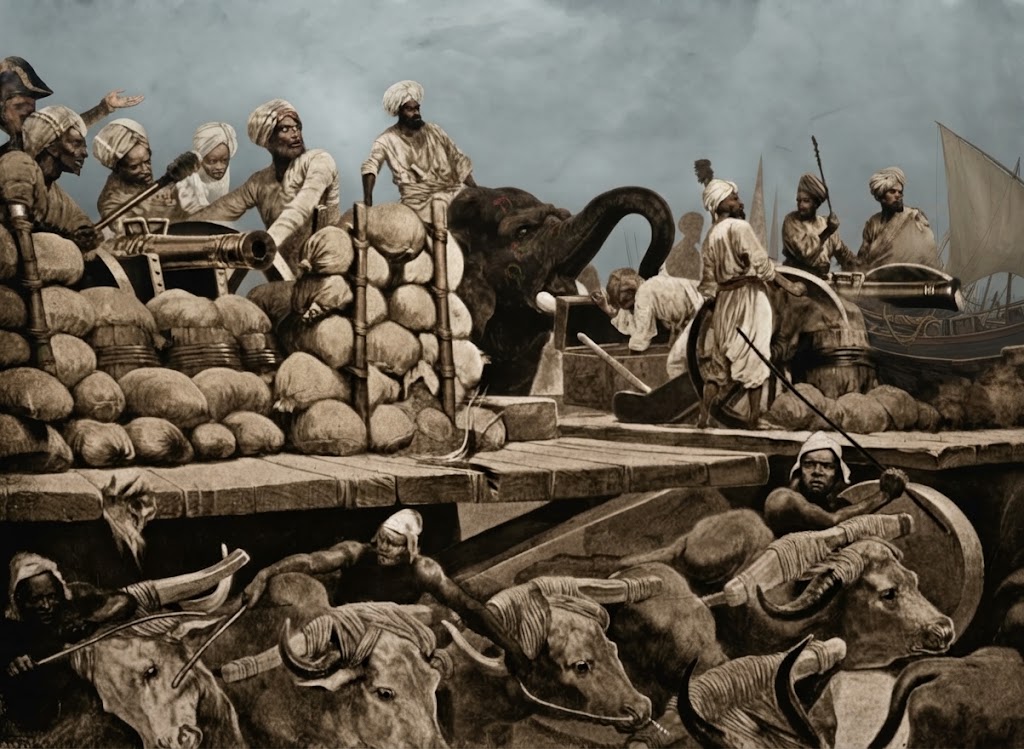
The two armies faced each other across open ground near a mango grove beside the Bhagirathi River on the morning of June 23, with Clive’s much smaller force taking up a defensive position in and around the grove, its earthen embankments offering useful cover, while Siraj-ud-Daulah’s vastly larger army, including a substantial contingent of French artillery advisors and gunners supporting the Nawab’s cause, arrayed itself across the surrounding plain in a wide arc that visually dwarfed the Company’s compact formation. Fighting opened around eight in the morning with an extended artillery exchange in which the Nawab’s numerically superior guns initially had the better of the engagement, inflicting some casualties on the Company’s more exposed positions and threatening to grind down Clive’s smaller force through sheer weight of fire if the bombardment continued unchecked through the day, prompting Clive to briefly consider whether his position could hold at all. The early afternoon’s sudden monsoon downpour then transformed the battle’s dynamics decisively: Company gunners, drilled to protect their ammunition and following orders to cover their powder quickly, kept their own artillery functional through the rain, while the Nawab’s much larger gun train, lacking the same discipline and preparation, was left with soaked, unusable powder once the rain passed. Believing the Company’s guns had also been silenced by the storm, the Nawab’s cavalry commander Mir Madan led a determined charge against Clive’s position, only to be killed by effective Company cannon fire that the rain had not, in fact, disabled, a loss that badly shook morale within the Nawab’s camp at a critical moment. With Mir Madan dead and the promised betrayal unfolding as arranged, Mir Jafar and several other senior Bengali commanders held their large divisions back from the fighting entirely, refusing to commit their troops despite Siraj-ud-Daulah’s urgent appeals for reinforcement, effectively removing the majority of the Nawab’s numerical advantage from the battle at the moment it mattered most. Clive, recognizing the disarray spreading through the opposing camp, ordered a general advance in the late afternoon, and the Company’s disciplined infantry and artillery pushed forward against a Bengali army whose cohesion was already unraveling from Mir Madan’s death and Mir Jafar’s inaction, capturing key Nawabi artillery positions as the advance gathered momentum. Siraj-ud-Daulah, seeing his army disintegrating around him and unable to rally the divisions still willing to fight, fled the field on a camel before the battle had fully concluded, disguising himself in the process, and his broader force collapsed into retreat shortly afterward, bringing a battle that had cost Clive’s own forces remarkably few casualties, by most accounts under two dozen killed, to a decisive close within a matter of hours despite the enormous imbalance in the two armies’ original size.
The Legacy of Plassey
Plassey installed Mir Jafar as the new Nawab of Bengal under Company oversight, but real political and economic authority over the region shifted decisively to the East India Company in the years that followed, marking the effective beginning of British colonial rule in India rather than merely another change of local ruler. Siraj-ud-Daulah was captured and executed within days of his defeat on Mir Jafar’s orders, removing any immediate challenge to the new arrangement, and Mir Jafar himself soon discovered his new authority was largely nominal, subject to Company demands he had little power to resist. The enormous wealth extracted from Bengal’s treasury and revenues in the years that followed financed further Company military expansion across the subcontinent and helped fuel Britain’s own industrial growth at home, and Plassey is conventionally treated by historians as the opening chapter of nearly two centuries of British colonial control in India, a single afternoon’s battle whose consequences reshaped the political map of an entire subcontinent.
What Remains at Plassey
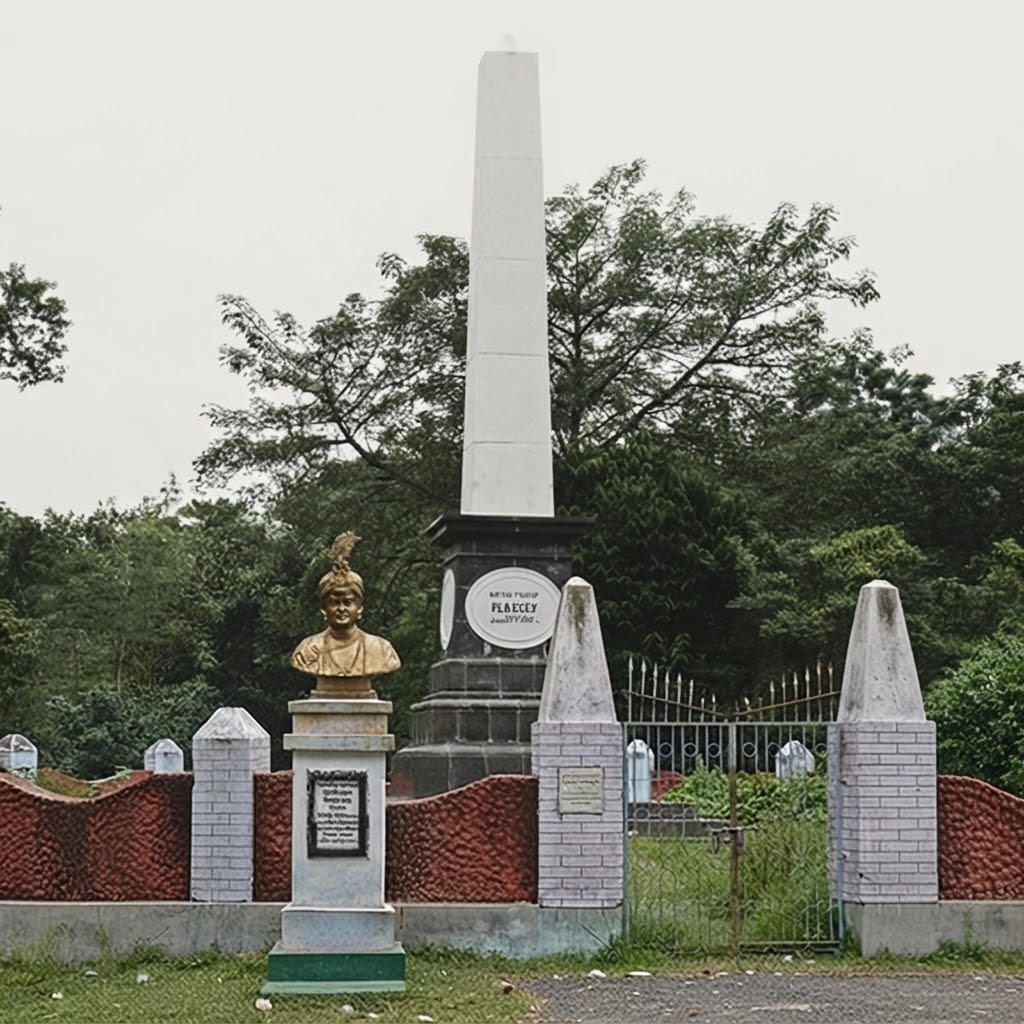
The Palashi Monument, an 1883 obelisk protected by the Archaeological Survey of India, marks the traditional site of the battle and remains freely accessible to visitors year-round, standing today as the principal physical marker of an engagement whose actual ground has changed considerably since 1757. The Bhagirathi River has shifted its course substantially over the intervening centuries, so relatively little of the original battlefield terrain, including the mango grove that gave Clive’s forces their defensive position, survives in a form recognizable from contemporary accounts of the fighting. The monument’s protected status has kept it well maintained despite the site’s otherwise low profile, a modest reminder that the fighting itself, whatever its historical weight, cost surprisingly few lives on the winning side and left correspondingly little in the way of physical scars for a memorial to mark. Palashi itself has limited infrastructure of its own for travelers, and visitors are generally better served finding lodging and food in nearby Murshidabad or Baharampur, both larger towns considerably better equipped than Palashi to accommodate an overnight stay. The site is reachable by rail via Plassey station or by road, roughly 150 kilometers from Kolkata, and no confirmed recurring annual commemorative event was found associated with the site, unlike some other battlefields of comparable historical weight. Cooler, drier months generally offer the most comfortable conditions for visiting, since Bengal’s summer heat and monsoon rains, the same rains that shaped the battle’s outcome centuries ago, can make an already understated rural site considerably less pleasant to explore on foot.
Remembrance at Plassey
Robert Clive himself provided the fullest British account of the battle in an official dispatch to the East India Company’s Secret Committee and Court of Directors, written just three days after the fighting on June 26, 1757, and preserved today in the Company’s India Office Records. As the general who fought and won the engagement, Clive’s account details troop dispositions, the storm that spoiled the Nawab’s gunpowder, Mir Madan’s death by cannon fire, and Mir Jafar’s refusal to engage, alongside Clive’s own justification of the secret political maneuvering, conducted through the broker Omichund, that had secured Mir Jafar’s defection before the battle ever began. A very different perspective survives in the Siyar-ul-Mutakherin, or “Review of Modern Times,” a major Persian-language history completed in the 1780s by Ghulam Husain Khan Tabatabai, a Bengal-based Muslim nobleman and historian connected by marriage to Mir Jafar’s own family. Though not present on the battlefield himself, Tabatabai had direct access to participants and court circles in the years after the battle, and his account, widely available today in an eighteenth-century English translation by Haji Mustapha, preserves an Indian and Mughal-successor-state perspective largely absent from British sources, including sharp criticism of both Mir Jafar’s treachery and the Company’s conduct in securing its victory. Read together, Clive’s own triumphant dispatch and Tabatabai’s more skeptical later history offer two starkly different verdicts on the same afternoon, one written by the victor within days of the fighting and the other compiled decades later from within the world that afternoon had upended.
Visitor Info: Book titled “Plassey: The Battle That Changed the Course of Indian History” by Sudeep Chakravarti (Aleph Book Company, 2020)
Location: Palashi Monument, Palashi (Plassey), Nadia district, West Bengal, India
Site Status: Marker or Monument Only
Visitation Notes: The Palashi Monument, an 1883 obelisk protected by the Archaeological Survey of India, marks the battle site and is freely accessible year-round; the Bhagirathi River has shifted course over the centuries, so little of the original battlefield ground survives near the marker. Reachable by rail via Plassey station or by road, roughly 150 km from Kolkata, with better lodging and food options in nearby Murshidabad or Baharampur than in Palashi itself. No confirmed recurring annual commemorative event was found. Cooler, drier months are generally the most comfortable time to visit.
Google Map
Visitor Comments
Visiting the Palashi memorials today means seeing a well-kept ASI obelisk alongside a more neglected officers’ memorial nearby, but very little of the actual 1757 battlefield remains recognizable since the Bhagirathi River has shifted its course substantially since then. It’s a quiet, low-key rural site rather than a developed tourist attraction, worth the detour mainly for the historical weight of the place rather than dramatic scenery.
— from Rangan Datta, travel blog
Palashi remains an unassuming village today, easy to overlook, yet it’s remarkable to stand at the spot where a single afternoon’s fighting redirected the course of Indian history for the next two centuries. The site rewards visitors more for its historical significance than for any polish or infrastructure.
— from Bengal Beckons (West Bengal Tourism blog)