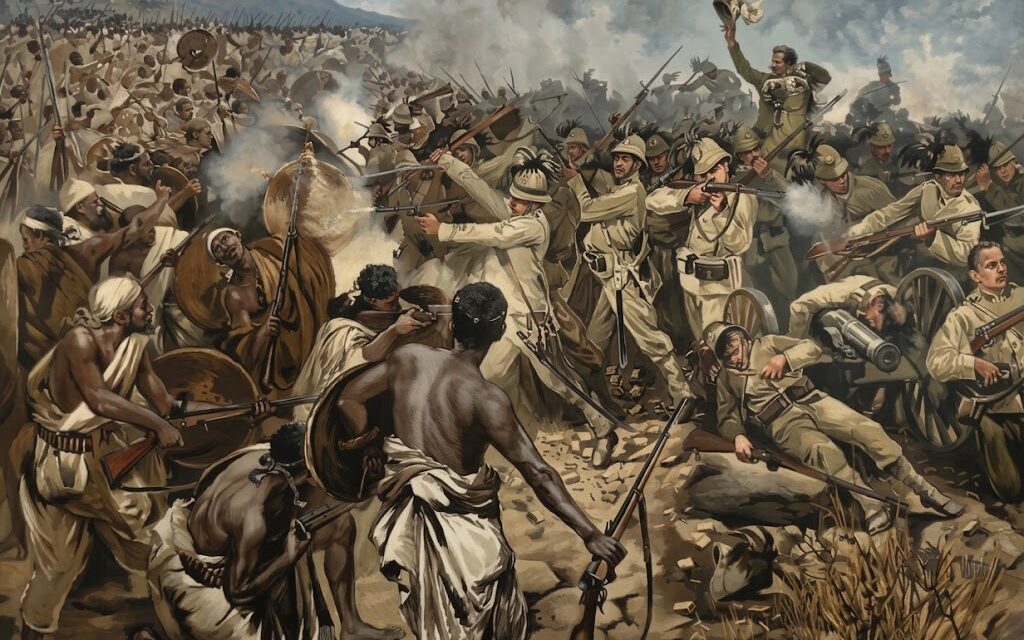
During the era when European powers carved up nearly the entire African continent among themselves, one African army stopped a colonial invasion cold and forced the invader to sue for peace. On March 1, 1896, Ethiopian forces under Emperor Menelik II and Empress Taytu Betul destroyed an invading Italian army near the town of Adwa, killing or capturing roughly half of the force Italy had sent to claim Ethiopia as a colony. The victory did more than end a single campaign: it preserved Ethiopian sovereignty through the height of the Scramble for Africa, leaving Ethiopia, alongside Liberia, as one of the only two African states never to fall under formal European colonial rule, a distinction that still shapes how the country understands its own history today, and one that made Adwa a rallying point for anti-colonial movements across the continent long before most of Africa’s colonized nations had even begun their own paths toward independence.
Adwa: The Road to Battle
Italy’s ambitions in the Horn of Africa took root in the 1880s, when the newly unified Italian kingdom, arriving late to Europe’s colonial scramble and eager to claim African territory of its own, established a foothold on the Red Sea coast that grew into the colony of Eritrea. In 1889, Italy and Ethiopia’s newly crowned Emperor Menelik II signed the Treaty of Wuchale, an agreement meant to formalize friendly relations between the two states, but the Amharic and Italian versions of the treaty’s Article 17 diverged sharply: the Amharic text permitted Ethiopia to conduct foreign relations through Italy if it chose, while the Italian text asserted that Ethiopia had accepted Italian protectorate status outright. When Italy began presenting Ethiopia to the other European powers as its protectorate on the strength of the Italian-language text, Menelik formally repudiated the treaty in 1893, rejecting any claim of Italian sovereignty over his empire and setting the two states on a collision course. Italy, unwilling to abandon its ambitions in the region, pressed forward with military expansion from its Eritrean colony over the following two years, provoking a series of border clashes that culminated in open war by late 1895. Menelik responded by mobilizing an extraordinarily large force drawn from across his empire, rallying regional rulers and their armies, including Ras Alula Engida, Ras Makonnen, and Ras Mengesha Yohannes, into a single imperial army that assembled through the early months of 1896 in the highlands of Tigray, in the country’s north, not far from the advancing Italian positions. General Oreste Baratieri, commanding Italy’s colonial forces, initially favored a cautious defensive strategy given the scale of the Ethiopian mobilization he faced, but mounting pressure from the government in Rome, impatient for a decisive victory and anxious about the campaign’s mounting costs, eventually pushed him toward the offensive movement that would bring the two armies together at Adwa.
The Battle of Adwa
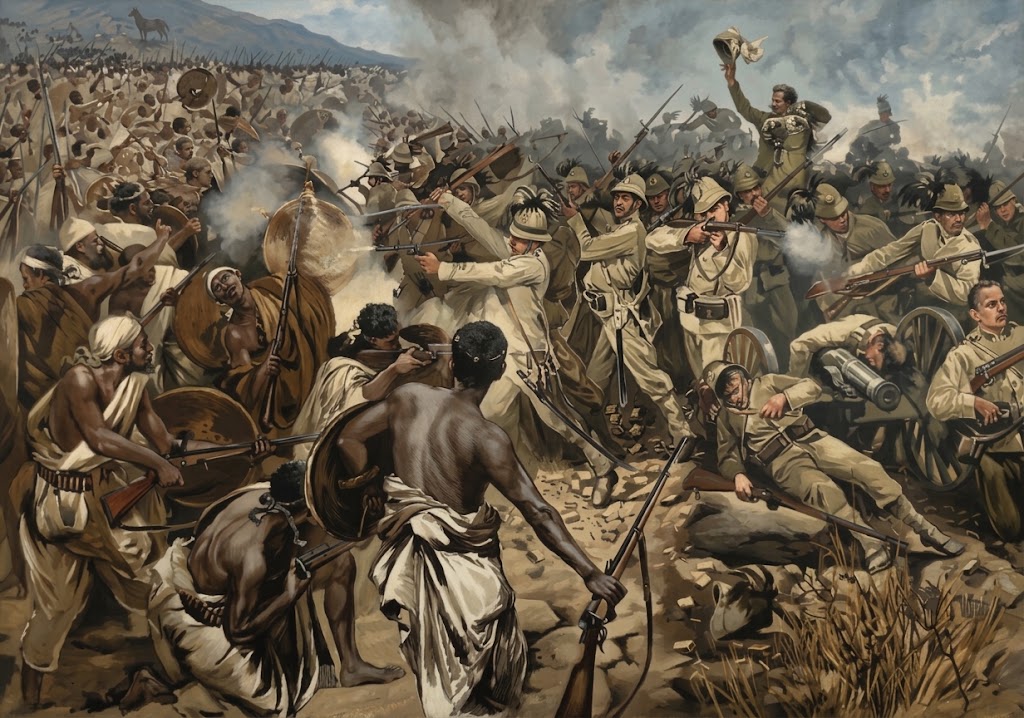
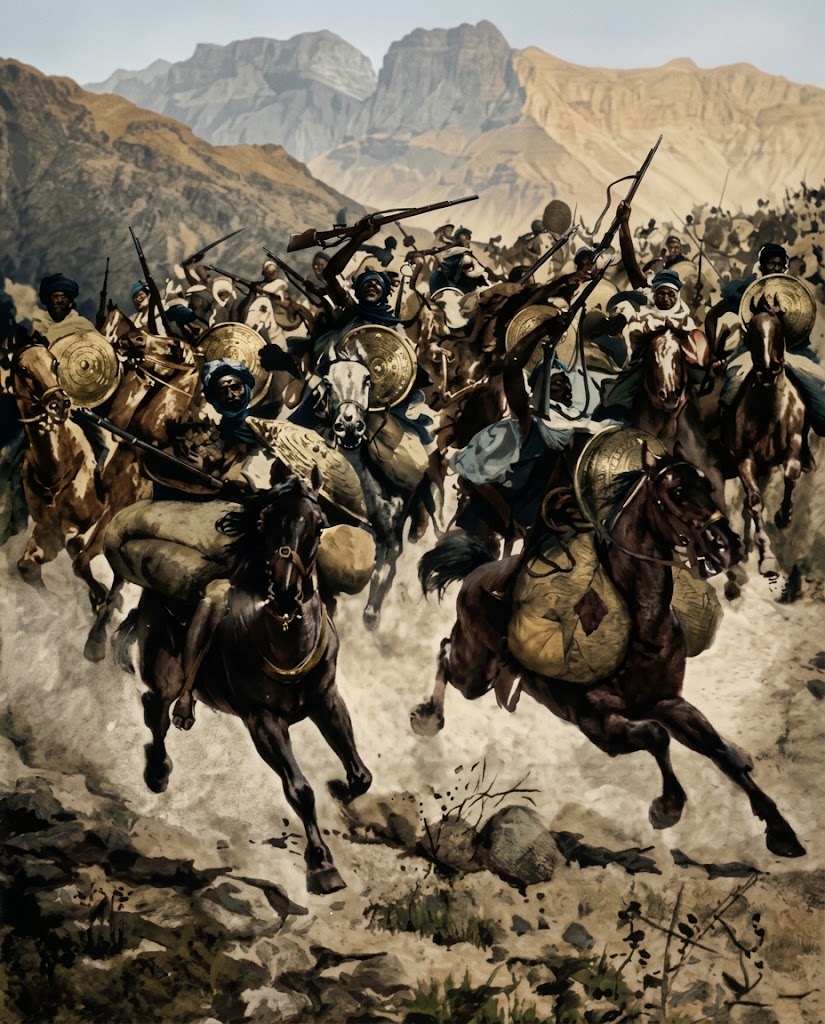
Baratieri’s plan called for his roughly 17,000 troops, organized in four brigades under generals Dabormida, Arimondi, Albertone, and Ellena, to advance under cover of darkness on the night of February 29 into March 1, 1896, seizing high ground near Adwa before dawn in the hope of forcing a defensive engagement on favorable terms against Menelik’s far larger army. The night march went badly from the start: the maps available to Italian commanders proved inaccurate and poorly detailed for the rugged, unfamiliar terrain, and in the darkness and confusion the four brigades drifted apart, losing contact with one another and arriving at their intended positions at different times and, in the case of General Matteo Albertone’s brigade, at entirely the wrong location, several miles out of position and dangerously exposed ahead of the rest of the Italian line. Ethiopian scouts detected the Italian advance well before daylight, and Menelik’s army, drawn up in strength across the surrounding high ground, moved to attack the separated Italian brigades one at a time rather than allowing them to reunite into a single coordinated force. The Ethiopian force, estimated at well over 100,000 fighters when cavalry, infantry, and irregular levies are counted together, vastly outnumbered the Italian brigades it engaged, and Empress Taytu Betul, who had personally commanded a division during the campaign’s earlier siege operations, took an active role in directing Ethiopian forces during the battle itself alongside Menelik and his regional commanders. Fighting raged through the morning of March 1 as Ethiopian forces first overwhelmed Albertone’s exposed and isolated brigade, capturing much of its artillery in the process, then turned on Arimondi’s brigade as it attempted to hold a defensive line and cover the growing collapse to its flank. General Dabormida’s brigade, ordered to support Arimondi, instead marched into a narrow highland valley where it was surrounded and effectively destroyed as a fighting force, its commander killed along with the great majority of his men, while Italian artillery and rifle fire inflicted serious losses on the attacking Ethiopian ranks throughout without ever coming close to halting the assault’s overall momentum. By early afternoon the entire Italian position had collapsed into a disorganized retreat back toward Eritrea, pursued for miles by Ethiopian cavalry that inflicted further heavy losses on the fleeing survivors and captured large numbers of prisoners along the retreat routes. When the fighting ended, Italy had lost roughly 7,000 men killed, with thousands more wounded or taken prisoner, a casualty rate approaching half the entire invading force and among the most complete defeats any European colonial army suffered in nineteenth-century Africa.
The Legacy of Adwa
The scale of the Italian defeat forced Rome to abandon its colonial ambitions in Ethiopia entirely, and the resulting Treaty of Addis Ababa, signed later in 1896, required Italy to recognize Ethiopian independence unconditionally, formally renouncing the protectorate claims that had triggered the war in the first place. News of the defeat also had domestic consequences in Italy itself, contributing to public outrage that helped topple the sitting Italian government within weeks of the battle. Adwa’s outcome made Ethiopia the striking exception to the era’s rule across the African continent, and the victory’s significance echoed far beyond Ethiopia’s own borders, becoming a touchstone for anti-colonial and Pan-African movements throughout the twentieth century as concrete proof that a European colonial army could be defeated outright by an African one. The battle’s memory would resurface decades later when Fascist Italy, seeking to avenge the defeat and finish what Baratieri’s army had failed to do, finally occupied Ethiopia by force in 1935 during the Second Italo-Ethiopian War, only for that occupation itself to end within five years.
Adwa: A Site Off-Limits
The battlefield itself lies within Ethiopia’s Tigray Region, an area currently under a Do Not Travel advisory from Western governments because of ongoing regional conflict and instability, and independent travel to the actual site near the town of Adwa cannot be responsibly recommended under present conditions. The genuine substitute for visitors interested in the battle’s history is the Adwa Victory Memorial Museum in the Piassa district of Addis Ababa, a purpose-built institution dedicated specifically to the 1896 campaign rather than a general national history museum, and one of the few sites anywhere focused entirely on this particular victory. Its exhibits center on a detailed terrain model of the battle that lays out the movements of both armies across the surrounding highlands, allowing visitors to trace the piecemeal collapse of the separated Italian brigades in a way that reading the campaign’s history alone cannot easily convey, alongside artifact displays documenting both the Ethiopian and Italian sides of the campaign. Guided tours are available and generally recommended, since the museum’s staff can walk visitors through the sequence of the day’s fighting far more clearly than the exhibits alone. Admission is paid, and the museum’s relatively compact scale means roughly an hour is generally enough time to see its full collection, making it a manageable addition to a broader day exploring the Ethiopian capital rather than a destination requiring a dedicated half-day visit. Travel to the battlefield itself in Tigray may become a realistic option again if regional conditions improve, but no reliable timeline exists for when that might happen, and visitors should rely on current government travel advisories rather than older guidance when planning any trip to northern Ethiopia. For now, the Addis Ababa museum remains the responsible and practical way to engage with Adwa’s history in person, and it is worth the visit on its own merits regardless of whether the battlefield itself ever becomes accessible again.

Remembrance at Adwa
The Ethiopian side of the campaign survives in unusually authoritative form through the Chronique du Regne de Menelik II, Roi des rois d’Ethiopie, written by the court chronicler Gebre Sellassie and later published in French translation in Paris during 1930 and 1931, the closest thing to an official Ethiopian court record of the emperor’s reign and his campaign against the Italian invasion. A remarkable counterpart survives from the losing side in General Oreste Baratieri’s own memoir, Memorie d’Africa, 1892-1896, written in his final years and published in Genoa in 1988, in which the Italian commander offered his own account and defense of the decisions that led to the disaster at Adwa, decisions that had already earned him a court-martial, from which he was ultimately acquitted, in the battle’s immediate aftermath. Read together, Gebre Sellassie’s court chronicle and Baratieri’s own late-life defense preserve the battle from the perspectives of both its victor and its defeated commander, an unusually direct pairing between an empire’s official record of triumph and a general’s personal reckoning with catastrophic defeat. Baratieri’s account, written so long after the events it describes, also reflects decades of a defeated commander’s own effort to explain a disaster that had ended his military career and left him defending his decisions for the rest of his life, giving it a different character from the more contemporaneous court chronicle produced on the victorious Ethiopian side.
Visitor Info: adwavictorymemorial.gov.et
Location: Battle of Adwa site, near Adwa, Tigray Region, Ethiopia
Site Status: Access Restricted or Unsafe
Visitation Notes: The battlefield near Adwa sits within Ethiopia’s Tigray Region, currently under a Do Not Travel advisory due to ongoing regional conflict and instability, so independent travel to the site cannot be responsibly recommended under current conditions. The genuine substitute is the Adwa Victory Memorial Museum in Addis Ababa’s Piassa district, a purpose-built museum dedicated specifically to this battle, with a detailed terrain model, artifact displays, and guided tours; admission is paid, and roughly an hour is enough for a visit. Travel to the actual battlefield may become viable again if regional conditions change, but no timeline can be given.
Google Map
Visitor Comments
Honza P remarks that the museum is impressively modern for a site dedicated to a 19th-century battle, with a detailed terrain model and interactive displays that make the tactics of the day genuinely easy to follow, and the guided tour adds context you wouldn’t get walking through alone.
— from TripAdvisor
Lindsay H remarks that its a powerful, well-presented tribute to Ethiopia’s victory over colonial invasion, with artifacts and photographs that bring the story to life — well worth the visit for anyone interested in the country’s history.
— from TripAdvisor