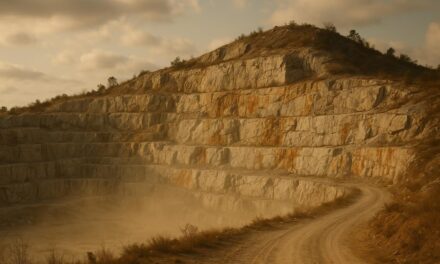
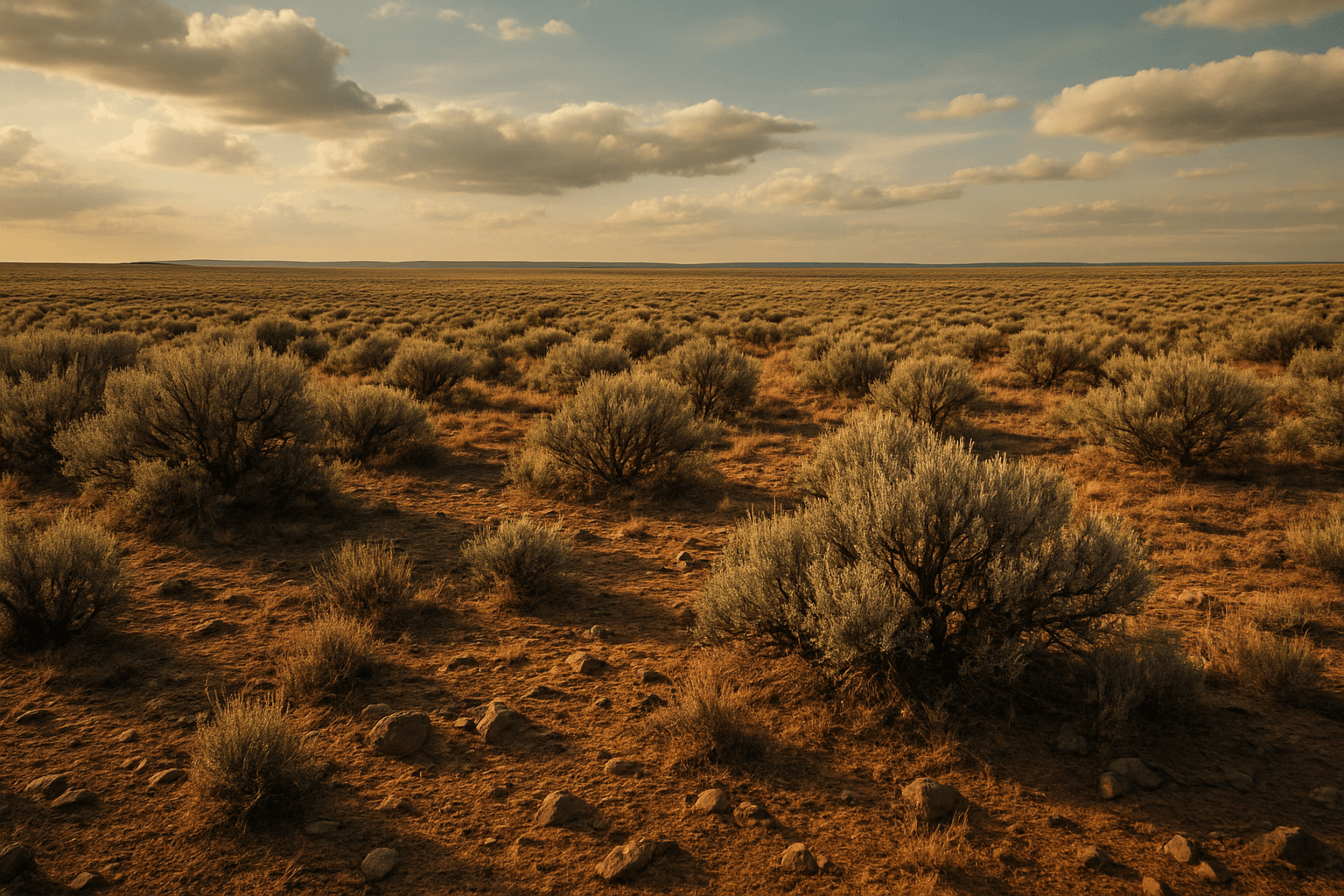
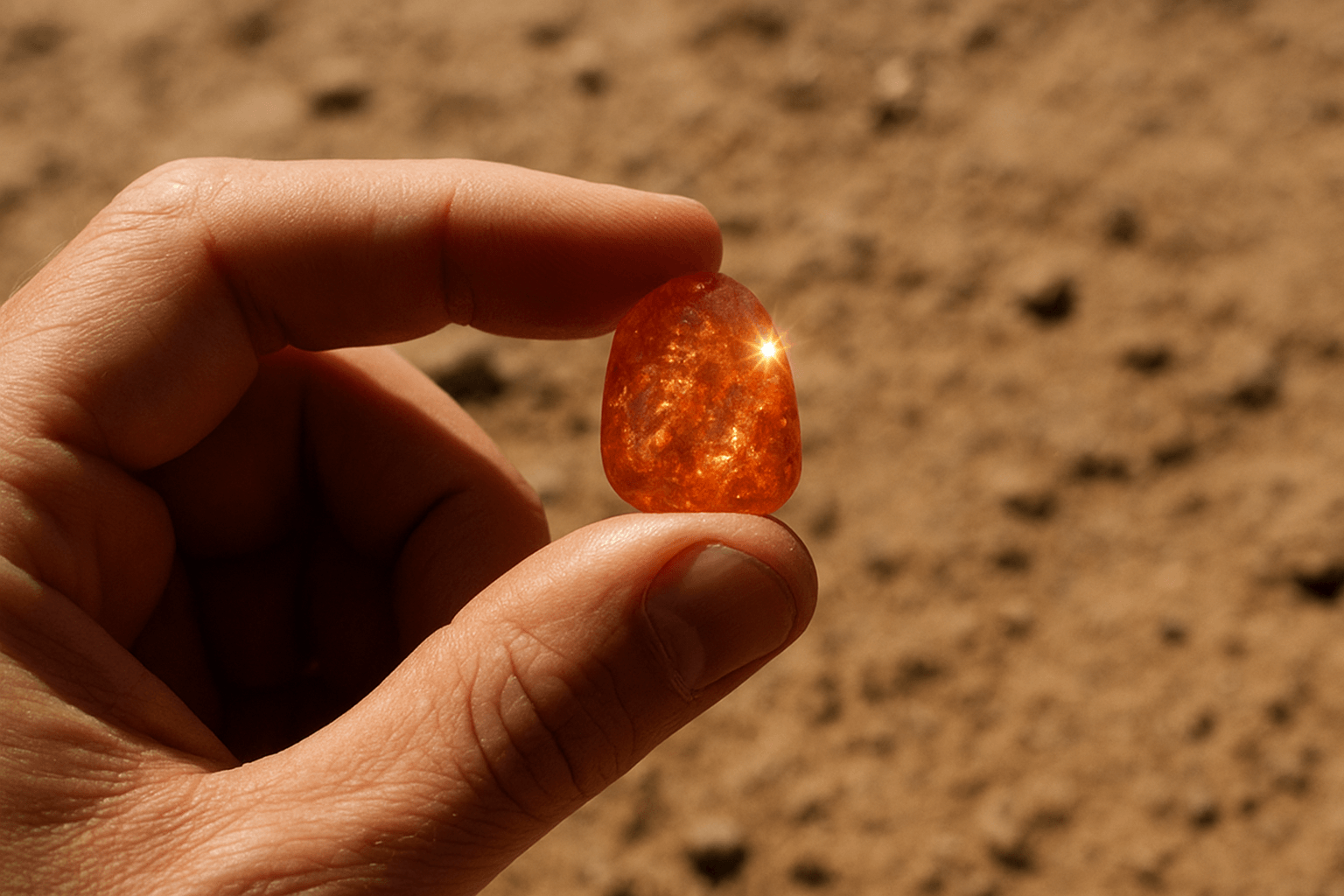
The wind never really stops out here. It moves across open sagebrush flats with nothing to slow it down, and underfoot the ground is loose, sun-baked dirt studded with small stones that look, at a glance, like nothing worth a second look. Then the light hits one at the right angle and it flashes — a deep red-orange glow from somewhere inside the stone itself, like a coal that never quite went out. That’s the moment every sunstone hunter comes to this stretch of high desert chasing, and it’s still happening today, out in the open, for anyone willing to get down on their knees and look — no claim, no fee, no locked gate standing between a person and the ground.
Rabbit Basin: Home to Oregon’s State Gem
Rabbit Basin sits about 23 miles north of the small town of Plush, in Oregon’s Lake County, on land managed by the Bureau of Land Management. It’s remote, high-desert country — exposed, windswept, and a long way from the nearest services. What makes this particular patch of ground significant is what’s underneath it: sunstone, a feldspar gem known for its glittering internal color caused by tiny copper inclusions scattered through the crystal structure, and Oregon’s official state gem since the legislature designated it as such. That copper-driven glow is what separates sunstone from ordinary feldspar and what makes a good specimen worth bending down for in the first place. Rabbit Basin is the site of the only public deposit of that gem in the entire state.
That distinction matters enormously to the rockhounding community, because sunstone country in this part of Oregon is otherwise almost entirely locked up under private claim, leaving very few legal doors open for anyone without a claim of their own. Surrounding the public collection area are roughly 370 privately held mining claims, ranging from 20 to 160 acres each, all off-limits to casual collectors. Against that backdrop, the roughly 2,500-acre public collection area at Rabbit Basin stands out as a rare exception — a genuine, sanctioned window into gem-bearing ground that would otherwise be entirely closed to the public. The Bureau of Land Management’s Lakeview District documents and manages the site specifically to keep that window open, treating the public collection area as a distinct, protected use of the land rather than an afterthought squeezed in around the surrounding claims.
The gem itself is what has drawn outside attention to this stretch of desert. Oregon sunstone has been notable enough in the gem trade to catch the eye of major jewelers, including Tiffany & Co. — a level of commercial interest that underscores just how significant this deposit is, both for collectors chasing a personal find and for the broader reputation of Oregon sunstone as a gemstone worth taking seriously. That’s a rare pedigree for a stone the general public can still legally dig for itself, rather than one locked entirely behind commercial mining operations the way most jewelry-grade gem deposits eventually become.
The Tiffany & Co. Connection
Oregon sunstone’s reputation didn’t build itself on rumor. The gem has been notable enough to draw interest from Tiffany & Co., one of the most recognized names in the jewelry trade — a fact that speaks directly to the quality and desirability of what comes out of the ground in places like Rabbit Basin. For a gem to catch that kind of commercial attention, it has to hold up under real scrutiny — cut quality, color saturation, clarity — and Oregon sunstone has done exactly that, repeatedly, enough to build a reputation that extends well beyond the rockhounding community into the broader jewelry trade.
What makes Rabbit Basin specifically important within that larger story is public access. Most ground capable of producing gem-quality sunstone in this part of Oregon sits under private claim, meaning the only legal path for an ordinary collector to dig their own stone from the same deposit that has drawn commercial-grade interest is the public collection area itself. The Bureau of Land Management drew a clear boundary here: roughly 2,500 acres set aside for personal-use collecting, surrounded by privately held claims that remain off-limits. That boundary is what turns Rabbit Basin from a locked-up gem district into a place where anyone can actually put a shovel in the ground, without a claim of their own, a lease, or permission from any of the roughly 370 private claim holders working the surrounding acreage.
The rules governing that access are specific and worth understanding before a visit. BLM personal-use limits apply: collectors can take up to 25 pounds of material per day, plus one additional piece, with an annual cap of 250 pounds. Only hand tools are permitted, and commercial resale of anything collected is prohibited. Those limits exist to keep the public collection area sustainable as a shared resource rather than a site that gets stripped by a handful of large-scale operations, and they’re part of what has kept Rabbit Basin open and productive for the rockhounding community over time, season after season, rather than picked clean in a single year.
Visiting Rabbit Basin Today
Rabbit Basin remains open to the public today, with no permit or fee required to collect sunstone within the designated BLM collection area. Visitors are limited to hand tools, a daily take of up to 25 pounds plus one piece, and an annual limit of 250 pounds, with no commercial resale of collected material. It’s a straightforward, no-permission-needed way to search for a real, gem-quality find in one of the few places in the country where the public can legally dig for sunstone at all, rather than watch it sold behind glass in a jewelry case.
That said, Rabbit Basin is genuinely remote, and visitors should treat it that way rather than assuming a quick, casual stop. The nearest services are roughly 45 minutes away in Lakeview, and the exposed plateau sees extreme temperature swings and high winds with no natural shade. The terrain itself is difficult and largely unmarked, and cell service is unreliable to nonexistent across the basin. None of that makes the site inaccessible — it just means a visit here calls for real preparation: water, proper clothing, sun protection, and a plan that accounts for how far away help actually is if something goes wrong on the plateau.
The Legacy of Rabbit Basin’s Sunstone Fields
Rabbit Basin matters to the rockhounding community because it’s one of the only places left where an ordinary collector can legally dig for a gem that has caught the attention of names like Tiffany & Co., without a claim, a lease, or a connection to any of the private operations working the ground around it. Nearly all of the surrounding ground capable of producing sunstone this good is locked up in private claims, which makes the public collection area a genuinely rare resource rather than a token gesture. For anyone serious about the hobby, that combination — a state gem of real commercial pedigree, and a real, legal, no-permit way to search for it yourself — is worth the trip into Lake County’s high desert. The wind and the remoteness are part of the deal, but so is the chance to find a piece of Oregon’s official gem with your own hands, on the one stretch of ground still open to try, using nothing more than a hand tool and the patience to keep looking until the light catches something red.
Story Source: www.blm.gov
Location: Sunstone Public Collection Area, Rabbit Basin, ~23 miles N of Plush, OR
Site Status: Open to public collecting
Legal Conditions: BLM-managed public collection area in Rabbit Basin (Lake County) requires no permit or fee. Standard BLM personal-use rockhounding limits apply: up to 25 lbs plus one piece per day, 250 lbs per year, hand tools only, no commercial resale. Surrounding claims (~370, ranging 20-160 acres) are privately held and off-limits; collecting is confined to the ~2,500-acre public area. Source: BLM Lakeview District (blm.gov/visit/sunstone-collection-area) and BLM OR/WA Rock Collecting Guide. Confidence: Verified.
Hazards: Remote high-desert location (nearest services roughly 45 minutes away in Lakeview); extreme temperature swings and high winds across the exposed Rabbit Basin plateau; difficult, unmarked terrain with no shade or cell service.
Google Map
Firsthand Accounts
In a Fall 2013 Gems & Gemology field report, GIA researchers Duncan Pay, Robert Weldon, Shane McClure, and Kevin Schumacher visited the Dust Devil mine in Rabbit Basin and documented the operation firsthand, crediting owners Don Buford, Terry Clarke, and Mark Shore for showing them the claim. Source: Pay, D., Weldon, R., McClure, S., and Schumacher, K., “Three Occurrences of Oregon Sunstone,” Gems & Gemology, Fall 2013, Vol. 49, No. 3 (Gemological Institute of America).
Dust Devil Mine co-owner Don Buford, a Vietnam veteran who first visited Rabbit Basin in 1991 to collect rocks for a youth group, and his partner Terry Clark, who recalled staking abandoned claims in 1992 and building their operation from hand tools and long weekends, both still work the site today. “Every day is like Christmas out here,” Clark said. Source: Alexandra Arch, “Sunstone Mining in Oregon,” 1859 Oregon’s Magazine, originally published January 1, 2011.
Spectrum Mine owner Chris Rose, a long-time rockhound who has held claims in Rabbit Basin for over a decade, told a reporter he believes his property is the original Tiffany & Co. “Plush Diamond” claim staked in 1913 — a claim Dust Devil’s Don Buford disputes, citing a different site nearer his own mine as the true original pit. Source: Alexandra Arch, “Sunstone Mining in Oregon,” 1859 Oregon’s Magazine, originally published January 1, 2011.