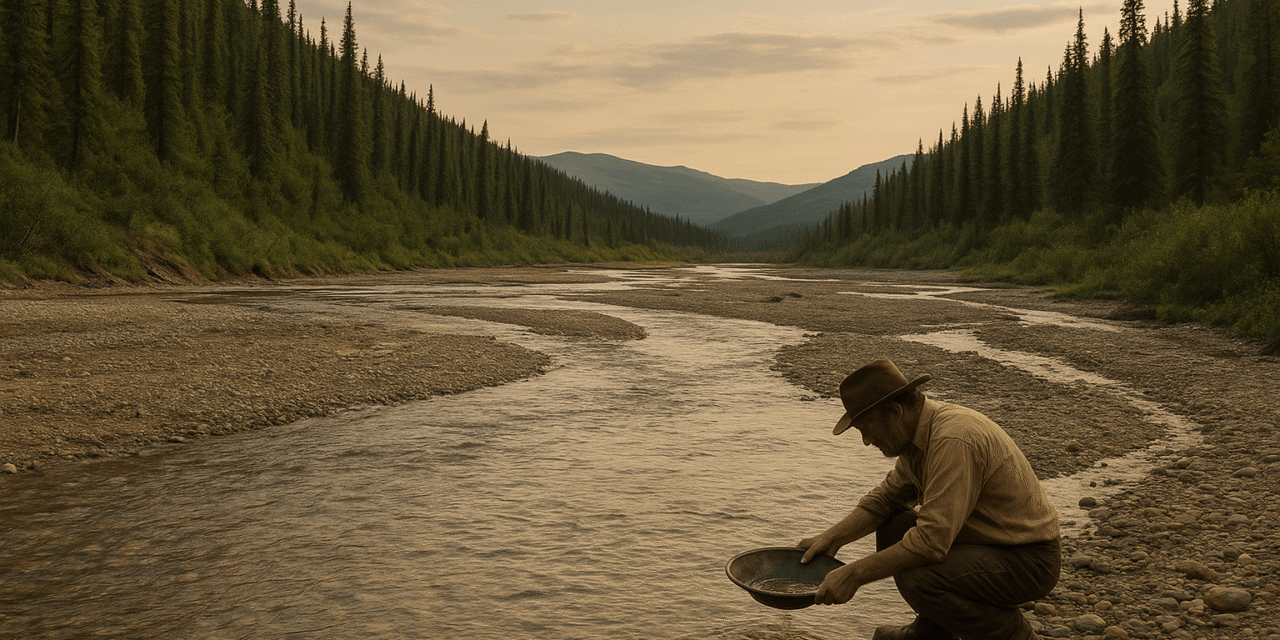
The creek runs fast and cold even in July, glacial melt cutting through gravel that has been turned over by hand, shovel, and machine for more than a century. Somewhere in that gravel, sitting heavier than the stone around it, is color — a fine trace of gold that settled here long before anyone came looking for it, and that keeps settling here every season, waiting for the next pan to find it. This is Bonanza Creek, and the ground on either side of the water is still doing exactly what made it famous, more than a hundred years after the first pans hit this gravel.

Free Claim #6: The Real Klondike Goldfields
Free Claim #6 sits on Bonanza Creek Road outside Dawson City, in Canada’s Yukon territory, in the heart of what is known simply as the Klondike goldfields. This isn’t a themed recreation or a stand-in for the real thing — it’s a working claim on the actual creek tied to the Klondike’s gold rush history, ground that has produced real gold for well over a century. The Yukon’s subarctic geography, with its glacial creeks and gold-bearing gravels, is what made this whole region legendary in prospecting circles, and Bonanza Creek sits at the center of that reputation — not a tributary or a lesser-known offshoot, but the creek the entire Klondike goldfields are named for in the popular imagination.
What makes Free Claim #6 unusual is who owns and maintains it: the Klondike Visitors Association, a Dawson City organization that holds and manages this specific claim not for commercial mining, but explicitly so the public can experience real Klondike gold panning firsthand, without needing to know anyone or negotiate access in advance. That’s a meaningful distinction. Most working claims in the Yukon are private ground, closed to casual visitors; Free Claim #6 exists as a deliberate exception, carved out and maintained specifically so that anyone can walk onto genuine Klondike ground and pan the same gravel that built Dawson City’s reputation.
For the modern prospecting community, that combination is rare. Bonanza Creek isn’t a replica or a museum exhibit — it’s the real goldfield, still producing, still cold, still remote, and still open to anyone willing to make the trip and put a pan in the water. Most people who read about the Klondike will never do more than that; Free Claim #6 is what turns the reading into something you can hold.

Panning the Real Klondike Goldfields
The core appeal of Free Claim #6 is straightforward: it offers unrestricted access to real Klondike gold, on real Klondike ground, without the barriers that normally separate visitors from an active claim. Because the Klondike Visitors Association owns and maintains the site specifically for public use, there’s no need to track down a private claim holder, negotiate access, or worry about trespassing on someone else’s working ground. The claim exists, in effect, as a standing invitation to try the same activity that drew prospectors to Bonanza Creek in the first place, without the years of local knowledge or connections it would otherwise take to find a legal way onto working Klondike ground.
That invitation comes with real conditions attached, though — and they’re part of what keeps the experience authentic. Panning at Free Claim #6 is restricted to hand tools only, specifically a pan and shovel, which mirrors the low-impact, hands-on method used since gold panning began on this creek. There’s no mechanized equipment allowed, no sluicing operation, nothing that would turn the activity into something closer to commercial extraction. It’s deliberately kept simple: dig gravel, load the pan, work the water, and see what settles at the bottom — the same sequence of motions that has defined placer gold recovery on this creek since long before anyone had a name for the technique.
Visitors keep everything they find, with no requirement to report, split, or hand over recovered gold. Combined with the fact that there’s no permit and no fee to access the site, Free Claim #6 functions as one of the most genuinely open points of entry into real Klondike prospecting anywhere in the Yukon — a claim with real gold in it, made deliberately accessible rather than deliberately guarded. The site is open to the public from May through September, a window that lines up with the region’s workable season, before the subarctic winter makes the creek and surrounding ground inaccessible.
Visiting Free Claim #6 Today
Free Claim #6 is open to the public, free of charge, from May through September each year. No permit is required, and there’s no fee to pan — visitors simply need hand tools, specifically a pan and shovel, since mechanized equipment isn’t permitted on the claim. Whatever gold a visitor recovers is theirs to keep, with the Klondike Visitors Association maintaining the site precisely so that experience remains available to the public rather than restricted to commercial operators.
Visiting does come with real Yukon conditions to plan around, and none of them should be treated as minor. Black bears and grizzly bears are common throughout the Yukon goldfields, and standard bear-country precautions — food storage, noise while moving through brush, awareness of surroundings — apply to anyone spending time along the creek. The Bonanza and Goldfield Loop roads have seen closures from flash flooding and saturated ground, so conditions are worth checking before heading out. The subarctic climate also means real exposure risk: the creek water itself is glacially cold enough to be dangerous on its own, and the area is remote enough to sit outside cell coverage, so visitors should be prepared for genuine backcountry conditions — proper clothing, a plan, someone who knows where you are — rather than a casual roadside stop.
The Legacy of Free Claim #6
Free Claim #6 matters to the prospecting community because it removes almost every barrier that normally stands between a visitor and a real, historic goldfield. There’s no permit process, no fee, no need to locate and negotiate with a private claim holder — just a working claim on Bonanza Creek, maintained by the Klondike Visitors Association specifically so people can experience genuine Klondike gold panning for themselves. For anyone serious about the hobby, that access is worth taking seriously: this is real gravel from the real Klondike goldfields, not a recreation, and whatever comes up in the pan is yours to keep. For prospectors planning a trip north, Free Claim #6 is about as direct a connection to the Klondike’s gold-bearing ground as the public can legally get, without a claim of their own and without paying anyone for the privilege.
Story Source: dawsoncity.ca
Location: Free Claim #6, Bonanza Creek Road, Dawson City, Yukon, Canada
Site Status: Open to public collecting
Legal Conditions: No Canada Tier 1 file exists in this repository yet. Researched directly (Verified confidence – Klondike Visitors Association’s own official site; KVA owns and maintains this specific claim). Free Claim #6 on Bonanza Creek is open to the public May-September with no permit and no fee; panning is restricted to hand tools (pan and shovel), and visitors keep everything they find.
Hazards: Wildlife (black bears and grizzly bears common throughout Yukon goldfields – standard bear-country precautions apply); Flash flooding (Bonanza/Goldfield Loop roads have had closures from flooding and saturated ground); Extreme heat/cold/exposure (subarctic climate, cold glacial creek water, remote location outside cell coverage)
Google Map
Firsthand Accounts
In a recorded oral history held by the Yukon Territorial Archives, storyteller Johnnie John recounts the discovery as told to him by Patsy Henderson, Skookum Jim’s nephew, who was camped nearby in August 1896. Sheltering from rain along Rabbit (later Bonanza) Creek, Skookum Jim went to fetch water and noticed the creek bed’s cracked bedrock lined with “funny coloured yellow rock.” He called out, “George, what’s this?” to George Carmack, who replied, “That’s gold, that’s what we’re looking for.” Source: Johnnie John, “Skookum Jim Discovers Gold,” Yukon Territorial Archives, 88/58 SR Tape 11-3, 11-4, n.d. (via canadianmysteries.ca).
George Carmack, one of the four co-discoverers of the Bonanza Creek strike, set down his own version of the August 1896 discovery in the self-published memoir “My Experiences in the Yukon.” He described spotting the first nugget after his party made camp along the creek: “Throwing off my pack, I walked down to the rim, and as soon as I reached it I stopped and looked down. My heart skipped a beat. I reached down and picked up a nugget about the size of a dime.” Source: George W. Carmack, “My Experiences in the Yukon” (Seattle: The Trade Printery, c. 1933), published by his widow Marguerite P. Carmack; available via Internet Archive and UBC Library Open Collections.