The water in the trough runs cold and fast, and for a second the gravel in the bottom of the pan looks like nothing but mud and gray stone. Then a tilt, a swirl, another tilt, and something in the pan refuses to wash away with the rest — a small, stubborn weight that catches the light differently than everything around it. It’s real. It’s gold. And the person holding the pan gets to keep it, walk out the gate with it, and carry it home as proof that the Victorian goldfields still have something to give up, more than a century and a half after the rush that put this ground on the map.
Sovereign Hill: Ballarat’s Living Gold Rush
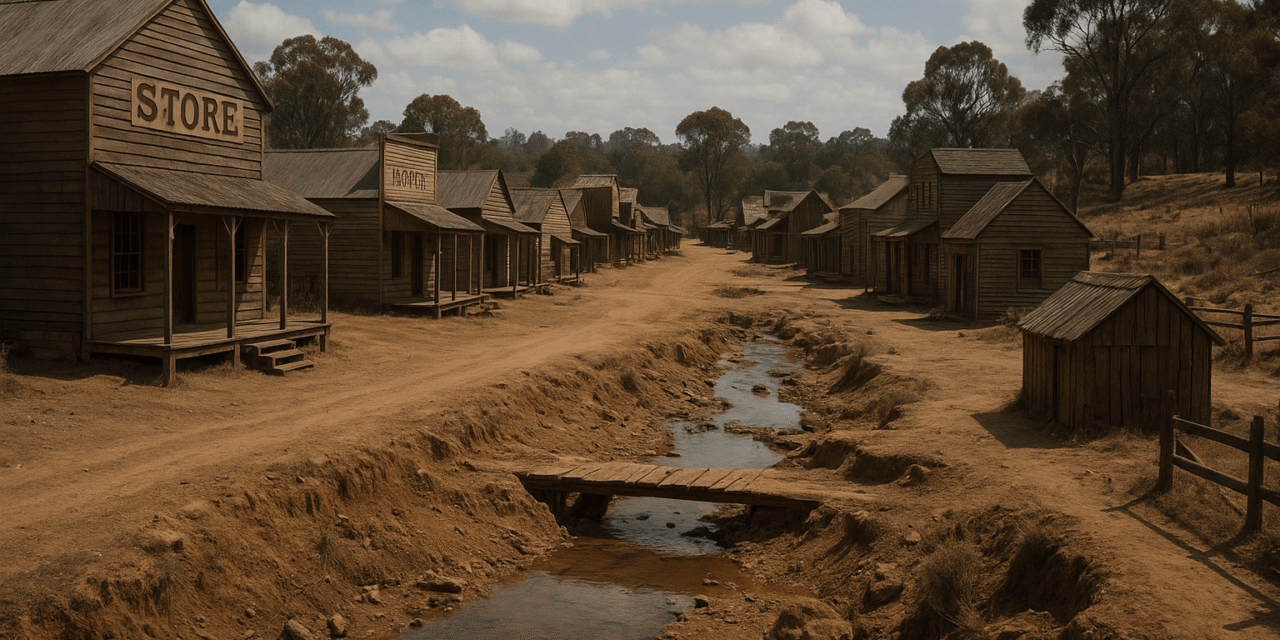
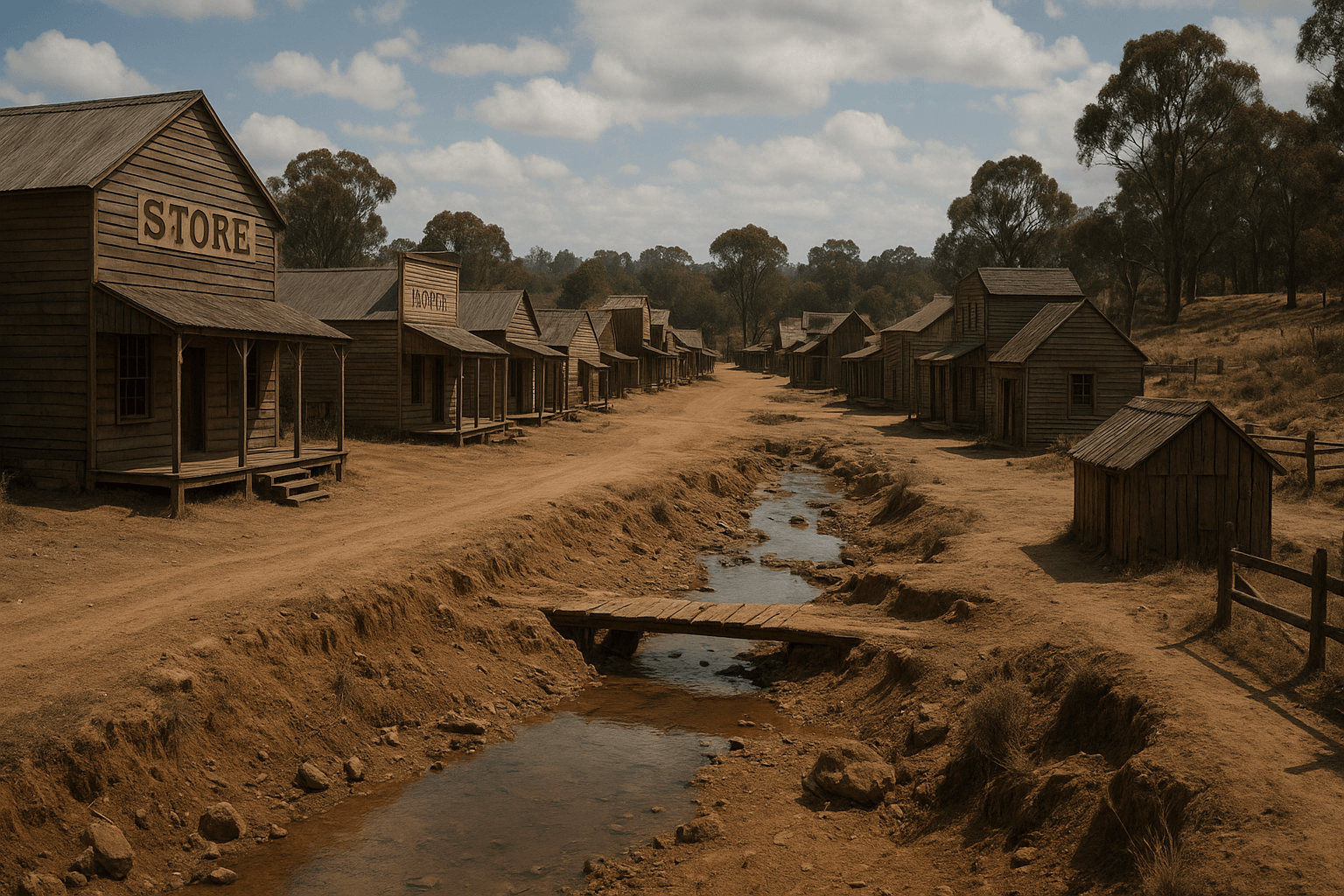
Sovereign Hill sits at Golden Point, on Bradshaw Street in Ballarat, Victoria, Australia — a name that isn’t an accident, since Golden Point was part of the real ground that made Ballarat one of the richest goldfields in the world during the 1850s gold rush. Sovereign Hill itself is built to recreate that era, reconstructing the look, feel, and daily activity of a working 1850s Ballarat gold-rush township for visitors to walk through today. Where many historic gold sites survive only as ruins, empty claims, or interpretive signage, Sovereign Hill takes the opposite approach: it rebuilds the world the gold rush created, so visitors experience the period directly rather than reading about it secondhand.
That distinction matters for anyone in the prospecting or treasure-hunting community. Sovereign Hill isn’t a wilderness site where visitors search for leftover gold missed by 1850s miners, and it isn’t a fenced-off ruin either — it’s a purpose-built recreation on private land in Ballarat, operated and maintained specifically to bring that history to life for people who will never get the chance to work an actual 1850s claim. The gold panning offered there isn’t an incidental activity tacked onto a museum visit; it’s a central, deliberately preserved piece of the experience, set in a creek within the property that’s kept stocked and workable for exactly this purpose. That makes Sovereign Hill less a mining site in the traditional sense and more a living document of what the Ballarat gold rush actually looked like, felt like, and — through the panning creek — tasted like for the ordinary people who lived it, rather than a static exhibit behind glass.
For visitors interested in prospecting history, that combination of accuracy and accessibility is rare. Few places let you handle the actual physical process — swirling a pan, watching gravel wash away, spotting color in the bottom — in a setting built around Ballarat’s real 1850s significance, rather than a generic recreation with no specific historical tie to the ground it sits on.

Panning for Real Gold at Sovereign Hill
The core experience at Sovereign Hill isn’t a single historic discovery — it’s an ongoing one, repeated every day the site is open. Visitors pan for real gold in the property’s creek, using the same basic technique that defined the 1850s rush: swirling water and gravel in a pan, tilting it just enough to let lighter material wash over the rim while gold — denser than almost anything else in the pan — settles toward the bottom. It’s a simple motion to describe and a genuinely satisfying one to get right, which is part of why the activity has remained central to the Sovereign Hill experience rather than fading into a minor add-on. Unlike a themed activity built purely for entertainment, the gold recovered at Sovereign Hill is genuine — not simulated, not seeded for effect in a way that’s disclosed as fake, but real gold that visitors are entitled to keep.
That “keep what you find” policy is central to what makes Sovereign Hill notable within the hobby, and it’s worth underlining precisely because so many recreated historical attractions stop short of it — plenty of heritage sites let visitors try an activity for show, without ever letting them leave with anything real. Panning is included in the price of general admission, with no separate permit or additional fee required to try it. There’s no paperwork to file and no waiting period — a visitor simply pays to enter the property, picks up a pan, and works the creek like the diggers who worked Golden Point more than a century and a half ago. For many visitors, it’s their first hands-on experience with actual gold prospecting, made possible specifically because Sovereign Hill has built its operation around Ballarat’s documented gold rush history rather than a generic, placeless version of the same idea. That grounding in a real place, rather than an invented one, is part of what gives the experience weight beyond a simple novelty activity.
What separates this from a wild prospecting site is also what makes it valuable to newcomers and serious hobbyists alike: predictability and access. There’s no guesswork about whether a stretch of creek has been panned dry by the last hundred visitors, and no need to already know how to read gravel or work a pan correctly before arriving — Sovereign Hill’s setup is built to let first-timers succeed. A visitor doesn’t need specialized permits, claim research, or advance planning to legally pan for keepable gold here — they need only Sovereign Hill’s standard admission. That accessibility, paired with the site’s grounding in real Ballarat gold rush geography, is what has kept the panning experience a defining feature of a visit rather than a minor sideshow.
Visiting Sovereign Hill Today
Sovereign Hill remains fully open to the public today as a paid attraction in Ballarat, Victoria. Gold panning in the property’s creek is included in general admission — there is no separate permit required, and no additional fee to try panning specifically. Visitors keep whatever gold they recover during their visit, a straightforward policy confirmed directly by Sovereign Hill’s own operators.
Because Sovereign Hill is private land rather than public wilderness, access works differently than at a free-to-roam historic goldfield. There’s no need to research claim status, secure landowner permission, or check public land use rules — paying general admission is the only requirement. That also means the experience is consistent and predictable in a way wild prospecting sites often aren’t: the creek is maintained specifically for panning, and every paying visitor has the same legitimate opportunity to find and keep real gold, regardless of prior experience with the hobby.
The Legacy of Sovereign Hill
Sovereign Hill matters to the prospecting community because it lowers the barrier to a real, hands-on encounter with gold rush history and genuine gold. Most people will never hold a valid claim or travel to a remote goldfield, but at Sovereign Hill, on the actual ground of Ballarat’s Golden Point, anyone can learn to swirl a pan and walk away with real gold they found themselves. That’s a meaningful entry point into the hobby — proof, in the hand, that the instinct driving every serious prospector is grounded in something real. For anyone planning a visit to Victoria’s goldfields, Sovereign Hill offers a legitimate, no-permit-required chance to try the exact activity that built Ballarat, on the property where that history actually happened — a rare combination of accuracy, accessibility, and the simple thrill of walking away with gold you found yourself.
Story Source: www.sovereignhill.com.au
Location: Sovereign Hill, Bradshaw Street, Golden Point, Ballarat VIC 3350, Australia
Site Status: Open to public collecting
Legal Conditions: No Australia Tier 1 file exists in this repository yet. Researched directly (Verified confidence – Sovereign Hill’s own official site, the operator of the property). This is private land, not public wilderness: gold panning in the creek is included in general paid admission, no separate permit needed, and visitors keep whatever gold they find. Not a wild/free-prospecting site – access depends on paying Sovereign Hill’s admission fee.
Google Map
Firsthand Accounts
Italian immigrant Raffaello Carboni arrived at the Ballarat goldfields in 1853 and, after digging for gold himself, became caught up in the miners’ unrest against colonial licensing enforcement that culminated in the Eureka Stockade. He wrote the earliest full eyewitness narrative of the diggings and the uprising, presenting himself throughout as a direct participant, and self-published it the year after the event to “vindicate” the miners and honor those killed. Source: Raffaello Carboni, “The Eureka Stockade” (self-published, 1855; digitized by Project Gutenberg Australia).
Ballarat businessman Charles Evans kept a diary from September 1853 to January 1855 documenting his daily life on the Victorian goldfields, including a rare eyewitness account of the December 1854 storming of the Eureka Stockade. His entries record details such as troop commander Robert Nickle’s arrival at the Ballarat camp, noting “already there is a sensible and gratifying deference in its appearance.” Source: “Diary of Charles Evans, 1853-1855,” State Library Victoria; added to the UNESCO Australian Memory of the World register, May 15, 2013.