Somewhere below the boots of a visitor descending into darkness, the rock still bears the marks of tools that haven’t been used in nearly two thousand years. A headlamp catches the wall at an angle, and there it is: a narrow, hand-cut passage driven through solid rock by people working with nothing more than iron chisels, fire-setting, and an almost unreasonable amount of patience.

Dolaucothi: Wales’s Roman-Era Gold Mines
Dolaucothi sits near Pumsaint in Carmarthenshire, Wales, and holds a distinction unmatched anywhere else in the country: it’s the only known Roman gold mine in Britain. That singular status is worth sitting with. Rome occupied Britain for roughly three and a half centuries, running an extensive administrative and economic apparatus across the province, and out of everything the Romans extracted from that occupation, Dolaucothi stands as the sole confirmed site where they mined gold specifically. No comparable Roman gold-mining operation has been identified anywhere else on the island, which makes this unassuming stretch of the Carmarthenshire countryside one of the more historically singular mining sites in the whole of Britain. That singularity is easy to state but worth genuinely appreciating: across the entire span of Roman rule in Britain, and across every mineral resource the empire is known to have extracted from the province, gold mining on any confirmed, identifiable scale happened in exactly one place. Whatever else is uncertain or lost to history about Roman industry in Britain, Dolaucothi’s status as that sole confirmed site is not in question.
That Roman-era origin is the foundation of everything else about Dolaucothi’s identity, but it’s not the only chapter in the site’s history. The mine has continued to exist as a place people think about, visit, and manage across the centuries since, and its current custodianship reflects a deliberate choice to preserve rather than abandon that legacy. The National Trust has owned and run Dolaucothi since 1941, a stewardship now stretching back more than eight decades. That’s a long institutional commitment to a single mining site, and it reflects the same underlying logic seen at other preserved historic mining locations: a recognition that a site like this, once lost to collapse, flooding, or redevelopment, can’t simply be recreated. What’s here is what survived, and the National Trust’s job since 1941 has been keeping it that way.
Visitors today can experience Dolaucothi on two distinct levels, literally and figuratively. There’s the underground portion of the mine, where the Roman-era tunnels themselves can be explored, and there’s the surface, where a different kind of prospecting experience is on offer entirely. Understanding both halves of that experience, and how differently each is managed, is essential to understanding what a visit to Dolaucothi actually involves. It’s a rare structure for a historic mining site to offer, most either preserve ancient workings as a pure walk-through exhibit, hands-off and observational, or offer a modern prospecting activity disconnected from any genuine historic infrastructure. Dolaucothi does both, on the same property, drawing a direct line between what the Romans once did underground and what a visitor can still do on the surface today.

Underground Tunnels and Surface Panning
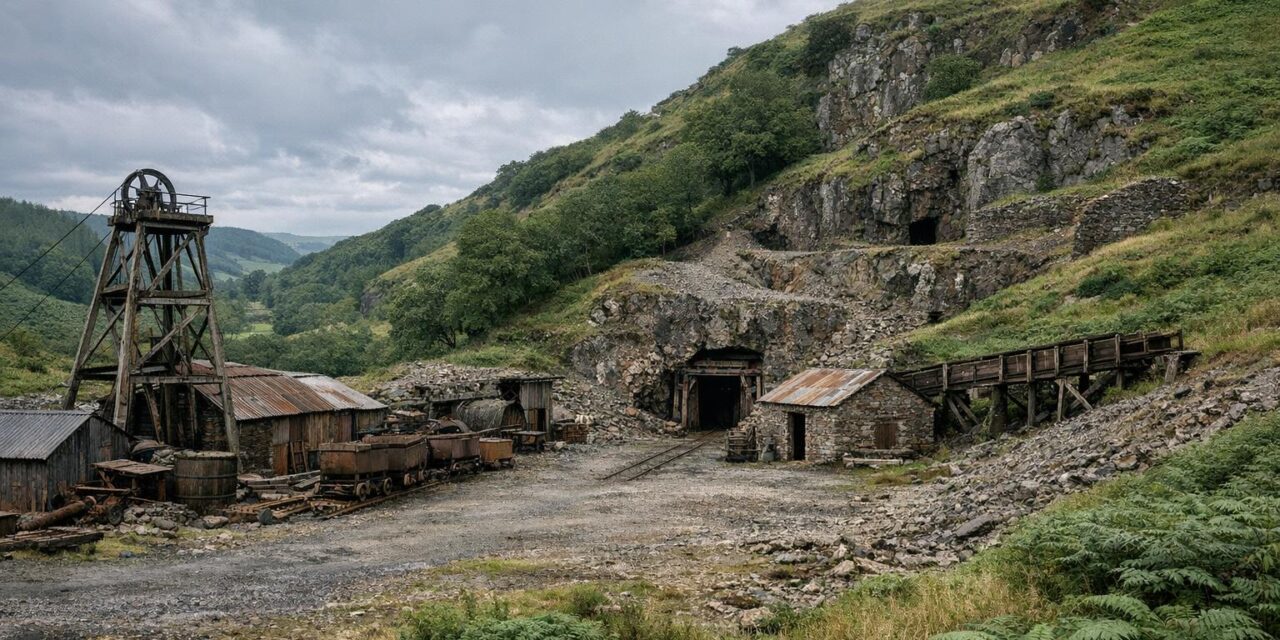
The underground portion of Dolaucothi is where the site’s Roman origins are most directly visible, tunnels and passages cut nearly two thousand years ago, preserved well enough that visitors can still walk through sections of them today. But that access comes with real structure attached to it. Underground access at Dolaucothi is only available via a bookable guided tour, with Victorian and Level tour options offered to visitors. That’s not a minor administrative detail, it’s the entire basis on which anyone is able to safely experience the underground workings at all. A mine shaft or collapse hazard exists in these underground sections, and they are accessible only via guided tour, not for unaccompanied entry under any circumstances. That restriction exists for an obvious and serious reason: a nearly two-thousand-year-old excavated passage, however remarkably preserved, is not infrastructure built to modern safety standards, and unsupervised entry into that kind of environment carries real risk that a trained guide is specifically there to manage.
Above ground, the experience shifts entirely. Surface gold panning takes place in the mine yard, and like the underground tours, it’s organized as a fee-based visitor activity rather than free-roam prospecting across the estate. A visitor pays to take part, follows the structure the National Trust has set up for the activity, and pans within the designated area rather than searching wherever they choose across the wider property. That distinction matters for anyone approaching Dolaucothi with expectations shaped by more permissive prospecting elsewhere. Unauthorized digging or detecting anywhere on the estate is explicitly not permitted, a rule that applies regardless of a visitor’s experience level or intentions. Between the underground guided-tour system and the surface panning structure, Dolaucothi offers two genuinely different ways to engage with its mining history, but both are deliberately organized and managed rather than open to independent exploration.
That combination, ancient underground workings paired with a modern, above-ground panning activity, gives Dolaucothi a kind of layered identity. A visitor isn’t just observing Roman history from a distance, they’re able to walk through the actual tunnels the Romans dug and then try their own hand at the same basic activity, gold panning, on the surface above. Few historic mining sites anywhere offer that particular combination of genuine ancient infrastructure and an active, hands-on modern activity built around the same underlying resource. It’s worth pausing on how unusual it is for both halves of that experience to be available at the same site at all. A visitor could easily encounter one without the other: an untouched Roman ruin with no modern activity attached, or a modern panning operation with no genuine ancient infrastructure behind it. Dolaucothi’s combination of the two, managed carefully enough that the underground portion remains safe to visit after nearly two thousand years, is a genuinely rare achievement in historic-site preservation.
Accessing Dolaucothi Today
Dolaucothi remains open to visitors under National Trust management, with both underground tours and surface gold panning available as organized, fee-based activities. Underground access requires booking a guided tour in advance, with Victorian and Level tour options to choose from, and unaccompanied entry into the underground workings is not permitted under any circumstances given the mine shaft and collapse hazards present in those centuries-old passages. Surface panning in the mine yard operates as its own separate, fee-based activity, distinct from the underground tours and likewise structured rather than open-ended. Unauthorized digging or metal detecting anywhere on the estate is not allowed.
A visitor planning a trip to Dolaucothi should expect to book ahead for the underground portion specifically, and to treat both halves of the experience, tunnels and surface panning, as organized activities rather than something to approach independently. That planning requirement is a small price for access to something genuinely singular: there is no other Roman gold mine in Britain to visit, guided or otherwise, which makes advance booking a minor inconvenience relative to what’s on offer.
The Legacy of Dolaucothi
For anyone serious about the history of gold prospecting, Dolaucothi occupies a category of its own: the only confirmed Roman gold mine in Britain, still standing, still walkable, and still actively managed nearly two thousand years after the tunnels were first cut. That’s a genuinely rare thing for any mining site to offer, a direct physical connection to a specific, singular chapter of Roman-era industry in Britain, paired with a modern gold-panning activity that lets visitors engage with the same basic resource the Romans once extracted. The National Trust’s stewardship since 1941 has kept that connection intact rather than letting it collapse into ruin or disappear into private, inaccessible land, and the structured access system now in place, guided underground tours and fee-based surface panning, reflects a serious, safety-conscious approach to sharing a genuinely ancient and genuinely singular piece of British mining history.
Story Source: www.nationaltrust.org.uk
Location: Dolaucothi Gold Mines (National Trust), Pumsaint, Carmarthenshire, Wales
Site Status: Permission or permit required
Legal Conditions: First entry for the UK’s Gold Prospecting category (Tier 2, Verified). Dolaucothi has been owned and run by the National Trust since 1941; underground access is only via a bookable guided tour (Victorian/Level tour options), and surface gold panning in the mine yard is likewise an organized, fee-based visitor activity rather than free-roam prospecting. Unauthorized digging or detecting on the estate is not permitted.
Hazards: Mine shaft or collapse hazard (underground sections accessible only via guided tour, not for unaccompanied entry)
Google Map
Firsthand Accounts
The Romans, who arrived in Carmarthenshire around AD 70, likely established a nearby fort largely to exploit the Dolaucothi gold deposits. Their engineers built the Melin-y-Milwyr (“soldier’s mill”), a reservoir and possible watermill complex with a wheel pit and tailrace for grinding ore — among the most sophisticated Roman hydraulic works found in Britain.
Egyptologist Sir John Gardner Wilkinson, a friend of the Johnes family who owned the Dolaucothi estate, surveyed and mapped the ancient “Ogofau” workings in 1868 and sketched gold jewellery recovered from the site; his watercolours and survey maps, held today in the Bodleian Library, are now displayed for visitors at the National Trust site.
Lead miner Edward Jones founded the South Wales Gold Mining Company in 1888, subletting the mines from the Johnes family, but the ore’s low gold content made large-scale extraction unprofitable and the company closed in 1897 after little gold was recovered despite extensive exploration.
James Mitchell, who had worked the South African gold rush, was hired by the Johnes family in 1905 to reopen the mines; turning a first-year profit, he founded the Ogofau Proprietary Gold Mining Company and, through Roman Deep Ltd, sank a shaft starting in 1909 that reached 480 feet — the deepest known shaft on site.
Gold mining at Dolaucothi finally ceased in 1938, and the National Trust acquired the mine and surrounding estate in 1941, preserving it as the only known Roman gold mine in Britain — per the Trust’s own published site history.