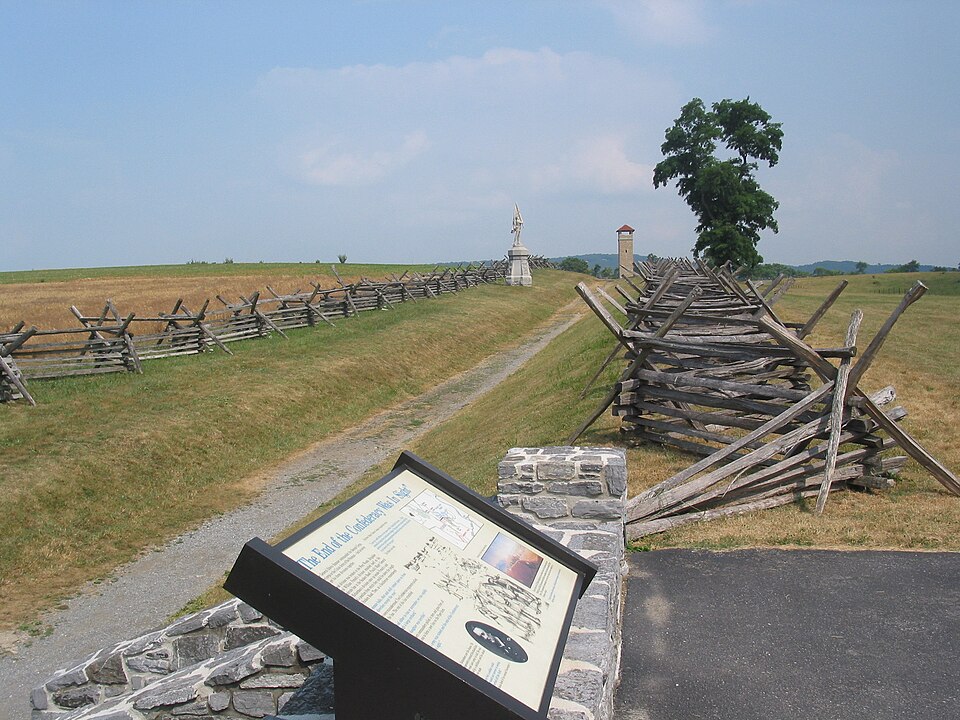
A country farm lane, worn down over decades of wagon wheels and cattle drives, sat several feet below the level of the fields around it. Nothing about it was built for war. But when Confederate soldiers filed into that sunken road and began firing up over its natural earthen parapet, and Union troops kept coming across the open ground above them anyway, the lane filled with bodies until men could walk its length without touching the ground. Soldiers on both sides started calling it something else before the day was even over.
Antietam: The Road to Battle
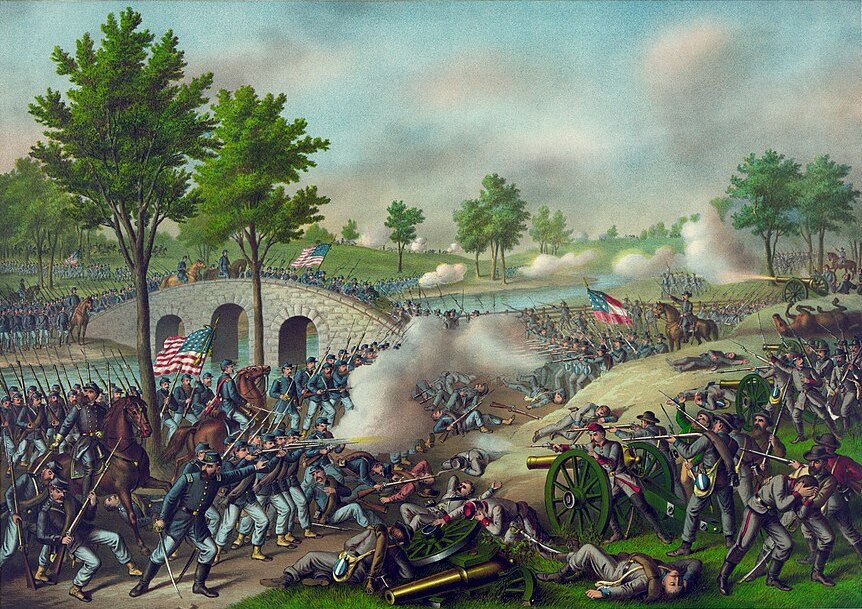
In September 1862, Confederate General Robert E. Lee pushed his Army of Northern Virginia across the Potomac River and into Maryland, the first major Confederate invasion of Union soil, hoping a decisive victory on Northern ground might win diplomatic recognition from Britain or France and shake Northern political will to continue the war. Lee split his army to besiege the Federal garrison at Harpers Ferry, a maneuver that worked but scattered his forces dangerously across the Maryland countryside just as Union General George B. McClellan was closing in with the much larger Army of the Potomac.
McClellan’s position was transformed by extraordinary luck: a copy of Lee’s own orders, detailing the exact location of every division in his divided army, was found wrapped around three cigars by Union soldiers in a field near Frederick, Maryland, and passed up the chain of command within hours. McClellan, who rarely moved quickly and habitually overestimated the size of the forces in front of him, still took nearly eighteen hours to act on the discovery, giving Lee just enough time to reunite much of his army behind Antietam Creek near the small town of Sharpsburg before the Union army arrived in force on September 15. Lee, working from a far smaller and more exhausted force than the one McClellan believed he faced, chose to stand and fight rather than retreat across the Potomac, a decision that put fewer than 40,000 Confederate troops against an army nearly twice that size on ground with a river at its back and only a handful of crossing points behind it.
The Battle of Antietam
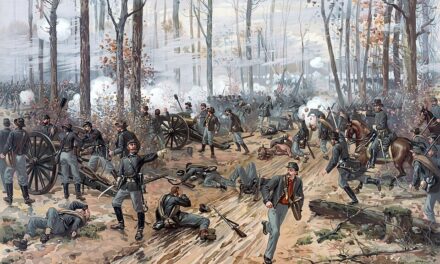
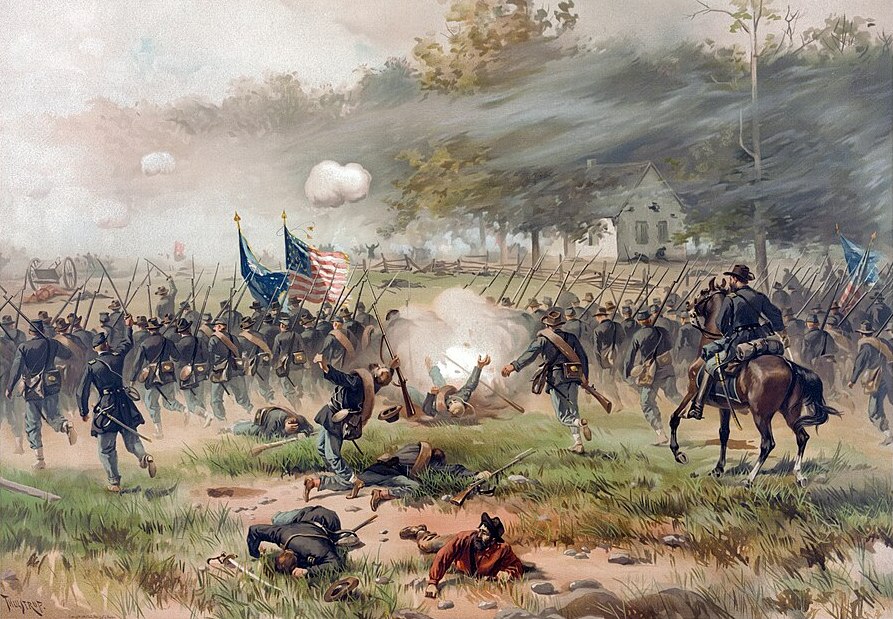
The fighting on September 17, 1862, opened at dawn with a Union assault through a cornfield north of the Confederate line, a field that changed hands some six times over the following hours as artillery fire cut the stalks down almost to the ground and casualties mounted on both sides at a rate few battles of the war would match. Major Rufus R. Dawes of the 6th Wisconsin, part of the Union’s Iron Brigade, fought through that fighting near the Cornfield and the Miller farm and later recorded the death of Captain Werner von Bachelle, a German-born officer in his regiment, alongside a detail that stayed with him for the rest of his life: Bachelle’s Newfoundland dog had followed him into the fight and was later found dead beside his body, having refused to leave him even as the battle raged on.
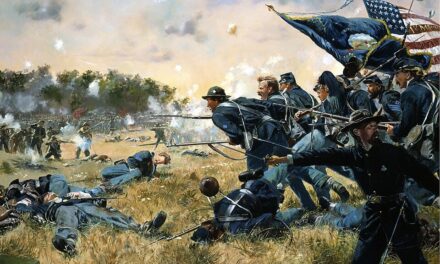
By midmorning the fighting shifted south to the sunken farm road that Confederate troops had turned into a natural trench, and Union assaults against it broke apart under fire for hours before finally overrunning the position from an unprotected flank, leaving the road choked with Confederate dead in numbers so dense that soldiers on both sides began calling it Bloody Lane before the sun had set. Even after the lane fell, McClellan held back the largest reserve of fresh troops on the field rather than commit them to exploit the breakthrough, a hesitation that left Lee’s badly outnumbered line intact at its most vulnerable moment, when a full-scale Union push might well have broken it in two. Late in the day, Union General Ambrose Burnside’s troops finally forced a crossing of the narrow stone bridge over Antietam Creek that would carry his name into history, after several costly failed attempts against a small but well-positioned Confederate force defending the far bank, only to be stopped from breaking Lee’s line entirely by the last-minute arrival of Confederate reinforcements marching up from Harpers Ferry after a grueling forced march from the Potomac crossings.
Behind the lines, the human cost overwhelmed every available resource. Clara Barton, who would go on to found the American Red Cross, arrived at Antietam with a wagonload of medical supplies just as army surgeons were running out of dressings and reduced to using corn husks as bandages, and she worked through the day and night tending the wounded close enough to the front that a bullet passed through her sleeve and killed the soldier she was holding. Army surgeon Dr. James Dunn later credited her arrival as decisive to the survival of many wounded men, and it was after Antietam that she became widely known as the “Angel of the Battlefield.” At the makeshift field hospitals that sprang up in barns and farmhouses across the area, William Child, a surgeon with the 5th New Hampshire, spent days treating a flood of wounded men in conditions he described in letters home as overwhelming, work that left an impression on him as lasting as anything he saw in the fighting itself. On the Confederate side, Private Alexander Hunter of the 17th Virginia had marched into Maryland days earlier and later described his fellow soldiers as starving and ragged, many without shoes, and recalled the surprising generosity some Maryland civilians showed them with food despite the state’s divided loyalties, an enlisted man’s account that offers a rare Confederate counterpoint to the mostly Union-authored memoirs that dominate the battle’s popular memory.
When the fighting ended, more than 22,000 men were dead, wounded, or missing, making September 17, 1862, the single bloodiest day in American military history, a toll that has never been matched in a single day of combat on American soil before or since.
The Legacy of Antietam
Though the battle ended in a tactical draw, with Lee’s battered army withdrawing back across the Potomac into Virginia, it gave President Abraham Lincoln the Union battlefield success he had been waiting for to issue the preliminary Emancipation Proclamation five days later, reframing the war as a fight against slavery and closing off any realistic chance that Britain or France would intervene on the Confederacy’s behalf. The proclamation transformed the conflict from a war fought solely to preserve the Union into one aimed at ending slavery outright, a shift with consequences that reached far beyond the war itself and into the constitutional changes that followed it. A single day’s fighting on a few square miles of Maryland farmland, in other words, helped decide the political direction of the entire war, a fact that the quiet fields and the stone bridge still standing at Antietam make no obvious show of on their own.
Visiting Antietam National Battlefield Today
Antietam National Battlefield, managed by the National Park Service near Sharpsburg, Maryland, about ten miles south of Hagerstown, is open year-round with standard daytime hours and closes only on Thanksgiving and during the winter holidays. A modest per-vehicle entrance fee applies, with reduced or free admission available under standard National Park Service pass categories for children, seniors, military members, and other groups, and the park does not accept cash on site, so visitors should bring a card.
The roughly 3,000-acre battlefield can be explored by car or on foot along a self-guided tour route that passes the Cornfield, Bloody Lane, and Burnside Bridge in the order the fighting unfolded that morning, and guided tours led by park staff or licensed battlefield guides are also available for visitors who want deeper context on the ground where each phase of the fighting took place. Walking the length of Bloody Lane or standing at either end of the stone bridge tends to leave a stronger impression than driving the tour road alone, since both places still carry the shape of the terrain that decided so much of what happened there. The visitor center near the start of the tour road houses a museum with period artifacts and exhibits explaining the battle’s course hour by hour, and it remains the best starting point for orienting a visit before heading out onto the grounds themselves, particularly for anyone unfamiliar with how the fighting moved from the Cornfield in the morning down to the bridge by late afternoon.
Remembrance at Antietam
The park holds a Memorial Day weekend commemoration and an annual observance around the September 17 anniversary of the battle, but its most distinctive tradition is the candlelight Memorial Illumination held each December, when volunteers place and light more than 23,000 individual luminaries across the battlefield, one for every soldier killed, wounded, or reported missing that single day. Visitors drive slowly through the darkened fields past the flickering lights in a procession that can take hours to complete, and the sheer scale of the display, spread across open farmland that looks much as it did in 1862, converts a casualty figure that can otherwise feel abstract into something visitors describe as physically overwhelming to witness in person.
Visitor Info: www.nps.gov
Location: Antietam National Battlefield Visitor Center, 5831 Dunker Church Road, Sharpsburg, Maryland 21782, USA
Site Status: National Park / Managed Historic Site
Visitation Notes: Antietam National Battlefield is managed by the National Park Service near Sharpsburg, Maryland, about 10 miles south of Hagerstown, and is open year-round with standard daytime hours, closed only on Thanksgiving and the winter holidays. A modest per-vehicle entrance fee applies, with reduced or free admission available for children, seniors, military, and other standard NPS pass categories, and the park does not accept cash, so a card is needed on site. The roughly 3,000-acre battlefield can be explored by car or on foot along the self-guided tour route past the Cornfield, Bloody Lane, and Burnside Bridge, and guided tours are also available. The park holds a Memorial Day weekend commemoration, an annual anniversary observance around September 17, and a candlelight Memorial Illumination in early December, when luminaries are lit for each soldier who died in the battle.
Google Map
Visitor Comments
This is one of the largest and most well-preserved battlefields we’ve visited remarks Kurt T. We paid for a three-hour guided tour with a knowledgeable local guide who used period photographs to show exactly where events unfolded, and it made the whole day much more meaningful than a self-guided walk would have been. Worth the extra time and cost if you can arrange it in advance.
— from Wanderlog
According to David M from San Antonio, Texas, this is a must-see for anyone interested in Civil War or military history. The battlefield is laid out well and works whether you have just a couple hours or a full day to spend. Don’t just drive the tour road, though — get out of the car and actually walk the Sunken Road and cross Burnside’s Bridge on foot, since that’s where the site really comes alive.
— from TripAdvisor
According to CynthiaB119 of Sedona, Arizona, it’s a chilling experience to walk out into these open farm fields and try to imagine what it was like to face thousands of men in battle across this same open ground. The fields are well maintained and quiet now, which somehow makes it more provocative rather than less — it really helps you grasp the scale and intensity of what happened here.
— from TripAdvisor
The site of the bloodiest day in American history is now, somewhat ironically, remarkably peaceful, quiet, and haunting. The battlefield is uncluttered by modern development, with only plaques and monuments marking where each unit fought and fell, which leaves the open fields and woodlots to speak for themselves.
— from Lonely Planet