Fifteen-year-old Tillie Pierce watched the armies converge on her hometown from the windows of her family’s house before neighbors urged her to safety at a farm outside town, only for that farm to become a field hospital swallowing the wounded of both sides within hours. She spent the following days carrying water and bandages between rows of injured soldiers, hearing the distant roar of cannon fire rattle the windows, unaware that the fighting unfolding a few miles away would decide the momentum of the entire war. Decades later she published her recollections as a book, one of the clearest civilian accounts of what it meant to live, by accident of geography, at the exact center of the Civil War’s bloodiest battle.
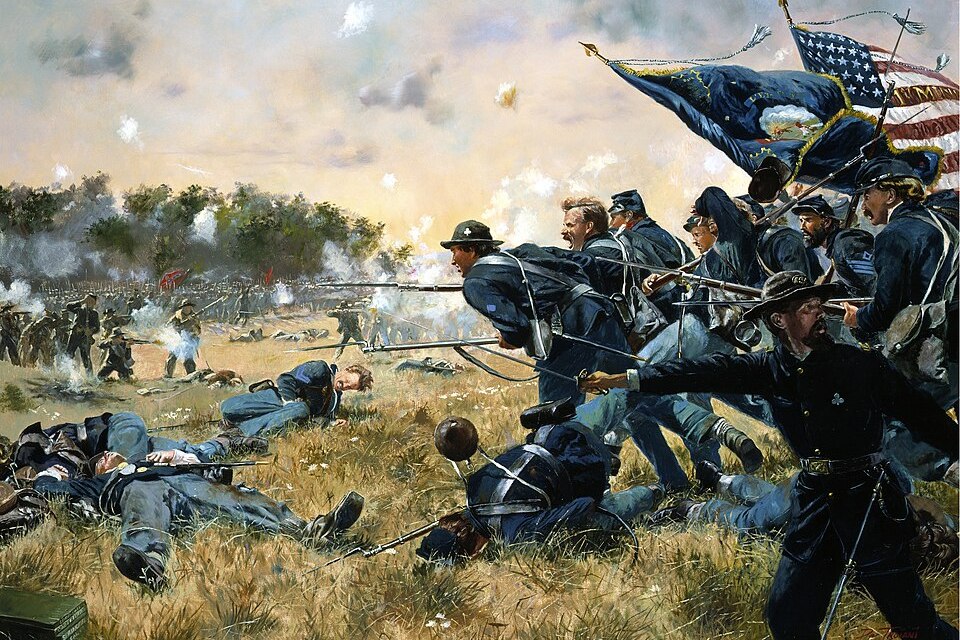
Gettysburg: The Road to Battle
By the summer of 1863, Confederate General Robert E. Lee had decided that a second invasion of the North offered his best chance to break the Union’s will to continue the war, relieve pressure on Virginia’s exhausted farmland, and possibly win the diplomatic recognition from European powers that had so far eluded the Confederacy. Lee’s Army of Northern Virginia crossed into Pennsylvania in June 1863, fresh off a decisive victory at Chancellorsville, and marched north largely blind to Union movements after his cavalry commander, J.E.B. Stuart, rode off on a raid that left Lee without reliable intelligence on the Army of the Potomac’s location. The Union army, now under newly appointed General George Meade after a string of failed predecessors, shadowed Lee’s advance northward, and the two armies, neither fully aware of the other’s exact position, began converging on the crossroads town of Gettysburg, Pennsylvania almost by accident.
On the morning of July 1, 1863, Union cavalry under Brigadier General John Buford reached Gettysburg first and recognized immediately that the ridges surrounding the town offered decisive high ground. Rather than withdraw before the approaching Confederate infantry, Buford chose to fight a delaying action from McPherson’s Ridge west of town, dismounting his troopers to fight as infantry with breech-loading carbines that let them fire far faster than the Confederate infantry advancing against them, buying precious hours for Union infantry under General John Reynolds to arrive and reinforce the position before Confederate forces could seize the high ground for themselves. Reynolds himself was killed by a sharpshooter’s bullet within minutes of bringing his corps onto the field, one of the first of many senior officers on both sides who would not survive the battle. The fighting that opened that day would grow, over the next seventy-two hours, into the largest battle ever fought in North America, eventually drawing in roughly 165,000 soldiers combined.
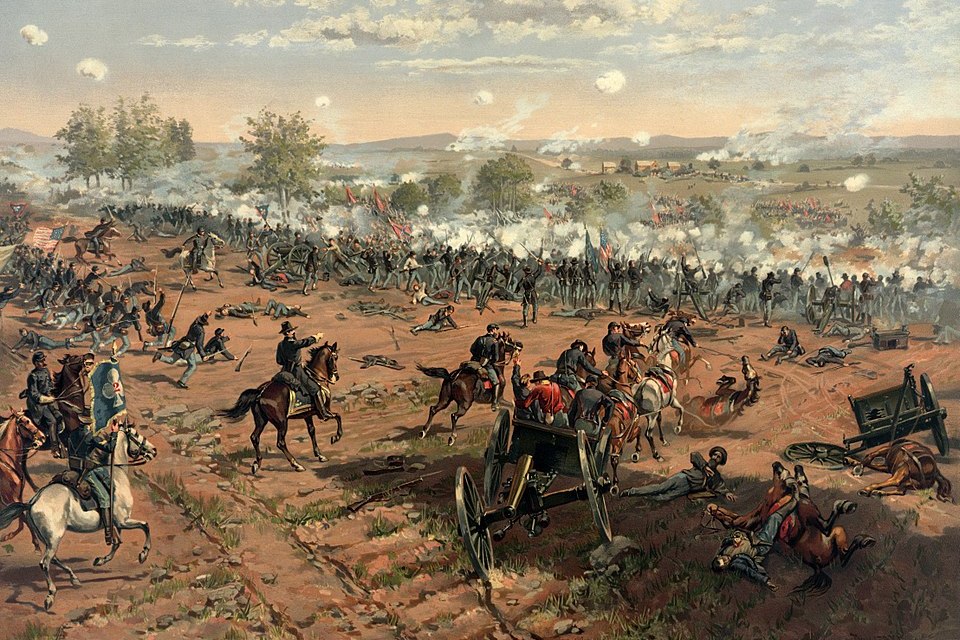
Three Days at Gettysburg
The first day’s fighting pushed Union forces back through the town itself to the hills south of Gettysburg, Cemetery Hill and Culp’s Hill, where they dug in as reinforcements from both armies continued arriving overnight and the Union line gradually took the shape of a fishhook curling around the high ground. On the second day, July 2, Lee attacked both flanks of the Union line, and the fighting at the southern end grew desperate when Confederate troops nearly turned the Union position at a rocky hill called Little Round Top, an outcropping that had been left almost undefended until a Union engineer officer spotted Confederate troops massing against it and rushed reinforcements onto the summit just in time. Colonel Joshua Lawrence Chamberlain of the 20th Maine held the extreme left of the entire Union line there, and when his regiment’s ammunition ran out under repeated assault, he ordered his exhausted men to fix bayonets and charge downhill into the attacking Confederates, a desperate gamble that broke the assault and secured the flank; he recounted the episode in his postwar memoir, The Passing of the Armies. Elsewhere along the second day’s line, brutal fighting engulfed the Wheatfield, the Peach Orchard, and Devil’s Den, ground that changed hands repeatedly as both armies fed in reserves, with casualties among some regiments running higher than in almost any other engagement of the entire war.
The battle’s climax came on July 3 with Pickett’s Charge, a massed Confederate infantry assault of some 12,500 men across nearly a mile of open ground toward the center of the Union line at a low stone wall known afterward as the Angle. Confederate General Lewis Armistead led his brigade over that wall in the attack’s furthest advance, briefly breaching the Union position before being mortally wounded moments later; Armistead had been close prewar friends with the Union officer commanding that sector of the line, General Winfield Scott Hancock, a friendship the war had placed on opposite sides of the same wall and one retold ever since as emblematic of the conflict’s toll on divided loyalties. The charge collapsed under concentrated Union artillery and rifle fire, and Lee’s shattered attacking force streamed back across the same open ground it had crossed less than an hour before, ending any realistic hope of a Confederate breakthrough; Lee reportedly rode out to meet the survivors himself, telling them the failure was his alone. Lee withdrew his battered army back toward Virginia the following day, delayed by a massive supply and ambulance train stretching for miles and slowed further by a swollen, unfordable Potomac River, though Meade’s cautious pursuit ultimately let the Confederate army escape back into Virginia intact. His invasion of the North was decisively turned back all the same, at a combined cost, across both armies over the three days, of more than 50,000 casualties, making Gettysburg the single bloodiest battle ever fought on American soil.
The Legacy of Gettysburg
Gettysburg is widely regarded as the turning point of the Civil War, the moment after which the Confederacy never again mounted a serious invasion of Union territory and the military initiative shifted permanently toward the North. Coming within a day of the fall of Vicksburg on the Mississippi River, the Union victory at Gettysburg marked a twin strategic disaster for the Confederacy that historians often treat as the war’s genuine hinge point, even though nearly two more years of grinding fighting remained. Lincoln’s address at the cemetery dedication that November reframed the war’s meaning for a divided public in ways that have echoed through American political rhetoric ever since, its brief phrases more widely quoted today than almost any other speech in the nation’s history. The scale of the carnage also permanently changed how Americans cared for their war dead, as the federal government’s decision to establish a national cemetery at Gettysburg rather than leave soldiers in scattered field graves helped set a precedent later extended to battlefields across the country. Today Gettysburg draws more visitors and more scholarship than any other American battlefield, still turning on the same handful of details that decided it in 1863 — a cavalry officer’s instinct to hold a ridge, a college professor’s bayonet charge on a rocky hilltop, and a fifteen-year-old girl carrying water between rows of wounded men who had no idea, any of them, how the country’s direction was being settled around them.
Visiting Gettysburg National Military Park Today
Gettysburg National Military Park preserves the battlefield around the town, anchored by the Museum and Visitor Center at 1195 Baltimore Pike just south of Gettysburg. The park grounds and a free driving tour are open daily year-round, though the museum, the restored Cyclorama painting, and an orientation film carry separate ticketed admission. Licensed battlefield guides are available for hire for private auto or walking tours, and the visitor center can typically arrange one on short notice for visitors who want a deeper, personally guided account of the fighting.
Key stops along the driving route include McPherson’s Ridge where Buford’s cavalry opened the battle, Little Round Top and Devil’s Den from the second day’s fighting, the Wheatfield, and Cemetery Ridge and the Angle where Pickett’s Charge reached its farthest point, along with the Soldiers’ National Cemetery where Abraham Lincoln later delivered the Gettysburg Address. Spring and fall bring the most comfortable weather for walking the grounds, and the park hosts a major living-history anniversary event each July around the battle’s original July 1 to 3 dates, drawing reenactors and visitors to walk the same ridges and fields where the armies fought.
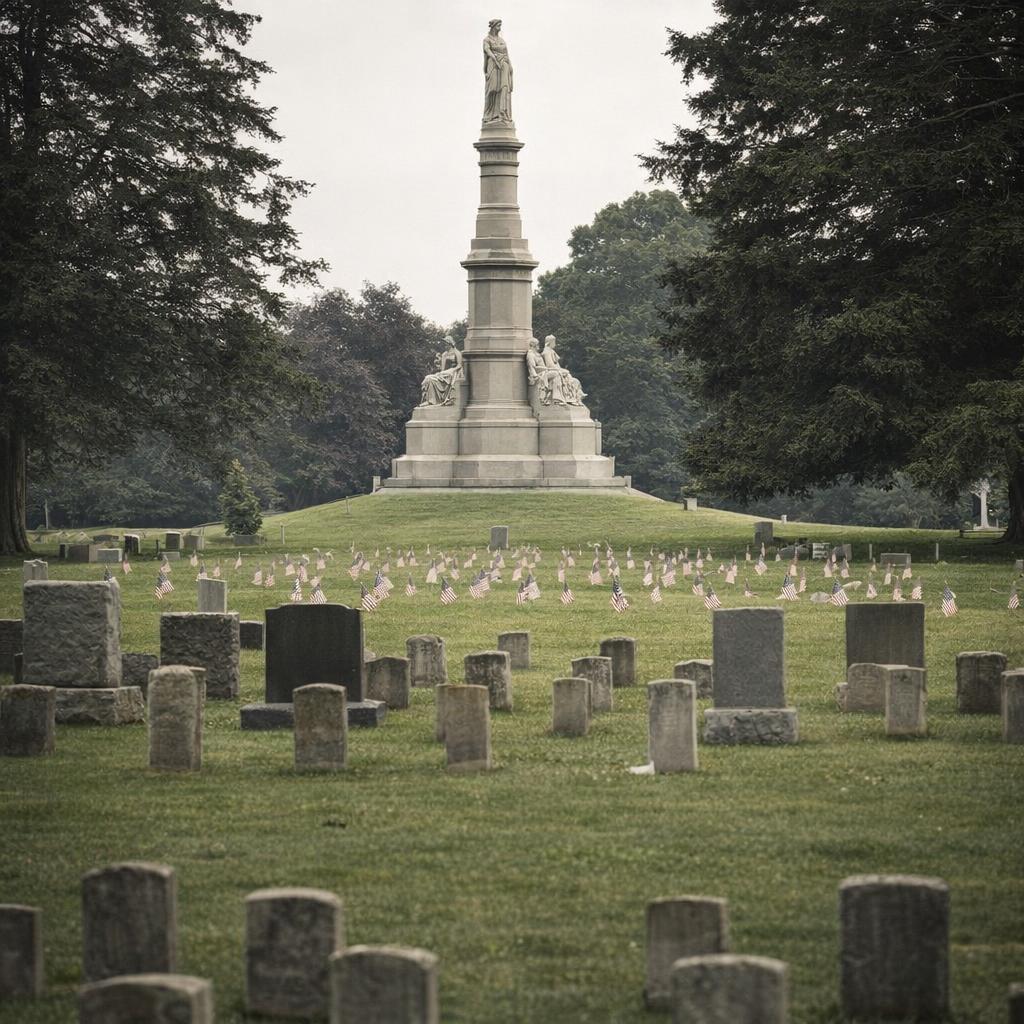
Remembrance at Gettysburg
Gettysburg’s memory is carried as much by its sheer density of monuments as by any single memorial, with more than 1,300 markers, statues, and regimental monuments scattered across the battlefield, placed over decades by the states and units that fought there. The Soldiers’ National Cemetery, dedicated in November 1863, became the site of Lincoln’s brief but enduring Gettysburg Address, delivered to reframe the war’s purpose around a “new birth of freedom” rather than mere territorial restoration; Lincoln spoke for barely two minutes, following a two-hour oration by the day’s featured speaker that has since been almost entirely forgotten. Civilian accounts like Tillie Pierce’s have kept the battle’s human cost visible alongside its military history, documenting how a town of some 2,400 residents absorbed tens of thousands of wounded soldiers and thousands of dead in the battle’s immediate aftermath, with homes, churches, and barns across Gettysburg pressed into service as makeshift hospitals for weeks afterward. The annual July anniversary events, along with the daily flow of licensed guides walking visitors across McPherson’s Ridge, Little Round Top, and the Angle, keep the individual stories of Buford, Chamberlain, Armistead, and Hancock in active circulation more than a century and a half later, while the Armistead-Hancock friendship in particular has become a recurring touchstone for discussions of the war’s cost to families and friendships split across the Union and Confederate divide.
Visitor Info: www.nps.gov
Location: Gettysburg National Military Park Museum and Visitor Center, 1195 Baltimore Pike, Gettysburg, Pennsylvania 17325, United States
Site Status: National Park / Managed Historic Site
Visitation Notes: The Gettysburg National Military Park Museum and Visitor Center sits at 1195 Baltimore Pike, just south of the town of Gettysburg. The park grounds and a free driving tour are open daily year-round, though the museum, Cyclorama painting, and film carry a separate ticketed admission. Licensed battlefield guides are available for hire for private auto or walking tours, and the visitor center can arrange one on short notice. Key stops include McPherson’s Ridge, Little Round Top, Devil’s Den, the Wheatfield, Cemetery Ridge and the Angle, and the Soldiers’ National Cemetery where Lincoln delivered the Gettysburg Address. Spring and fall bring the most comfortable weather for walking the grounds, and the park hosts a major living-history anniversary event each July around the battle’s July 1-3 dates.
Google Map
Visitor Comments
Stephanie C, visiting from Erie, Pennsylvania, booked a private two-hour guided tour and said the guide gave great insight into the battle and patiently answered every question. She also took in the park’s movies and VR experience, spending about six hours at the site in total.
— from TripAdvisor
MidwestKathM, from Detroit, Michigan, described decades of repeat visits to the battlefield that never get old. On a November trip she explored Devil’s Den, Little Round Top, and the Pennsylvania Monument, and said she still finds something new to discover each time she returns.
— from TripAdvisor
Taylor B, on his tenth visit to the battlefield, recommended the self-guided audio tour for letting visitors linger as long as they like at each of its fifteen stops. He named McPherson’s Ridge and the Angle as bookends of the driving route and singled out Little Round Top and Devil’s Den as highlights worth extra time.
— from TripAdvisor
Travel writer Caroline Makepeace toured the battlefield with her family and a licensed guide of over 30 years’ experience, and said hearing the stories told in person was far more moving than reading plaques and monuments on her own. She also recommended the park museum’s Cyclorama film as riveting and insightful, and visited the National Cemetery and sites including Cemetery Hill, Peach Orchard, Little Round Top, and Culp’s Hill.
— from Y Travel Blog