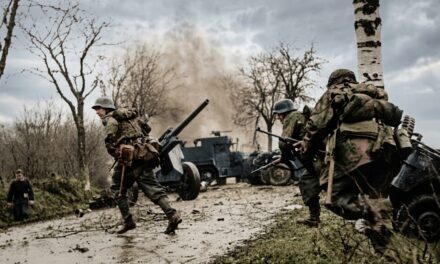
Before a single soldier stepped off a landing craft, General Dwight D. Eisenhower sat down and wrote a note he hoped he would never have to release. It took full personal blame for a failure that had not yet happened, in case the largest amphibious invasion in history collapsed on the beaches of Normandy. He mistakenly dated it a month wrong and never needed it at all, but the note survives as one of history’s starkest documents of a commander shouldering total responsibility for an outcome he could not control.

Normandy: The Road to Battle
By 1944, Nazi Germany had spent years fortifying the coastline of occupied France with the Atlantic Wall, a sprawling network of bunkers, gun emplacements, mines, and beach obstacles meant to make any Allied invasion catastrophically costly, and Field Marshal Erwin Rommel had been placed in command of strengthening these defenses in the months before the invasion, convinced the battle would be won or lost in the first hours on the beaches themselves. The Allies spent more than a year planning the invasion in painstaking detail, coordinating an enormous deception campaign known as Operation Fortitude that used fake armies, phantom radio traffic, and double agents to convince German intelligence the main assault would come at Calais rather than Normandy, a ruse that worked well enough to keep German reserves pinned in the wrong place for critical days after the real landings began.
Poor weather in early June forced Eisenhower to postpone the invasion by a day, and a narrow break in the storms on June 5 gave him the window he needed to commit to June 6, a decision made under enormous pressure with no guarantee the weather would hold and no realistic option to delay much further, since the tides, moon phase, and the logistics of assembling nearly 7,000 vessels and over 150,000 men left only a handful of viable dates each month. Rommel, convinced that the same poor conditions ruled out any Allied landing in the immediate future and with the tides also seeming wrong for an assault, left Normandy for Germany to celebrate his wife Lucie’s 50th birthday and to press Hitler personally for more panzer reserves near the coast, a decision that would prove one of the invasion’s defining ironies given how closely he had studied and prepared for exactly the scenario about to unfold without him.

D-Day: The Normandy Landings
In the early hours of June 6, 1944, Allied airborne troops began dropping behind German lines to secure key roads, bridges, and causeways ahead of the main seaborne assault, and just after midnight, Major John Howard’s D Company of the Oxfordshire and Buckinghamshire Light Infantry carried out what remains one of the most precise glider landings of the war: Staff Sergeant Jim Wallwork piloted the lead Horsa glider, released from its tow plane in darkness with no engine, to a landing within yards of Pegasus Bridge over the Caen Canal. Howard’s men stormed and captured both that bridge and the nearby Orne River bridge intact within about ten minutes, securing the invasion’s eastern flank before the main landings had even begun.
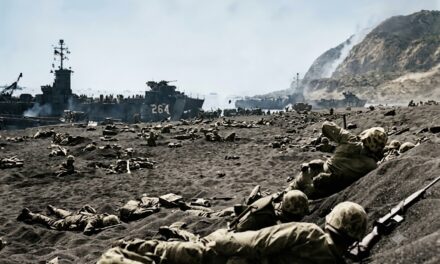
At dawn, Allied forces stormed ashore across five code-named beaches, Utah, Omaha, Gold, Juno, and Sword, in the largest amphibious invasion in history, supported by naval bombardment from thousands of ships and overwhelming Allied air superiority that harassed German reinforcements attempting to reach the coast throughout the day. Resistance varied enormously by sector; at Omaha Beach, American troops faced the war’s most brutal landing conditions, pinned down on open sand under intense machine-gun and artillery fire from well-prepared German positions on the bluffs above, with entire units suffering catastrophic losses within the invasion’s opening minutes, while landings at the other four beaches, though still costly, generally advanced more quickly against lighter or less prepared resistance. Rommel, still racing back from Germany when news of the landings reached him at home in Herrlingen, did not return to the front until Allied troops were already ashore in strength across all five beaches, and by the time German commanders could organize a coordinated counterattack, the window to drive the invasion back into the sea had already closed. Compounding the confusion, Hitler himself had gone to bed the night before and left orders that he not be woken, and several senior officers, uncertain whether the Normandy landings were the main invasion or merely a diversion ahead of the expected attack at Calais, hesitated to release nearby panzer reserves without his direct authorization, a delay of several critical hours that Allied planners’ deception efforts had specifically been designed to produce.
The Legacy of Normandy
The successful establishment of the Normandy beachhead opened the long-awaited Western Front against Nazi Germany, forcing German forces to fight a two-front war that steadily ground down their capacity to resist even as fighting through the dense hedgerow country of the Normandy interior proved slower and more costly than Allied planners had anticipated in the weeks immediately following the landings. Within eleven weeks, though, Allied forces had broken out of Normandy entirely and liberated Paris, setting in motion the campaign that would end in Germany’s surrender less than a year later. Eisenhower’s private note taking sole blame for the invasion’s failure, misdated and ultimately unused, survives today as one of the most striking documents of military leadership on record, a reminder of just how uncertain the outcome genuinely was in the hours before the first troops hit the beaches. Statistics and history books can only carry a reader so far; the thousands of individual graves lined up on the quiet bluff above Omaha Beach carry the rest.
Visiting the Normandy American Cemetery Today
The Normandy American Cemetery, managed by the American Battle Monuments Commission, overlooks Omaha Beach and is open daily through standard daytime hours, closed only on December 25 and January 1, with free admission drawing more than a million visitors each year. Its 172.5 acres hold 9,389 graves alongside a Walls of the Missing listing 1,557 additional names, and the visitor center, opened in 2007, provides historical context and personal stories before visitors reach the graves themselves and the striking “Spirit of American Youth Rising from the Waves” memorial at the reflecting pool.
Visitors should note that the direct pathway down to the beach itself has been closed since 2016 for security reasons, so the experience today involves viewing Omaha Beach from the bluff above rather than walking down onto the sand directly from the cemetery grounds. Most who make the trip recommend budgeting a full afternoon, spending two to three hours in the visitor center absorbing the historical context and personal stories before walking among the graves themselves, an experience several visitors describe as far more overwhelming in person than any photograph or written account had prepared them for.

Remembrance at Normandy
Few stories capture the human cost of D-Day as starkly as that of the “Bedford Boys” of Company A, 116th Infantry Regiment, 29th Division, who suffered the highest known per-capita D-Day loss of any American community. Of roughly 30 men from the small town of Bedford, Virginia, who landed in the first wave on Omaha Beach, 19 were killed on June 6 itself, out of a town of only about 3,200 people, including company commander Captain Taylor Fellers, twin brothers Ray and Roy Stevens, and brothers Raymond and Bedford Hoback. The scale of loss to a single small town helped inspire the creation of the National D-Day Memorial in Bedford, dedicated in 2001, and visitors to the Normandy American Cemetery today consistently describe a similar sense of scale and grief on encountering rows of white crosses and Stars of David stretching out above the beach, with more than one noting how young most of the buried soldiers were when they died.
Visitor Info: www.abmc.gov
Location: Normandy American Cemetery, 14710 Colleville-sur-Mer, France
Site Status: National Park / Managed Historic Site
Visitation Notes: The Normandy American Cemetery, managed by the American Battle Monuments Commission, overlooks Omaha Beach and is open daily during standard daytime hours (closed Dec 25 and Jan 1), with free admission and over 1 million visitors a year. Its 172.5 acres hold 9,389 graves and a Walls of the Missing listing 1,557 names. The visitor center, opened in 2007 at a cost of $30 million, provides historical context before visitors reach the graves and the ‘Spirit of American Youth Rising from the Waves’ memorial. Note that the direct pathway down to the beach itself has been closed since 2016 for security reasons, so visitors view Omaha Beach from the bluff above rather than walking onto the sand from the cemetery.
Google Map
Visitor Comments
Admission is completely free says bunnySouthport from Southport, United Kingdom, which feels right given what this place represents. We spent about 2-3 hours in the visitor center reading the personal stories and looking at artifacts, then another 1-2 hours walking among the graves themselves. Seeing the rows of white crosses and Stars of David stretching out above Omaha Beach is something photos never quite prepare you for.
— from TripAdvisor
This is a must-do if you’re anywhere near Bayeux or Caen says kunfushuss from Pennsylvania. Walking through the cemetery and realizing how many of these men were barely 20 years old when they died is humbling in a way that’s hard to put into words. Take your time, don’t rush it.
— from TripAdvisor
Rob M visited on a sunny early-February morning and called it a must-see memorial honoring those who fought and died for freedom, praising the on-site museum’s detailed overview of D-Day and the Omaha Beach invasion, the memorial reflecting pool overlooking the beach, and the perfectly manicured grounds where every one of the roughly ten thousand headstones has a view of Omaha Beach.
— from Google Reviews
According to jpalermi from Columbus, Ohio, the visitor center does a great job setting up the historical context before you walk out to the graves, and the reflecting pool with the ‘Spirit of American Youth Rising from the Waves’ statue at the end is a striking spot to pause. Well worth the drive from Bayeux, and everything is well maintained by the ABMC staff.
— from TripAdvisor