By the third morning, the mountain path was gone as a secret. A local guide had shown the Persians a route around the pass, and the Greek force holding the narrow gap between cliff and sea was about to be surrounded. Rather than order a full retreat, the Spartan king chose to send most of his allies away to fight another day, keeping only a remnant who would not leave, knowing exactly what staying meant.
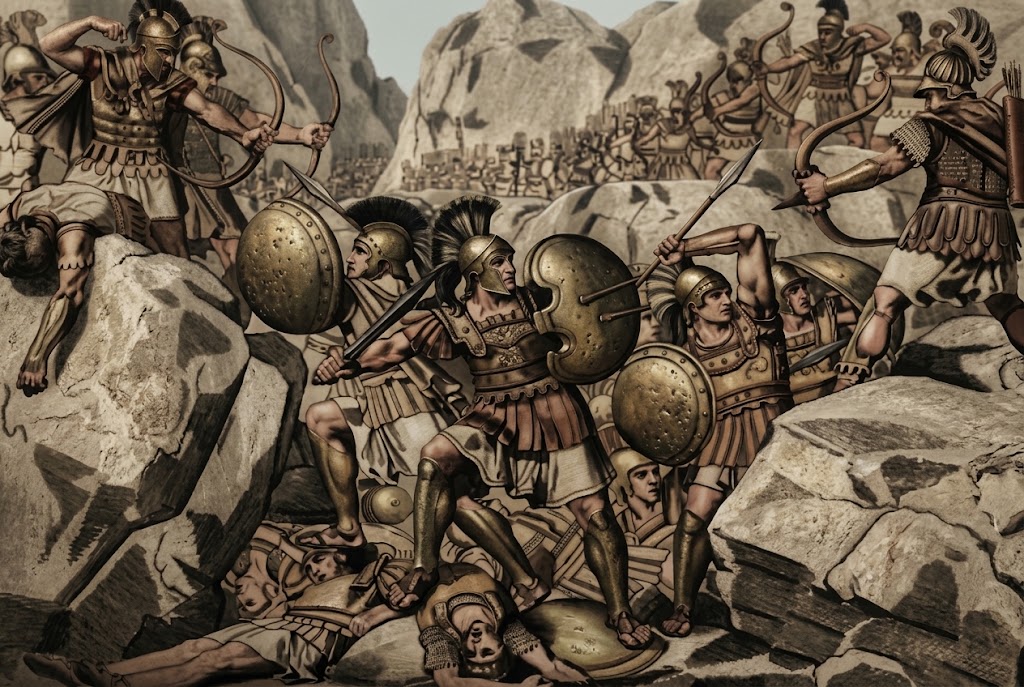
Thermopylae: The Road to Battle
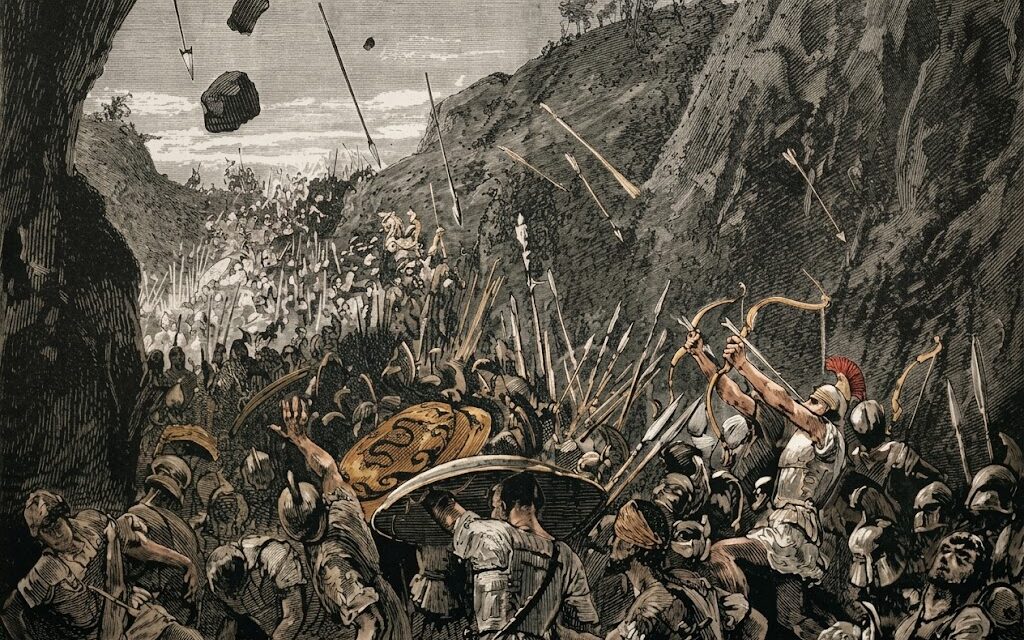
In 480 BC, the Persian king Xerxes I invaded Greece with an army ancient sources describe as vast beyond precedent, seeking to punish Athens and complete the conquest his father Darius had failed to finish a decade earlier at Marathon. To move that force into Europe, Xerxes had engineers bridge the Hellespont with a line of lashed-together ships and cut a canal through the Mount Athos peninsula so his fleet could avoid the storms that had wrecked an earlier Persian expedition there, preparations that took years and signaled an invasion on a scale Greece had never faced. A coalition of Greek city-states, still bitterly divided by rivalry and unable to agree on a unified strategy, settled on a narrow coastal pass at Thermopylae, “the Hot Gates,” as the place to make a stand, since its width there was barely wide enough for a single chariot and would neutralize the Persians’ overwhelming numbers.
King Leonidas of Sparta led the defense with a relatively small force that included his personal guard of 300 Spartans, alongside helots and several thousand allied Greek troops from other city-states, most notably around 700 volunteers from Thespiae who chose to remain to the end. Sparta’s own religious calendar complicated the response, since the sacred Carneian festival was underway and Spartan custom held that campaigning during it was improper, one reason Leonidas marched north with only a small advance force rather than the full Spartan army, expecting reinforcement once the festival had passed, while a Greek fleet simultaneously screened the coast at nearby Artemisium so the campaign was fought on land and sea at once. Rather than face the full weight of Xerxes’s army in open ground, Leonidas positioned his men squarely across the pass, using the terrain itself as a force multiplier against the Persians’ far larger numbers.
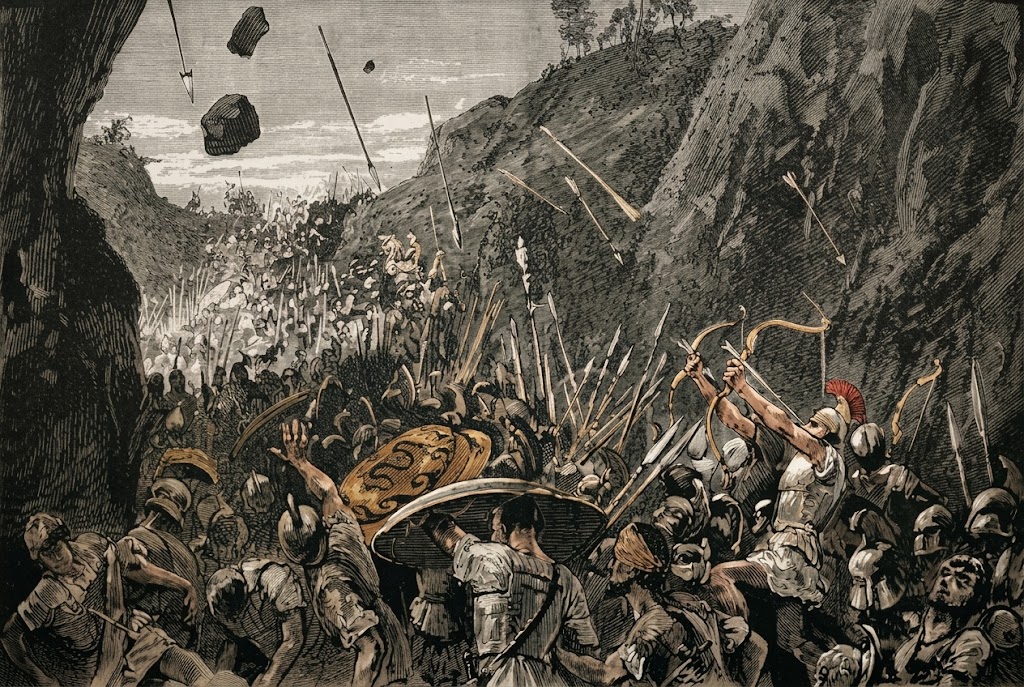
The Battle of Thermopylae
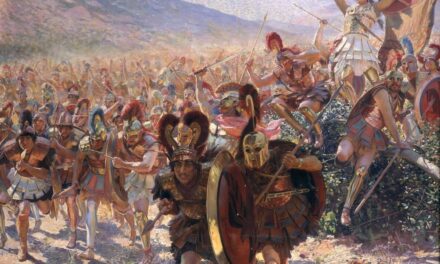
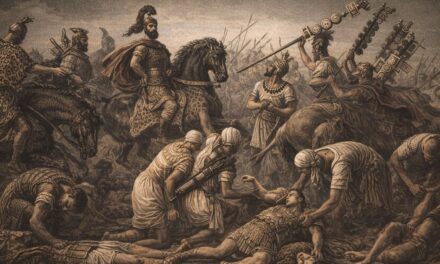
For two days, the Greek line held the pass and repelled repeated Persian assaults, including an attack by Xerxes’s elite Immortals, a corps of hand-picked infantry regarded as the best troops in the Persian army, inflicting disproportionate casualties on an army many times its size and forcing Xerxes, watching from a nearby vantage point, to commit wave after wave without breaking the Greek line. The Greek historian Herodotus, writing several decades after the battle in his Histories, recorded that the narrow terrain forced the Persians to attack in numbers too cramped to bring their full strength to bear, turning what should have been an overwhelming advantage into a bottleneck that favored the smaller, heavily armored Greek hoplites. Herodotus also preserved one of the battle’s most repeated exchanges: when a Trachinian warned that Persian arrows would be so numerous they would blot out the sun, a Spartan named Dienekes is said to have replied that this was good news, since it meant the Greeks would fight in the shade, a line that captured the defenders’ composure even as the odds against them were already plain.
Everything changed on the third day, when a local Greek named Ephialtes, seeking reward from the Persians, revealed a mountain path that allowed a Persian detachment to circle behind the Greek position. Warned of the coming encirclement, Leonidas dismissed the bulk of the allied Greek force, an estimated several thousand men, allowing them to retreat and preserve the larger Greek war effort, while he remained with his 300 Spartans, their helots, and the roughly 700 Thespians who refused to abandon the position. According to Herodotus’s account, the remaining Greeks fought with spears until their weapons broke, then continued with swords, and finally with bare hands and teeth when even those were lost, before being overwhelmed and killed to the last man.
The poet Simonides of Ceos, a near-contemporary of the battle, composed the epitaph later inscribed at the site to honor the Spartan dead, traditionally rendered in English as “Go tell the Spartans, stranger passing by, that here, obedient to their laws, we lie.” The line survived through Herodotus and other ancient writers and remains one of the most quoted epitaphs to survive from the ancient world, still reproduced at the modern monument nearly 2,500 years later.
The Legacy of Thermopylae
Though Thermopylae ended as a tactical defeat, buying the rest of Greece only days before Xerxes’s army pushed south and burned Athens, it gave the Greek city-states time to organize the naval and land resistance that ultimately turned back the Persian invasion at Salamis that same year and at Plataea the year after. The battle’s outsized reputation owes as much to how it was told afterward as to what it changed militarily, and it has since been invoked, adapted, and sometimes oversimplified by later generations looking for a symbol of small forces standing against long odds. Simonides’s epitaph has outlived every other detail of the battle, four unadorned lines that have been recited, translated, and adapted for war memorials across two and a half millennia, proof that how a defeat is remembered can matter as much as whether it was won.
Visiting Thermopylae Today
The Thermopylae battlefield sits directly beside the modern E75 highway between Athens and Lamia, and because the site is open-air and ungated, it can be visited at any time, free of charge. Centuries of coastal silting have pushed the sea several kilometers from its ancient position, so the narrow pass ancient writers described is no longer visually obvious on the ground today, a detail worth knowing in advance so the modern landscape doesn’t undercut the story.
The main features are the bronze statue and monument wall dedicated to Leonidas, a small on-site information center with a modest museum, café, and short film, and a walking trail up Kolonos Hill to the spot traditionally identified as the Greeks’ final stand, where the Simonides epitaph is inscribed on stone. English-language signage on site is limited, and visitors consistently note that reading up on the battle beforehand, watching the short film in the visitor center, or pairing the stop with a guide, adds context the site itself doesn’t fully provide, since the modern highway and shifted coastline give little visual sense of the pass ancient writers described. Most visitors treat it as a stop of an hour or two along the Athens-Lamia route rather than a destination requiring a dedicated trip, and several note that nearby roadworks in recent years have altered the immediate approach without affecting the monument itself.
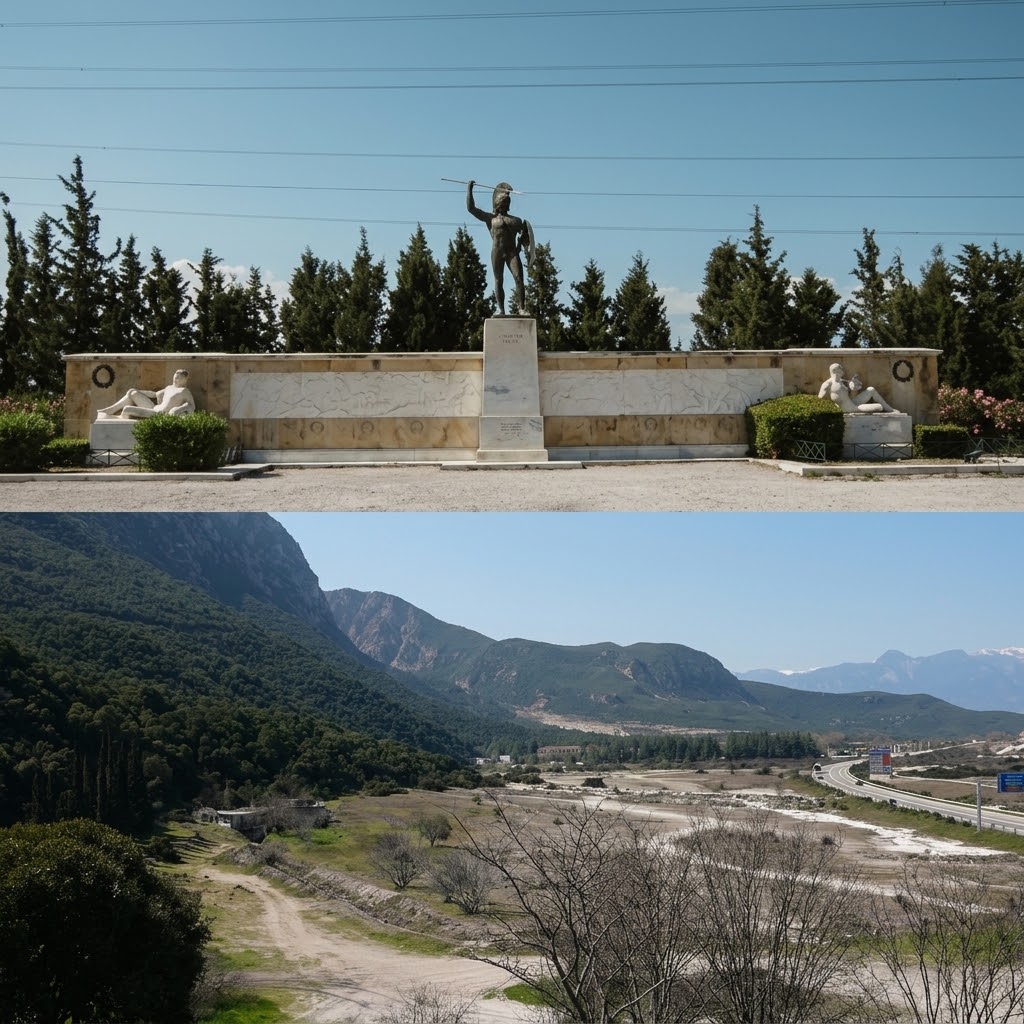
Remembrance at Thermopylae
Unlike many ancient battlefields, Thermopylae has no single annual ceremony tied to its anniversary, but the site itself functions as a permanent memorial, anchored by Simonides’s four-line epitaph and the Leonidas monument that draws a steady stream of visitors traveling the Athens-Lamia corridor. The bronze Leonidas statue, added in the twentieth century, and the older inscribed epitaph stone on Kolonos Hill together form the closest thing the site has to a formal remembrance space, without the calendar of organized ceremonies found at more modern battlefields. Many describe reading the epitaph at the spot traditionally identified as the final stand as the moment the visit’s meaning lands hardest, since the words require no further explanation of what happened there.
Visitor Info: Documentary titled “Last Stand of the 300” (History Channel, 2007)
Location: Leonidas Monument and Thermopylae battlefield site, along the Athens-Lamia highway (E75) near Thermopyles, Phthiotis, Central Greece
Site Status: Preserved Site, Minimal Facilities
Visitation Notes: The Thermopylae site sits right beside the E75 highway between Athens and Lamia, near the town of Lamia, and is free and open-air, accessible at any time since it’s not gated. The ancient coastline has silted up over the centuries, so the sea is now several kilometers away and the original narrow pass is no longer visually obvious, which is worth knowing before visiting so expectations match reality. The main features are the bronze Leonidas statue and monument wall, a small on-site information center with a modest museum, and a short walking trail up the Kolonos hill to the spot traditionally identified as the Spartans’ final stand. Some visitors note ongoing nearby construction and limited English-language signage, so pairing the visit with a guide or prior reading adds a lot of context that isn’t available on-site.
Google Map
Visitor Comments
Gene R J from Silver Spring, Maryland says it’s easily accessible right off the main highway, so it’s a great quick stop if you’re driving between Athens and points north. We paired the monument with the small visitor’s center, which has a short video and a modest café, and then climbed Kolonos Hill for the views over where the battlefield used to be.
— from TripAdvisor
This is genuinely amazing and well worth stopping for, don’t be put off by a few negative reviews you might see says tubby999 from Wiltshire, United Kingdom. Take the time to watch the video and walk through the museum before you head up the hill to see the epitaph stone — having that context first makes the walk up to the memorial hit a lot harder.
— from TripAdvisor
Nothing beats learning about history quite like walking in the same steps taken by those who actually took part in it says Benjamin Nerding. And that’s exactly what standing at Thermopylae offers. Even with the coastline long since shifted away from the original pass, there’s something powerful about being on the ground where the story actually happened rather than just reading about it.
— from The Tandem Ramble
This is one of the greatest military feats of antiquity, and it’s still legendary 2,500 years on. The site is well signposted off the main road toward Athens, making it an easy stop even though the modern landscape looks very different from the narrow coastal pass described in ancient accounts.
— from Lonely Planet