Mary Ann Webster Loughborough dug a cave into a Vicksburg hillside and lived there with her young daughter for weeks, listening to Union shells pass overhead while the bread ration shrank to little more than ground peas. She was one of thousands of civilians who endured the siege underground rather than leave the city Grant was determined to starve into submission.
Vicksburg: The Road to Battle
By the spring of 1863, Vicksburg had become one of the last major obstacles to full Union control of the Mississippi River, a fortified city perched on high bluffs overlooking a bend in the river that made it nearly impregnable to direct naval assault. Confederate control of Vicksburg kept the river closed to Union shipping and preserved a supply link between the eastern Confederacy and its territory west of the Mississippi, giving the city an outsized strategic importance relative to its size.
Union General Ulysses S. Grant spent months maneuvering to get his army into position south and east of the city after repeated efforts to approach it directly through the surrounding swampland failed, eventually crossing the river below Vicksburg and marching his army inland in a bold campaign that cut loose from his own supply lines, living off the countryside as he moved. That decision alone was a considerable gamble: an army operating without a secure supply line deep in hostile territory risked disaster if it failed to win quickly, but the approach let Grant maneuver faster than Confederate forces could react, winning a string of smaller battles at places like Port Gibson, Raymond, and Jackson before he ever reached Vicksburg itself.
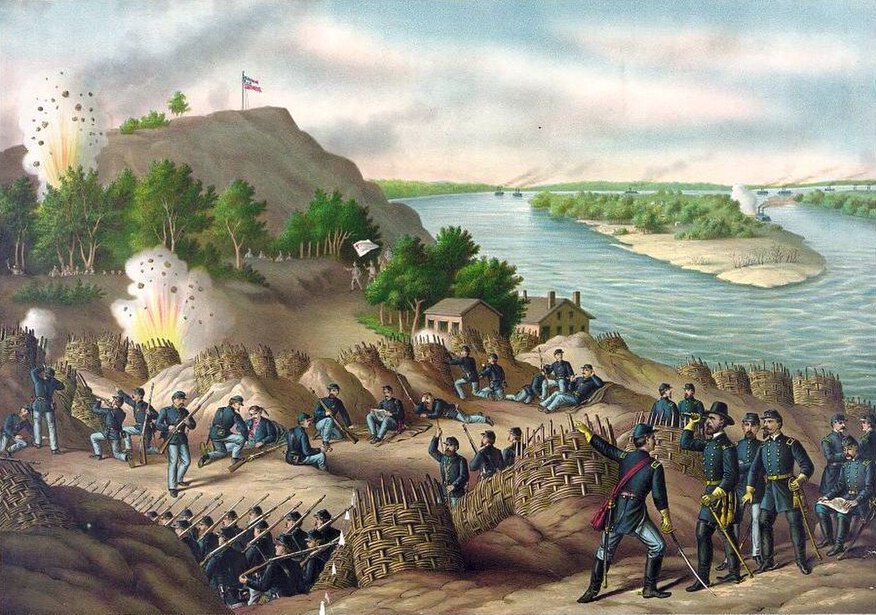
After two costly frontal assaults on the city’s defenses in mid-May failed to break through, Grant settled on a siege instead, digging his own lines around Vicksburg’s roughly seven and a half miles of Confederate fortifications and settling in to starve the garrison out. Confederate commander John C. Pemberton, for his part, had been ordered by Confederate President Jefferson Davis to hold Vicksburg at all costs, a directive that left him little room to maneuver once Grant’s siege lines closed around the city.
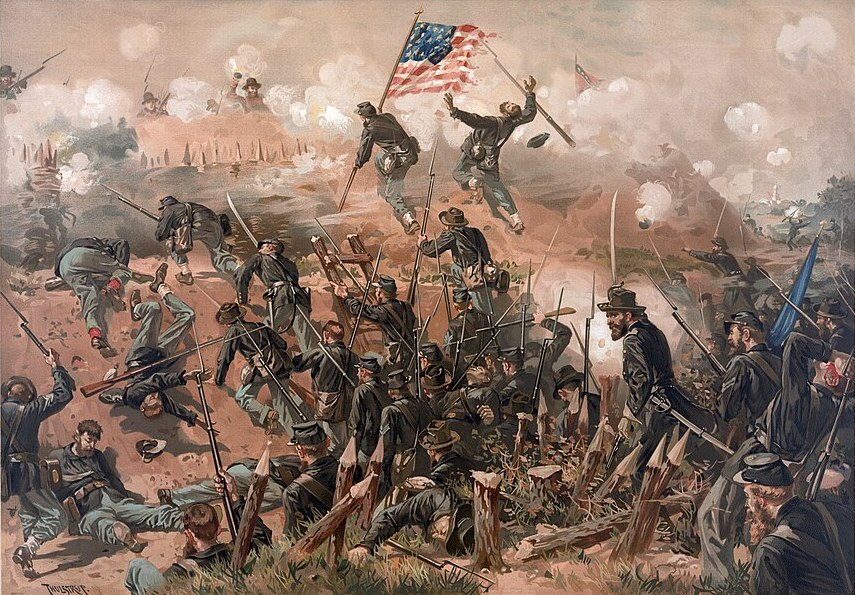
The Siege of Vicksburg
The siege that followed ran for forty-seven days, during which Union forces steadily tightened their lines while Confederate soldiers and civilians alike faced dwindling food supplies and near-constant bombardment. Union private Osborn H. Oldroyd, serving in the 20th Ohio Volunteer Infantry, kept a field diary through the siege describing the investment line stretching those seven and a half miles and the repulse of the May 22 assault on Fort Hill, one of the war’s more detailed soldier’s-eye accounts of a Civil War siege in progress.
Inside the lines, Confederate sergeant William Tunnard of the 3rd Louisiana Infantry, positioned near a redan that would later become the site of a Union mine and crater assault, recorded the army’s deteriorating food situation as the siege wore on, including the seizure of surplus civilian provisions to keep soldiers fed. For civilians unable or unwilling to leave, conditions grew desperate enough that many, including Mary Ann Webster Loughborough, dug caves into the city’s hillsides to shelter from the constant shelling, describing in her later memoir the oppressive heat underground and rations reduced to little more than pea-meal bread by the siege’s final weeks.
By late June, with food nearly exhausted and no relief in sight, Confederate commander John C. Pemberton opened surrender negotiations, and on the morning of July 3, 1863, white flags appeared along the Confederate lines. Grant later recounted the negotiations in detail in his memoirs, describing his terms to Pemberton as demanding unconditional surrender in order to stop, in his own words, the useless effusion of blood. Vicksburg formally surrendered on July 4, 1863, the same day Confederate forces were retreating from Gettysburg more than a thousand miles away, and the fall of the city gave the Union uncontested control of the Mississippi River, splitting the Confederacy in two.
The Legacy of Vicksburg
Vicksburg’s fall, arriving within a day of the Confederate defeat at Gettysburg, marked one of the clearest turning points of the Civil War, giving the Union unbroken control of the Mississippi River and cutting the Confederacy’s eastern and western halves off from each other for the remainder of the conflict. For Grant personally, the campaign’s combination of bold maneuver and grinding siege warfare established the reputation that would eventually bring him command of the entire Union army, while for the residents who had spent weeks living in hillside caves to survive the shelling, Vicksburg’s cost was measured in a far more immediate and personal register than the map of the war it ultimately helped redraw.
Visiting Vicksburg Today
Vicksburg National Military Park preserves the siege lines and is open year-round, best explored by its sixteen-mile self-guided driving tour past the original earthworks, monuments, and the USS Cairo Museum, home to a raised and restored Union ironclad gunboat sunk in the Yazoo River during the campaign. A modest per-vehicle entrance fee applies, standard National Park Service passes are accepted, and the park does not accept cash on-site, so a card is worth having on hand.
Visiting the full tour road, the visitor center exhibits, and the national cemetery comfortably takes at least half a day, and as with many National Park Service sites, hours and building access can shift seasonally, so checking the park’s official page before a visit is worthwhile.
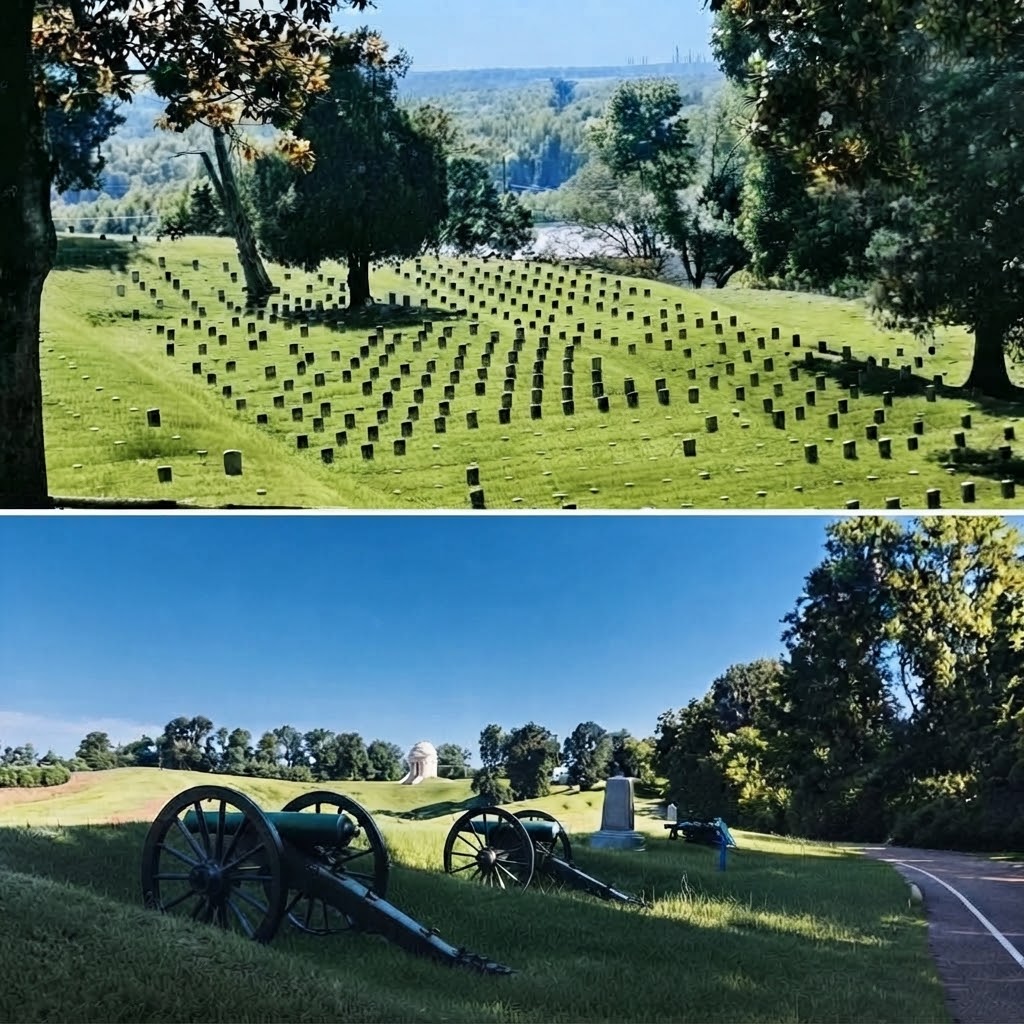
Remembrance at Vicksburg
Vicksburg National Military Park contains one of the largest collections of monuments and memorials on any Civil War battlefield, placed by the many states whose regiments fought in the campaign, and its national cemetery holds the graves of more than seventeen thousand Union soldiers, most of them unidentified. The park’s orientation film, “Here Brothers Fought: The Siege of Vicksburg,” frames the campaign for visitors before they set out on the driving tour, situating the monuments they will pass within the broader sweep of the forty-seven-day siege.
Visitor Info: NPS orientation film “Here Brothers Fought: The Siege of Vicksburg”; official park page (National Park Service, Vicksburg National Military Park)
Location: Vicksburg National Military Park, 3201 Clay Street, Vicksburg, Mississippi (siege lines, the Shirley House, and the USS Cairo Museum)
Site Status: National Park / Managed Historic Site
Visitation Notes: Vicksburg National Military Park is open year-round and is best explored via its sixteen-mile self-guided driving tour, which winds past the original siege lines, monuments, and the USS Cairo gunboat museum. A modest per-vehicle entrance fee applies, standard National Park Service passes are accepted, and the park does not accept cash, so a card is recommended. Plan for at least half a day to see the full tour road, visitor center exhibits, and the national cemetery. As with many National Park Service sites, hours and building access can shift seasonally, so it’s worth checking the park’s official page before visiting.
Google Map
Visitor Comments
Visitors consistently praise the scenic sixteen-mile driving tour past the monuments and earthworks says 419trinaw, calling it an awesome road tour with a great deal to see and admiring the beauty of the memorials along the way.
— from TripAdvisor
An overnight visitor, shopgir, described the park’s candlelit luminary tour as transforming an already worthwhile daytime site into something incredible after dark, saying the lights gave the battlefield tour a new meaning.
— from TripAdvisor
pixelhon3y, a first-time visitor with little prior knowledge of the Civil War, found the scenic drive well worth it, saying they learned a great deal simply by working their way through the park’s tour stops.
— from TripAdvisor
A National Park Service-focused blogger, John Tillison, highlighted the USS Cairo exhibit as a visitor favorite, remarking on how striking it was that ironclad gunboats like the Cairo were already in use in the 1860s, and praised the park for letting visitors decide how deep to go into the history.
— from ParkRangerJohn.com