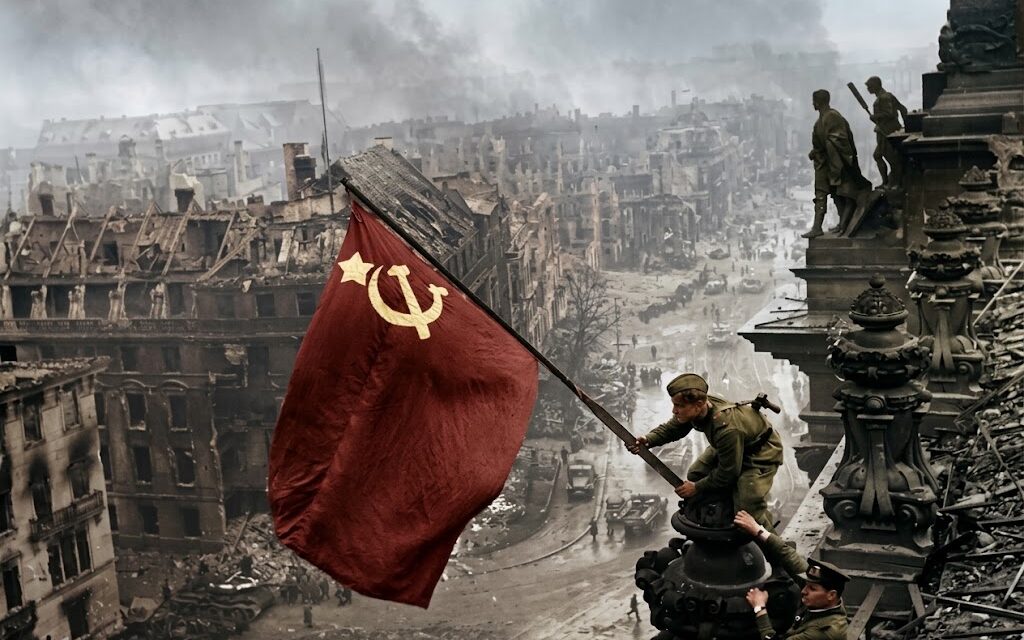
The spot where Adolf Hitler took his own life as his empire collapsed around him is today an ordinary residential parking lot, marked by a single small information sign that most passersby never notice. Nothing about the site hints at what happened beneath it in the final days of April 1945, when the Fuhrerbunker sheltered the dictator through the last, desperate weeks of a war he had started and lost. Above ground, Soviet forces were closing a ring around the German capital in a battle that would leave much of the city in rubble, kill tens of thousands of soldiers and civilians on both sides, and bring the Third Reich to its formal end within a matter of days, a collapse whose scattered physical traces across modern Berlin are, in most cases, every bit as easy to walk past unnoticed as that quiet parking lot.
Berlin: The Road to Battle
By the spring of 1945, Nazi Germany’s military position had collapsed on every front, with Soviet forces advancing rapidly from the east after a string of devastating defeats inflicted on German armies throughout the preceding winter, while American, British, and other Allied forces pushed in from the west following their own rapid advance across occupied Europe. Soviet commanders, eager to capture the German capital before Western Allied forces could reach it and aware of the enormous symbolic and strategic value of taking Hitler’s seat of government, committed three entire fronts, an immense concentration of Soviet military power under Marshals Georgy Zhukov, Ivan Konev, and Konstantin Rokossovsky, to a coordinated assault converging on Berlin from multiple directions simultaneously. German defenses, by this stage of the war desperately thin and improvised, relied heavily on the Volkssturm, a hastily organized militia drawing on old men and teenage boys with little or no military training, alongside remaining regular army units, Waffen-SS formations, and Hitler Youth conscripts pressed into a defense that senior German officers increasingly recognized as hopeless even as Hitler himself refused to countenance surrender or evacuation from the capital. Germany’s regular army, badly depleted after years of grinding losses on the Eastern Front and further weakened by the collapse of entire army groups in the war’s final winter, could field only a fraction of the manpower needed to defend a city the size of Berlin against the scale of the Soviet forces now converging on it from three directions at once. Hitler remained in the Fuhrerbunker beneath the Reich Chancellery garden throughout the battle’s opening phase, directing what remained of Germany’s military response from underground even as Soviet artillery and aircraft began striking the city center directly, issuing orders to divisions that in many cases no longer existed in any meaningful fighting strength and repeatedly demanding counterattacks that the remaining German forces had no realistic capacity to carry out.
The Battle of Berlin
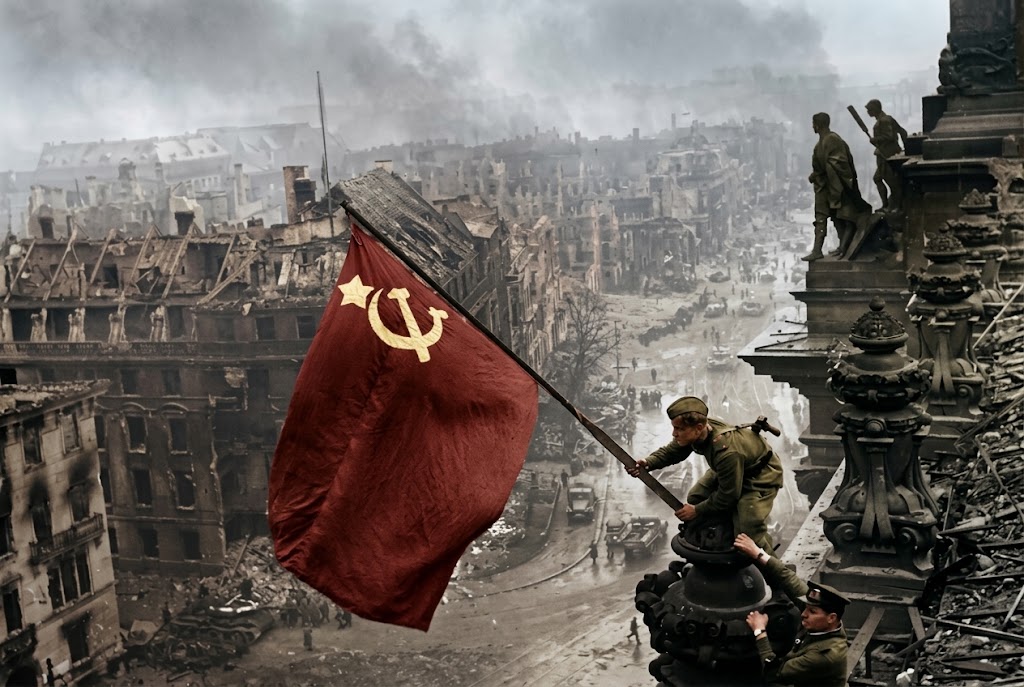
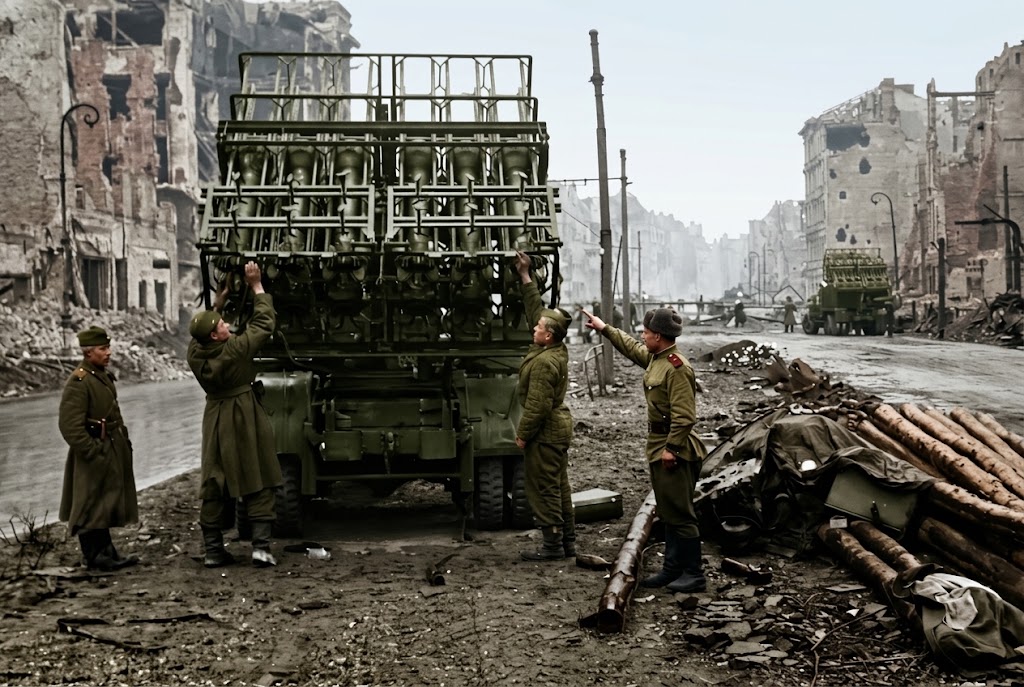
Soviet forces launched their assault on the Seelow Heights, the last major defensive line east of Berlin, on April 16, 1945, breaking through after several days of extremely costly fighting against a well-prepared German defense before pushing on toward the capital itself. The fighting at Seelow Heights alone produced tens of thousands of Soviet casualties, a costly reminder that even a German army stripped of most of its remaining strength could still exact a heavy price from an attacker willing to press forward regardless of losses. By April 21, Soviet artillery had begun shelling central Berlin directly, and within days the city was effectively encircled by the converging Soviet fronts, cutting off any hope of relief or evacuation for the German garrison and the roughly two million civilians still trapped inside the closing ring. Fighting inside the city itself proved intensely brutal and costly for both sides, as Soviet troops advanced street by street and building by building against defenders who, despite being poorly equipped and often barely trained, frequently fought with desperate tenacity in basements, sewers, and the ruins of bombed-out buildings throughout the city center. Hitler, isolated in the Fuhrerbunker as the military situation collapsed entirely around him and Soviet forces closed to within blocks of the Reich Chancellery, took his own life on April 30, 1945, along with his wife Eva Braun, whom he had married only the day before, as Soviet troops fought their way toward the Reichstag building barely a few hundred meters away. Soviet soldiers raised a flag over the ruined Reichstag on May 2, an image captured by war photographer Yevgeny Khaldei that became one of the war’s most iconic photographs, though Khaldei himself later documented how the scene was carefully arranged and reshot after the actual moment for a clearer, more dramatic photograph. That same day, General Helmuth Weidling, the last commandant of the Berlin Defence Area, formally surrendered the city’s garrison to Soviet General Vasily Chuikov, ordering the immediate cessation of resistance and bringing organized fighting inside Berlin to a close after roughly two weeks of urban combat that had killed tens of thousands of soldiers and reduced much of the city center to rubble. Fighting inside the city continued in isolated pockets even after Weidling’s surrender order, as some German units, cut off from communication and unaware or unwilling to believe the war was truly over, kept resisting for a short time before organized combat inside Berlin finally ceased entirely. In the days and weeks that followed the fighting’s end, Soviet occupation of the conquered city was marked by widespread violence against the civilian population, including mass rape committed against German women and girls on a scale that historians have since documented extensively through survivor accounts and wartime records.
The Legacy of Berlin
The battle’s end brought the formal collapse of the Nazi regime, and Germany’s overall unconditional surrender to the Allied powers followed within days, signed first at Reims on May 7 and ratified the following day at what is now the German-Russian Museum in Berlin-Karlshorst, ending the war in Europe after nearly six years of fighting. Berlin’s capture by Soviet forces, achieved before Western Allied troops could reach the city, shaped the postwar division of the German capital into occupation sectors controlled by the four victorious powers, a division that would harden over the following years into the defining geographic symbol of the Cold War itself. The battle’s staggering human cost, among both the Soviet and German militaries and the civilian population trapped inside the encircled city, left a lasting and deeply painful mark on Berlin’s own historical memory that persists in how the city commemorates the war’s final days today.
What Remains at Berlin
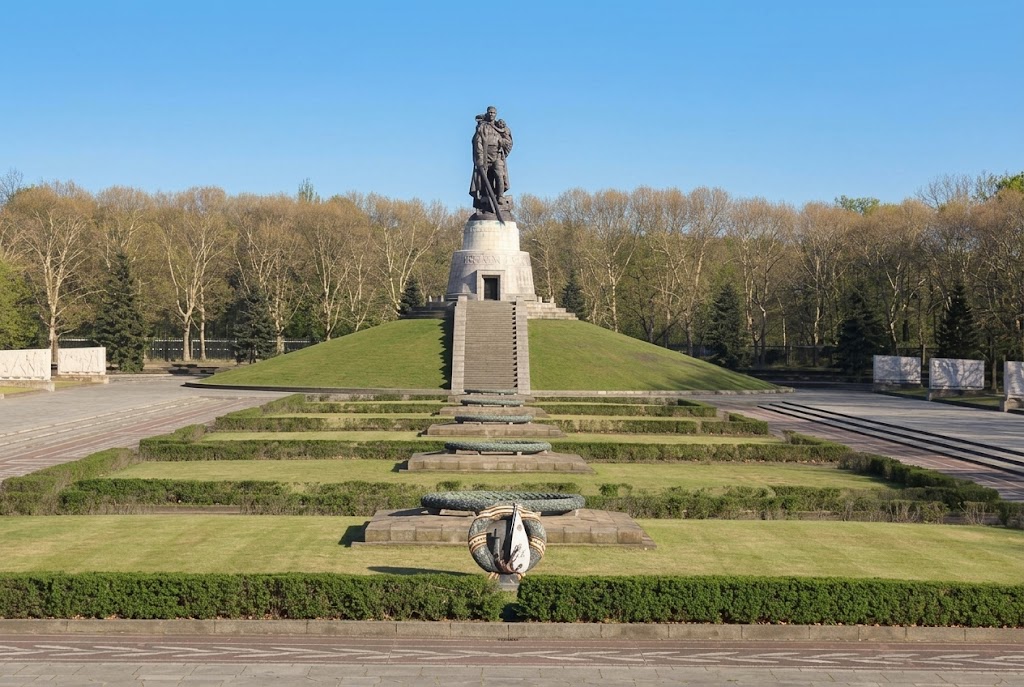
Unlike a single battlefield, the Battle of Berlin left behind a scattered set of distinct sites across the modern city rather than one central location for visitors to explore. The Reichstag building itself, now home to Germany’s Bundestag parliament, preserves original graffiti left by Soviet soldiers in 1945 as a curated exhibit inside, though visiting the building and its glass dome requires advance online registration for security screening rather than allowing walk-in access. The Soviet War Memorial in the Tiergarten, notable for having sat within the British sector of West Berlin throughout the entire Cold War despite its Soviet dedication, and the considerably larger Soviet War Memorial and cemetery at Treptower Park, are both freely accessible to visitors at any time. The site of the Fuhrerbunker itself offers far less: an ordinary residential parking lot marked only by a single small information sign, worth a brief stop for historical context but not a destination that justifies significant travel time on its own. For visitors seeking the most historically direct indoor connection to the battle’s actual conclusion, the German-Russian Museum in Berlin-Karlshorst preserves the room where Germany’s surrender was formally signed on May 8 and 9, 1945, and charges paid admission to see it. Because these sites are scattered across different parts of the city rather than concentrated in a single walkable area, visitors hoping to see more than one or two of them in a single day should plan their route carefully and budget travel time between locations, treating a visit to Berlin’s Second World War sites as a themed itinerary woven into a broader stay in the city rather than a single dedicated excursion.
Remembrance at Berlin
Helmut Altner, a young German conscript who fought in the city’s final defense, published a firsthand account of the battle’s last days, later translated into English as Berlin Soldier, describing the desperate and often chaotic experience of hastily conscripted, poorly trained defenders in the war’s closing hours. A markedly different perspective survives in A Woman in Berlin, the diary of German journalist Marta Hillers, published anonymously in the 1950s and only publicly attributed to her decades later, documenting her experience as a civilian during the Soviet occupation, including the widespread sexual violence committed against German women in the battle’s aftermath. General Helmuth Weidling, the German officer who organized the city’s final defense and ultimately signed its surrender, left no personal memoir, but his own surrender order and subsequent Soviet interrogation and war-crimes-trial records preserve his account of the battle’s closing days from the perspective of the man who ended it. Photographer Yevgeny Khaldei’s own detailed recollections of capturing and later re-staging the famous Reichstag flag photograph on May 2 add a further layer to the battle’s visual legacy, illustrating how one of the war’s most enduring images was as much a constructed piece of wartime propaganda as it was a spontaneous record of the moment. Taken together, these four accounts, an ordinary conscript’s desperate defense, a civilian journalist’s survival under occupation, a defeated commander’s official surrender, and a photographer’s staged record of victory, preserve the battle’s final days from angles that rarely appear side by side in a single retelling of the war’s European conclusion.
Visitor Info: Feature film titled “Downfall” (Constantin Film, 2004)
Location: Reichstag Building, Platz der Republik 1, Berlin, Germany (also: Soviet War Memorials at Tiergarten and Treptower Park; the Fuhrerbunker site near In den Ministergarten)
Site Status: Marker or Monument Only
Visitation Notes: The battle left several distinct sites rather than one: the Reichstag (now the Bundestag) preserves 1945 Soviet soldiers’ graffiti as a curated exhibit inside, but visiting the dome and building requires advance online registration for security reasons. The Soviet War Memorials at Tiergarten (notable for having sat within the British sector of West Berlin throughout the Cold War) and the larger Treptower Park memorial and war cemetery are both freely accessible. The Fuhrerbunker site itself is genuinely just a residential parking lot with a single small information sign — worth a brief stop for context, not a destination in itself. The German-Russian Museum Berlin-Karlshorst, where the German surrender was actually signed on 8-9 May 1945, preserves the signing room and is arguably the most historically direct indoor site tied to the battle’s end; admission is paid.
Google Map
Visitor Comments
We booked the Reichstag dome tour about a month in advance and had our ID details ready as required comments Stay28500649747 — the guided tour itself was excellent, and seeing the preserved Soviet soldiers’ graffiti inside really brings the building’s history home.
— from TripAdvisor
According to Mo R, its a slightly bizarre place to put this memorial, since it ended up sitting in the British sector of the city after WW2 — an odd quirk of Cold War history that’s part of what makes it worth visiting.
— from TripAdvisor
This is the largest war memorial in Berlin comments Dr. Alejandro D, built by Stalin after the war, and walking through it feels like a genuine testimony to Soviet idealism as it was presented at the time — a striking, sobering place.
— from TripAdvisor
According to brixton456, the main conference room here is set up almost exactly as it appeared during the signing of the German surrender — standing in the actual room where the war in Europe formally ended is a genuinely powerful experience.
— from TripAdvisor