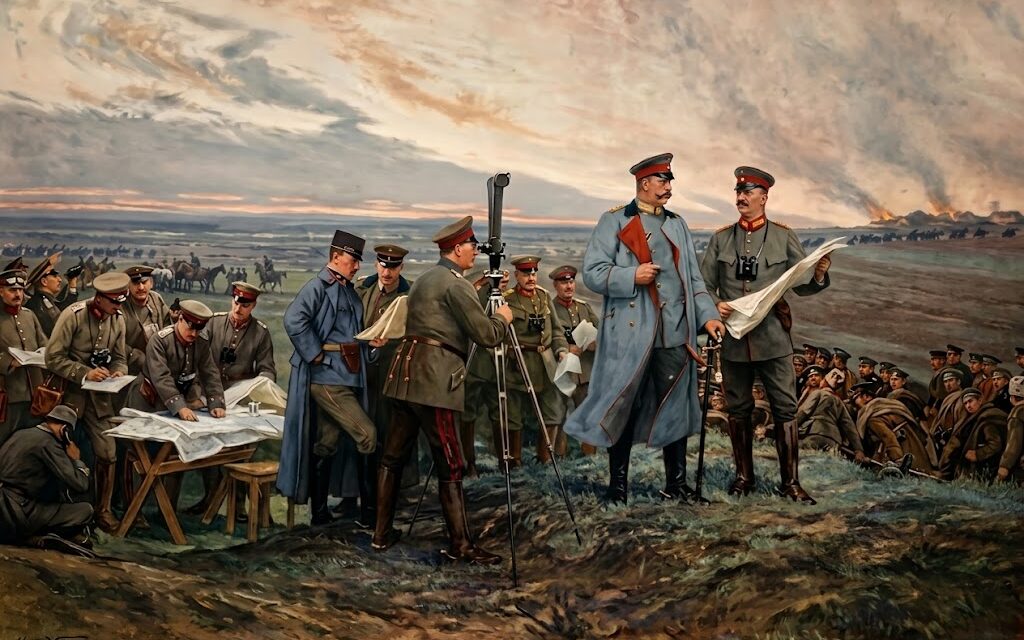
The Russian army broadcast its battle plans in the clear, uncoded, over the open airwaves, and the Germans were listening to every word. Two Russian armies had pushed into East Prussia in the war’s opening weeks, and their inability to agree on shared ciphers meant that orders detailing troop positions, objectives, and timing crossed the ether for any German wireless operator to intercept and read. German commanders used that intelligence to identify a dangerous gap between the two advancing Russian forces, and by the time the fighting near the town of Tannenberg ended in late August 1914, one of those armies had been almost entirely destroyed, in a defeat so complete that its commanding general took his own life rather than report it to the tsar, a collapse that made overnight national heroes of the German commanders who had exploited the intercepted signals so effectively.
Tannenberg: The Road to Battle
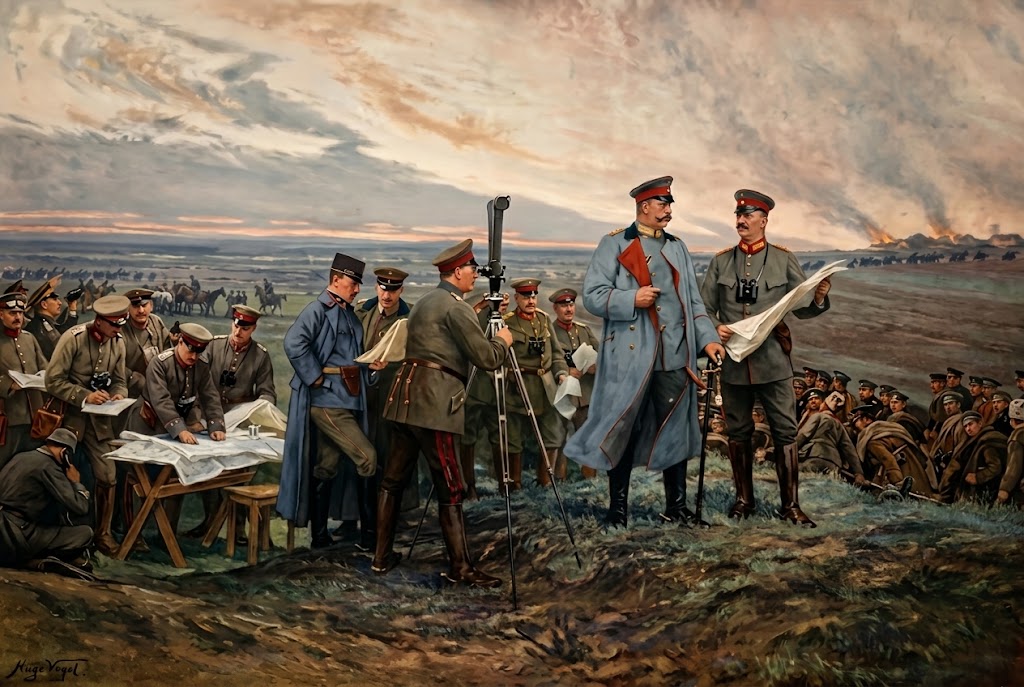
In August 1914, honoring a pre-war alliance commitment to France that called for a rapid offensive against Germany’s eastern flank, Russia pushed two armies into the German province of East Prussia far sooner than German planners had expected, hoping to draw German troops away from the decisive campaign then unfolding in the west. General Paul von Rennenkampf’s Russian First Army advanced from the northeast and General Alexander Samsonov’s Second Army from the southeast, intended to converge and trap the German defenders between them, but poor coordination between the two commanders, compounded by a personal rivalry that historians still debate the true extent of, left a dangerous gap opening between the two advancing Russian forces as the campaign unfolded. Germany’s 8th Army, initially commanded by General Maximilian von Prittwitz, suffered a costly defeat against Rennenkampf’s First Army at the Battle of Gumbinnen in mid-August and briefly considered a general retreat behind the Vistula River, a response that alarmed German high command enough to relieve Prittwitz of command entirely. Berlin recalled the aging General Paul von Hindenburg from retirement to take command of the 8th Army, pairing him with the ambitious chief of staff Erich Ludendorff, fresh from earlier successes on the Western Front, though much of the operational plan the two men would ultimately execute had already been sketched out by a staff officer already at 8th Army headquarters, Max Hoffmann, before either of them even arrived to take command. Aided by the intercepted Russian radio traffic revealing Rennenkampf’s continued slow advance and Samsonov’s exposed line of march, German planners made the calculated gamble of shifting the bulk of their forces south by rail to concentrate overwhelming strength against Samsonov’s Second Army while leaving only a thin covering screen to watch Rennenkampf’s larger but more cautious force to the north. The gamble depended heavily on East Prussia’s dense rail network, which allowed German divisions to redeploy across the theater far faster than either Russian army could realistically respond, and on the continued failure of the two Russian commanders to establish reliable communication with one another as their separate advances proceeded largely in isolation.
The Battle of Tannenberg
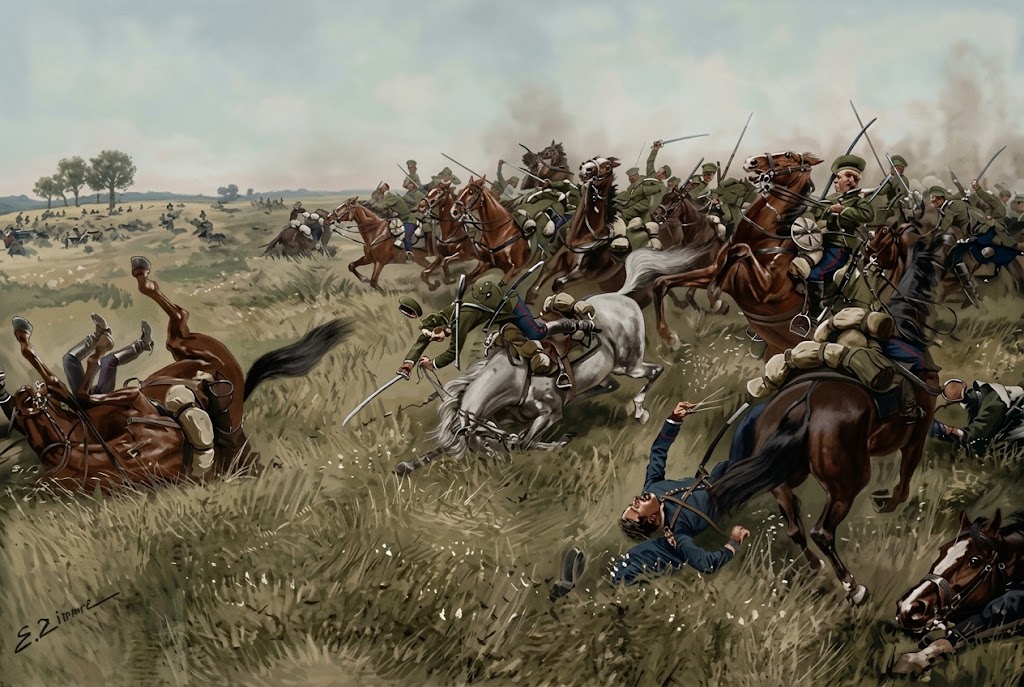
Fighting began in earnest on August 26, 1914, as German forces, redeployed with unusual speed by rail to concentrate against the more exposed Russian Second Army, struck Samsonov’s flanks even as his center continued to advance deeper into what was rapidly becoming a trap. German commanders, reading Russian wireless orders sent uncoded across the front, were able to track Samsonov’s dispositions and Rennenkampf’s continued sluggish advance almost in real time, allowing them to commit their forces with a confidence that would have been impossible without such direct insight into Russian intentions. Over the following days, German forces steadily encircled Samsonov’s army from both flanks, closing the ring around the bulk of the Second Army’s divisions near the forests and lakes surrounding the town of Tannenberg while Rennenkampf’s First Army, still advancing only cautiously to the north and receiving unreliable information about Samsonov’s true situation, failed to intervene in time to relieve the pressure. By August 29 and 30, the encirclement was essentially complete, and Russian units trapped inside the pocket, often confused, poorly supplied, and cut off from any coordinated command, surrendered in overwhelming numbers or were destroyed attempting to break out through the surrounding marshland and forest, with some units reportedly drowning or becoming hopelessly mired while trying to escape through the region’s lakes and bogs under German pressure. German forces captured roughly 92,000 Russian prisoners along with hundreds of artillery pieces, while Russian killed and wounded numbered in the tens of thousands, against comparatively light German losses of around 10,000 to 15,000 casualties for the entire engagement, a lopsided outcome that reflected both the effectiveness of German intelligence and the near-total collapse of Russian command and control once the encirclement closed. General Samsonov, having ridden into the forest away from his staff as the scale of the disaster became clear and reportedly unwilling to face the tsar with news of such a catastrophic defeat, took his own life rather than survive to report it, a death confirmed only when his body was recovered some time later. In choosing to name the victory after the nearby town of Tannenberg rather than the actual center of the fighting, which had occurred somewhat closer to other villages in the area, Hindenburg deliberately evoked the German defeat at the original Battle of Tannenberg in 1410, in which Polish-Lithuanian forces had crushed the Teutonic Knights, transforming the 1914 victory into a symbolic act of historical revenge for German audiences even though the two battles were fought under entirely different circumstances five centuries apart.
The Legacy of Tannenberg
The scale and completeness of the victory made national heroes of Hindenburg and Ludendorff almost overnight, propelling both men to ever-greater authority over the German war effort and, by 1916, to command of virtually the entire German military machine on every front, a position from which Hindenburg would later ascend to the presidency of Germany’s postwar Weimar Republic. The battle’s outcome also fed a lasting rivalry over credit for the winning plan, with staff officer Max Hoffmann long insisting, both privately and eventually in his own published memoir, that the core operational concept had been his before Hindenburg and Ludendorff ever set foot at 8th Army headquarters. Tannenberg’s crushing defeat of an invading army also became a foundational element of German nationalist memory in the interwar years, commemorated on a scale that would shape how the battle’s site itself was later treated, and its symbolism only deepened once Hindenburg, by then the aging president of the Weimar Republic, chose to be buried at the memorial complex built to commemorate his greatest victory.
Tannenberg Today
The massive Tannenberg National Memorial, a monumental structure built near the battle site in the years after the war and later serving as Hindenburg’s own tomb following his death in 1934, no longer exists in any recognizable form. Retreating German forces demolished the memorial themselves in 1945 rather than allow it to fall into Soviet hands as the Red Army advanced through East Prussia, and Polish authorities subsequently cleared away the bulk of the remaining ruins over the following decades, leaving only scattered, unmarked debris in an open field near the modern Polish village of Stebark to mark the site today. One surviving element, a large stone lion sculpture originally part of the memorial complex, was relocated and now stands in the town square of nearby Olsztynek, offering visitors the closest thing to a tangible artifact connected to the battle anywhere in the region. No dedicated museum or visitor center covering this specific 1914 battle exists in the area, and the well-known Grunwald battlefield museum located nearby commemorates an entirely different and much earlier conflict, the 1410 battle from which Hindenburg borrowed his victory’s name, and should not be mistaken for a substitute site covering the 1914 fighting. For anyone interested in the battle’s history, books and documentaries remain the most practical way to engage with Tannenberg today, since no on-site visitor experience comparable to other major First World War battlefields currently exists at the location itself. Visitors traveling through the Warmian-Masurian region for the nearby Grunwald site or other regional attractions can still make the short detour to see the debris field and the relocated lion sculpture, but should arrive with realistic expectations of what remains and treat the stop as a brief historical curiosity rather than a full destination in its own right.
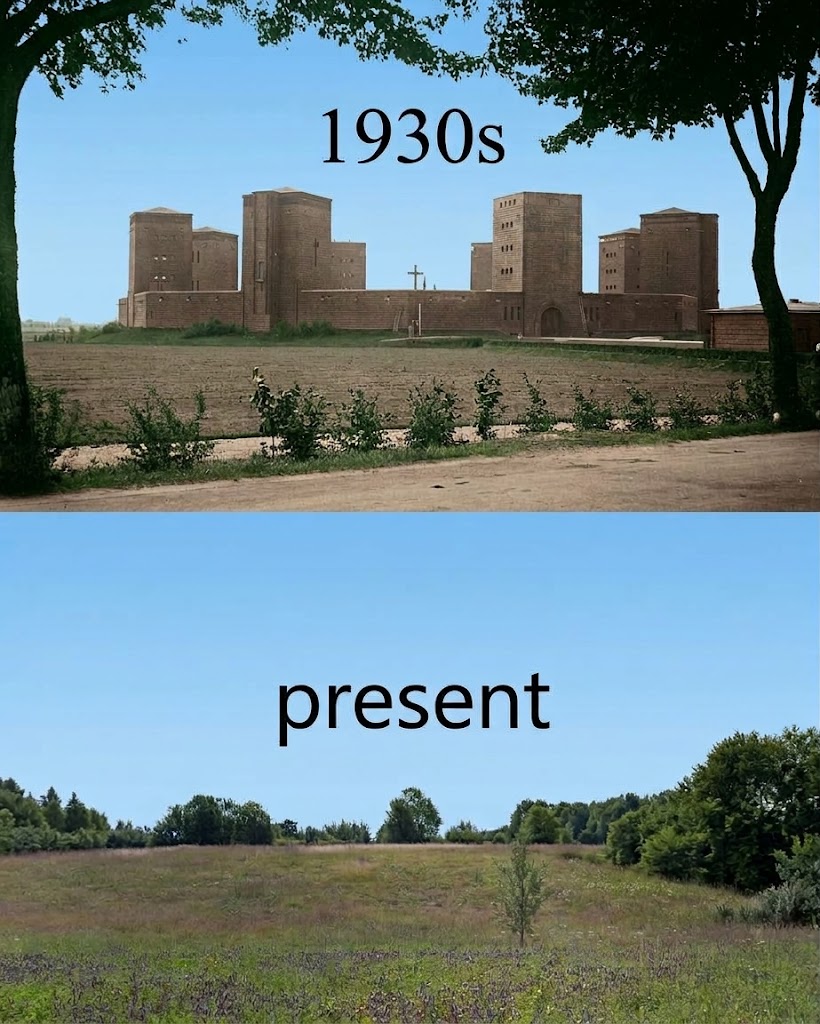
Remembrance at Tannenberg
Paul von Hindenburg’s own memoir, Out of My Life, published in English translation in 1920, offers the German 8th Army commander’s detailed account of the campaign’s planning and execution from the very top of the German command structure, while his chief of staff Erich Ludendorff provided his own extensive version of events in My War Memories, 1914-1918, published in 1919, including a pointed account of his later disputes with staff officer Max Hoffmann over credit for the operational plan that won the battle. Hoffmann’s own memoir, The War of Lost Opportunities, published in English translation in 1924, presents yet a third perspective from inside 8th Army headquarters, insisting on his own central role in devising the plan before his superiors ever arrived to claim it. A rare outside vantage point on the battle’s other side survives in Major-General Alfred W. Knox’s book With the Russian Army, 1914-1917, published in 1921, in which the British military attache embedded with Russian forces described the disaster and its aftermath as a genuine eyewitness, though not a Russian officer himself, from within the defeated army’s own command structure. No comparably well-documented firsthand memoir from a Russian officer who fought at Tannenberg has surfaced, leaving Knox’s outside account as one of the fullest available views of the battle’s other side, a gap that itself reflects how thoroughly the Russian Second Army’s command structure was shattered in the encirclement.
Visitor Info: Book titled “Tannenberg: Clash of Empires, 1914” by Dennis E. Showalter (Brassey’s/Potomac Books, 1991)
Location: Site of the Battle of Tannenberg (1914), near Stebark (formerly Tannenberg), Warmian-Masurian Voivodeship, Poland — the historic memorial complex here was destroyed in 1945
Site Status: Site No Longer Exists
Visitation Notes: The massive Nazi-era Tannenberg National Memorial built near the battle site in the 1920s-30s was demolished by retreating German forces in 1945 to keep it from Soviet hands, and Polish authorities cleared the remaining ruins over subsequent decades; only scattered, unmarked debris remains in an open field today, with a relocated lion sculpture standing in nearby Olsztynek’s town square. No dedicated substitute institution covering this specific 1914 battle was found — the region’s Grunwald battlefield museum covers an entirely different, much earlier 1410 battle and should not be treated as a substitute. The site is best understood through books and documentaries rather than an on-site visit.
Google Map
Visitor Comments
Martin called this a significant World War I battlefield that was decisive for the development of events on the Eastern Front during the war’s first year, and felt the site’s history deserved more recognition than it currently receives.
— from Google Reviews
Ka Pruszek noted that almost nothing remains of the mausoleum today beyond a few bricks and a hole in the ground, but said it’s still worth experiencing the spirit of the place and imagining the grand scale it was once built on.
— from Google Reviews
Marcin Cyl tried to imagine what a large structure once stood there, finding only a hole left behind, and observed that many locals today don’t even realize a huge mausoleum once stood on the site.
— from Google Reviews