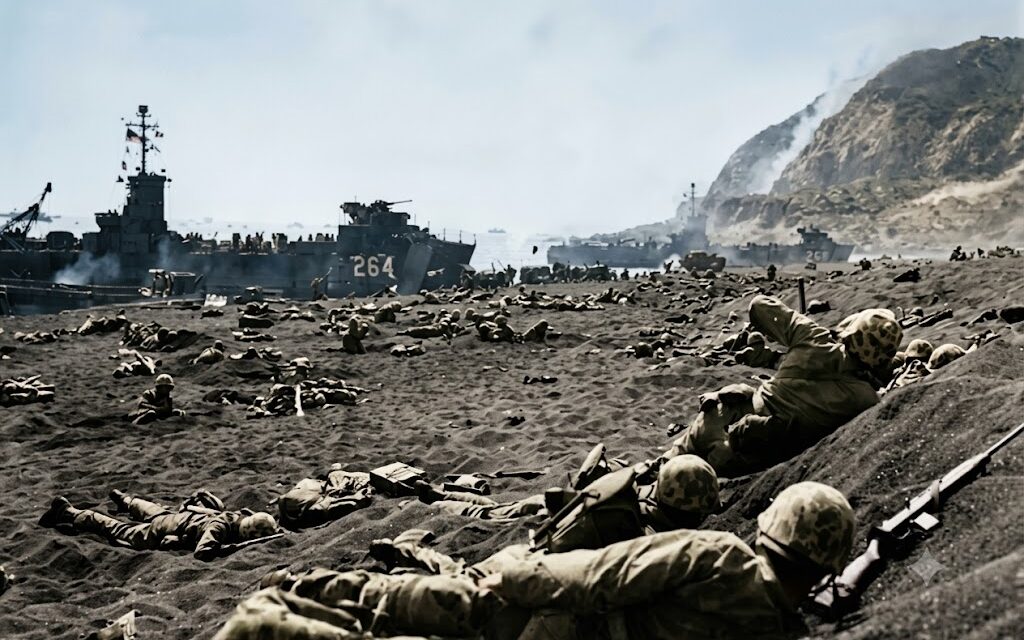
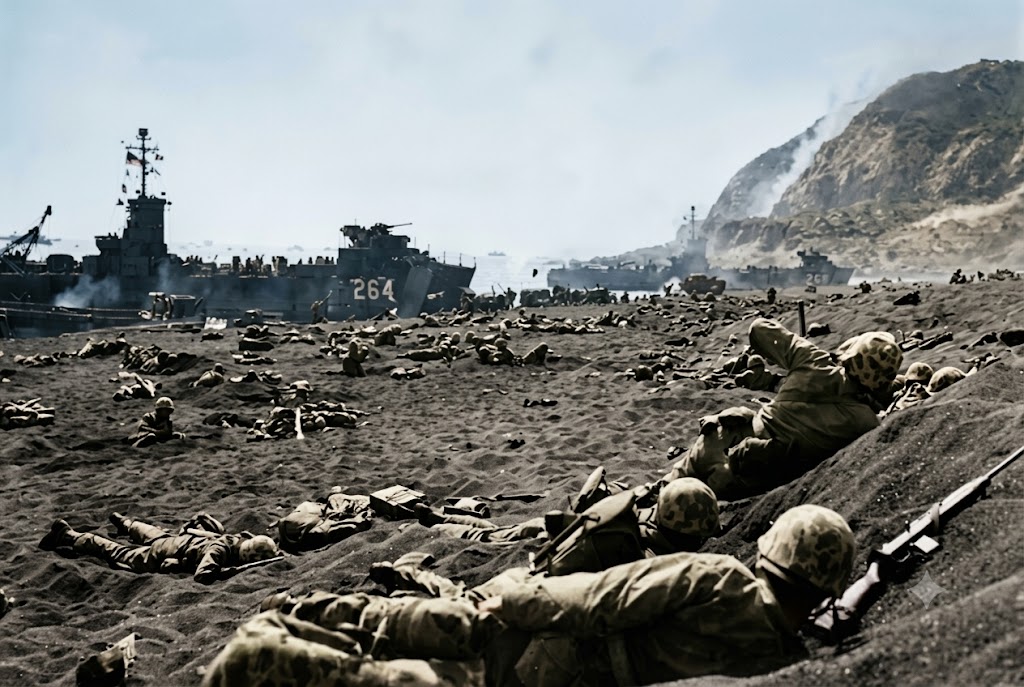
The sand itself fought against them. Black, volcanic, and soft enough that boots sank to the ankle with every step, it turned the simple act of moving up the beach into exhausting work even before the first shell landed. Marines who had trained for a beach assault found their training only partly useful here: nothing had quite prepared them for ground that swallowed their feet while an enemy they could barely see waited in tunnels beneath it.
Iwo Jima: The Road to Battle
By early 1945, American forces had spent more than three years pushing back across the Pacific island by island, and Iwo Jima, a small volcanic island roughly 750 miles south of Tokyo, had become the next objective largely because of what sat on it: two operational airfields and a third under construction, all valuable as emergency landing strips for damaged American B-29 bombers returning from raids on the Japanese home islands, and as a future base for fighter escorts making the long trip alongside the bombers they protected. Its position also made it useful to Japan as an early-warning station for incoming American air raids, giving the island strategic weight on both sides of the fight well beyond its eight square miles. American commanders expected the island to fall within a matter of days, a miscalculation the coming weeks of fighting would correct at enormous cost.
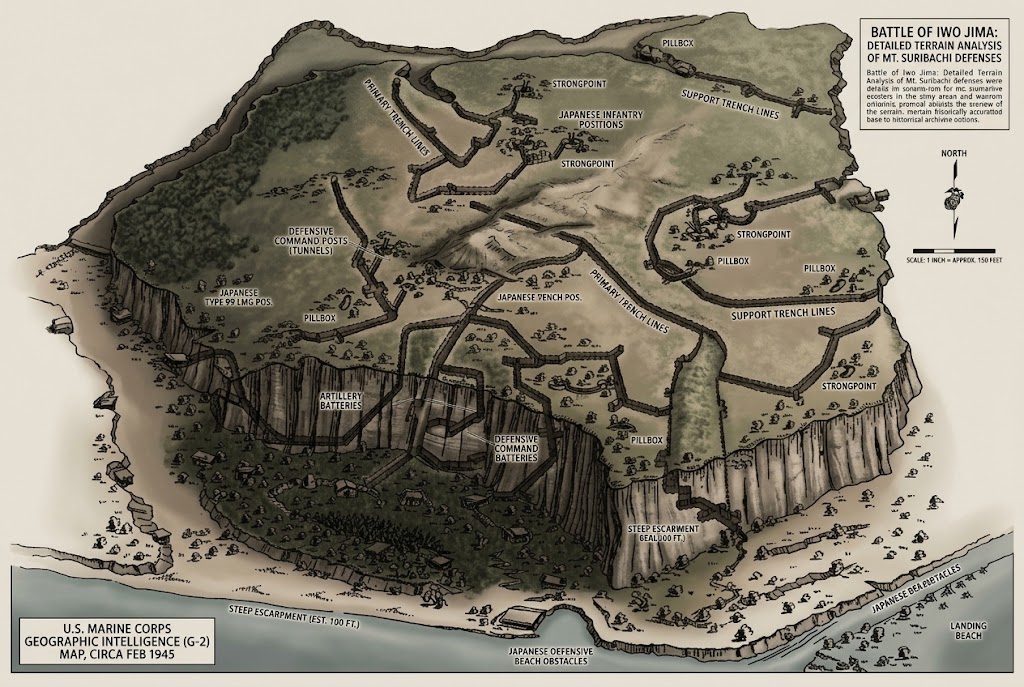
Japanese Lieutenant General Tadamichi Kuribayashi, who took command of the island’s defense in mid-1944, made a deliberate break from the doctrine that had cost Japan so many of its Pacific garrisons: rather than mass his forces at the water’s edge to try to stop the landing outright, he ordered an extensive network of tunnels, caves, and fortified bunkers dug into the island’s volcanic rock, connecting an underground system that in places ran for miles beneath the surface, planning to let the Americans come ashore largely unopposed and then bleed them from concealed positions inland. It was a strategy built around the assumption that Japan could not win the battle outright, only make its cost to the Americans high enough to matter, and Kuribayashi told his men from the outset not to expect reinforcement or survival, only to sell their positions as dearly as possible.
The Battle of Iwo Jima
American Marines landed on February 19, 1945, and Kuribayashi’s plan worked exactly as intended in the battle’s opening hours: the beach itself was nearly undefended, but as thousands of men and vehicles crowded onto the narrow strip of volcanic sand, hidden Japanese artillery and mortar positions opened fire from Mount Suribachi and the high ground beyond, inflicting heavy casualties on troops with almost nowhere to take cover. The volcanic sand that slowed every step also made digging foxholes for shelter nearly impossible, leaving Marines exposed on ground that offered no real protection from above.
Mount Suribachi, the dormant volcano dominating the island’s southern tip, fell to the Marines on February 23, and Associated Press photographer Joe Rosenthal captured the moment a group of six men raised the second, larger flag atop its summit, an image that won the Pulitzer Prize and would later become the basis for the Marine Corps War Memorial. Rosenthal spent the rest of his life countering rumors that the shot had been staged, and his own account of scrambling up the ash slope moments before the flag went up survives in period interviews and later oral histories. Of the six men in the photograph, only three survived the battle; Pima Marine Ira Hayes, one of the survivors, struggled for years afterward with the fame the photo brought him and later said he wished he had never posed for it. Navy corpsman John Bradley, also identified in the photograph for decades, rarely spoke about the battle after the war, and a 2016 Marine Corps investigation ultimately determined he had actually raised a different flag earlier that same morning and was not present for the iconic second raising, correcting a detail of the historical record more than seventy years after the fact.
The fighting for the rest of the island continued for another month past Suribachi’s capture, as Marines fought to clear a defense network of tunnels and bunkers that Kuribayashi’s men defended almost to the last man rather than surrender, often refusing evacuation or capture even when a position had clearly become hopeless. The battle produced a far higher American casualty rate than any prior Pacific landing, and is widely cited as one of the few engagements of the entire Pacific war in which American casualties ultimately matched or exceeded Japanese losses, a statistic that alone conveys how completely Kuribayashi’s strategy of attrition succeeded on its own narrow terms even as the island itself was lost. His own wartime letters home to his family, later published as Picture Letters from Commander in Chief, offer a rare firsthand Japanese account of a defense he understood from the outset could not ultimately succeed, only exact a price.
The Legacy of Iwo Jima
Iwo Jima produced the most iconic image of the entire Pacific war and, with it, one of the most recognized war memorials in the United States, yet the island the photograph was taken on remains almost entirely inaccessible to the public it has come to represent. That gap between the battle’s outsized place in American memory and the physical inaccessibility of the ground itself is, in its own way, part of what Iwo Jima has become: a story told almost entirely through a single photograph and the men in it, several of whom spent the rest of their lives unable to fully escape what that image made of them, a memorial built from bronze rather than the volcanic sand where it actually happened.
Iwo Jima: A Site Off-Limits
Iwo Jima itself, now officially known as Iwo To, is not open to public tourism. The island is administered by Japan’s Self-Defense Forces, and civilian access is effectively limited to occasional government-organized memorial trips such as the biennial Reunion of Honor, rather than any ordinary form of visit.
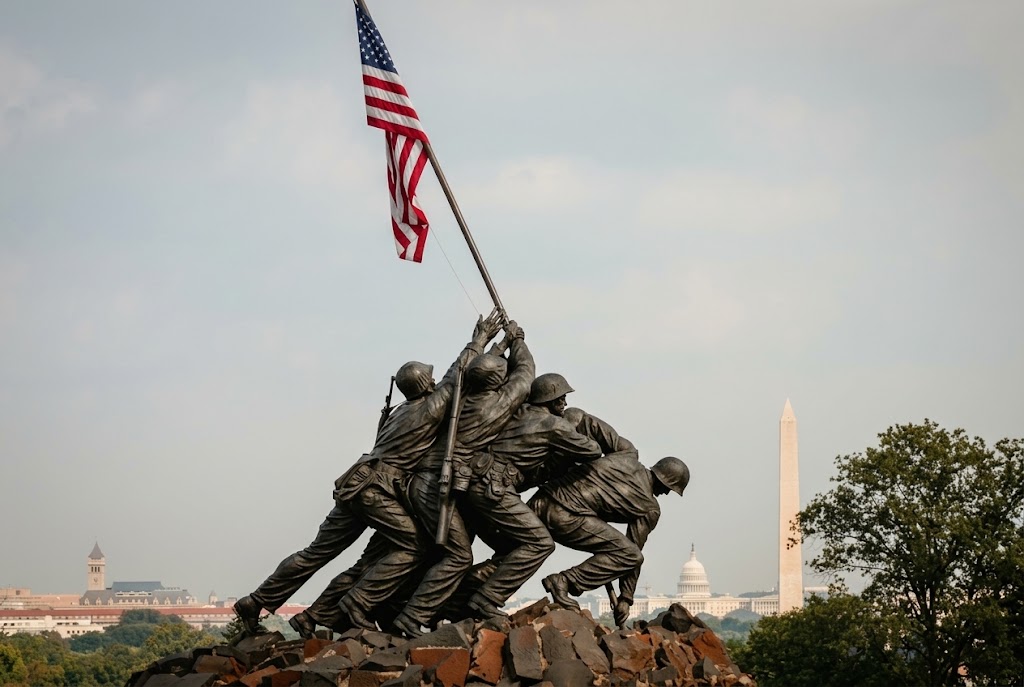
Travelers wanting to engage with this history in person are far better served by the Marine Corps War Memorial in Arlington, Virginia, a free, publicly accessible national memorial built directly around Rosenthal’s flag-raising photograph and depicting the six figures from it in bronze at monumental scale, with Iwo Jima artifacts and exhibits also on view at the nearby National Museum of the Marine Corps in Triangle, Virginia. The memorial sits outdoors and is accessible at any hour, with no admission fee or advance booking required at any time. The accounts quoted below in “What Others Have Experienced” describe visits to the Arlington memorial, not to Iwo Jima itself, since the island remains closed to the kind of visit this section would otherwise describe.
Remembrance of Iwo Jima
The Marine Corps War Memorial hosts a summer evening parade program that draws larger crowds during the season, and the memorial’s scale and prominent Washington-area location have made it one of the most visited symbols of the battle, arguably more central to how Americans remember Iwo Jima today than the island itself. In Japan, the biennial Reunion of Honor brings American and Japanese veterans’ descendants together on Iwo To itself, a rare joint commemoration held on ground that neither country’s civilians can otherwise reach.
Visitor Info: Feature titled “Battle of Iwo Jima” (Naval History and Heritage Command); documentary pairing “Flags of Our Fathers” / “Letters from Iwo Jima” (2006) for dramatized treatment
Location: Iwo Jima (Iwo To), Ogasawara Islands, Tokyo Metropolis, Japan (Mount Suribachi and the former invasion beaches)
Site Status: Access Restricted or Unsafe
Visitation Notes: Iwo Jima itself is not open to public tourism — the island (now officially Iwo To) is administered by Japan’s Self-Defense Forces, and civilian access is effectively limited to occasional government-organized memorial trips such as the biennial Reunion of Honor. Travelers wanting to engage with this history in person are better served visiting the Marine Corps War Memorial (Iwo Jima Memorial) in Arlington, Virginia, a free, publicly accessible national memorial built around Joe Rosenthal’s iconic flag-raising photograph. The memorial is outdoors, open 24 hours, and requires no admission fee or advance booking, though a summer evening parade program draws larger crowds in season. Visitors can also see Iwo Jima artifacts and exhibits at the National Museum of the Marine Corps nearby in Triangle, Virginia.
Google Map
Visitor Comments
Tanya Lee M described walking from Arlington National Cemetery to reach the memorial, calling it an amazing sight to see, and was struck by the statue’s massive scale and emotional impact.
— from TripAdvisor
David B called it one of the most iconic memorials near Washington, D.C., noting it was kept in immaculate condition with informational displays about its construction and the battle it commemorates.
— from TripAdvisor
jamesaI3832SQ called the memorial well worth a quick trip to see and reflect on the sacrifices of servicemembers, and recommended arriving early in the day before tour buses bring larger crowds.
— from TripAdvisor
A travel blogger by the name of Ki recounted an unplanned stop at the memorial during a Washington business trip, describing an emotional reaction to the bronze statue’s scale and later sharing the experience with their own son.
— from Travel Made Personal