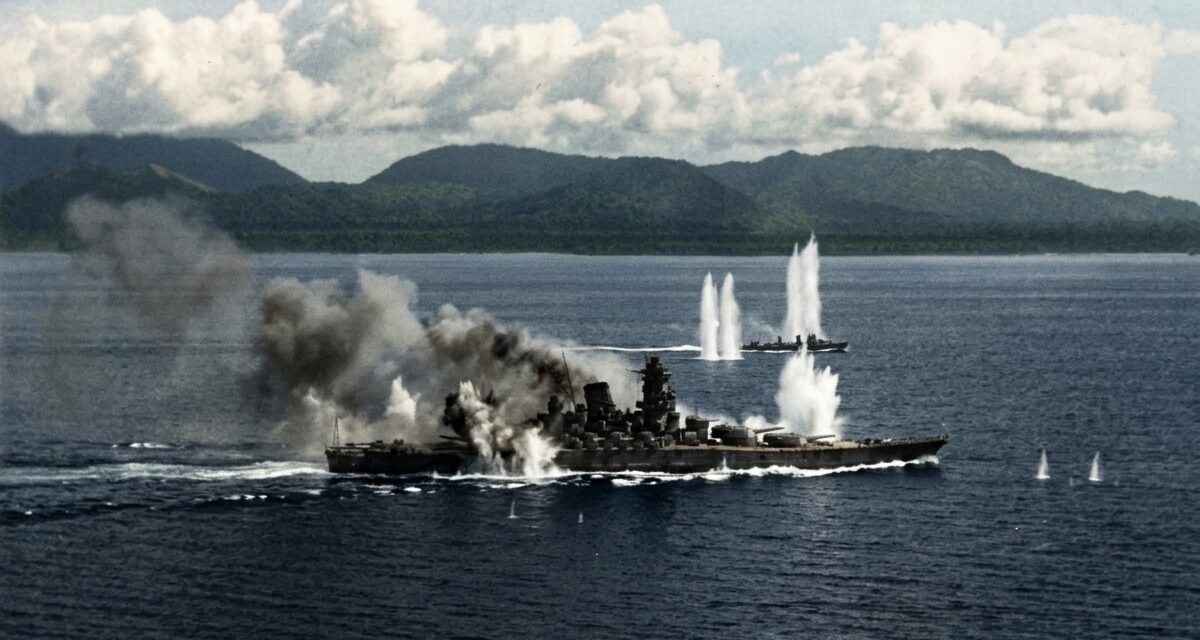
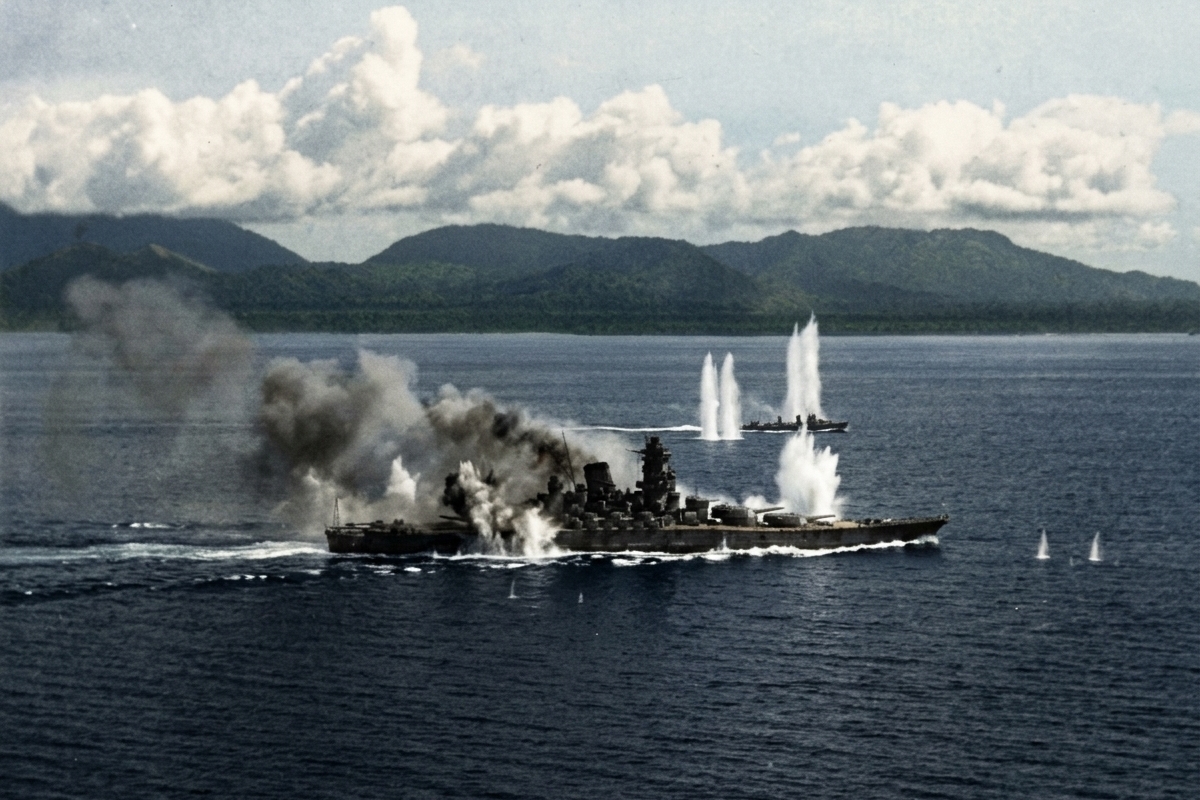
A Japanese battle fleet had just smashed through an unguarded strait and was tearing apart the flimsy American ships defending an invasion force with nowhere to run—and then, with total victory in reach, it simply turned around and sailed away. Vice Admiral Takeo Kurita’s decision to break off the attack off Samar on October 25, 1944, with the beaches of Leyte and thousands of American lives essentially undefended before him, remains one of the most debated command decisions of the Pacific War. His own postwar explanations cited confusion about the size of the force he faced and worry over his dwindling fuel, but no account has ever fully settled why he turned back from a battle he was winning, at the very moment an entire American invasion hung in the balance.
Leyte Gulf: The Road to Battle
By October 1944, General Douglas MacArthur was finally in position to make good on the pledge he had made after being forced out of the Philippines in 1942: “I shall return.” The planned invasion of Leyte was designed to reestablish an Allied foothold in the islands and cut Japan off from the oil and resources of Southeast Asia that its war economy depended on. Japan’s naval command understood the stakes just as clearly. Losing the Philippines would sever the supply lines keeping its fleet fueled and its war machine running, so Japan committed nearly everything it had left afloat to stopping the landing, setting the stage for what would become the largest naval battle in history.
The Japanese plan, codenamed Sho-Go, was audacious and desperate in equal measure, reflecting a navy that understood it was gambling nearly everything it had left. A decoy carrier force under Vice Admiral Jisaburo Ozawa, its flight decks nearly emptied of aircraft after earlier catastrophic losses, was sent north to lure the powerful American Third Fleet away from the invasion beaches, sacrificing itself as bait. Meanwhile, two separate Japanese surface forces, built around the surviving battleships and heavy cruisers of what had once been among the most powerful fleets in the world, would converge on the exposed landing area from the south and center, hoping to fall on the invasion fleet while its main protection was drawn off in pursuit of the decoys. It was a plan that depended entirely on American commanders taking the bait, and on the morning of October 24, 1944, as American carrier aircraft began pounding the approaching Japanese formations in the Sibuyan Sea, the pieces of what would become the largest naval engagement in history started falling into place across hundreds of miles of Philippine waters.
The Battle of Leyte Gulf
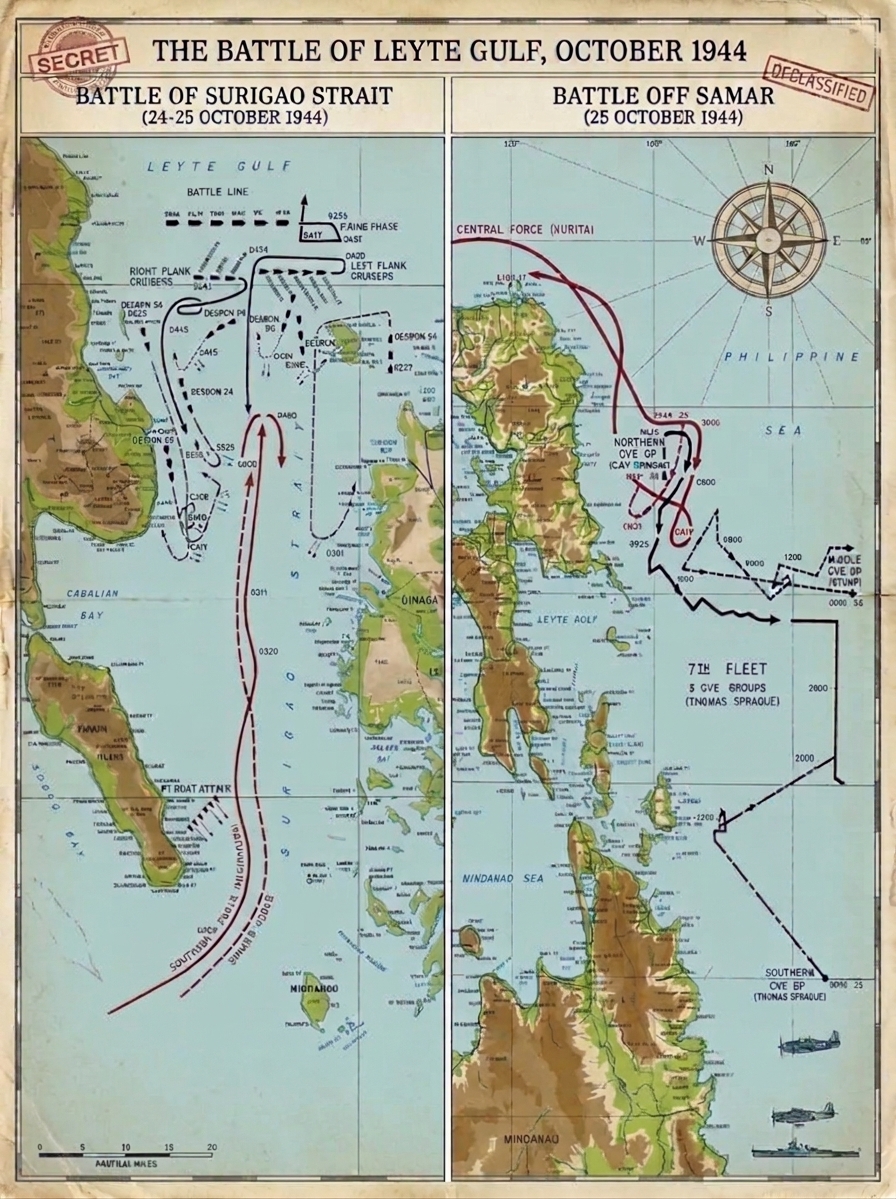
The battle unfolded simultaneously across four separate actions spread over several days and a vast expanse of ocean, making it in truth several battles fought under one name. In the Sibuyan Sea on October 24, American carrier aircraft launched wave after wave of attacks against Vice Admiral Kurita’s powerful Center Force, the strongest of the Japanese formations, built around battleships and heavy cruisers. The onslaught sank the giant battleship Musashi, one of the two largest battleships ever built, and damaged several other ships badly enough that Kurita temporarily reversed course, convincing American search planes and commanders that his force had been effectively neutralized as a threat to the landings.
Meanwhile, in the pitch darkness of the Surigao Strait to the south, a smaller Japanese force attempting to force its way through toward the landing beaches ran straight into a waiting American battle line. Several of the American battleships positioned there had themselves been raised and repaired after being sunk at Pearl Harbor less than three years earlier, and they now exacted a measure of revenge, executing a textbook nighttime ambush that crossed the Japanese formation’s T and virtually annihilated it. It stands today as the last engagement in history between battleships firing on each other directly, a fitting and symbolic end to an era of naval warfare.
Far to the north, Admiral William “Bull” Halsey took the bait laid by Ozawa’s decoy carrier force. Believing Kurita’s Center Force had been crippled beyond further threat and eager above all to destroy Japan’s remaining carriers once and for all, Halsey took his entire powerful Third Fleet in pursuit off Cape Engaño, leaving the San Bernardino Strait and the invasion beaches beyond it essentially unguarded. It was a gamble that nearly proved catastrophic. Kurita’s force, having reversed course yet again and slipped through the unwatched strait undetected overnight, emerged at dawn on October 25 directly in front of the small, lightly armed escort carriers and destroyers of the American task unit known as Taffy 3, which stood almost alone between the Japanese fleet and the vulnerable landing beaches.
What followed was one of the most desperate defensive actions of the Pacific War. Heavily outgunned and outmatched on paper, the American escort carriers launched every aircraft they had while their handful of destroyers charged directly at the much larger Japanese warships, laying smoke screens and pressing torpedo attacks at point-blank range to buy time. The scrappy defense sank or crippled several Japanese cruisers and destroyers, while an urgent, sharply-worded message from Admiral Chester Nimitz finally pulled Halsey’s distant fleet back south, though far too late to influence the fighting off Samar directly.
With the escort carriers burning, ammunition running desperately low, and the path to the essentially undefended landing beaches open before him, Kurita inexplicably broke off the attack and ordered a general withdrawal, just as total victory appeared within his grasp. By the time the four-day battle finally ended, Japan had lost most of its remaining large warships, including four carriers, three battleships, and numerous cruisers and destroyers, while enduring the first organized kamikaze attacks of the war. The Imperial Japanese Navy, gutted of its offensive strength, would never again mount a large-scale operation for the remainder of the conflict.
The Legacy of Leyte Gulf
Leyte Gulf effectively ended Japan’s ability to wage organized naval warfare for the rest of the war, clearing the way for the Philippine liberation campaign and the eventual advance toward the Japanese home islands. The battle also marked a grim turning point in tactics, introducing the organized kamikaze attacks that would grow into a defining and costly feature of the war’s final year, as a navy stripped of conventional striking power turned to more desperate means. For MacArthur, the successful landing fulfilled his public promise and became one of the most photographed and mythologized moments of the entire Pacific War. For historians, Kurita’s unexplained withdrawal at Samar remains one of the great unresolved questions of naval history, a decision that likely cost Japan its last realistic chance to inflict a serious blow on the American invasion at its single most vulnerable moment.
Visiting Leyte Gulf Today
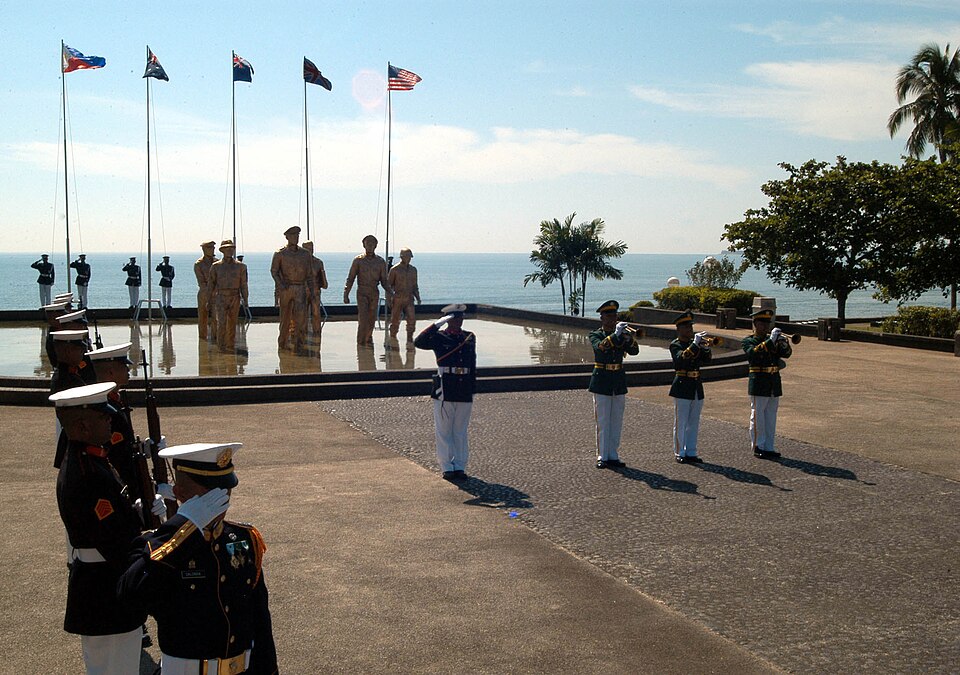
Like Jutland, the naval battle itself was fought entirely at sea, spread across the Sibuyan Sea, Surigao Strait, Cape Engaño, and the waters off Samar—far too vast an area to visit as a single battlefield. What visitors can see instead is the Leyte Landing Memorial, which commemorates the amphibious invasion that triggered the entire engagement rather than the naval fighting itself. Located about 5 km from Tacloban City, the memorial’s centerpiece is a striking set of seven double-life-sized bronze statues depicting General MacArthur and his officers wading ashore through a shallow reflecting pool, recreating the iconic photograph taken on October 20, 1944.
A small adjacent museum displays photographs and memorabilia from the campaign, along with a bronze cast of MacArthur’s own footprints taken at the landing site. The park is best visited in the afternoon or evening, when temperatures are more comfortable for walking the grounds and reflecting pool area, and its proximity to downtown Tacloban makes it an easy addition to a visit that also takes in the city’s other wartime landmarks.
Annual commemorations are held every October 20 to mark Leyte Gulf Landing Day, featuring historical reenactments and wreath-laying ceremonies that draw both Filipino and international visitors. While the memorial focuses on the land invasion rather than the sprawling naval battle it set in motion, it remains the most tangible physical connection to one of the largest and most consequential naval engagements ever fought.
Remembrance of Leyte Gulf
Because the battle unfolded across such a vast stretch of ocean, formal remembrance is scattered rather than centered on a single site. The ships lost in the four separate actions—American, Japanese, and Australian among them—rest across hundreds of miles of Philippine waters, with many crews never recovered and no accessible grave beyond the sea itself. In the Philippines, the Leyte Landing Memorial serves as the focal point for both national commemoration and the broader story of liberation that followed the invasion. The USS Samuel B. Roberts, one of the destroyers lost defending Taffy 3 off Samar, was located on the ocean floor by deep-sea researchers in 2022, briefly reviving public attention to a stand still regarded by many naval historians as one of the most courageous actions in American naval history. Veterans’ associations and naval historical societies in the United States, Japan, and Australia continue to mark the battle’s anniversary each October, often with academic conferences examining the still-unresolved tactical questions it raised. For a battle whose scale and consequences are difficult to overstate, Leyte Gulf’s memory survives less through a single hallowed ground than through the enduring debate over the decisions—Halsey’s pursuit, Kurita’s withdrawal—that decided its outcome.
Further Exploration: Book titled “The Battle of Leyte Gulf: 23-26 October 1944” by Thomas J. Cutler (Naval Institute Press, 1994)
Location: MacArthur Landing Memorial National Park, Barangay Candahug, Palo, Leyte, 6501, Eastern Visayas, Philippines (the naval battle itself was fought across open waters around Leyte, Samar, and Surigao Strait with no fixed land site)
Site Status: National Park / Managed Historic Site
Visitation Notes: Like Jutland, the naval engagement itself was fought at sea across a huge area (Sibuyan Sea, Surigao Strait, Cape Engaño, and off Samar), so this memorial commemorates the Leyte landings that triggered the battle rather than a naval battlefield. The centerpiece is a set of seven double-life-sized bronze statues of MacArthur and his officers wading ashore through a shallow reflecting pool, recreating the iconic October 20, 1944 landing photo. A small adjacent museum holds photographs, memorabilia, and a bronze cast of MacArthur’s footprints. The site is about 5 km from Tacloban City. Annual commemorations are held every October 20 (Leyte Gulf Landing Day), with reenactments and wreath-laying. Best visited afternoon or evening to avoid midday heat.
Google Map
Visitor Comments
Marty (Mandaue, Philippines) wrote it was “well worth the visit, even if you aren’t into military history,” and recommends taking a tricycle or tour guide from downtown Tacloban.
— from TripAdvisor
Teresa C (Metro Manila, Philippines) called it “quite a sight seeing the monument to this historical event… tastefully done,” and liked the bilingual English/Filipino plaques and uncrowded displays.
— from TripAdvisor
JARROD W (Port Hope, Canada) praised a new boardwalk at the park and recommended evening visits for cooler walking.
— from TripAdvisor
Levi Sanchez called the memorial a powerful tribute to history and heroism, reflecting on the scale of the naval battle fought in these waters.
— from Google Reviews