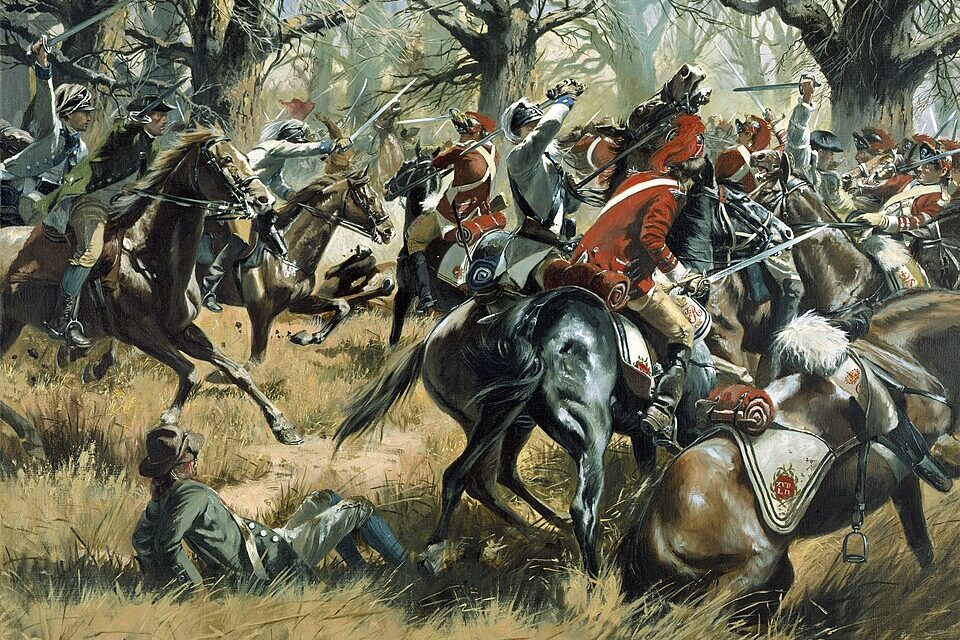
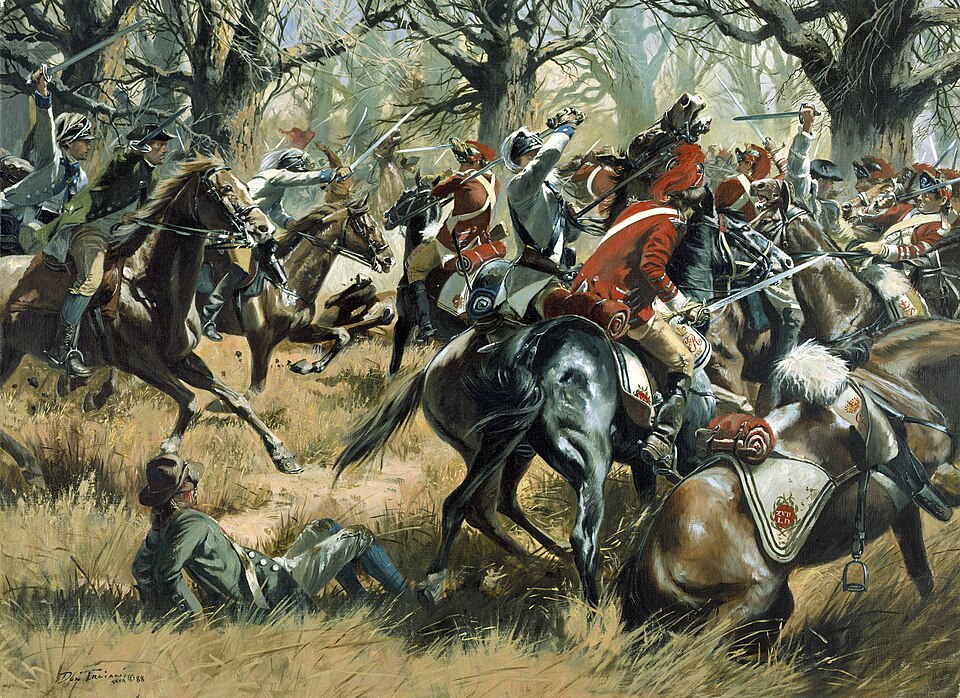
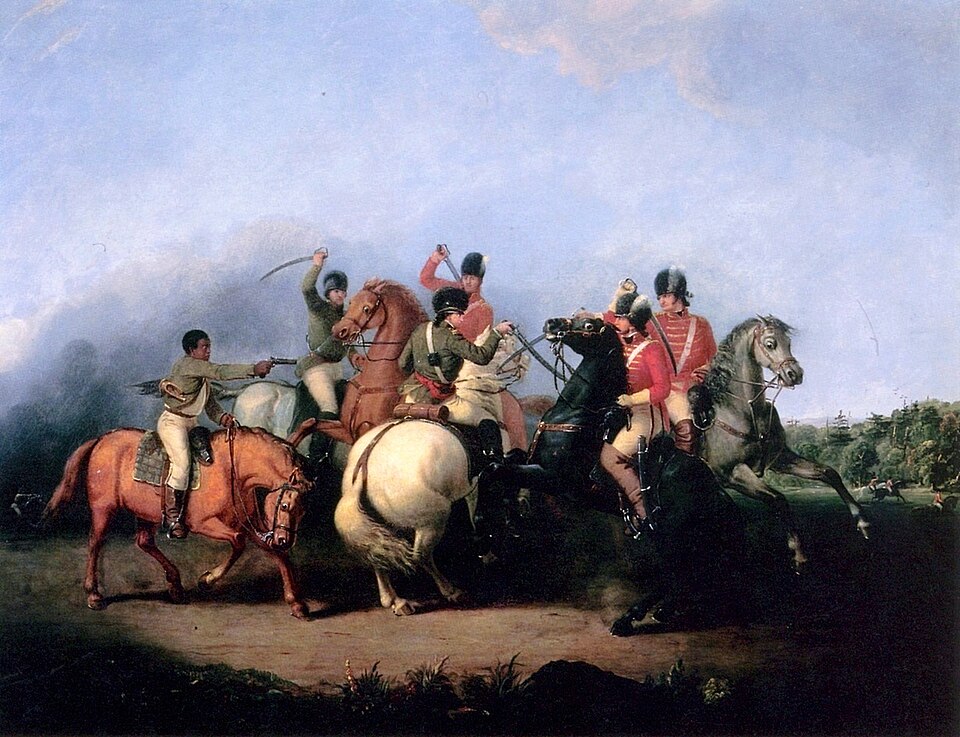
In the chaos of retreat at Cowpens, South Carolina, on January 17, 1781, Lieutenant Colonel William Washington spurred his horse straight at the fleeing Banastre Tarleton and traded saber blows with the British cavalry commander in a duel so close that a teenage bugler reportedly saved Washington’s life by shooting Tarleton’s pistol hand before the two men parted, Tarleton galloping off with a saber-scarred hand and his legendary Legion destroyed behind him. That brief, almost theatrical clash between two rival commanders capped one of the most tactically sophisticated victories of the American Revolution, an engagement in which General Daniel Morgan turned his army’s greatest weakness, unreliable militia prone to bolting under fire, into the very mechanism that lured a numerically similar British force into a trap it never saw coming.
Cowpens: The Road to Battle
By early January 1781, the war in the South had become a grinding pursuit, with Lieutenant Colonel Banastre Tarleton’s British Legion chasing Daniel Morgan’s smaller American force across the Carolina backcountry after the Continental Army’s stinging defeat of Patrick Ferguson’s Loyalists at Kings Mountain months earlier had emboldened the American cause. General Charles Cornwallis, eager to crush Morgan’s detachment before it could reunite with Nathanael Greene’s main Southern Army, dispatched Tarleton with a fast-moving force of roughly 1,100 British regulars, Loyalist infantry, and dragoons to hunt Morgan down, confident that his opponent’s mix of Continental regulars and unreliable militia could not withstand a determined assault. Morgan, retreating northward with the swollen Broad River at his back, made the deliberate and controversial decision to make his stand at a stretch of open pastureland known locally as the Cowpens, a place with no natural escape route, a decision that struck some of his own officers as reckless precisely because a river to the rear meant defeat would be catastrophic and there could be no orderly retreat if his lines broke.
Morgan’s genius lay not in avoiding this risk but in transforming it into a tactical asset: with escape effectively foreclosed, he calculated that his militia, so often blamed for battlefield collapses because they fled at the first volley, could be given an achievable, narrowly defined task rather than an open-ended stand, and would perform admirably. He devised an unusual three-line defense, placing skirmishers with rifles in front, a second line of militia under Andrew Pickens with explicit orders to fire exactly two aimed volleys at the advancing British and then deliberately withdraw around the American left flank, and Continental regulars under John Eager Howard positioned on a slight rise as the third and decisive line. Morgan personally rode among his militia companies the night before the battle, encouraging the men and making sure every soldier understood the plan in detail, a level of direct engagement with the rank and file that historians have credited with the unusual discipline the militia displayed the following morning. Tarleton, meanwhile, pushed his exhausted men through a grueling overnight march to catch Morgan before he could escape across the river, arriving at Cowpens still confident that a quick, aggressive assault would scatter the American militia as it always had before.
The Battle of Cowpens
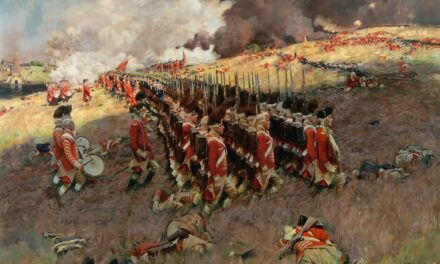
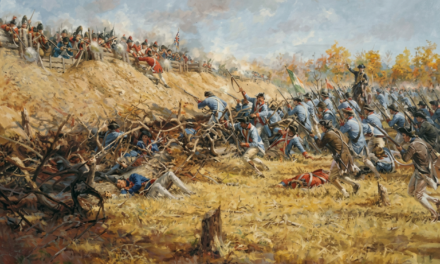
When Tarleton’s force advanced onto the field on the morning of January 17, 1781, the battle unfolded almost exactly as Morgan had planned it, a rare instance in military history of a commander’s pre-battle calculations matching the chaotic reality of combat with startling precision. American skirmishers opened fire first, picking off several British officers before falling back, and then Pickens’s militia delivered their promised two volleys at close range, inflicting serious casualties before withdrawing around the American left exactly as ordered, a controlled retreat that Tarleton’s forces mistook for the customary militia collapse they had exploited in every previous engagement. Believing the Americans were breaking, the British pressed forward in a disorganized rush directly into Howard’s waiting line of Continental regulars, who delivered a devastating volley at close range that stopped the British advance cold and, after a brief confused moment when a mistaken order to retreat was quickly reversed, the Continentals turned and delivered a bayonet charge that shattered the British center. At the critical moment, Lieutenant Colonel William Washington’s Continental cavalry, held in reserve, swept around the American right to strike the British flank and rear just as Pickens’s supposedly fleeing militia reformed behind the hill and rejoined the fight from an unexpected angle, catching Tarleton’s force in a near-complete double envelopment that left his soldiers surrounded on three sides with nowhere to retreat.
The destruction of the British force was swift and total: within roughly an hour, the bulk of Tarleton’s vaunted Legion, considered one of the most feared units in the British Southern Army, was killed, wounded, or captured, while Tarleton himself managed to escape only after his brief, furious saber duel with Washington during the general collapse of his line. American losses were remarkably light, a handful of dead and wounded against British casualties that approached nine hundred killed, wounded, or captured out of a force of roughly eleven hundred, one of the most lopsided tactical victories of the entire war. Lieutenant Colonel William Washington’s cavalry, having broken the British right during the envelopment, pursued fleeing Legion dragoons for miles afterward, ensuring that few of Tarleton’s mounted troops escaped to fight another day. Historians studying the battle, including Lawrence Babits in his detailed reconstruction “A Devil of a Whipping,” have emphasized that Morgan’s success depended on precise timing and disciplined execution at every level, from the militia’s exact two volleys to the Continental line’s coordinated counterattack, a degree of battlefield choreography rarely achieved by armies of the period. Andrew Pickens, commanding the militia line that had absorbed so much of the pre-battle worry, deserves particular credit for holding his men to their assigned task under fire, since a premature or disorganized retreat at that stage could easily have unraveled into the very rout Morgan had feared and handed Tarleton the victory his aggressive tactics had won so many times before.
The speed of the American collapse of British resistance also owed something to psychological momentum: once the Continental bayonet charge broke the British center and Washington’s cavalry appeared on the flank simultaneously, many British soldiers simply threw down their weapons rather than continue fighting a battle that had turned, in the span of minutes, from an apparently easy pursuit into a closing trap. Morgan himself remained active throughout the engagement, riding along his lines to steady nervous militia and coordinate the Continental counterattack, a hands-on style of command that contemporaries credited with holding together a battle plan whose success depended on split-second timing between separate, physically distant units of his small army.
The Legacy of Cowpens
The destruction of Tarleton’s Legion at Cowpens dealt a blow to Cornwallis’s Southern strategy from which the British effort never fully recovered, stripping away a substantial portion of his mobile strike force and forcing him into the exhausting pursuit of Nathanael Greene’s army that would eventually lead to the costly British victory at Guilford Courthouse and, ultimately, the road to Yorktown. Morgan’s tactics at Cowpens became a celebrated case study in military academies for generations afterward, admired as one of the few genuinely original tactical innovations of the Revolutionary War, a battle plan that turned a conventional weakness into a decisive advantage through discipline and careful preparation.
Visiting Cowpens National Battlefield Today
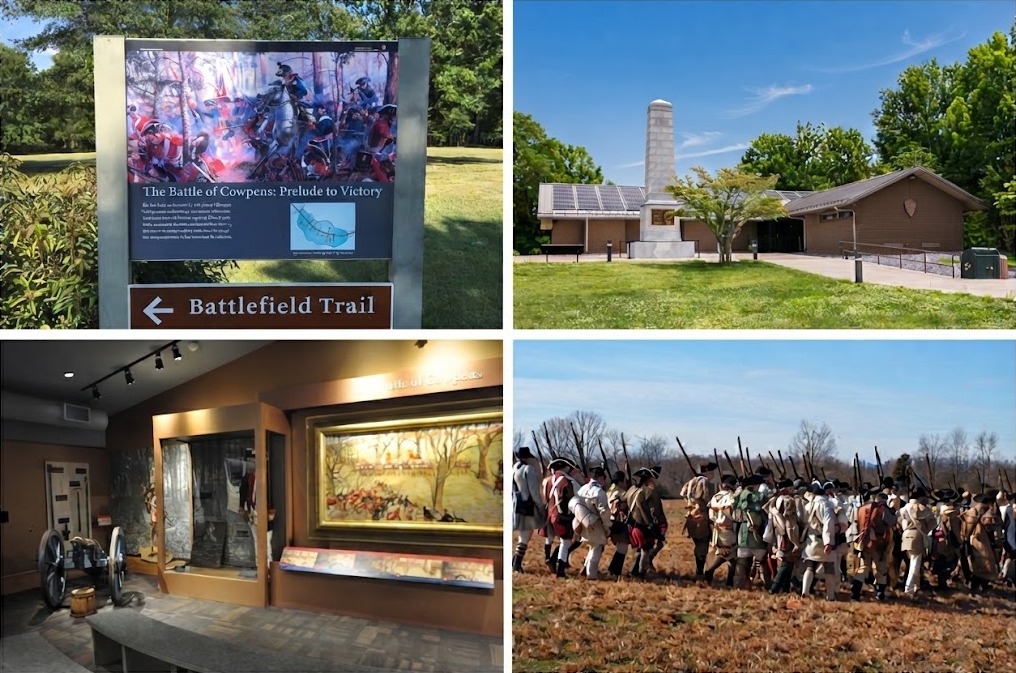
Cowpens National Battlefield, managed by the National Park Service near Gaffney, South Carolina, preserves the open pastureland where Morgan’s three-line defense unfolded, and the visitor center offers an eighteen-minute orientation film shown hourly alongside museum exhibits displaying period weaponry and uniforms that help visitors picture the militia and Continental lines as they stood on the morning of the battle. Visitors can walk the mile-long Battlefield Trail through the actual preserved terrain where Pickens’s militia fired their two volleys and withdrew, or take the self-guided three-mile driving loop that traces the wider battlefield, including the ground where Washington’s cavalry executed its decisive flanking maneuver. The park’s grounds include picnic areas and biking-friendly roads, along with Junior Ranger programs for younger visitors and periodic ranger talks and reenactment events that bring the battle’s tactics to life for a modern audience.
Visitors and reviewers have consistently described the site as quiet, well-preserved, and refreshingly undeveloped, a landscape that has changed little enough since 1781 that it remains possible to stand on the rise where Howard’s Continentals held their line and see the same open ground across which Tarleton’s confident, exhausted soldiers advanced into disaster. The battlefield’s largely unspoiled character, without the modern intrusions that crowd many other Revolutionary War sites, makes it especially well suited to visitors trying to understand the tactical geography that made Morgan’s unusual three-line gamble possible in the first place. Because the terrain remains open pastureland much as it was in 1781, visitors walking the Battlefield Trail can trace the actual sequence of the fight on foot, moving from the ground where the skirmishers first opened fire, through the low rise where Pickens’s militia turned and delivered their two volleys, to the slight elevation where Howard’s Continentals held the line that ultimately broke Tarleton’s advance. The National Park Service maintains the site with an emphasis on interpretation rather than reconstruction, relying on wayside markers and the orientation film to help visitors understand a battle whose outcome depended less on fortifications or terrain features than on the disciplined timing of separate units moving according to Morgan’s carefully rehearsed plan.
Remembrance of Cowpens
General Daniel Morgan’s own after-action report to Nathanael Greene, written just two days after the battle on January 19, 1781, remains the essential primary source for understanding how deliberately he had planned the American defense, and it is cited throughout modern historical accounts of the engagement. Banastre Tarleton’s own version of events, published in his 1787 memoir “A History of the Campaigns of 1780 and 1781,” offers a self-serving but historically valuable British perspective on a defeat that effectively ended his reputation as an invincible cavalry commander. Lawrence Babits’s academic study “A Devil of a Whipping,” published by the University of North Carolina Press, remains the most thorough modern reconstruction of the battle’s tactical details, including the William Washington-Tarleton duel that became one of the Revolution’s most retold personal confrontations. The firsthand memoir of James Potter Collins, a teenage South Carolina militiaman who fought in the battle and later published his recollections, offers a rare enlisted man’s perspective on the militia’s controlled retreat and the moment Washington’s cavalry swept back into the fight to complete the American victory.
Visitor Info: Cowpens National Battlefield (National Park Service)
Location: Cowpens National Battlefield, 4001 Chesnee Hwy, Gaffney, SC 29341
Site Status: National Park/Managed Historic Site
Visitation Notes: The visitor center features an 18-minute orientation film shown hourly, museum exhibits with period weaponry and uniforms, and a bookstore. Visitors can walk the 1-mile Battlefield Trail or take a self-guided 3-mile loop driving tour, both winding through the actual preserved pasture where the battle occurred. The park includes picnic areas, biking-friendly roads, Junior Ranger programs, and periodic ranger talks and reenactment events. The site is widely described as quiet, well-preserved, and largely undeveloped, letting visitors picture the battle’s terrain.
Google Map
Visitor Comments
A visitor named manfredl visited during a July 2016 reenactment event, calling it awesome and praising the well-organized event, quality walking trails, and attractive, historically rich landscape.
— from TripAdvisor
A visitor named etaravella described the battlefield as quiet, peaceful and haunting with beautiful scenery, enjoyed the museum’s weaponry and tactics exhibits, walked part of the loop trail, and appreciated a ranger who gave helpful context, though they wished they’d budgeted more time there.
— from TripAdvisor