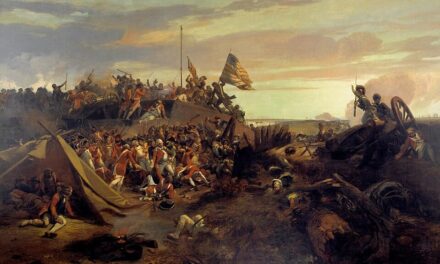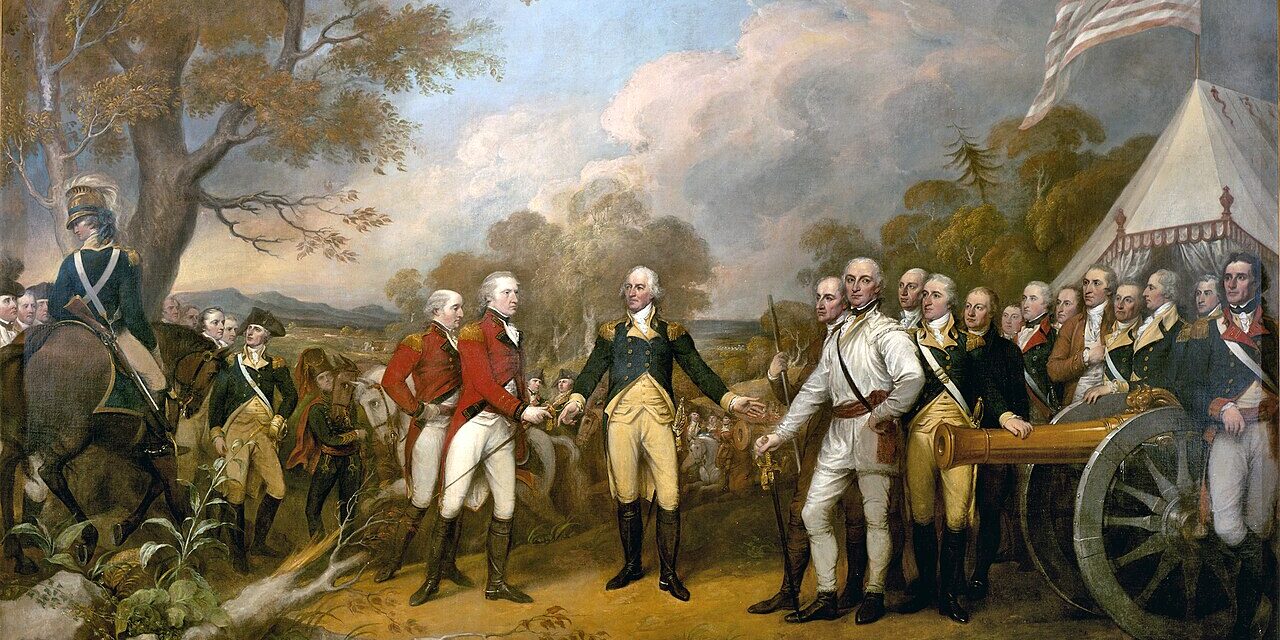
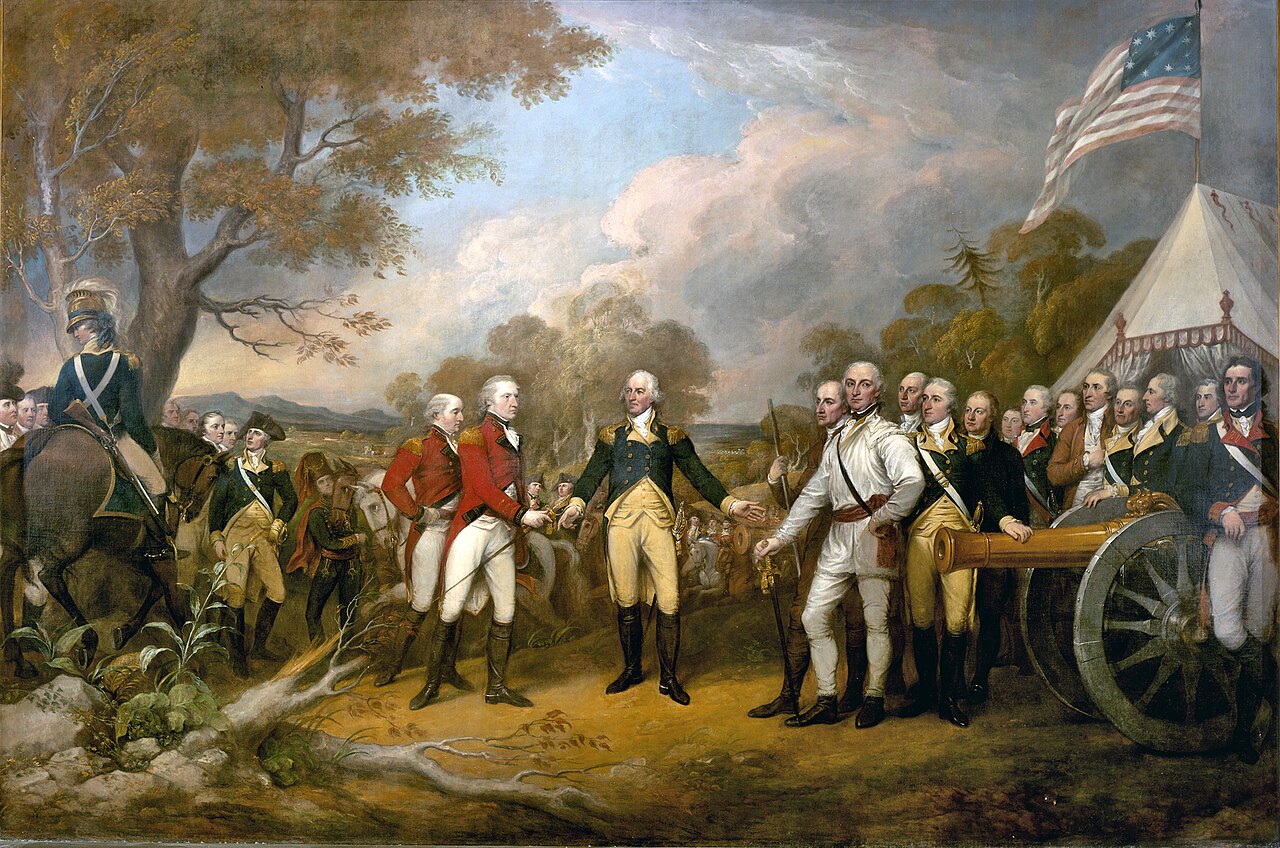
Muskets went down in neat rows, stacked by soldiers who had marched south from Canada certain they would help cut the American rebellion in half. Nearly six thousand of them laid down their arms that October afternoon in a ceremony neither army had ever staged on this scale before — the first time an entire British field army surrendered in the war. Regimental fifers and drummers reportedly played their own defeated companies past the American lines without lifting their eyes, and the American officers watching, exhausted from a month of hard fighting, stood by in something closer to silence than celebration, as if aware that whatever had just happened mattered well beyond this one Hudson Valley field. Word of that quiet, humiliating ceremony would cross the Atlantic within weeks and pull an entire foreign power into the war.
Saratoga: The Road to Battle
In the summer of 1777, British General John Burgoyne set out from Canada with a force of roughly 8,000 British, German, and allied troops, intending to march south along the Hudson River corridor and link up with British forces advancing from New York City. The plan, if it succeeded, would have cut off New England from the rest of the rebelling colonies and, British planners hoped, broken the back of the American war effort in a single stroke. Burgoyne’s advance went well at first, capturing the American stronghold at Fort Ticonderoga in early July without a serious fight, but the campaign slowed badly as his army struggled to move heavy artillery and supplies through dense wilderness while American militia felled trees and destroyed bridges in its path.
By September, Burgoyne’s army had crossed the Hudson River and encountered a growing American force under Major General Horatio Gates, dug in on high ground near Saratoga, New York, with subordinate commanders Major General Benedict Arnold and Colonel Daniel Morgan playing central roles in the defense. American militia and Continental regiments had swelled Gates’s ranks throughout the summer as word spread of Burgoyne’s slow, grinding advance, and by the time the two armies faced each other near Saratoga the numerical advantage had shifted decisively toward the Americans. Burgoyne, increasingly short on supplies and still hoping for reinforcement from British forces under Sir Henry Clinton advancing up the Hudson from New York City, pressed forward into a fight he could not avoid and reinforcements that would not come in time. Tension within the American command was also building that same month, as Gates and his subordinate Arnold clashed bitterly over strategy and credit, a rivalry that would shape how the coming battles were fought and remembered.
The Battles of Saratoga
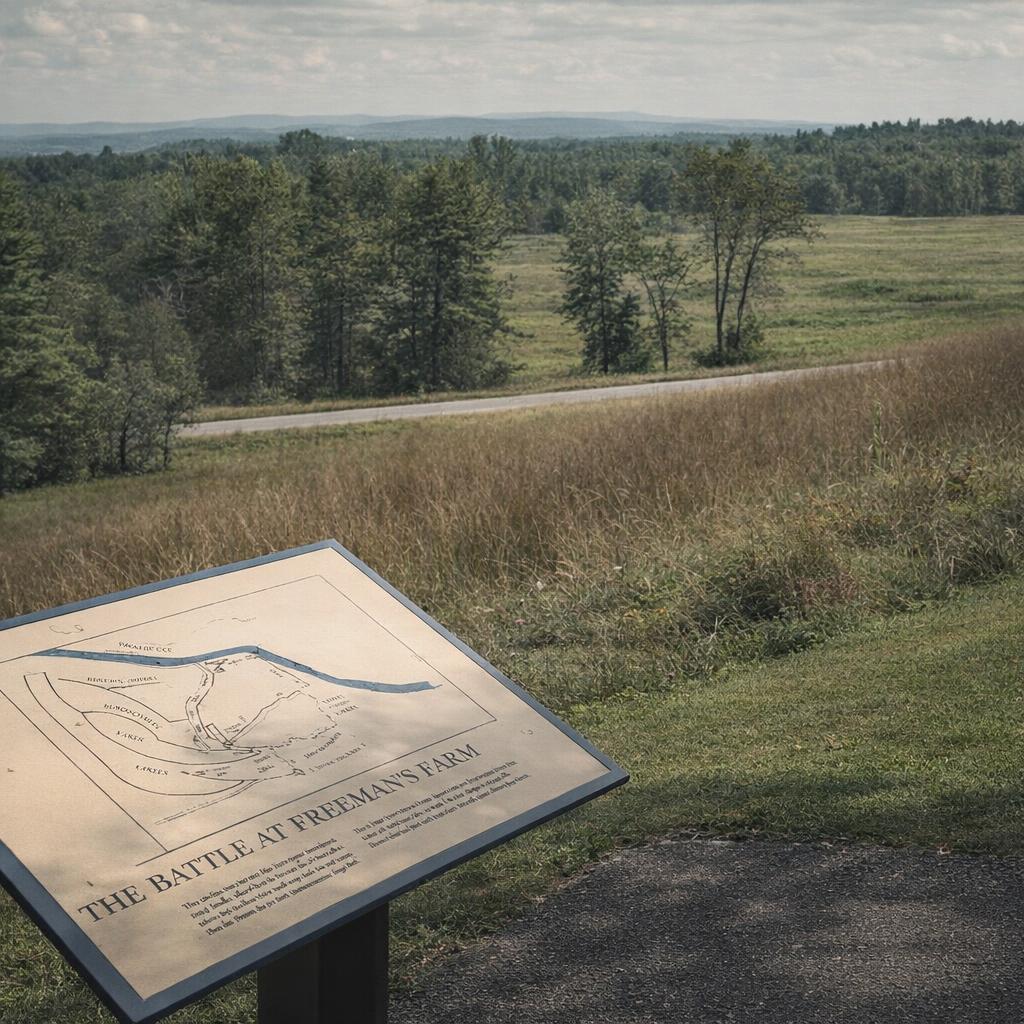
The first clash, the Battle of Freeman’s Farm on September 19, 1777, was a bloody, seesawing fight in which Daniel Morgan’s riflemen, an elite corps of sharpshooters, harassed British officers with accurate long-range fire from the tree line while American and British regulars traded volleys across open farmland for hours, the fighting surging back and forth over the same few hundred yards of clearing as first one side and then the other gained the upper hand. Burgoyne’s troops held the field by nightfall, but at a cost of several hundred casualties his depleted army could not easily absorb, while the Americans, though pushed back, remained very much intact and dug in behind their lines under fortifications designed by the Polish military engineer Thaddeus Kosciuszko. Lieutenant William Digby of the British 53rd Regiment of Foot recorded the fighting at Freeman’s Farm in a campaign journal that survived the war, later published as The British Invasion from the North, offering a rare first-hand British account of an engagement that left his side technically victorious but strategically no closer to breaking through, and one in which he described the shock of facing riflemen who could pick off officers at ranges far beyond the reach of standard infantry muskets.
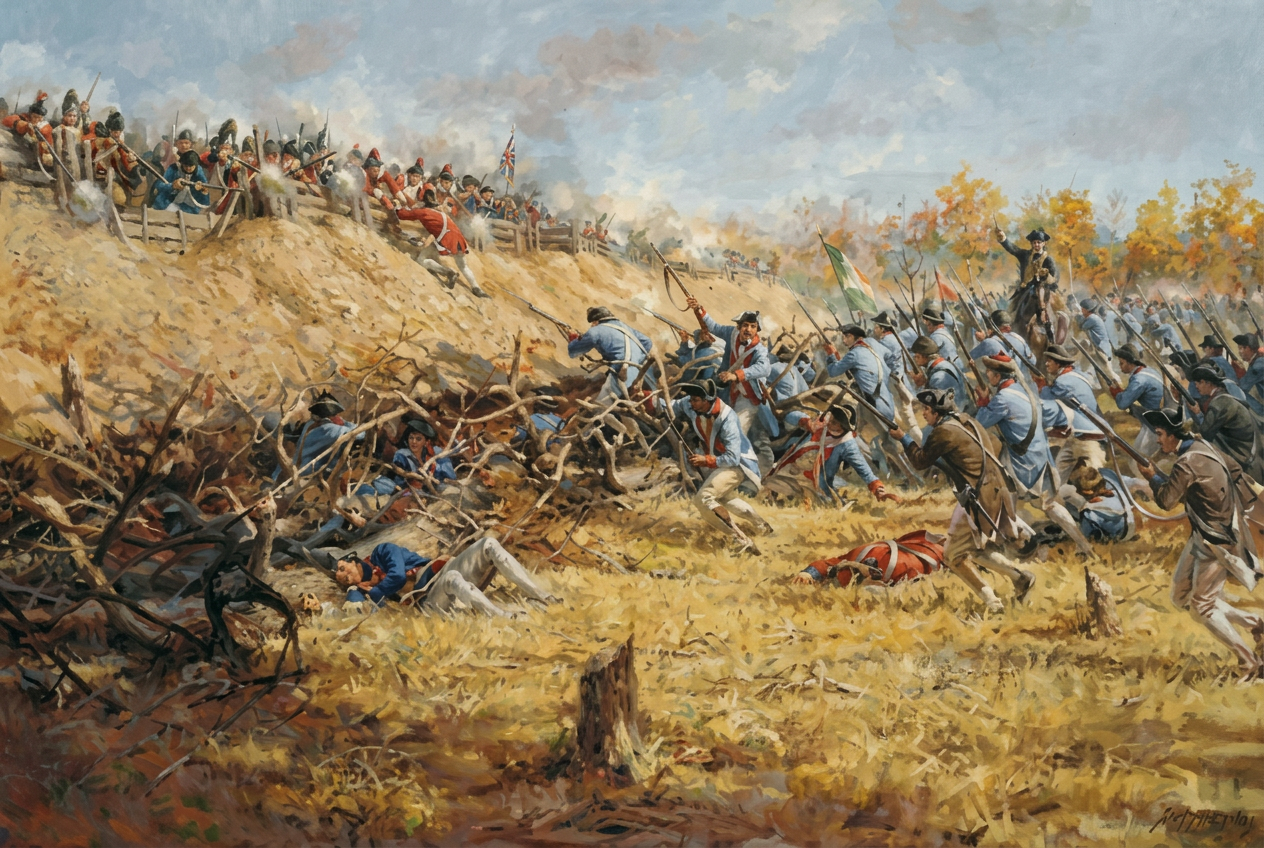
Three weeks later, on October 7, Burgoyne sent a reconnaissance force forward to probe the American lines at Bemis Heights, triggering a second, far more decisive battle. Benedict Arnold, who had been stripped of formal command by Gates after a bitter dispute between the two generals, rode onto the field without orders and personally led an unauthorized charge against the Breymann Redoubt, a key British fortification anchoring the north end of Burgoyne’s line. The assault broke through, and Arnold was shot and wounded in the same leg he had injured two years earlier during the failed invasion of Quebec, a wound serious enough that doctors considered amputation before he refused it. Daniel Morgan’s riflemen, meanwhile, continued targeting British officers from a distance, and their fire is credited with mortally wounding British Brigadier General Simon Fraser, a loss that badly demoralized Burgoyne’s army in the battle’s final phase. With his lines collapsing and casualties mounting, Burgoyne ordered a retreat to fortified positions near Saratoga village, but American forces under Gates soon surrounded his weakened army entirely, cutting off any hope of escape or resupply.
Trapped and outnumbered, with no relief force in sight, Burgoyne surrendered his entire army of nearly 6,000 men to Gates on October 17, 1777, under the terms of what became known as the Convention of Saratoga, which nominally allowed his troops passage home to Britain in exchange for a pledge not to serve again in the war, a pledge Congress later refused to honor. It was the first time an entire British army had surrendered in the field during the war, and news of the victory reached Paris within weeks, carried across the Atlantic by American envoy Benjamin Franklin’s contacts, convincing the French government that the American cause was one worth backing openly rather than merely supplying in secret as it had done for the previous two years. France signed a formal treaty of alliance with the United States the following February, providing the money, arms, and naval power that would prove decisive in the years of fighting still to come, including the eventual siege at Yorktown that ended the war.
The Legacy of Saratoga
Historians widely regard Saratoga as the turning point of the American Revolutionary War, not for the size of the armies involved but for the diplomatic earthquake the victory triggered in Europe. The surrender of an entire British army persuaded France that the American rebellion had a genuine chance of success, and the alliance that followed brought French ships, soldiers, and money into the war at a moment when the Continental Army badly needed all three, transforming a colonial uprising into a wider international conflict that stretched British resources across the globe. Benedict Arnold’s unauthorized charge at Bemis Heights, and the wound he suffered there, sit uneasily alongside his later betrayal at West Point, a complication that has kept his role at Saratoga a subject of ongoing historical debate rather than simple celebration; the Boot Monument’s refusal to name him captures that discomfort in stone. Daniel Morgan, by contrast, went on to a celebrated later career, most notably commanding the decisive American victory at the Battle of Cowpens in 1781. In the end, it wasn’t a single tactic on the field at Saratoga that changed the war’s trajectory — it was the alliance the surrender bought in Paris, a reminder that a battle’s true significance sometimes lies far from the ground where it was actually won.
Visiting Saratoga National Historical Park Today
Saratoga National Historical Park preserves the core of the battlefield near Stillwater and Schuylerville, New York, roughly 30 miles north of Albany, and is free to enter and open daily. A nine-mile self-guided auto tour road with ten interpretive stops leads visitors past the key sites of the fighting, including Freeman’s Farm, the Neilson Farm, and the Breymann Redoubt where Arnold was wounded, and the road is open to walkers, runners, and cyclists before it opens to vehicle traffic each morning. The Neilson Farm cabin, the only surviving 1777 structure on the battlefield, still stands along the tour route, and the visitor center lets children try on reproduction Continental Army uniforms alongside displays of period artillery.
Spring through fall offers the most comfortable conditions for the driving and walking trails, which range from about two to 4.2 miles across the rolling farmland where the two battles were fought, and no advance booking is required for a general visit. The park hosts annual living-history encampments and commemorative events each October around the anniversary of Burgoyne’s surrender on October 17, drawing costumed reenactors and crowds who come to walk the same ground where Morgan’s riflemen and Arnold’s charge broke the British line. Visitors with more time can also continue a few miles north to the Saratoga Surrender Site and Monument in Schuylerville, where Burgoyne formally laid down his arms.
Remembrance at Saratoga
Saratoga is remembered today through the preserved landscape itself as much as through any single monument, with the auto tour route and its interpretive stops designed to let visitors trace the two battles across the same farmland and forest edges where they were fought. The park’s most quietly telling memorial may be the Boot Monument, which honors Benedict Arnold’s leg wound at the Breymann Redoubt without naming him directly, a deliberate omission reflecting his later treason and the country’s uneasy relationship with commemorating a traitor’s undeniable battlefield courage. Visitors describe the landscape as remarkably preserved and historically accurate, making it possible to picture the terrain much as the soldiers on both sides would have seen it, while the October living-history encampments bring the daily routines of Continental and British camp life back to the fields for a few days each year. A few miles north in Schuylerville, the Saratoga Surrender Site and Monument marks the spot where Burgoyne formally laid down his arms, a quieter counterpart to the battlefield itself that many visitors add to their trip as a coda to the auto tour.
Visitor Info: www.nps.gov
Location: Saratoga National Historical Park, 648 Route 32, Stillwater, New York 12170, United States
Site Status: National Park / Managed Historic Site
Visitation Notes: The park is near Stillwater and Schuylerville, New York, about 30 miles north of Albany. A 9-mile self-guided auto tour road with 10 interpretive stops (opens each morning, weather permitting) leads past Freeman’s Farm, the Neilson Farm, and the Breymann Redoubt where Benedict Arnold was wounded. Spring through fall is the most comfortable season for the driving and walking trails. The park hosts annual living-history encampments and commemorative events each October around the anniversary of Burgoyne’s surrender (October 17), and no advance booking is required for a general visit.
Google Map
Visitor Comments
Hannah H took a guided tour of the battlefield with guide Jim Hughto and came away having learned about the two separate battles fought at Saratoga in September and October 1777. She noted that the landscape remains remarkably preserved and historically accurate, making it easy to picture the terrain as the soldiers would have seen it.
— from TripAdvisor
emeraldisle45 from Morrisville, NY, using the handle emeraldisle45, said you really need to spend a full day here to absorb all the history the park holds. They praised the scenic views across the rolling farmland and battlefield and made a point of stopping to listen to a park docent along the tour route.
— from TripAdvisor
BurtNDee, visiting from Albany, NY, highlighted the reconstructed Neilson Cabin on the southern end of the Patriot encampment and the period artillery pieces displayed around the grounds. They also mentioned that the visitor center lets children try on reproduction Continental Army uniforms, a nice touch for families.
— from TripAdvisor
Travel writer Jennifer Broome described driving the nine-mile self-guided auto tour loop with its ten interpretive stops and recommended stopping at every one. She singled out the Neilson Farm, the only surviving 1777 structure on the battlefield, along with Freeman’s Farm, Bemis Heights, Breymann’s Camp, and the Boot Monument, which honors Benedict Arnold’s leg wound without naming him directly. She advised planning two to four hours for the tour, noted the road opens at 9am and is open to walkers, runners, and cyclists before then, and pointed out additional hiking trails ranging from two to 4.2 miles as well as the nearby Saratoga Surrender Site and Monument in Schuylerville.
— from Swept Away Today