French military planners chose the remote valley of Dien Bien Phu because its surrounding hills made heavy artillery impossible to bring within range, or so they believed. General Vo Nguyen Giap’s Viet Minh forces spent weeks doing what French commanders had judged physically impractical, hauling disassembled artillery pieces up steep, densely forested mountain trails by hand, using ropes, bamboo poles, and sheer manpower to drag guns into firing positions overlooking the French base rather than on the valley floor where French defenses expected them. When Viet Minh gunners opened fire from those hillside positions in March 1954, French artillery officers who had guaranteed the position’s safety found themselves unable to locate or silence guns firing down into their own fortifications, and the fifty-six-day siege that followed ended not just a single battle but France’s entire colonial presence in Indochina.
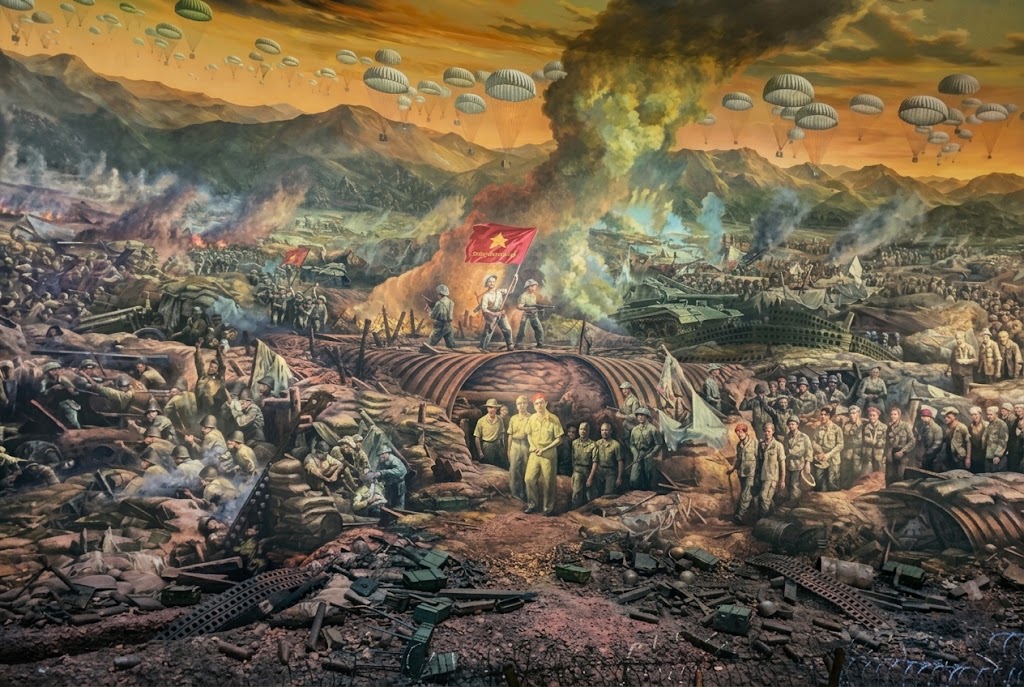
Dien Bien Phu: The Road to Battle
By late 1953, French commanders in Indochina, seeking to draw Viet Minh forces into a decisive conventional battle where superior French firepower and air support could destroy them, established a heavily fortified base in the remote valley of Dien Bien Phu near the border with Laos, reinforcing it with paratroopers and building a network of interconnected strongpoints, each given a woman’s name, across the surrounding terrain. French planners believed the valley’s location, ringed by steep, densely forested hills, made it effectively impossible for the Viet Minh to bring heavy artillery within range without French air power detecting and destroying the guns during transport, a calculation that assumed no army could move field artillery through terrain that lacked usable roads. General Vo Nguyen Giap, however, ordered his forces to disassemble their artillery pieces and haul them by hand up the steep jungle slopes overlooking the French base, a grueling months-long effort involving tens of thousands of laborers and soldiers working largely at night to avoid French aerial reconnaissance.
Giap positioned his guns not on the valley floor where French commanders expected any artillery threat to materialize, but dug into camouflaged firing positions on the surrounding high ground, giving Viet Minh gunners a commanding view directly down into the French fortifications below. By the time the siege began in March 1954, Giap had also assembled a vastly larger force than French intelligence had estimated possible in such difficult terrain, encircling the French garrison with troops and supply lines that French commanders had judged the surrounding jungle incapable of supporting. Tens of thousands of civilian laborers, many of them women, hauled supplies and ammunition along jungle trails by bicycle and on foot over hundreds of kilometers, a logistical effort French planners had likewise dismissed as impractical at the scale required to sustain a prolonged siege of this size. The French garrison itself numbered roughly 11,000 troops by the time fighting began, a force French commanders considered more than adequate to defend a position they believed no conventional army could realistically threaten with heavy weapons.
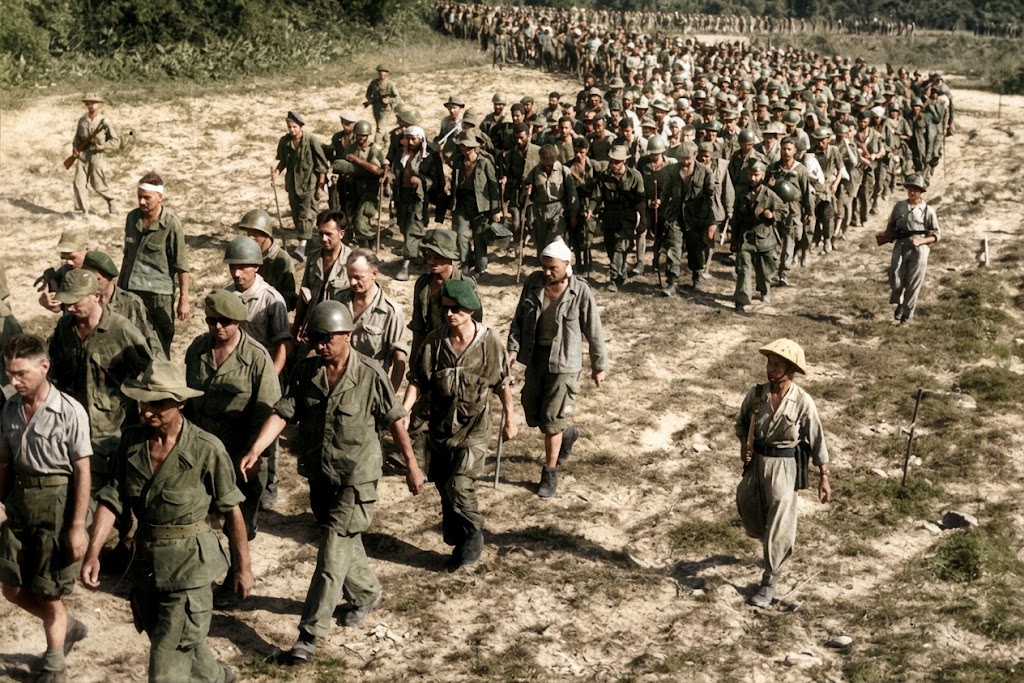
The Battle of Dien Bien Phu
Viet Minh artillery opened a devastating bombardment on March 13, 1954, catching French gunners completely unprepared for fire accurate enough to destroy the French airstrip within days, cutting off the garrison’s ability to resupply or evacuate wounded by air except through increasingly dangerous parachute drops. The French artillery commander, Colonel Charles Piroth, who had personally guaranteed that Viet Minh guns could never threaten the base, took his own life days into the siege once it became clear his artillery could not locate or silence the well-camouflaged Viet Minh positions in the surrounding hills. Fighting for the outlying strongpoints grew increasingly desperate over the following weeks as Viet Minh forces employed extensive trench and tunnel networks to approach French positions under cover, gradually strangling the garrison’s ability to maneuver or resupply between its fortified islands. The strongpoint known as Eliane 2, atop a hill the French called A1, became the scene of some of the siege’s bitterest fighting, culminating on May 6 when Viet Minh sappers detonated a mine packed with roughly 1,000 kilograms of explosives beneath the French position, blasting a massive crater and opening the way for the assault that finally overran the hill.
French Air Force flight nurse Genevieve de Galard, grounded at the base when her medevac aircraft was damaged under fire early in the siege, remained the only French woman in the garrison for its duration, tending wounded soldiers in field hospitals that grew steadily more overwhelmed as the fighting dragged on and evacuation became impossible. By early May, with ammunition and supplies critically low and the perimeter collapsing under repeated Viet Minh assaults, French commander Colonel Christian de Castries formally surrendered the garrison on May 7, 1954, ending fifty-six days of fighting that had cost the French roughly 2,200 killed and thousands more wounded or captured, with Viet Minh losses estimated considerably higher, a testament to the sheer scale of the assaults Giap had been willing to order against the French strongpoints throughout the siege.
The battle’s final hours saw French positions collapse in rapid succession as ammunition ran out across the perimeter, and by the time de Castries gave the order to cease resistance, organized French defense of the valley had effectively already ended in all but a handful of isolated pockets. News of the surrender reached Geneva the following day, where international negotiations over Indochina’s future were already underway, and the French defeat fundamentally reshaped the terms of the settlement that followed. Of the roughly 11,000 French Union troops taken prisoner at the siege’s end, only a fraction survived the brutal marches and camp conditions of Viet Minh captivity in the months that followed, a grim postscript to the battle that added significantly to its ultimate human cost on the French side.
The Legacy of Dien Bien Phu
The French defeat at Dien Bien Phu effectively ended France’s colonial rule in Indochina, leading directly to the Geneva Accords later that year that partitioned Vietnam and set in motion the conflicts that would eventually draw in the United States. The battle demonstrated to anti-colonial movements across the world that a well-organized indigenous force could defeat a major European colonial power in conventional battle, a lesson that reverberated far beyond Vietnam’s borders in the decades that followed. For France, the defeat marked a profound and lasting blow to its standing as a colonial power and to its military’s confidence in its ability to win wars of this kind, a wound that shaped French foreign and military policy for years afterward.
Visiting Dien Bien Phu Today
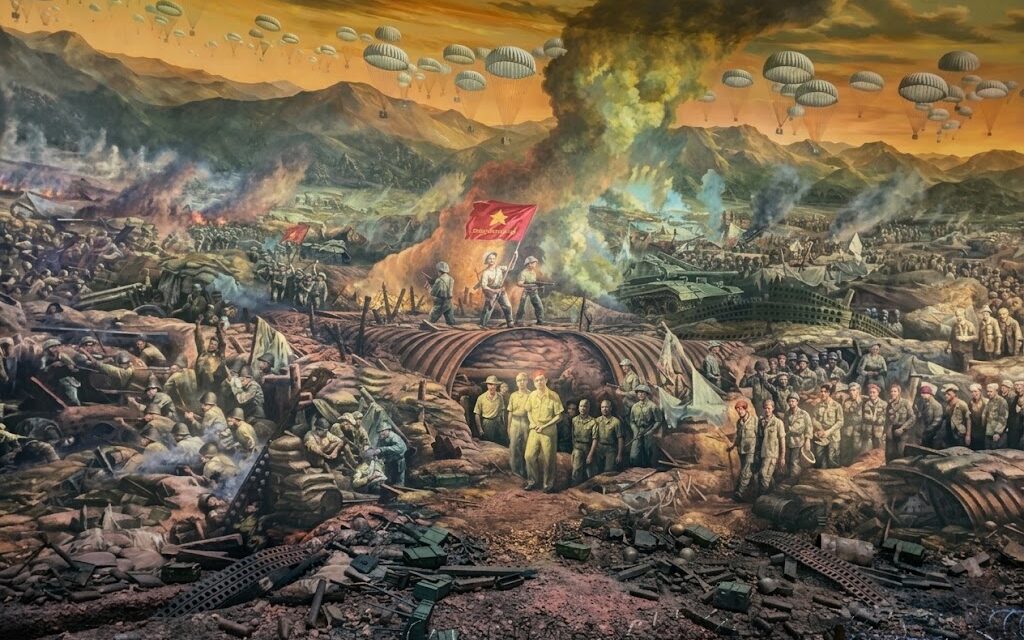
The Dien Bien Phu Victory Museum, opened in 2014 in Dien Bien Phu City, displays roughly 1,000 artifacts from the campaign alongside a sweeping 132-meter panoramic painting depicting the battle’s four distinct phases. Directly across the street from the museum, A1 Hill, the site of the former French strongpoint Eliane 2, preserves original trench systems, bunkers, and barbed-wire emplacements alongside a knocked-out French tank and the large crater still visible from the roughly 1,000-kilogram Viet Minh mine that triggered the battle’s final assault on May 6, 1954. General de Castries’ reconstructed command bunker is preserved within the same relic complex, offering visitors a direct sense of the cramped conditions under which the French command directed the siege’s final weeks, and the adjacent Martyrs’ Cemetery honors the Vietnamese soldiers killed during the campaign. Most visitors combine the museum, A1 Hill, and the cemetery into a single half-day visit, making Dien Bien Phu a manageable stop despite its remote location in Vietnam’s mountainous northwest.
The site anchors major annual commemorations each May 7, including a large military parade and state ceremony, with the battle’s seventieth anniversary in 2024 drawing especially large crowds and international attention to the site. Getting between the museum, A1 Hill, and the outlying relic sites generally requires a car or motorbike, since the sites are spread across a wider area than the city center’s compact museum-and-hill core alone would suggest. Dien Bien Phu City itself lies well off Vietnam’s main tourist circuit, roughly a full day’s travel from Hanoi by road or a short domestic flight, so most visitors treat the battlefield as the centerpiece of a dedicated trip to the region rather than an easy add-on to a broader Vietnam itinerary.
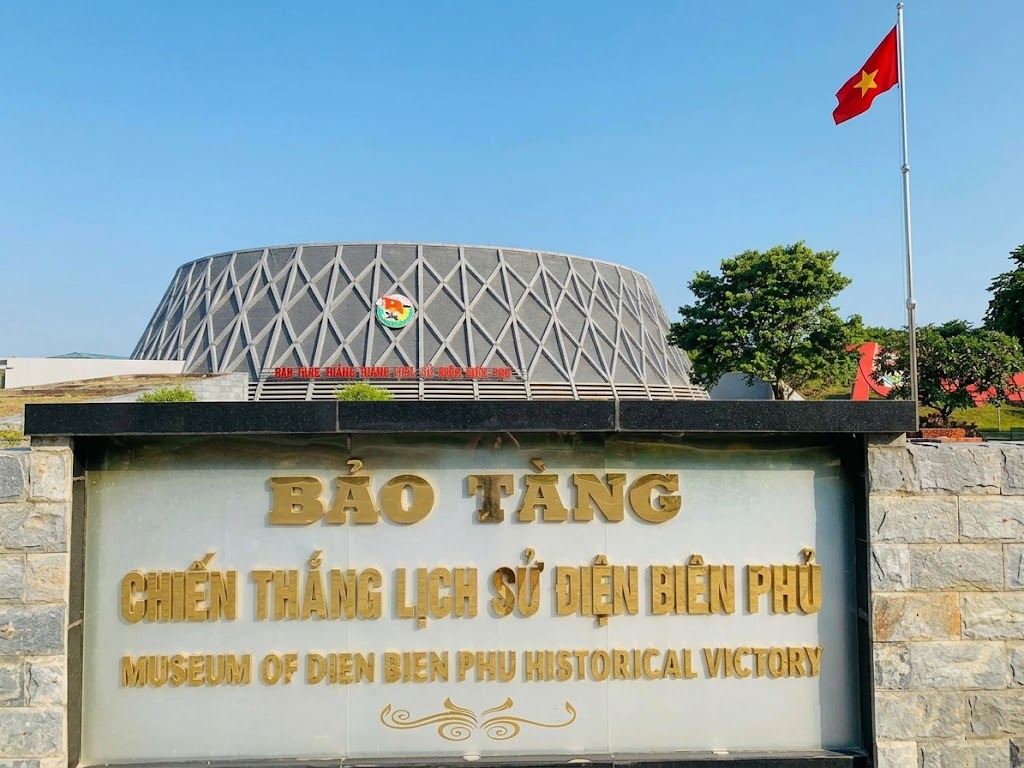
Remembrance at Dien Bien Phu
Genevieve de Galard, the French Air Force flight nurse stranded at the base for the siege’s duration, documented her experience in the memoir “The Angel of Dien Bien Phu” and was later honored with both the United States Medal of Freedom and France’s Legion of Honor for her work tending the garrison’s wounded. General Vo Nguyen Giap himself wrote extensively about planning and directing the siege in his own memoir, detailing the decision to haul heavy artillery onto the surrounding hills by hand rather than positioning it on the valley floor as French planners had expected, the tactical surprise that ultimately crippled the French garrison’s defenses. Colonel Christian de Castries, who commanded the French garrison throughout the siege and formally surrendered on May 7, 1954, had his command decisions and wartime communications documented extensively in French military records and later postwar interviews and testimony. Pierre Schoendoerffer, a French Army combat cameraman captured when the garrison fell, later became a filmmaker and drew directly on his own experience as a prisoner of war to write and direct the 1992 feature film “Dien Bien Phu,” giving that production a rare foundation of firsthand veteran authorship. Taken together, these four accounts, a grounded nurse’s wartime memoir, a victorious general’s own record of his tactics, a defeated commander’s documented testimony, and a captured cameraman’s later cinematic retelling, preserve Dien Bien Phu from angles spanning both sides of a battle that changed the course of a region’s history.
Visitor Info: Book titled “Hell in a Very Small Place: The Siege of Dien Bien Phu” by Bernard Fall (Lippincott, 1966); Film titled “Dien Bien Phu” (dir. Pierre Schoendoerffer, 1992)
Location: Dien Bien Phu Victory Museum, Vo Nguyen Giap Street, Muong Thanh Ward, Dien Bien Phu City, Dien Bien Province, Vietnam
Site Status: National Park / Managed Historic Site
Visitation Notes: The Dien Bien Phu Victory Museum, opened in 2014 in Dien Bien Phu City, displays roughly 1,000 artifacts and a 132-meter panoramic painting depicting the four phases of the campaign. Directly across the street, A1 Hill (the former French strongpoint Eliane 2) preserves original trench systems, bunkers, barbed-wire emplacements, a knocked-out French tank, and the large crater left by the roughly 1,000-kilogram Viet Minh mine detonated beneath the position on May 6, 1954, the trigger for the battle’s final assault. General de Castries’ reconstructed command bunker is also preserved within the relic complex, and the adjacent Martyrs’ Cemetery honors Vietnamese soldiers killed in the campaign. Most visitors combine the museum, A1 Hill, and cemetery into a half-day visit. The site anchors major annual commemorations each May 7, including a large military parade and state ceremony for the battle’s 70th anniversary in 2024.
Google Map
Visitor Comments
Gene R J praised the preserved French trenches, command post, captured tank, and mine crater at A1 Hill as genuinely moving to see in person rather than just read about.
— from TripAdvisor
Phil W called A1 Hill essential viewing for anyone interested in military history, noting the well-preserved trenches and bomb crater bring the scale of the final assault to life.
— from TripAdvisor
Ronny from Switzerland called their historical discovery tour of the battlefield sites fantastic, praising their guide’s deep knowledge and safe driving through the hills.
— from GetYourGuide
Mathieu, a visitor from France, enjoyed combining the Victory Museum visit with a motorbike tour through the surrounding hills and a hearty local meal, and recommended checking the weather beforehand given the mountainous terrain.
— from GetYourGuide