Two Delta Force snipers watched a wounded helicopter pilot burning to death in his crash site, surrounded by an entire militia, and asked their commanders three times for permission to be dropped in to defend him, knowing the position was almost certainly indefensible with just two men. Gary Gordon and Randy Shughart got their answer on the third request, roped down from a hovering Black Hawk into a crowd of armed Somali fighters, and fought until they ran out of ammunition protecting a stranger they had never met. Both were killed, and both received the Medal of Honor posthumously, the first awarded since the Vietnam War, for a decision made in the space of a radio call during a battle that was supposed to last less than an hour and instead stretched into an overnight siege that reshaped American military policy for a decade.
Mogadishu: The Road to Battle
By the summer of 1993, Somalia had collapsed into famine and clan warfare following the fall of dictator Siad Barre, prompting a United Nations humanitarian intervention that American forces supported under Operation Restore Hope and its successor missions. Warlord Mohamed Farrah Aidid, whose militia controlled much of Mogadishu, emerged as the primary obstacle to the UN mission after his forces ambushed and killed twenty-four Pakistani peacekeepers in June 1993, prompting the UN Security Council to authorize his capture. The United States deployed Task Force Ranger, a elite force built around Army Rangers and Delta Force operators, specifically to hunt down Aidid and his top lieutenants in the dense, unfamiliar streets of Mogadishu.
By early October, the task force had already conducted six similar raids into the city without major incident, building a pattern of quick helicopter insertions, rapid arrests, and equally rapid extractions that commanders expected to repeat once again. On October 3, 1993, intelligence placed two of Aidid’s senior lieutenants at a building near the Bakara Market, a crowded, militia-friendly neighborhood in south Mogadishu that American forces had previously avoided entering in force because of its density and its reputation as the stronghold of Aidid’s most committed fighters. Task Force Ranger planners expected the raid to take roughly thirty minutes, and the assault force of roughly 160 American soldiers, moving in on helicopters and a ground vehicle convoy, carried ammunition and water supplies calculated for a mission of that length rather than for a prolonged firefight lasting through the night. Somali militia forces in the neighborhood, however, had grown increasingly organized after each previous raid, developing informal radio networks and rapid mobilization routines specifically in anticipation of another American helicopter assault landing somewhere in the crowded city, and Mogadishu’s residents had learned to recognize the sound of approaching Black Hawks as a signal to arm themselves and converge on wherever the aircraft set down.
The Battle of Mogadishu
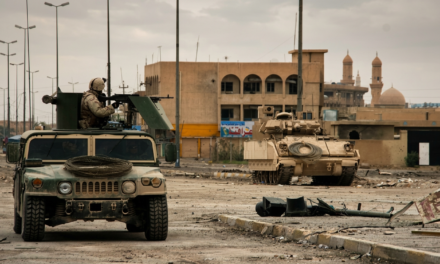
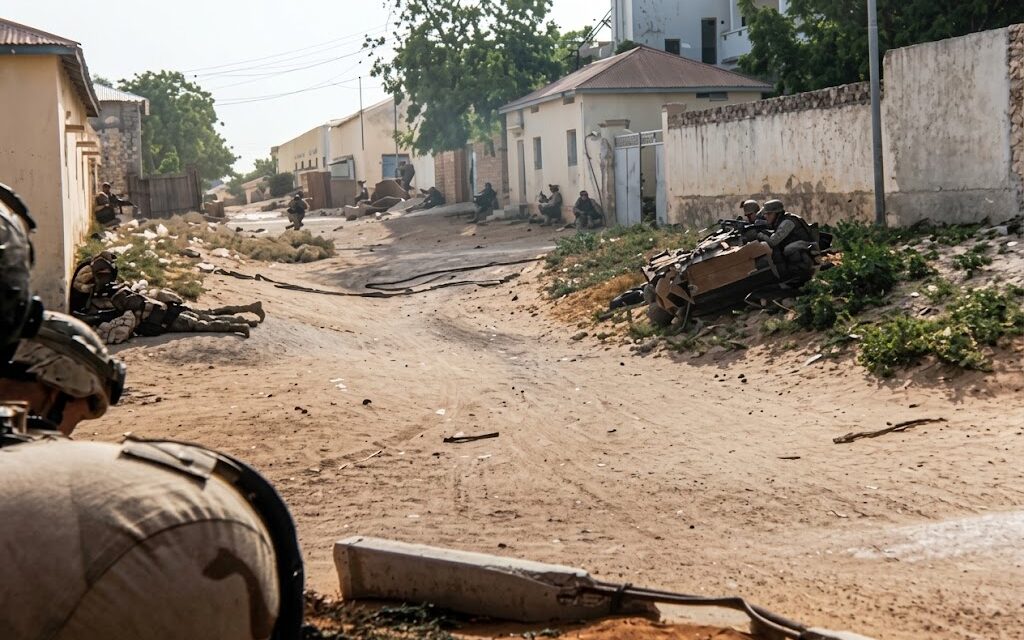
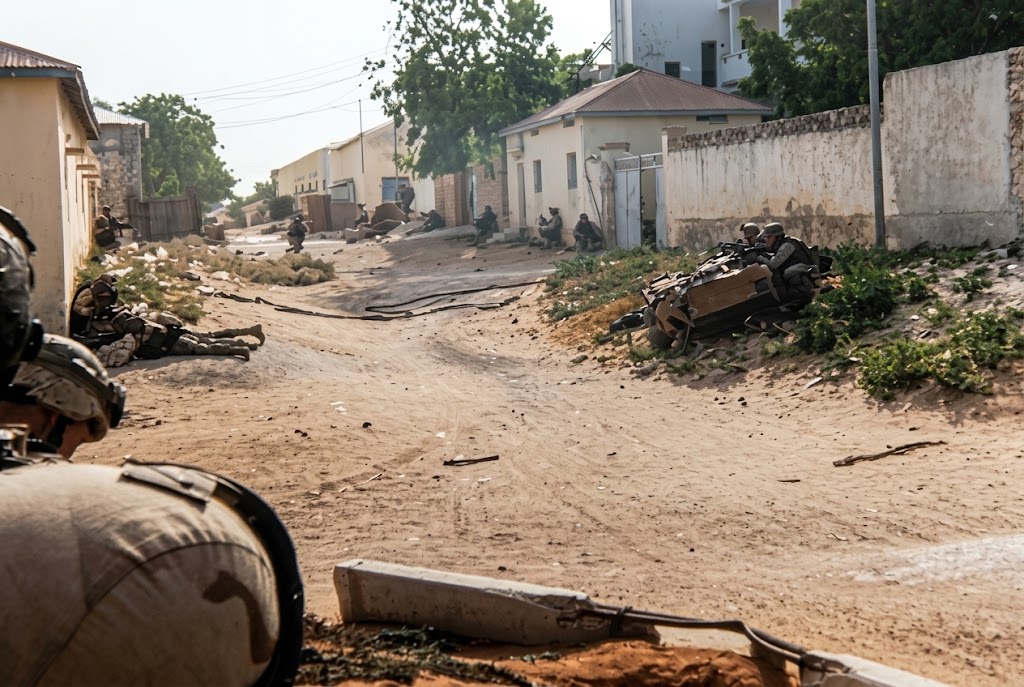
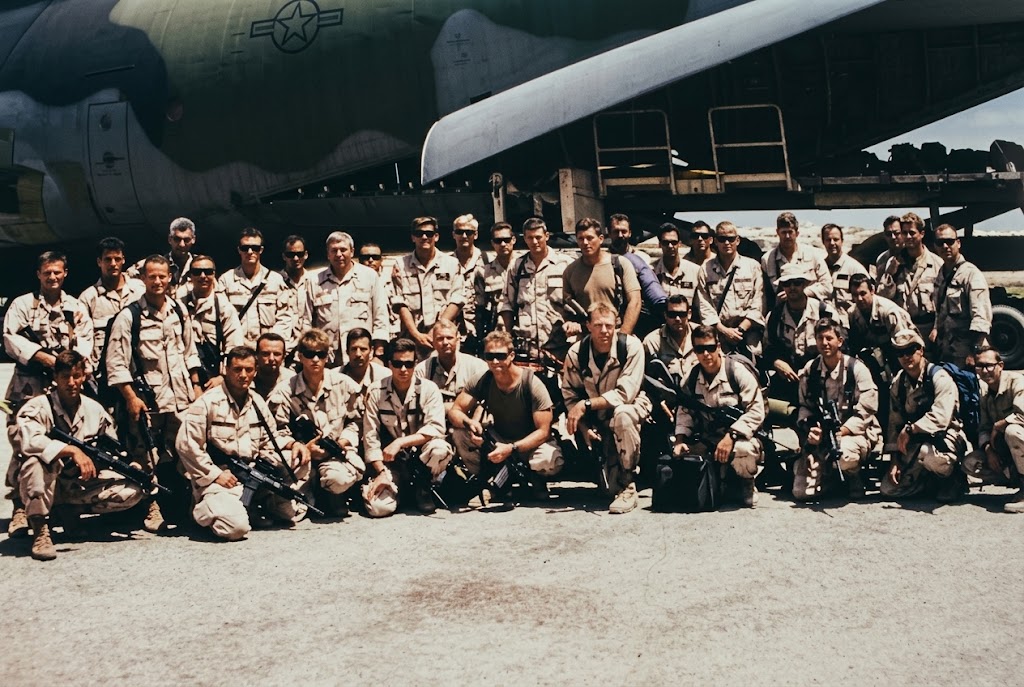
The raid began smoothly on the afternoon of October 3, with Rangers fast-roping into the target building and Delta operators securing the Somali officials inside within minutes, exactly as the previous six raids had unfolded, but the operation unraveled almost immediately afterward when a Black Hawk helicopter, Super Six-One, was struck by a rocket-propelled grenade and crashed several blocks from the target site. A ground convoy sent to recover the crash site and extract the arrest team became lost in Mogadishu’s poorly marked, maze-like streets and was pinned down under increasingly heavy fire from Somali militia and armed civilians who converged on the area from across the city, alerted by the crash and by informal radio and drum-signal networks that had grown more sophisticated with each prior American raid. A second Black Hawk, Super Six-Four piloted by Michael Durant, was also struck by a rocket-propelled grenade roughly twenty minutes later and went down in a different part of the neighborhood, prompting Delta snipers Gary Gordon and Randy Shughart to radio their commanders three times requesting insertion to protect the surviving crew, despite having only two men to hold the position against a mob that numbered in the hundreds. Their request was granted only after the third call, and both snipers were killed after running out of ammunition defending the crash site, actions for which each later received the Medal of Honor posthumously, the first awarded since the Vietnam War.
Durant, badly injured in the crash and the only survivor Somali fighters found alive at the site, was captured and held for eleven days before international negotiations secured his release. Throughout the night, isolated pockets of American soldiers, cut off from each other across several city blocks and low on ammunition and water they had packed for a thirty-minute mission, fought to hold defensive positions in courtyards and alleyways against sustained fire from all directions. A relief convoy, reinforced with Pakistani tanks and Malaysian armored personnel carriers because American forces in the city lacked armor of their own, struggled for hours to fight its way through a gauntlet of flaming barricades, hastily built roadblocks, and ambushes to reach the scattered American positions. The rescue convoy finally reached the surrounded Americans in the early morning hours of October 4, nearly eighteen hours after the operation began, in what became known afterward as the “Mogadishu Mile” for the harrowing final stretch some soldiers had to run on foot under continued fire because the arriving vehicles had no room left to carry them.
The overnight battle left eighteen American soldiers dead and more than seventy wounded, the highest single-battle American death toll since the Vietnam War, while Somali casualties, both militia fighters and civilians caught in the crossfire, were estimated in the hundreds to over a thousand by various accounts, a disparity that later fueled sharp debate over the operation’s proportionality. Images of a dead American soldier being dragged through the streets of Mogadishu by a jeering crowd, broadcast on television news within days, produced a wave of public shock and anger back in the United States that neither military planners nor the Clinton administration had anticipated from what had been framed internally as a low-risk, routine snatch operation.
The Legacy of Mogadishu
The battle’s political fallout proved as significant as its human cost, prompting President Clinton to announce a withdrawal of American forces from Somalia within six months and reshaping U.S. foreign policy toward a deep reluctance to commit ground troops to humanitarian interventions for years afterward. Military historians and journalists have since credited the battle with contributing directly to American hesitancy over intervening in the Rwandan genocide the following year, a caution some critics argue cost many more lives than it saved. The battle’s lasting cultural memory was cemented by Mark Bowden’s 1999 book “Black Hawk Down” and Ridley Scott’s 2001 film adaptation, both of which introduced the battle’s details to a global audience far beyond the small community of soldiers who had actually fought there.
Mogadishu: A Site Off-Limits
The actual battle site in and around Bakara Market in south Mogadishu remains firmly closed to any form of tourism, and the U.S. State Department rates all of Somalia at its highest travel warning level, Do Not Travel, citing an ongoing high terrorism threat that has included recent attacks in and around the capital. Even American government personnel stationed in Mogadishu today are confined to the fortified airport complex rather than moving freely through the city, underscoring how far the security situation remains from anything resembling normal access. No preserved battlefield, historical marker, or dedicated memorial exists at the site in Somalia itself, and none is likely to be established while the security situation remains as unstable as it has been for the three decades since the battle.
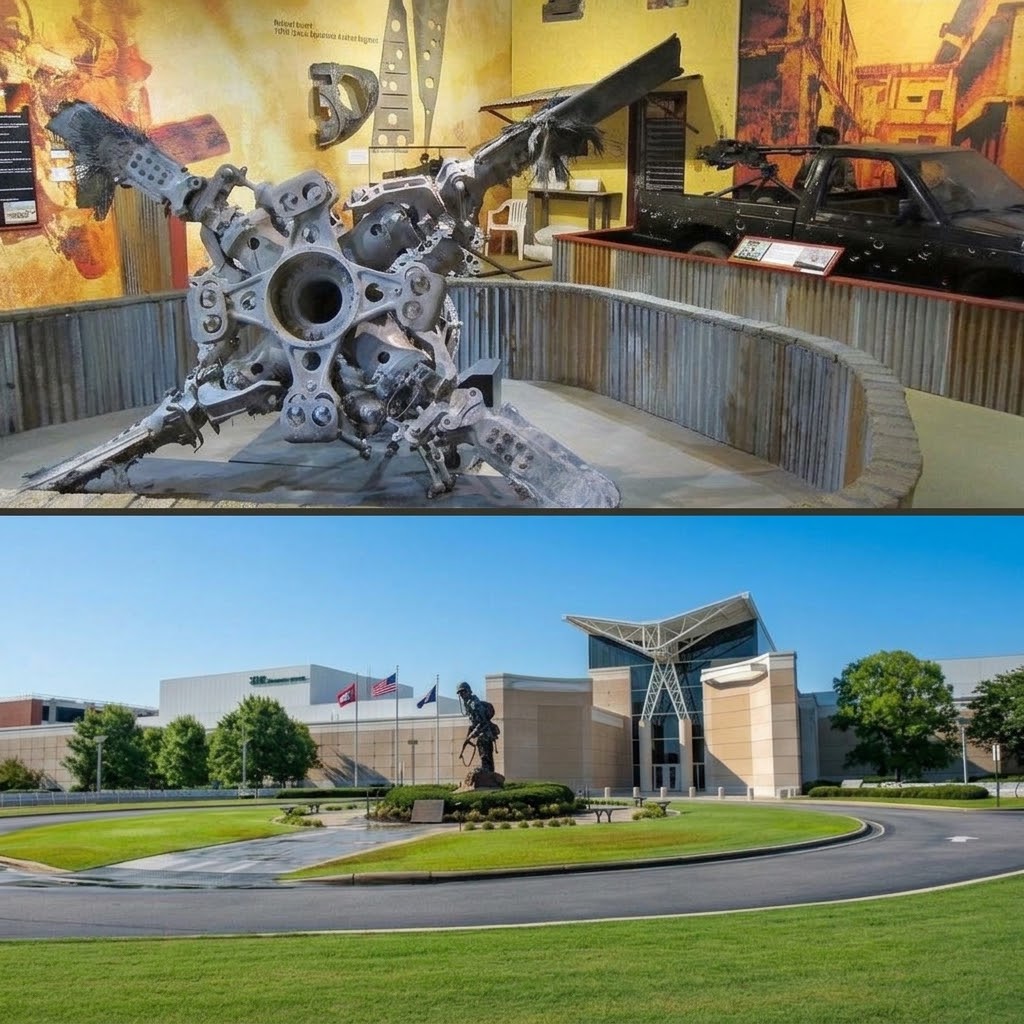
The closest tangible artifacts connected to the battle sit thousands of miles away at the Airborne and Special Operations Museum in Fayetteville, North Carolina, which holds the rotor from Super Six-One and a nose piece from Super Six-Four within its broader collection covering the history of Army special operations forces. Visitors to that museum should understand it as a general institution documenting decades of airborne and special operations history rather than a site built around this specific battle, since the Mogadishu artifacts represent a small part of a much larger collection. For anyone drawn to this history, engaging with it responsibly today means turning to the substantial written and documentary record rather than attempting to visit a site that offers no safe or meaningful way to experience it in person. That record is unusually rich for a battle of this size, built from firsthand memoirs, journalistic reconstruction, and testimony collected specifically because the participants recognized how significant the night had become.
Remembrance at Mogadishu
Michael Durant, the pilot of Super Six-Four who was shot down, wounded, and held captive for eleven days, documented his experience in the memoir “In the Company of Heroes,” including his account of the two Delta snipers who gave their lives defending his crash site. Jeff Struecker, then an Army Ranger staff sergeant who drove a Humvee in the overnight relief convoy, later wrote his own book, “The Road to Unafraid,” describing the chaos of the fighting and its lasting personal toll. Matt Eversmann, a Ranger platoon leader in the battle, co-edited a documented collection of firsthand testimony from the American soldiers who fought that night and was also extensively interviewed for the journalistic reporting that followed. Mohammed Abdi Elmi, a special assistant to warlord Mohamed Farrah Aidid who witnessed the battle from the Somali side, published his own account of the fighting, offering a rare documented counterpoint to the extensive body of American-side testimony. Taken together, these four accounts, a captured pilot’s memoir, a driver’s firsthand record of the relief convoy, a platoon leader’s collected soldier testimony, and a Somali witness’s account from the opposing side, preserve Mogadishu from angles spanning a battle whose consequences reached far beyond the single night it was fought.
Visitor Info: Book titled “Black Hawk Down: A Story of Modern War” by Mark Bowden (Atlantic Monthly Press, 1999); Film titled “Black Hawk Down” (dir. Ridley Scott, 2001)
Location: Bakara Market area, south Mogadishu, Somalia
Site Status: Access Restricted or Unsafe
Visitation Notes: The battle site in Bakara Market and the surrounding south Mogadishu neighborhoods is not visitable under any reasonable safety standard. As of 2026, the U.S. State Department rates all of Somalia Level 4, Do Not Travel, and the UK FCDO advises against all travel to much of the country, both citing an ongoing high terrorism threat with recent attacks in and around Mogadishu, including on the airport and near markets. Even U.S. government personnel stationed in Mogadishu are confined to the airport complex. There is no preserved battlefield, marker, or dedicated memorial at the site in Somalia. The closest tangential artifacts are the rotor of Super Six-One and the nose piece of Super Six-Four, the two downed Black Hawk helicopters, held in the general collection of the Airborne and Special Operations Museum in Fayetteville, North Carolina, though that museum covers the broader history of Army special operations rather than this battle specifically and should not be marketed as a dedicated Battle of Mogadishu destination.
Google Map
Visitor Comments
No visitor comments on record for this location.