The commanding officer who charged an Argentine trench alone with a sub-machine gun and died winning Britain’s highest award for valor is not, by the account of many who fought alongside him, the reason his battalion won. Lieutenant-Colonel Herbert “H” Jones’s posthumous Victoria Cross has been publicly disputed for decades by veterans and historians who argue his isolated, emotionally-driven assault disrupted the wider attack rather than saving it, and that it was his second-in-command’s calmer reorganization of the battle, not Jones’s death, that actually broke the Argentine defense at Goose Green. The battle that followed his death would become Britain’s first land victory of the Falklands War, but the story of how it was actually won remains more contested than the official history suggests.
Goose Green: The Road to Battle
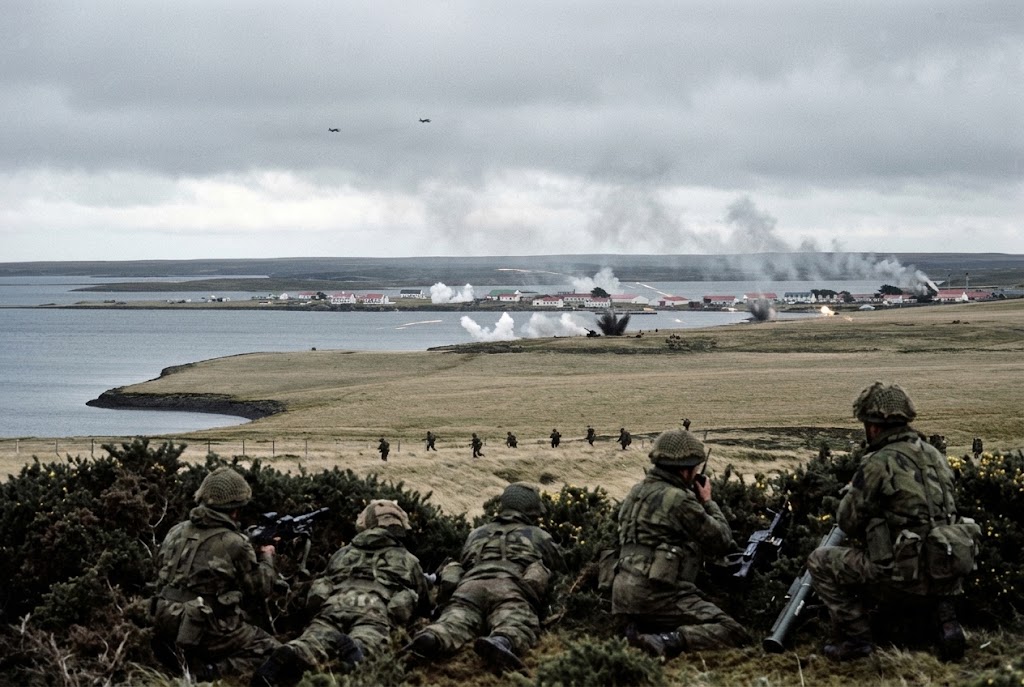
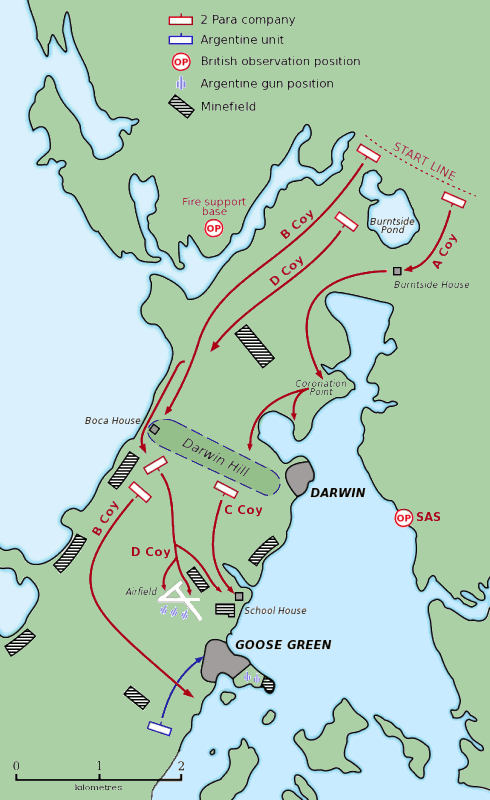
In the weeks following Argentina’s April 1982 invasion and occupation of the Falkland Islands, British forces landed at San Carlos on East Falkland in late May as part of the campaign to retake the territory, and 2nd Battalion, the Parachute Regiment, under the command of Lieutenant-Colonel Herbert “H” Jones, was tasked with advancing south to seize the Argentine-held settlements of Darwin and Goose Green. The Argentine garrison at Goose Green, Task Force Mercedes under Lieutenant-Colonel Ítalo Piaggi, held a well-prepared defensive position across the narrow isthmus leading to the settlement, benefiting from entrenched positions and the advantage of defending a chokepoint that limited the attacking British force’s options for maneuver. Jones led 2 Para on a lengthy night approach march toward the Argentine positions, intending to strike before dawn and exploit the element of surprise, but the advance was slowed by difficult terrain and the sheer scale of the defensive network the Argentine garrison had constructed across the isthmus.
As daylight broke without the battle being decided, 2 Para found itself pinned down in the open by determined Argentine resistance from fortified positions, a situation considerably more difficult than the relatively lightly defended objective British commanders had anticipated before the operation began. The Falkland Islands’ civilian population also featured directly in the stakes of the coming fight, since Argentine forces had confined a number of local civilians inside the settlement’s Community Hall during the occupation, adding a further dimension of urgency to the British effort to retake the settlement quickly and decisively. British planners had also initially believed, based on available intelligence, that the Argentine garrison at Goose Green was comparatively lightly held, an assessment that proved considerably mistaken once 2 Para’s advance ran into the full scale of the defensive network Piaggi’s forces had constructed across the narrow isthmus, forcing Jones and his officers to adapt their plan under fire rather than executing the more straightforward operation they had anticipated.
The Battle of Goose Green
As the British attack stalled under heavy Argentine fire from well-sited trenches and fortified positions along the isthmus, Lieutenant-Colonel Jones grew visibly frustrated with the slowing momentum of the assault and personally led a charge against one of the Argentine trench positions, armed with a sub-machine gun, in an apparent attempt to break the deadlock through direct, individual action at the front of the fighting. Jones was killed while attempting to outflank a second Argentine position during this charge, and his death, along with the official account crediting his personal bravery with reinvigorating the stalled attack, led to his posthumous award of the Victoria Cross, Britain’s highest award for gallantry. In the years since, however, a number of veterans of the battle and military historians have challenged this official narrative, arguing that Jones’s isolated charge was a reckless, emotionally driven action that briefly disrupted rather than aided the broader assault, and that the credit given to his individual bravery has obscured a more complicated and, in their view, more accurate account of how the battle was actually turned.
Command of 2 Para passed immediately to Major Chris Keeble, the battalion’s second-in-command, who responded to Jones’s death not with another individual charge but with a fundamental reorganization of the attack, adopting a more flexible and decentralized command style that delegated greater tactical autonomy to his company commanders rather than attempting to direct every element of the assault personally. This shift in approach allowed British forces to gradually work around and reduce the remaining Argentine strongpoints through more coordinated, patient small-unit tactics, a marked contrast to the costlier direct assaults that had characterized the battle’s opening hours. As the fighting increasingly settled into what Piaggi himself later described as something closer to a sniping contest than a conventional battle, with both sides trading fire from fixed positions rather than engaging in further large-scale maneuver, Keeble made the decision to open negotiations directly with the Argentine garrison rather than continuing to press the attack at further cost to his own men.
Piaggi and fellow Argentine officer Wilson Pedrozo, recognizing the increasingly untenable position of their garrison, accepted Keeble’s terms and surrendered unconditionally on May 29, 1982, bringing the battle to a close without the further bloodshed that continued fighting might have produced. Keeble’s role in reorganizing the attack after Jones’s death and subsequently negotiating the Argentine surrender earned him the Distinguished Service Order, a recognition that, in the eyes of many who study the battle closely, reflects contributions to the eventual British victory that were at least as consequential as anything that happened during Jones’s fatal charge earlier in the fighting. The surrender itself proved larger in scale than British commanders had initially anticipated, since the Argentine garrison at Goose Green numbered considerably more troops than the attacking British force, a disparity that made Keeble’s negotiated resolution all the more significant in avoiding what could otherwise have become a much costlier final assault against a numerically superior, still-entrenched defender. The battle’s total British casualties, while serious and deeply felt within the close-knit ranks of 2 Para, remained relatively contained given the scale and duration of the fighting, a testament to the eventual effectiveness of Keeble’s more methodical approach once the initial momentum of the dawn assault had stalled.
The Legacy of Goose Green
Goose Green stood as Britain’s first land victory of the Falklands War, providing an important early morale boost for British forces and the public at home during a conflict whose outcome remained genuinely uncertain in its early weeks. The battle’s outcome also freed captured civilians who had been confined in the settlement’s Community Hall during the Argentine occupation, giving the victory a humanitarian dimension beyond its immediate military significance. The ongoing historical debate over Jones’s Victoria Cross and Keeble’s underappreciated role in the actual turning of the battle has made Goose Green a frequently cited case study in how official military honors and popular memory can diverge from the more complicated judgments of participants and later historians.
Visiting Goose Green Today
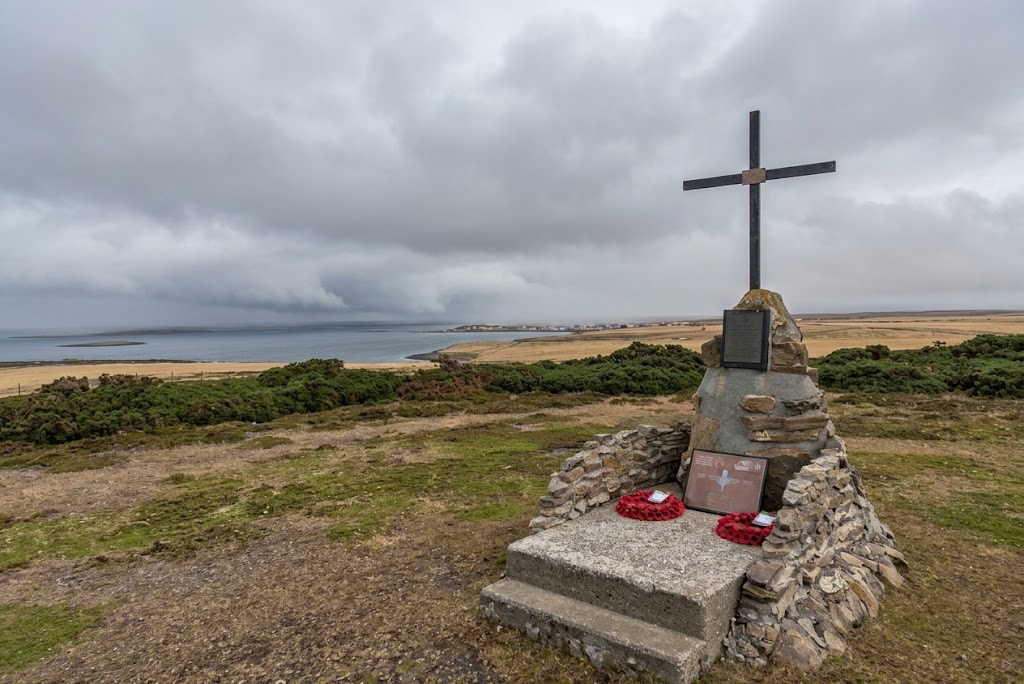
Goose Green remains a small, working farm settlement on East Falkland today, its wartime history marked chiefly by a stone memorial cross dedicated to the soldiers of 2 Para standing on a hill overlooking the site of the battle, a memorial that remains open to visitors at all times without restriction. A small Goose Green Museum nearby covers the events of 1982 in more detail, though its key is held at the neighboring Galley Cafe rather than the museum itself being staffed full-time, a detail worth knowing in advance for anyone planning a visit. Some organized tours of the area also include a stop at the former Community Hall where Argentine forces held Falkland Islands civilians during the occupation, adding an important civilian dimension to a site otherwise focused on the military engagement itself.
Because of the Falkland Islands’ remoteness and limited infrastructure, most visitors reach Goose Green as part of organized battlefield tours departing from Stanley rather than attempting the trip independently, and combined itineraries sometimes pair the battlefield with nearby cemeteries associated with the 1982 conflict. The settlement’s continued life as a working farm gives the site a lived-in, unpolished character quite different from more heavily curated battlefield memorials elsewhere, a quality that some visitors find adds to rather than detracts from the experience of standing on genuinely contested ground. The isthmus terrain that shaped the battle’s difficult, funnel-like tactical geography remains largely unchanged today, allowing visitors who walk or drive the approach to Goose Green to appreciate why the narrow, exposed ground proved so costly for the attacking paratroopers in 1982. Given the islands’ unpredictable weather and limited transport options beyond organized tours, visitors are generally encouraged to plan a Goose Green visit well in advance rather than attempting to arrange it spontaneously while already in the Falklands, since availability of guides and transport to this relatively remote part of East Falkland can be limited outside the main tourist season.
Remembrance of Goose Green
Mark Adkin’s detailed 1992 account, “Goose Green: A Battle Is Fought to Be Won,” remains one of the most thorough published examinations of the battle, including its careful treatment of the disputes surrounding Jones’s charge and Keeble’s subsequent reorganization of the attack. The stone memorial cross overlooking the battlefield continues to serve as the primary physical site of remembrance for the soldiers of 2 Para who fought and died at Goose Green, a modest but consistently accessible monument on a hillside that saw some of the fiercest fighting of the entire Falklands campaign. The continuing historical debate over how credit for the eventual British victory should be apportioned between Jones’s fatal individual bravery and Keeble’s methodical reorganization and negotiated surrender ensures that Goose Green remains a battle whose full story is still being actively discussed by historians and veterans alike, more than four decades after the fighting ended.
Further Exploration: Book titled “Goose Green: A Battle Is Fought to Be Won” by Mark Adkin (Leo Cooper, 1992)
Location: Goose Green Settlement, near Darwin, East Falkland, Falkland Islands (2 Para Memorial nearby; no formal street address, GPS 51°49’43.8″S 58°58’9″W)
Site Status: Marker or Monument Only
Visitation Notes: Goose Green remains a small working farm settlement with a stone 2 Para Memorial cross on a hill overlooking the battlefield, open at all times, plus a small Goose Green Museum (key held at the nearby Galley Cafe) covering the 1982 fighting. The former Community Hall where Argentine forces held island civilians is also included on some tours. The Falklands’ remoteness means most visitors reach the site via organized battlefield tours out of Stanley rather than independently.
Google Map
Visitor Comments
A visitor named AW0001 took the Goose Green battlefield tour and visited the Community Hall where Argentine forces once held Falkland Islands civilians, along with the museum, H Jones memorials, and nearby cemeteries. They called their guide ‘friendly and helpful’ with knowledge ‘second to none’ and said it was an experience they’d remember for a long time.
— from TripAdvisor
A visitor named Stuart220 stayed at a guesthouse near Goose Green and praised its location for putting the airfield, settlement, and battlefield all within easy reach, noting how close it placed them to the site’s 1982 history.
— from TripAdvisor
A visitor named Carolyn took a combined cemetery-and-battlefield tour and found it a bit disorganized: she’d been told it would include penguin viewing, which it didn’t, and felt the guide could have been more informative. She was also disappointed when promised sandwiches were swapped for crackers.
— from GetYourGuide