For decades, the standard account of the Battle of Prokhorovka described a headlong collision of hundreds of tanks that all but annihilated an elite German division in a single afternoon. Rudolf von Ribbentrop, a tank company commander who fought in that exact engagement, told a very different story for the rest of his life — one that Russian archival research would eventually confirm came far closer to the truth than the myth that had calcified around it.
Kursk: The Road to Battle
By the summer of 1943, Germany’s options on the Eastern Front had narrowed considerably. The catastrophic loss of an entire army at Stalingrad that winter had cost Hitler the initiative, and German planners settled on a large pincer attack against the Kursk salient, a bulge in the Soviet lines roughly ninety miles wide, hoping to encircle and destroy the Red Army units massed inside it before the Soviets could rebuild their own offensive strength. The operation, codenamed Citadel, was delayed repeatedly through the spring as Hitler waited for new Panther and Tiger tanks to reach the front in greater numbers, a delay that gave Soviet intelligence, which had learned of the German plan in advance, months to prepare.
Soviet commanders used that time to turn the salient into one of the most heavily fortified defensive zones of the entire war, laying minefields, anti-tank ditches, and successive belts of trenches and gun emplacements to a depth of more than a hundred miles in places, while holding back substantial armored reserves rather than committing everything to the front line. Marshal Georgy Zhukov, coordinating the Soviet defense, had argued successfully against a preemptive Soviet strike in favor of absorbing the German attack first and only then counterattacking with the reserves held back for that purpose, a strategic patience that ran directly counter to the more improvised defenses the Red Army had often been forced into earlier in the war. Rather than a hasty defense thrown together against a surprise attack, Kursk became a battle the Soviets had spent months specifically designing to absorb and then destroy a German offensive whose general shape they already understood.
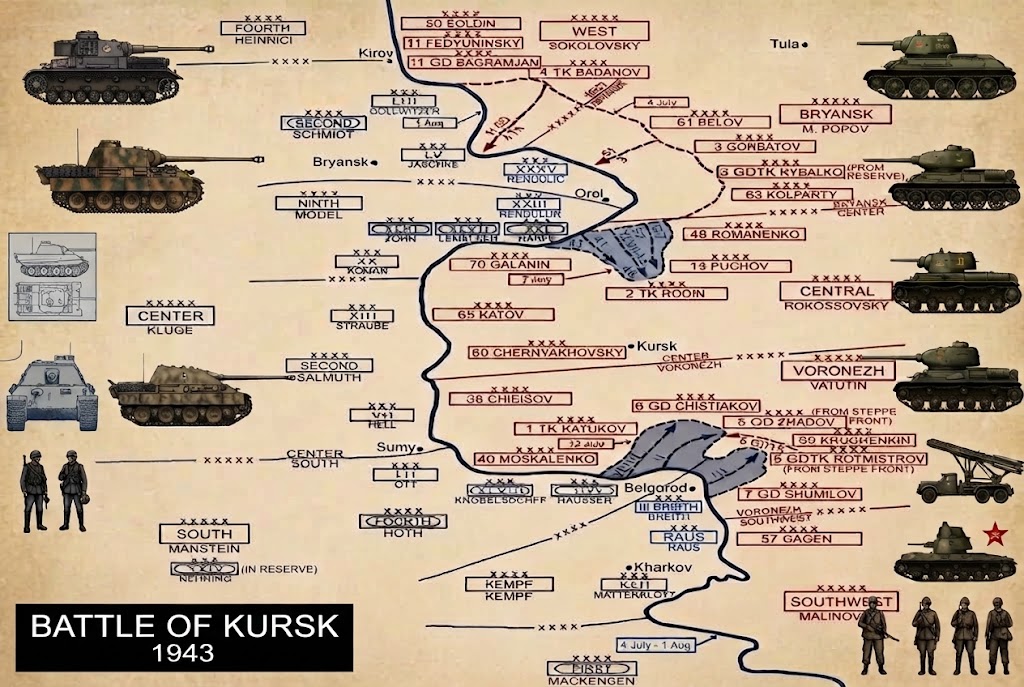
The Battle of Kursk
The German attack opened on July 5, 1943, striking the northern and southern shoulders of the salient simultaneously, and almost immediately ran into the depth of Soviet preparation rather than the open tank country German commanders had hoped for. Progress on both fronts was slow and costly from the first day, as German armor pushed through minefield after minefield and gun line after gun line, gaining ground in places but nowhere near the pace the operation’s planners had assumed.
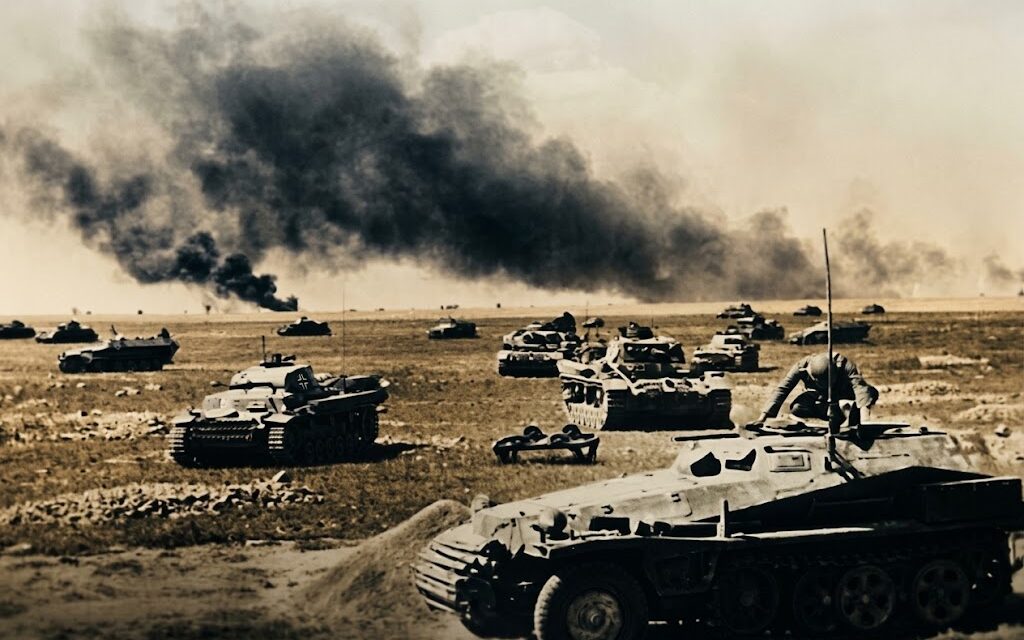
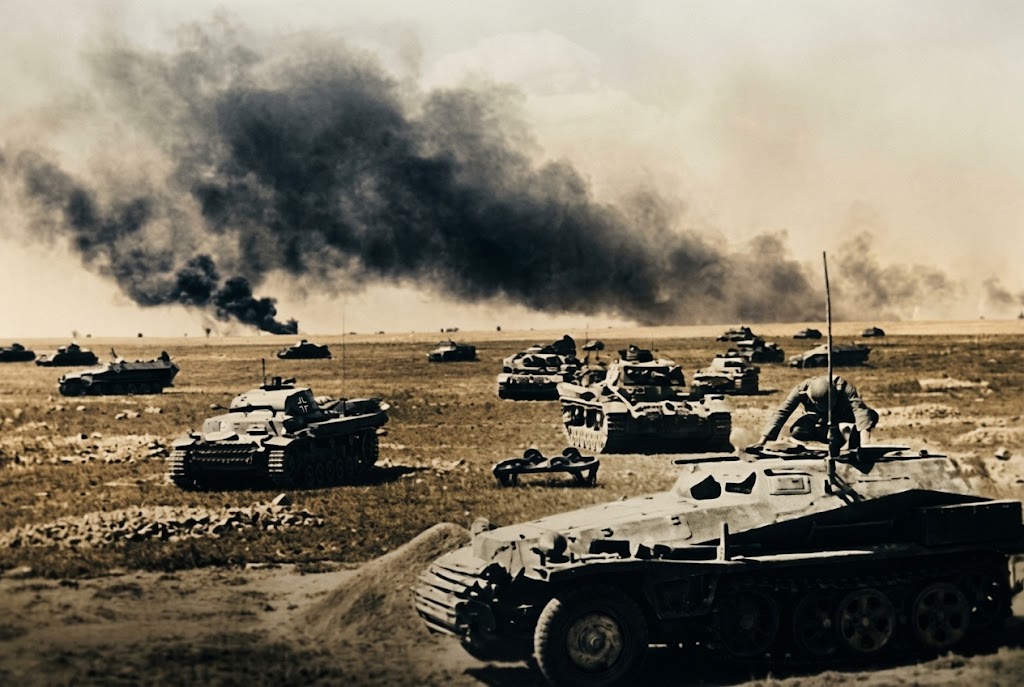
The battle’s best-known moment came on July 12 near the village of Prokhorovka, where the 1st SS Panzer Division’s Leibstandarte, including a company commanded by SS-Obersturmfuhrer Rudolf von Ribbentrop, engaged Soviet armor in an action that Soviet-era histories long described as a climactic clash of many hundreds of tanks, resulting in catastrophic German losses that broke the offensive’s momentum outright. Von Ribbentrop’s own account, along with archival research conducted decades later by historian Valeriy Zamulin using formerly closed Soviet military records, described a considerably smaller and less one-sided engagement than the postwar legend, with German losses far below what Soviet accounts had claimed for years, a correction that took the better part of a half-century to work its way into the wider historical record.
Soviet tank crews fought through Prokhorovka and the wider battle in T-34s that German infantryman Erwin Bartmann, serving in the same division as von Ribbentrop, later described facing at close range in his memoir of the campaign, while Soviet tank commander Vasiliy Bryukhov, who fought at Kursk in a T-34 himself, later wrote of the tank’s mechanical reliability and thin armor in roughly equal measure, a firsthand Soviet perspective on the very machine that has since become a symbol of the battle. Overhead, Soviet fighter pilot Ivan Kozhedub scored his first aerial victories during the air battles fought above the salient that July, flying a La-5 in combat that would help make him the highest-scoring Allied ace of the entire war by 1945. Hitler ultimately called off the offensive on July 13, partly because of the losses being sustained and partly because an Allied landing in Sicily that same week demanded troops be shifted west, ending Germany’s last major strategic offensive in the east and shifting the initiative permanently to the Soviets.
The Legacy of Kursk
Kursk is often described as the largest tank battle in history and the moment the strategic initiative on the Eastern Front passed permanently to the Soviet Union, a judgment that has held up well even as historians have revised the details of individual engagements like Prokhorovka downward from their Cold War-era proportions. After Kursk, the German army in the east fought an almost unbroken series of retreats for the remainder of the war, never again mounting an offensive on a comparable scale, while the Red Army’s confidence in its own ability to plan and win a set-piece defensive battle, rather than simply absorb losses and fall back, was validated in a way that shaped Soviet strategy for the rest of the conflict. That revision is itself part of the battle’s legacy: few engagements of the Second World War illustrate as clearly how thoroughly a wartime narrative, once established, can outlive the archival evidence eventually gathered to correct it, and how long it can take a firsthand account like von Ribbentrop’s to be believed over the version everyone had already settled on.
Kursk: A Site Off-Limits
The Kursk battlefield sites, including the Prokhorovka Field museum-reserve, lie within Kursk and Belgorod Oblasts in Russia, a region currently under a U.S. State Department Do Not Travel advisory and, following the Kursk Oblast incursion that began in 2024, an active conflict zone. BattlegroundGuide does not currently recommend travel to the area, and this guidance reflects present conditions rather than a permanent judgment about the site.
Travelers wanting to engage with Kursk’s history firsthand are better served by The Tank Museum in Bovington, England, home to surviving examples of the German armor that fought in the battle, including a genuine Elefant tank destroyer that served at Kursk itself. The museum charges a modest general admission fee, keeps seasonal hours, and includes a twelve-month pass with each ticket for return visits. The accounts quoted below in “What Others Have Experienced” describe visits to the Tank Museum in England, not to the Kursk battlefield itself, since the region remains closed to the kind of visit this section would otherwise describe.
Remembrance at Kursk
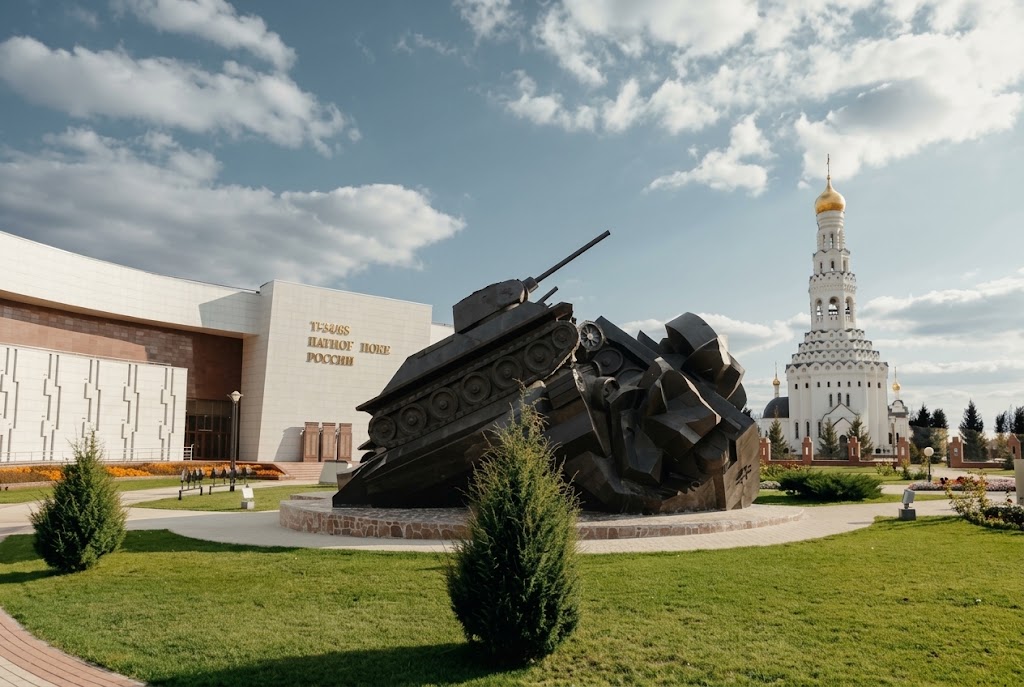
Within Russia, the Prokhorovka Field museum-reserve has historically served as the primary site of commemoration for the battle, anchored by a large bell tower memorial and a museum built specifically around the July 12 tank engagement, and Russia has traditionally marked the battle’s anniversary each July with state-organized ceremonies at the site, though the site’s current accessibility to foreign visitors is subject to the same restrictions affecting the wider region. In England, The Tank Museum’s collection keeps the battle’s material history visible to visitors who cannot reach the battlefield itself, anchoring the story in the surviving machines themselves rather than in the ground they once fought over.
Visitor Info: Article titled “German Tanks at Kursk” (The Tank Museum, Bovington), featuring a Kursk-veteran Elefant tank destroyer
Location: Prokhorovka, Belgorod Oblast, Russia (Prokhorovka Field battlefield, near Kursk)
Site Status: Access Restricted or Unsafe
Visitation Notes: The Kursk battlefield sites, including the Prokhorovka Field museum-reserve, lie within Kursk and Belgorod Oblasts in Russia, a region currently covered by a U.S. State Department Do Not Travel advisory and, following the Kursk Oblast incursion that began in 2024, an active conflict zone; BattlegroundGuide does not currently recommend travel there. Travelers wanting to engage with Kursk’s story firsthand can instead visit The Tank Museum in Bovington, England, home to surviving examples of the German armor that fought at Kursk, including a genuine Elefant tank destroyer that served in the battle. The museum charges a modest general admission fee and keeps seasonal hours, with an included annual pass allowing return visits. This guidance reflects current conditions and will be revisited if the regional situation changes.
Google Map
Visitor Comments
biertonscout1 praised the museum’s extensive collection spanning from the early Royal Armoured Corps through modern operations, noting there’s always something new to see, and highlighted the knowledgeable staff and the value of the included annual pass for return visits.
— from TripAdvisor
paulpS5787MR, a parent visiting with young children, called the museum well thought out and interactive, and was especially pleased that their autistic six-year-old utterly loved the exhibits and hands-on displays.
— from TripAdvisor
A tank enthusiast, Liam L, called it the best tank museum in the world, highlighting the massive collection, special events like Tiger Day, and the chance to ride an armored personnel carrier around the track.
— from TripAdvisor
Stephen Hayter appreciated the twelve-month ticket validity, noting a single visit doesn’t do the museum justice, and reflected on their admiration for tank designers and deep respect for the crews who fought in them.
— from Trustpilot