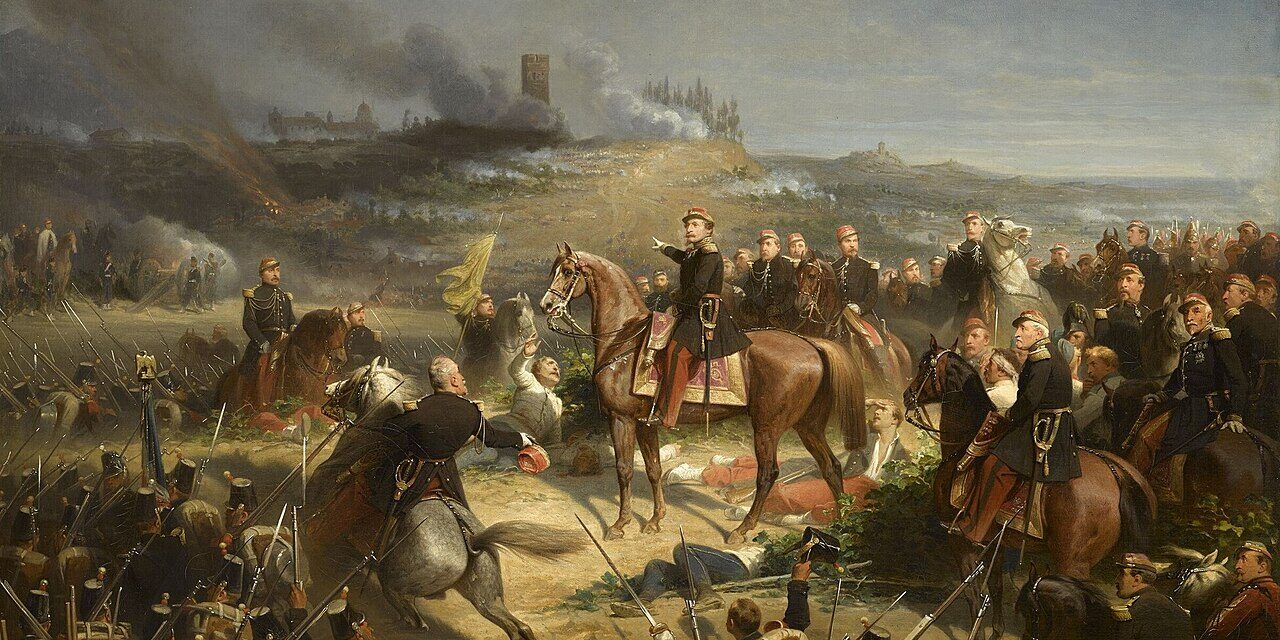
A Swiss businessman traveling to meet an emperor stumbled instead into a scene so horrific it changed the course of humanitarian history. Henry Dunant arrived at Castiglione delle Stiviere in the immediate aftermath of the Battle of Solferino, expecting to discuss business with Napoleon III, and found instead roughly forty thousand dead and wounded soldiers scattered across the Lombard countryside with almost no organized medical care to tend them. What Dunant witnessed that day, and the improvised relief effort he organized in response, would within a few years give rise to an institution now recognized around the world: the International Committee of the Red Cross. Few battles in modern history have produced a legacy so disconnected from the fighting itself, a single afternoon of carnage transformed into the founding moment of international humanitarian law, a legal and institutional legacy that has long outlasted the empires whose armies clashed that day.
Solferino: The Road to Battle
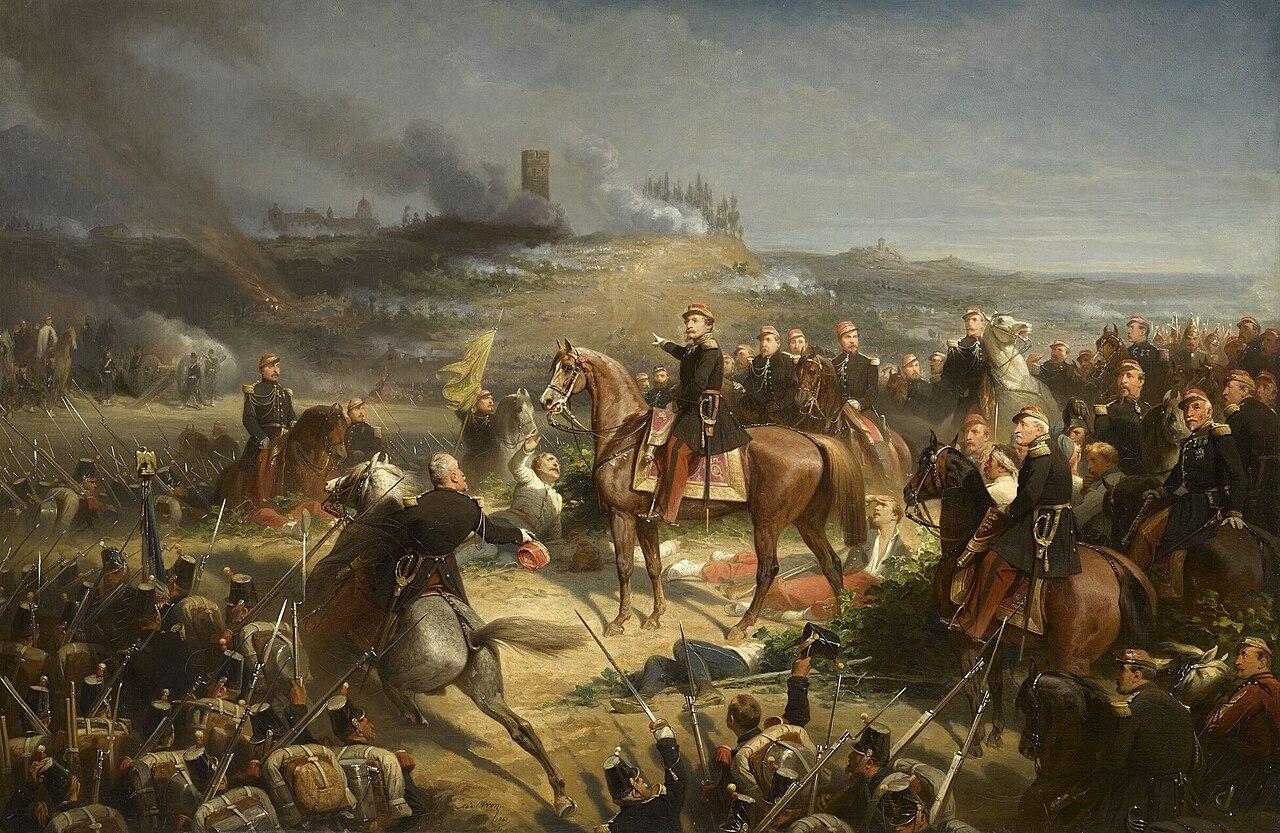
By June 1859, the Second Italian War of Independence had drawn France and the Kingdom of Sardinia into a joint campaign against the Austrian Empire for control of northern Italy, a conflict that pitted two of Europe’s most powerful militaries against each other on a scale not seen on the continent since the Napoleonic Wars decades earlier. Napoleon III, Emperor of the French, personally took the field as supreme commander of the allied Franco-Sardinian forces, a decision that placed the ultimate authority over French strategy directly in the hands of a monarch with limited personal battlefield experience compared to his professional generals. On the Austrian side, the young Emperor Franz Joseph I likewise assumed personal command of his army in the field, the only time in his long and eventful reign that he would lead troops directly in a major battle, a choice that reflected both the stakes of the campaign and the gravity with which Vienna regarded the Italian theater.
Both armies, each numbering well over one hundred thousand men, converged on the rolling hills and vineyards around the small town of Solferino in Lombardy without either side fully anticipating that the other’s main force lay so close, a mutual miscalculation that would turn a series of scattered advances into one of the largest pitched battles fought in Europe since Leipzig. The medical services of both armies, structured around the assumption of comparatively contained engagements, were entirely unprepared for the scale of casualties that a clash between two full field armies, fought across a wide front in the punishing midsummer heat, was about to produce. Neither Napoleon III’s staff nor Franz Joseph’s high command had any organized system for treating tens of thousands of wounded men at once, a gap in nineteenth-century military planning that the coming battle would expose with brutal clarity.
The Battle of Solferino
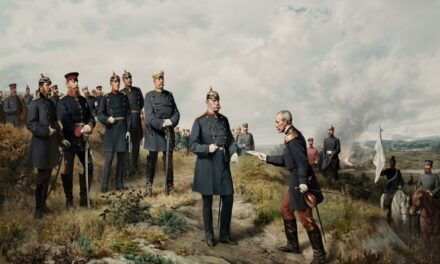
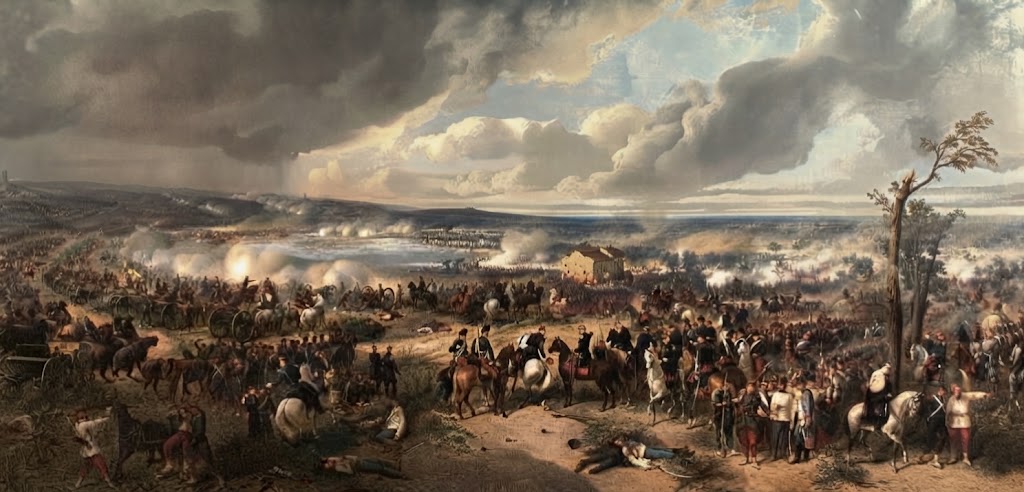
On June 24, 1859, the Franco-Sardinian and Austrian armies collided across a front stretching many miles through the hills and villages around Solferino and San Martino della Battaglia, fighting a grueling engagement that lasted more than fifteen hours under a brutal summer sun. Napoleon III’s forces pressed the central and southern sectors around Solferino itself, eventually storming the town’s hilltop fortress tower after fierce house-to-house and hand-to-hand fighting, while Sardinian troops under Victor Emmanuel II battled Austrian defenders at San Martino to the north in an equally costly and prolonged struggle. Franz Joseph’s Austrian forces fought with tenacity throughout the day, but coordination between the widely separated Austrian corps broke down as the battle wore on, and by late afternoon a violent thunderstorm added chaos to an already disintegrating tactical picture on both sides. As Austrian positions began to collapse under sustained pressure, Franz Joseph ordered a general withdrawal across the Mincio River, ceding the field to the allies but preserving the bulk of his army from complete destruction.
The human cost of the day’s fighting proved staggering even by the standards of nineteenth-century warfare, with combined casualties, killed, wounded, and missing, estimated at close to forty thousand men, overwhelming the primitive medical arrangements both armies had brought into the field. Wounded soldiers of all nationalities lay for days in makeshift shelters, churches, and open fields around Castiglione delle Stiviere with almost no doctors, supplies, or organized care available to treat them, a humanitarian catastrophe unfolding in plain sight even as the armies themselves began to disengage. It was into this scene that Henry Dunant arrived, a Swiss businessman who had traveled to the region hoping to secure an audience with Napoleon III over an unrelated commercial matter, only to find himself confronted with human suffering on a scale he had never imagined. Dunant abandoned his original errand entirely and threw himself into organizing relief, recruiting local townspeople, especially women, to help feed, clean, and comfort the wounded regardless of which uniform they wore, an act of impartial mercy that would become the founding principle of the institution his experience at Solferino was about to inspire.
The shock of the casualties, on both the French and Austrian sides, weighed heavily on Napoleon III as well, and the emperor’s own dismay at the scale of the slaughter helped drive his decision in the battle’s immediate aftermath to unilaterally pursue an armistice with Austria rather than continue the costly campaign. Field surgeons on both sides, lacking anything resembling a coordinated evacuation system, were forced to triage the wounded with whatever bandages, water, and manpower could be scraped together from the surrounding villages, and it was precisely this vacuum of organized care that gave Dunant’s improvised relief effort its urgency and its lasting significance. Townspeople in Castiglione, moved by Dunant’s example, worked alongside him for days, tending soldiers from both armies without regard to nationality, an act of impartial mercy under the simplest of circumstances that would later be codified as a founding legal principle of the international humanitarian movement.
The Legacy of Solferino
Napoleon III’s shock at Solferino’s casualties led directly to the Armistice of Villafranca just weeks later, ending the war and reshaping the political map of northern Italy in ways that accelerated the broader movement toward Italian unification. Far more enduring, however, was the transformation Henry Dunant underwent at Castiglione: haunted by what he had witnessed, he wrote A Memory of Solferino in 1862, a firsthand account of the battle’s aftermath that called for the creation of national relief societies and international agreements to protect the wounded, a proposal that directly led to the founding of the International Committee of the Red Cross and the first Geneva Convention the following year. Dunant’s business venture, ironically, collapsed into bankruptcy not long afterward, but the humanitarian institution born from his single afternoon of improvised relief work has endured for more than a century and a half, extending protections to wounded soldiers and civilians in conflicts across the globe.
Visiting Solferino Today
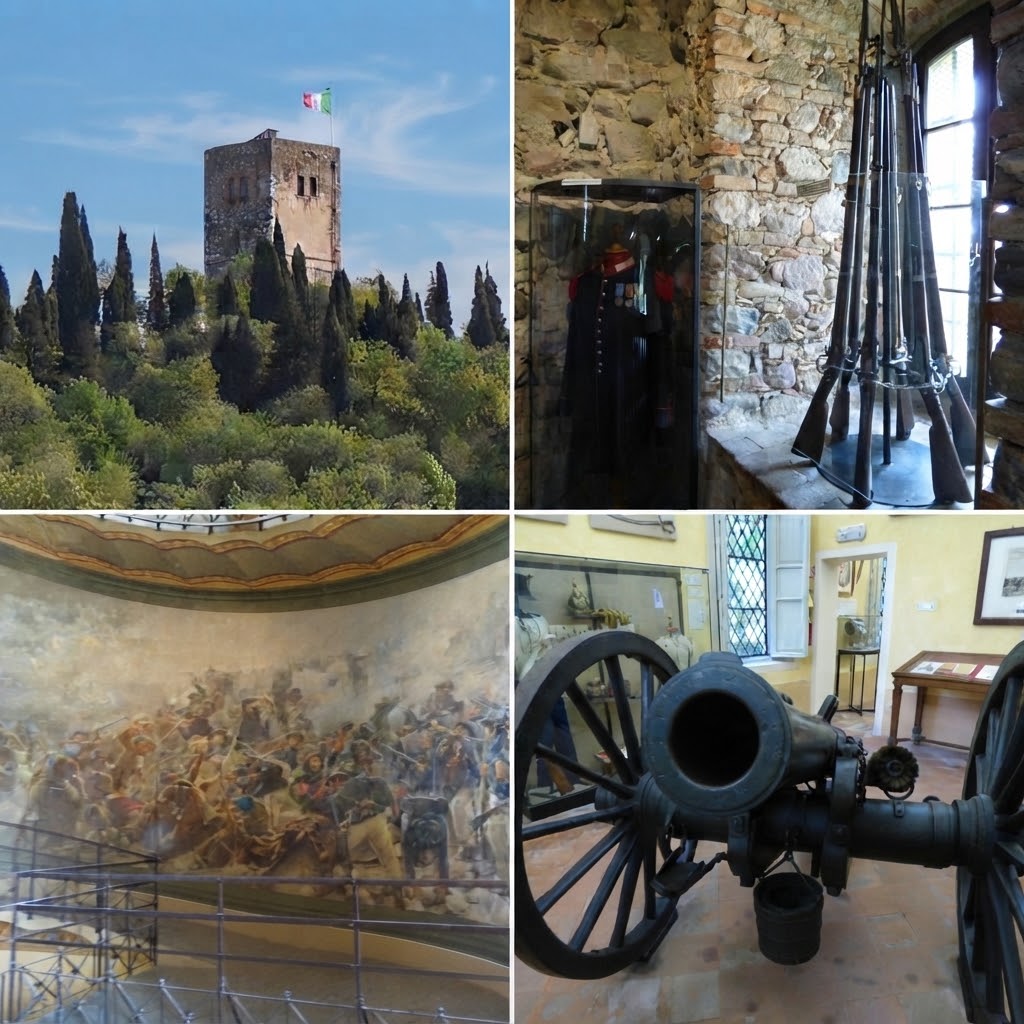
The Solferino battlefield today centers on the Rocca di Solferino, a hilltop tower housing a battle museum, standing alongside the Ossuary Chapel at the nearby Church of San Pietro in Vincoli, a striking and genuinely moving memorial displaying the remains of soldiers from all four armies that fought there. A short drive of fifteen to twenty minutes away, near Lake Garda, the separate Torre di San Martino della Battaglia offers a taller tower monument with its own museum and ossuary, commemorating the Sardinian side of the battle at San Martino. The International Red Cross Museum in nearby Castiglione delle Stiviere, the town where Henry Dunant actually organized his relief efforts for the wounded, completes the humanitarian dimension of the story and is widely considered essential viewing for visitors interested in the battle’s most lasting legacy.
A combined ticket covers admission to multiple sites across the cluster, and the nearest full-service base for travelers is Desenzano del Garda on the shores of Lake Garda, a convenient hub with lodging, dining, and transport connections. Visitors focused solely on the Rocca and its adjoining ossuary should budget roughly one and a half to two hours, while a thorough tour taking in all four sites, the Rocca, the ossuary, the San Martino tower, and the Red Cross museum, comfortably fills half a day. Each June, the region hosts annual commemorations that include a torchlit procession retracing the path of Dunant’s original relief efforts, drawing visitors interested in the humanitarian history alongside those focused purely on the military campaign. Guided tours in multiple languages are available seasonally at the main sites, and the surrounding Lombard countryside, still largely agricultural, offers a striking contrast to the scale of destruction the region witnessed in the summer of 1859.
Remembrance of Solferino
Henry Dunant’s own 1862 account, A Memory of Solferino, remains the single most consequential firsthand record to emerge from the battle, a work that not only documented the horror he witnessed at Castiglione delle Stiviere but directly inspired the international humanitarian movement that followed. Napoleon III’s shock and subsequent correspondence regarding the scale of French and allied casualties, preserved in French Second Empire records and summarized by the Fondation Napoléon, illuminates how the human cost of a single day’s fighting could alter the strategic calculations of an emperor determined to see the campaign through. Franz Joseph I’s decision to personally command Austrian forces at Solferino, documented across standard Habsburg military histories, marks the only occasion in his lengthy reign that he led troops in a major battle, a fact that has made his own experience of the day’s chaos and eventual retreat a recurring subject of biographical interest. Taken together, these accounts, a businessman’s transformative eyewitness testimony, an emperor’s private dismay, and another emperor’s singular battlefield command, preserve Solferino as both a pivotal moment in European military history and the improbable origin point of the modern humanitarian movement, a legacy that today overshadows, in most popular memory, the territorial and political outcomes the battle was actually fought to decide.
Further Exploration: Book titled “A Memory of Solferino” by Henry Dunant (Geneva, 1862)
Location: Rocca di Solferino, Solferino, Mantua Province, Italy
Site Status: National Park/Managed Historic Site
Visitation Notes: The site cluster includes the Rocca di Solferino tower and its battle museum, the Ossuary Chapel at the nearby Church of San Pietro in Vincoli (a striking, genuinely moving display of soldiers’ remains from all four armies), and the separate Torre di San Martino della Battaglia — a taller tower monument with its own museum and ossuary about 15–20 minutes away, near Lake Garda. The International Red Cross Museum, in nearby Castiglione delle Stiviere where Henry Dunant actually organized relief for the wounded, completes the humanitarian side of the story. A combined ticket covers multiple sites. The nearest full-service base is Desenzano del Garda on Lake Garda. A thorough visit covering all four sites takes half a day; the Rocca and Ossuary alone take about 1.5–2 hours. Annual commemorations are held each June, including a torchlit procession retracing Dunant’s relief efforts.
Google Map
Visitor Comments
Alessandro C called the tower anonymous-looking from the outside but praised the stunning interior, with a wooden staircase wrapping the walls and unmatched views from the top.
— from TripAdvisor
Michael K praised the museum’s quality and specifically noted that the founder of the Red Cross was inspired to organize relief after witnessing the carnage in the battle’s aftermath.
— from TripAdvisor
Beppe found the combined ticket covering three attractions worthwhile, and appreciated the convenient nearby parking and dining options.
— from TripAdvisor
A visitor named 2000CoastToCoast praised the San Martino tower’s spiral interior ramp and was moved by the frescoes and the panoramic views over Lake Garda from the top.
— from TripAdvisor